Does Your Dental Practice Need More Hygiene Days?

Co-Founder, Minty Dental

A Full Hygiene Schedule Doesn't Always Mean Enough Hygiene Capacity
A hygiene column that books out two or three weeks can feel like a sign of a healthy practice. In reality, it tells you almost nothing on its own. The schedule being full this week only means demand currently exceeds your available slots. It does not tell you whether your existing patients are actually getting seen, how long new patients are waiting to get in, or whether your hygienist has any room to absorb a growing patient base. Those questions require a different kind of look.
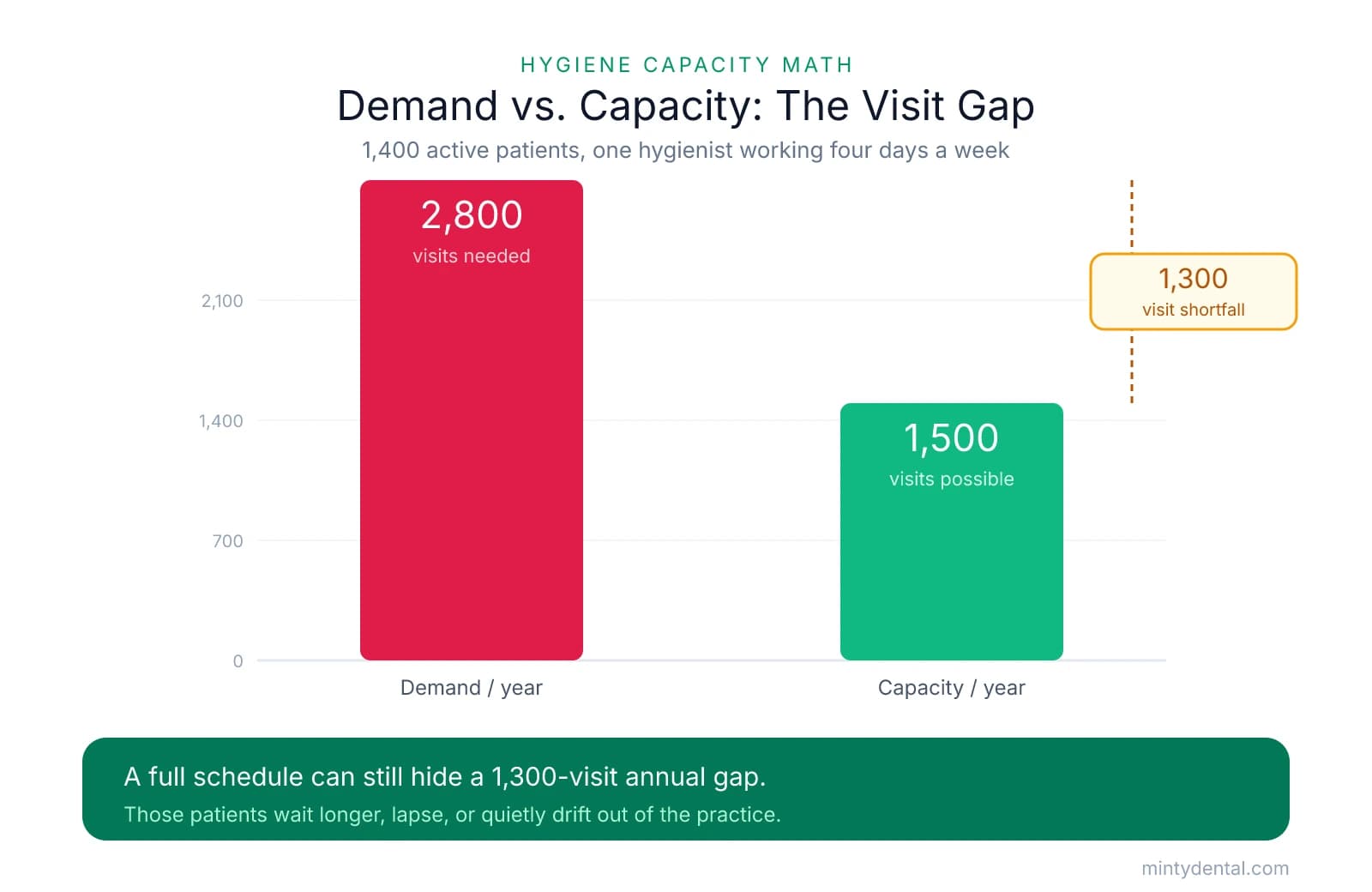
Hygiene capacity is best understood as the number of patient visits a hygienist can complete in a year, not whether individual slots are filled on any given day. A full-time hygienist working four days a week, with eight patient appointments per day, can complete roughly 1,500 to 1,600 visits annually after accounting for cancellations, holidays, and the occasional admin day. That sounds like a lot until you consider how many active patients a practice is trying to serve.
It takes roughly 800 to 1,000 active patients to keep one full-time hygienist productively scheduled year-round. That benchmark exists because most patients are on a six-month recall cycle, which means each active patient needs two hygiene visits per year. At 1,000 active patients and a six-month interval, you need to deliver 2,000 hygiene visits annually. One full-time hygienist cannot do that. The math only works at the lower end of the range, and it assumes your recall system is capturing nearly every eligible patient.
Here is where the real diagnostic problem starts. Suppose your practice has 1,400 active patients and one hygienist working four days a week. At two visits per year per patient, you need to complete roughly 2,800 hygiene appointments annually. Your hygienist, working at full capacity, can deliver somewhere around 1,500. That leaves 1,300 visits unaccounted for. Some of those patients will wait longer than six months between appointments. Some will simply drift out of your practice altogether. And yet, week to week, your schedule looks full.
That last point matters because a full schedule can mask two completely different situations. The first is a genuine capacity shortage: you have more active patients than one hygienist can serve, and the waitlist is growing. The second is a recall system failure: established patients are quietly lapsing while new patients (or reactivated ones) fill those open slots, creating the appearance of a busy practice while your true retention rate erodes. Understanding hygiene reappointment rate is one of the key signals that separates these two problems, but you need the underlying reports to see it clearly.
The schedule view in your practice management software shows you demand against available time. It does not show you who is missing, how long patients are waiting, or what percentage of your active base received a hygiene visit in the last twelve months. Those answers come from four specific reports.
Four Reports That Reveal Whether You Have a Capacity Problem
Your practice management software already has the data you need. Whether you're on Dentrix, Eaglesoft, Open Dental, or another system, these four reports can usually be generated in under ten minutes. Run them together, because the combination is what tells the story.
1. Overdue and Unscheduled Hygiene Patients Report
This report lists active patients who have no future hygiene appointment on the books, or whose last hygiene visit was more than six months ago with nothing scheduled to follow. In most systems, you can filter by last visit date and appointment status simultaneously.
If more than 15 to 20% of your active patient base shows up on this list, something is off. The question the report can't answer on its own is whether those patients can't get in or simply haven't been contacted. That's where the next three reports come in.
2. Next Available Hygiene Appointment
Pull up your hygiene columns and find the first genuinely open slot available to a new patient calling today. You're looking for a single number: how many days out is that appointment?
When new patients have to wait more than three to four weeks, a significant share simply never show up for the appointment they booked. They book out of obligation at the moment they're motivated, then life moves on and they quietly ghost before you ever send a confirmation. A wait time beyond four weeks is a direct capacity signal, not a scheduling optics problem.
3. Hygiene Production as a Percentage of Total Practice Production
Run a production report by provider for the last twelve months, then calculate what hygiene generated as a share of the total. The ADA notes that the hygiene department should account for roughly 25% of adjusted production, with the doctor generating the remaining 75%. Hygiene departments that fall below 25% usually lack a structured recare system, which means the underlying problem is likely recall, not capacity.
A figure below 25% points to a scheduling or reactivation gap. A figure in the normal range combined with a long new-patient wait time suggests you've actually filled the available capacity and need more of it.
4. Hygiene Reappointment Rate
This is the percentage of hygiene patients who leave their appointment with the next one already scheduled. The target is 85 to 90%. When the rate is low, patients exit without a future appointment and re-enter the unscheduled pool, which creates artificial open time. That open time makes the schedule look less full than the underlying demand actually warrants. Improving your hygiene reappointment rate is one of the highest-leverage changes a hygiene department can make.
Reading the Reports Together
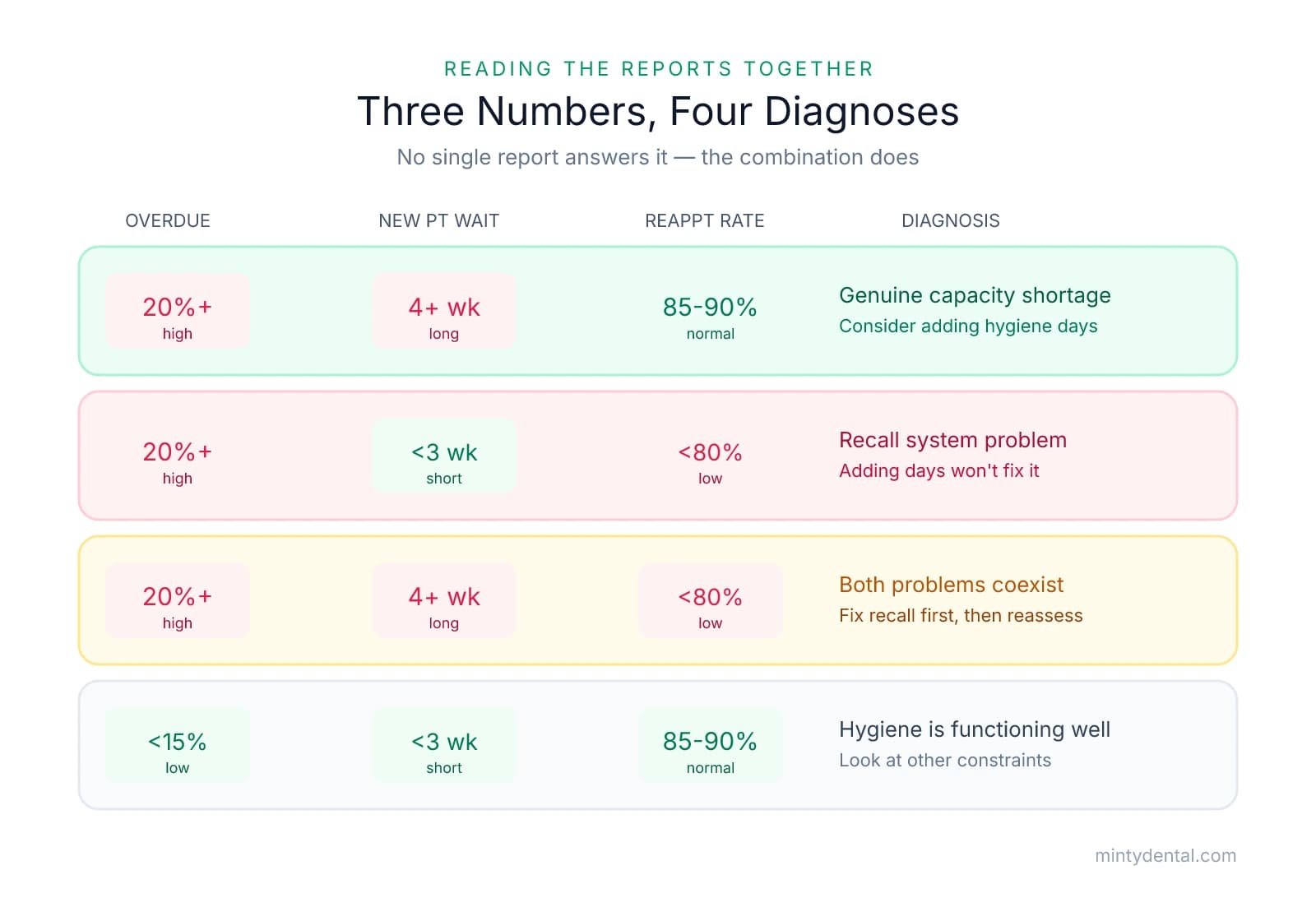
No single report gives you a clean answer. The combination does.
| Overdue patient count | New patient wait | Reappointment rate | What it suggests |
|---|---|---|---|
| High (20%+) | Long (4+ weeks) | Normal (85-90%) | Genuine capacity shortage; consider adding hygiene days |
| High (20%+) | Short (under 3 weeks) | Low (under 80%) | Recall system problem; adding days won't fix it |
| High (20%+) | Long (4+ weeks) | Low (under 80%) | Both problems coexist; fix recall first, then reassess capacity |
| Low (under 15%) | Short (under 3 weeks) | Normal (85-90%) | Hygiene is functioning well; investigate other production constraints |
A high overdue count paired with a long new-patient wait is a genuine capacity shortage: patients want to come in and there's no room for them. A high overdue count paired with a short wait and a low reappointment rate means patients aren't being pre-scheduled and are falling out of the system, and the open slots that result are masking the recall failure. Adding hygiene days in that second scenario doesn't solve anything; you'd be adding capacity to a leaky bucket. Tracking these four numbers alongside your other monthly practice KPIs makes it much harder to misread what the schedule is actually telling you.
Why Hygiene Capacity Affects Restorative Production Too
Most owners think about a constrained hygiene schedule as a hygiene revenue problem. It's actually a whole-practice production problem, and the downstream effect on the doctor's chair is usually larger than the hygiene production loss itself.
Roughly 75% of restorative needs are identified during hygiene visits, which makes the hygiene appointment the primary diagnostic pipeline for the doctor. When hygiene capacity is tight, fewer patients are being examined, which means fewer treatment plans are being generated. The doctor's restorative column doesn't fill itself; it fills because hygienists and exams are creating opportunities. Constrain the hygiene schedule and you constrain the flow of diagnosed work into the doctor's chair, even if the doctor has open time to do it.
Your overdue patient list makes this concrete. Take a practice with 200 patients sitting overdue for hygiene. If 20% of hygiene exams result in a restorative finding and the average restorative case runs $500, that's 40 patients with undiagnosed treatment and $20,000 in restorative production sitting dormant in the recall backlog. That's a hypothetical illustration, not a benchmark, but the logic applies to any practice: an overdue hygiene list isn't just a hygiene revenue gap, it's an unexamined patient pool that isn't generating treatment plans.
One way to evaluate whether your hygiene department is generating enough downstream value to justify adding capacity: a well-functioning hygiene department should produce roughly three times the hygienist's wages in combined direct and downstream production. If that ratio is materially lower, the question isn't just whether to add hygiene days, but whether the existing department is operating at its productive ceiling before you expand it.
There's also a retention dimension here that compounds over time. Patients who leave a hygiene appointment without a future one scheduled are significantly more likely to lapse from your practice entirely. Once a patient lapses, bringing them back costs considerably more in outreach and lost continuity than simply keeping them scheduled in the first place. The strategies for reactivating lapsed patients exist, and they can recover some of that value, but it's a harder and more expensive path than pre-appointment. Patients who stay on a consistent recall schedule are also more likely to accept treatment recommendations, since trust and familiarity build over multiple visits.
Deciding Whether to Add Hygiene Days, Fix Recall, or Both
If your new-patient wait time is over three to four weeks, your reappointment rate is at or above 85%, your overdue list is large relative to your active patient count, and hygiene production is running below 25% of total practice production, you have a genuine capacity shortage. The demand is real; you simply don't have enough hygiene time to serve it. Adding days is the right move.
If your wait time is short, slots are frequently open or being filled by new patients, your reappointment rate is below 75%, and your overdue list is still large, the problem is recall, not capacity. Adding a hygiene day in that scenario gives you more empty columns, not more revenue. The existing demand isn't being captured because patients are exiting without a future appointment scheduled and aren't being effectively reactivated. Fix the recall system first; capacity expansion before that is wasted overhead.
The third scenario is the trickiest: a long wait time combined with a low reappointment rate. Both problems coexist, which might seem to call for fixing both at once. In practice, the sequencing matters. Start with recall, because improving the reappointment rate increases the productive load on your existing schedule. Once the schedule is consistently full at a healthy reappointment rate, the wait time data will tell you clearly whether you've reached a genuine ceiling. Add capacity then, not before.
When the data does point to scenario one, you have a few practical options. Extending an existing hygienist's schedule by one day is usually the fastest path if your hygienist has capacity and is willing. Bringing in a part-time hygienist to cover one or two days per week adds flexibility without a full-time salary commitment. A second full-time hygienist makes sense when your active patient count has grown past roughly 800 to 1,000 patients per current hygienist, because that's the threshold where one column genuinely can't serve the base at a six-month recall interval — though the appropriate interval varies by patient risk profile. Before committing to any of those options, it's worth understanding the full compensation picture; the structure of hygiene pay affects how the added production pencils out depending on whether you're extending hours or adding a headcount.
One other consideration if you're weighing a part-time day versus a second full-time hire: new clinical staff typically take several months to reach full productive output, so the financial return on a second hygienist won't be immediate. It's also worth confirming that patient demand consistently exceeds your current team's capacity before committing to a full-time headcount — a temporary surge in busy weeks is not the same signal as a sustained pattern.
None of these reports should be a one-time exercise. Hygiene capacity, recall health, and patient volume all shift gradually enough that a single snapshot can look fine while the trend moves in the wrong direction. Running these four reports together every quarter keeps the decision data-driven rather than reactive to a single busy stretch. A quarterly review also gives you a clear before-and-after benchmark if you do make a change, so you can see whether adding a day or tightening recall actually moved the numbers you expected it to.
Sources & References
The data and claims in this article are drawn from the following sources. We prioritize government data, peer-reviewed research, and established industry publications to ensure accuracy.
- Understanding your numbers: The dental hygienist's role in business ...— www.rdhmag.comIndustry
- Dental Hygiene Schedule Capacity: Where New Patients Ghost ...— www.dentalbase.aiIndustry
- 4a. Key Performance Indicators (KPIs) | American Dental Association— ada.orgIndustry
- Signs Your Dental Office Needs Additional Hygiene Hours - Aprio— aprio.comIndustry
- The Successful Hygiene Department: Understanding The Numbers— hygienemastery.comIndustry
- Dental Hygiene Recall Rates: The Key DSO Valuation Driver— mybcat.comIndustry
- Dental Hygiene Recall Rates: The Key DSO Valuation Driver— mybcat.comIndustry
- selecting the appropriate recall interval for an individual patient— www.ncbi.nlm.nih.govGovernment
- When Does Hiring Another Dental Hygienist Make Sense? - Toothio— www.toothio.com
Turn Hygiene Data Into a Smarter Schedule Decision
If your hygiene reports are pointing to a capacity or recall problem, Minty can take the billing and operations work off your plate so you can focus on fixing it. See how Minty supports independent practice owners.