Dental Practice Staff Turnover: How to Stop Losing Employees

Co-Founder, Minty Dental

In Summary
- Front-office staff turnover reached roughly 29.7% in 2024, and associate dentist mobility hit 29%, giving owners concrete benchmarks to measure their own rate against.
- Calculate your annual turnover rate: divide departures in the last 12 months by average headcount, then multiply by 100.
- Staffing shortages have cut estimated dental practice capacity by about 11% nationwide, making turnover a revenue problem, not only an HR one.
- Most departures trace back to four addressable causes: below-market compensation, weak onboarding, poor workplace culture, and no visible career path.
- A majority of voluntary leavers say their manager could have done something to keep them, which means most turnover is preventable rather than inevitable.
High Staff Turnover Is a Fixable Systems Problem, Not an Industry Constant
Staffing has become one of the tightest constraints in dentistry. Only about 60% of dentists report adequate hygienist staffing, and 91% of those actively recruiting call it very or extremely challenging. Against that backdrop, keeping the people you already have matters more than it did even a few years ago, because replacing them means competing in a market where qualified candidates are scarce.
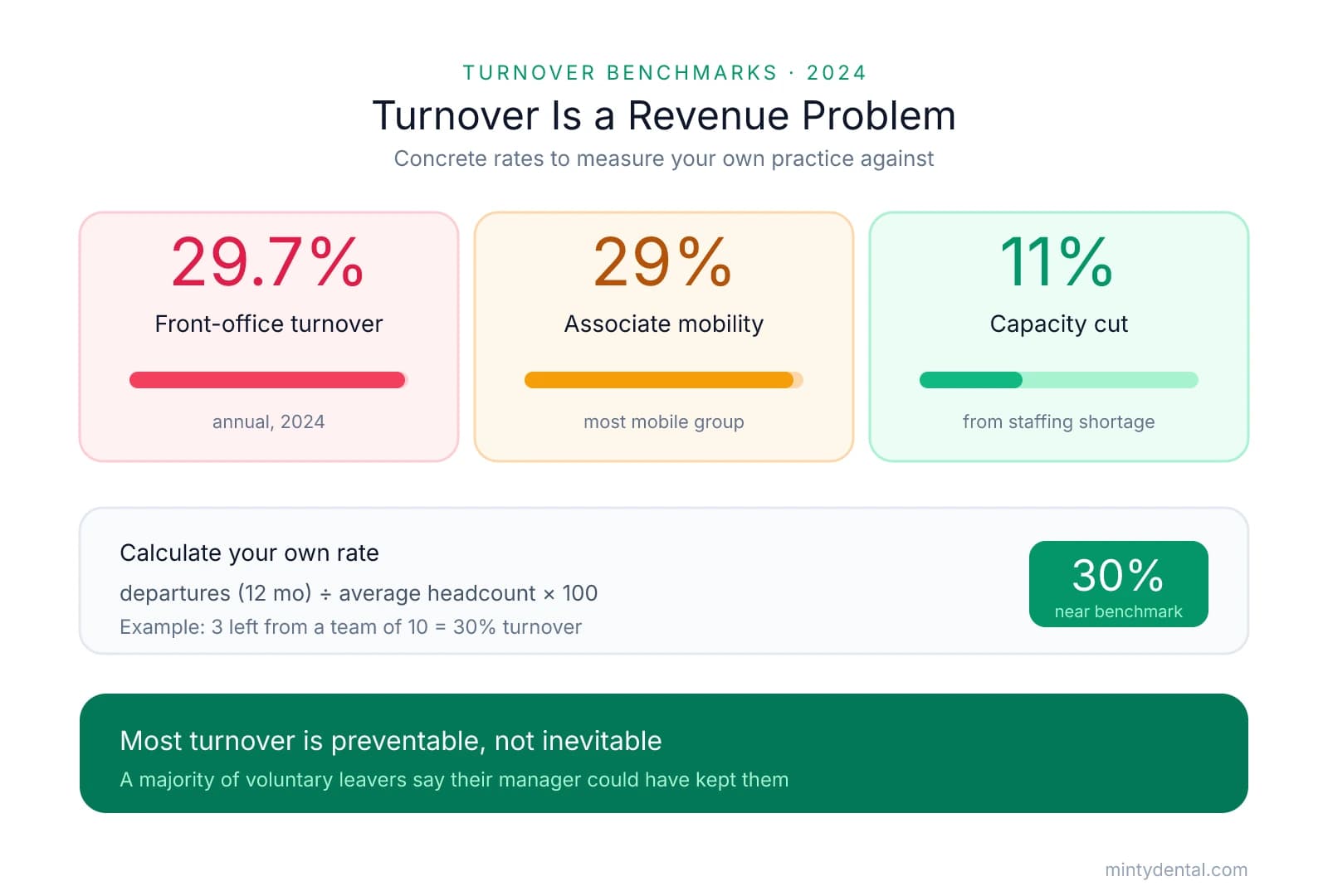
The turnover itself is measurable. Front-office staff turnover reached roughly 29.7% in 2024, and associate dentists were the most mobile group at 29%. These figures give you a reference point. To find your own rate, divide the number of employees who left in the last 12 months by your average headcount over that period, then multiply by 100. A practice that lost three people from an average team of ten has a 30% turnover rate, which sits near the front-office benchmark and suggests the pattern is worth diagnosing rather than absorbing as a cost of doing business.
Turnover is a revenue issue, not only an HR one. Staffing shortages have caused an estimated 11% reduction in dental practice capacity nationwide, which shows up directly in unfilled hygiene columns and delayed treatment.
What tends to make turnover feel inevitable is treating each departure as an isolated event. In most cases the causes are knowable and repeat across practices. Four explain the majority of exits: below-market compensation, inadequate onboarding, poor workplace culture, and no visible career path. Each is examined in the sections that follow, along with the specific changes that address it. The reason this framing holds up is that research consistently shows a majority of voluntary leavers report their manager could have done something to keep them, which points to decisions within an owner's control rather than a fixed feature of the industry.
How to Benchmark Compensation and Benefits Before the Next Resignation
A compensation audit answers a specific question: for each person on your team, how does their total package compare to what the same role earns in your regional market? The audit covers more than base pay. It includes benefits, bonuses, and schedule flexibility, because staff evaluate the whole picture when a competing offer arrives.
Start with the base pay benchmark. The 2025 median pay for dental hygienists is $98,100 per year, or $47.16 per hour. Treat that median as a floor to benchmark against in high-cost markets, not a ceiling. National medians run below coastal metro rates, so adjust for your region before drawing conclusions.
Base pay alone does not explain retention. Only 50.3% of registered hygienists report being satisfied with their total 2024 compensation, despite an average salary that rose to $81,267, a 2.9% increase over the prior year. The gap between rising pay and flat satisfaction traces largely to benefits. The dental field has a documented reputation for offering fewer benefits than comparable industries, and roughly 20% of hygienists looked for a new job in the prior year.
The benefits gap is the most common blind spot in small practices. Many owners operate without health insurance, a retirement plan, or structured PTO because these costs are real and budgets are tight. Practices that do offer them tend to retain staff meaningfully better. Continuing education reimbursement is consistently cited as high-value relative to its cost, because it signals long-term investment in the employee while building clinical skill the practice benefits from directly.
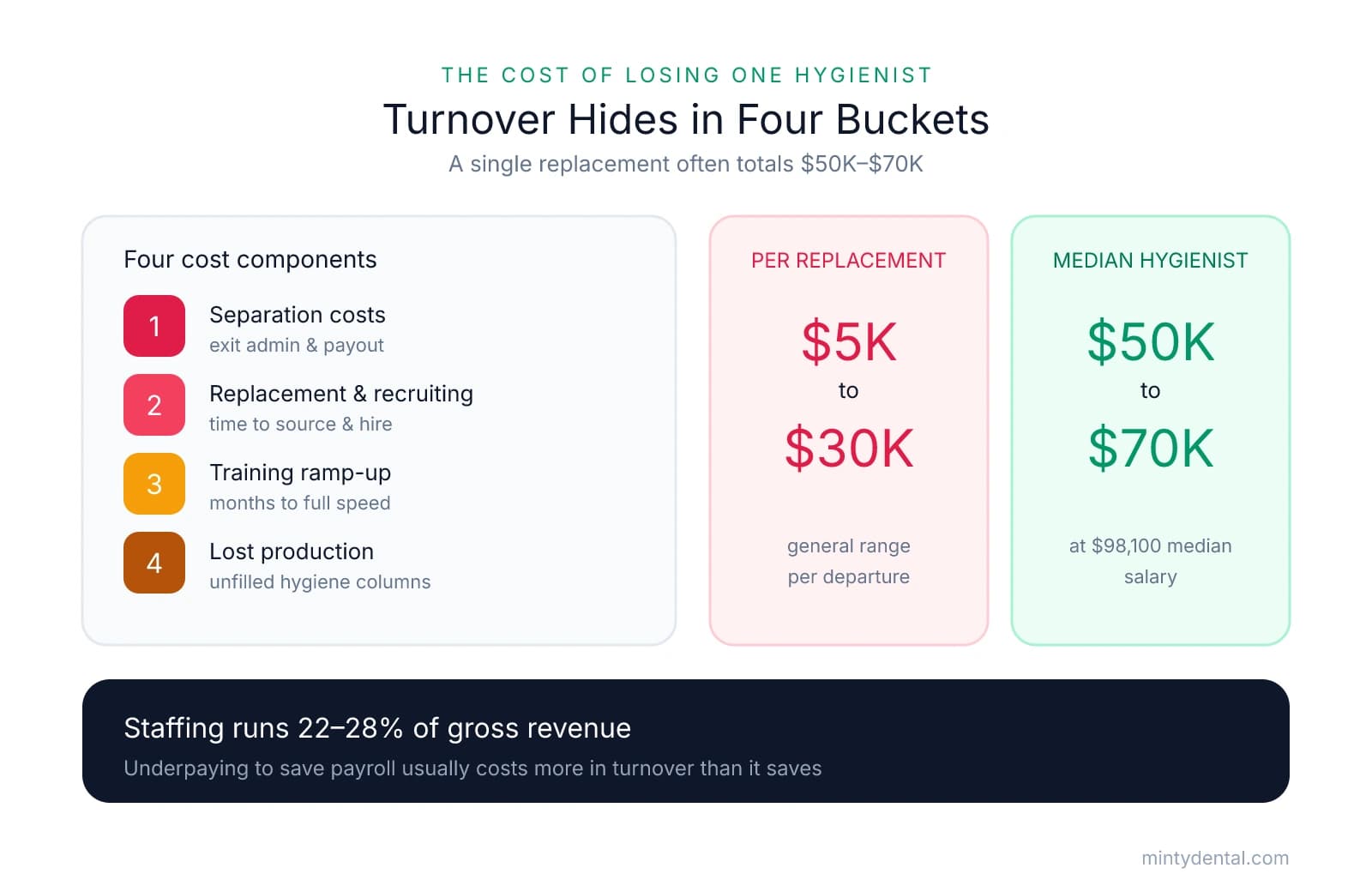
Watch your staffing ratio while you adjust. Staffing costs typically run 22-28% of gross revenue. Underpaying to stay below that band often costs more in turnover, which runs $5,000 to $30,000 per replacement, than it saves in payroll.
To close a pay gap without permanently raising fixed overhead, consider a production-based bonus or profit-sharing structure. A hygiene bonus tied to production above a monthly threshold, or a front-office incentive linked to collections and reactivation, ties added compensation to added output. The associate pay calculator can help you model how incentive structures interact with base pay.
Run the audit in three steps:
- Pull each team member's current total compensation, including benefits value.
- Compare each figure to BLS and DentalPost benchmarks for your region and role.
- Rank team members by the size of the gap to identify who is most at risk of leaving.
The largest gaps mark your highest retention priorities.
The Two Retention Levers Most Owners Underuse: Onboarding and Culture
Compensation gaps explain part of turnover, but two non-financial drivers account for a large share of departures that raises alone will not fix. Both are learnable systems, which matters because many owners are clinically excellent without ever having been trained to manage a team.
Structured onboarding is a 30-to-90-day process, not a first-day paperwork event. Most practices treat onboarding as the time it takes to complete forms and walk through the software, then expect the new hire to be fully productive the following week. That gap has measurable consequences: 43% of job seekers left a new position because they were unaware of the full responsibilities of the role. The healthcare research points in the same direction. A 2023 systematic review of 55 studies found structured onboarding and mentoring consistently linked to lower first-year turnover, with one nurse residency program cutting first-year turnover from 23.9% to 7% after adding structured preceptorship. The setting was hospital nursing, but the mechanism, replacing an unstructured first year with defined support, applies to a dental team.
A workable onboarding framework has four parts:
- Written role expectations before day one. Document chairside protocols, scheduling and production targets, and instrument standards so the new hire knows what "doing well" looks like.
- A named mentor. Assign a specific clinical or administrative colleague as the go-to person for questions the handbook does not cover.
- 30/60/90-day structured check-ins. Review defined performance milestones at each interval rather than waiting for a single review at 90 days.
- A staged ramp-up. Increase caseload against clear milestones instead of expecting full production in week one.
Feedback matters beyond the first year. 27% of dental practices do not conduct regular performance reviews, which leaves employees without a sense of how they are doing or where they stand. Documenting review cadence, along with the workflows a new hire needs to learn, is one way to reduce the practice's reliance on any single person, a theme covered in reducing owner dependence.
Culture is the second lever, and its signals are specific. Chaotic systems, micromanagement, bullying, and being left to fend for oneself rank among the top reasons dental staff leave. Each has a practical response:
- Unaddressed toxic behavior. When a leader avoids confronting one difficult team member, the rest of the team reads it as tolerance. The most reliable employees tend to leave first, so addressing behavior early protects the people you most want to keep.
- Lack of recognition. Generic praise such as "good job" rarely registers. Recognition that lands is specific, timely, and matched to the individual's preferences.
- Chaotic or shifting systems. Documented workflows and consistent protocols reduce daily friction and signal that the practice is well run.
These changes cost little beyond attention, which is why they are often the highest-leverage retention work available.
What Stable Staffing Is Worth: Financial and Practice Value Implications
Turnover is one of the largest controllable expenses in a practice, yet it rarely appears on a P&L. Its four cost components spread across categories that no single line item captures: separation costs, replacement and recruiting time, training ramp-up, and lost production during the vacancy. For a hygienist earning the $98,100 median, the total often lands between $50,000 and $70,000 once you count weeks of unfilled hygiene columns, new-patient calls that do not convert during the gap, and the months before a replacement performs at full speed. Because most of that cost hides in schedule holes and management hours rather than an invoice, owners routinely underestimate it.
Team stability also functions as a valuation signal. Buyers and DSOs treat retention as evidence that the practice can run without the owner, which lowers perceived risk and supports a stronger multiple; high turnover disrupts continuity and can compress the multiple. A practice where the hygienist has been in place eight years and the office manager five is a different asset than one where both roles turned over twice in three years. The first reads as a self-running business; the second reads as owner-dependent risk that a buyer will price down. Practices with documented systems and stable teams tend to sell faster and at higher multiples, which means the retention work you do now directly affects the exit value you capture later. This connection is worth weighing alongside the other levers covered in increasing practice value before a sale.
You do not need to address everything at once. A practical sequence:
- Run the compensation audit and name your one or two highest-risk team members. Use the gap ranking from the audit to focus attention where a departure would cost most.
- Address the most visible culture issue before the next departure. An unaddressed behavior problem or a chaotic workflow is often the trigger a competing offer needs.
- Build a structured 90-day onboarding process for the next hire. This shortens ramp-up and reduces the chance the replacement becomes a repeat departure.
Owners within three to five years of a sale can treat retention as a pre-sale priority alongside collections and overhead, because it moves both the multiple and the buyer's confidence. Handled systematically, these changes produce measurable results in the operating year and in the eventual sale.
Sources & References
The data and claims in this article are drawn from the following sources. We prioritize government data, peer-reviewed research, and established industry publications to ensure accuracy.
- Dental Hygienist Shortage - American Dental Association— www.ada.orgIndustry
- What The Latest Salary Survey Tells Us About Dental Team Turnover— dentalpost.netIndustry
- Dental Hygienists : Occupational Outlook Handbook— www.bls.govGovernment
- What The Latest Salary Survey Tells Us About Dental Team Turnover— dentalpost.netIndustry
- Dental Staff Hiring And Compensation Guide [2026 Benchmarks]— dentalpracticeinsider.orgIndustry
- Why Dental Staff Onboarding Determines Whether Your New Hire ...— themedicusfirm.comIndustry
- 2023 systematic review of 55 studies found structured onboarding and mentoring consistently linked to lower first-year turnover, with one nurse residency program cutting first-year turnover from 23.9% to 7%— pubmed.ncbi.nlm.nih.gov
- Prevent the Great Resignation in Your Dental Practice | DirectDental Blog— directdental.comIndustry
- The Real Cost of Dental Team Turnover - Scheduling Institute— schedulinginstitute.comIndustry
- How Team Retention Impacts Practice Valuation— ppssellsdds.comIndustry
Ready to build a stable, thriving dental team?
Retaining top talent requires more than good intentions. Minty's Operations service handles the business fundamentals that keep your team engaged and your practice running smoothly, from fair compensation structures to streamlined workflows that reduce burnout.