Treatment Acceptance Rate: What It Tells Dental Practice Buyers

Co-Founder, Minty Dental

In Summary
- Treatment acceptance rate measures the percentage of recommended treatment that patients actually agree to and schedule—calculated as accepted treatment value divided by total presented treatment value, multiplied by 100
- The metric reveals whether a practice has effective patient communication and trust-building systems, or whether patients routinely decline care despite clinical recommendations
- You can measure acceptance two ways: by patient count (what percentage of patients say yes to any part of the plan) or by dollar value (what percentage of total recommended treatment value gets scheduled)
- A practice with strong collections but low acceptance may be maxing out a shrinking patient base rather than converting new opportunities, signaling limited growth potential under new ownership
Treatment Acceptance Rate Reveals Whether Patients Trust the Practice—Or Just Tolerate It
Most buyers focus on production and collections when evaluating a practice. Those numbers tell you what happened last year. Treatment acceptance rate tells you what's possible next year.
The calculation is straightforward: take the dollar value of treatment patients accepted and divide it by the total dollar value of treatment you presented, then multiply by 100. If you presented $100,000 in treatment plans last month and patients scheduled $65,000 of it, your acceptance rate is 65%. National benchmarks sit around 57%, with most practices falling between 40% and 70%.
What that percentage reveals goes deeper than revenue. A practice with high acceptance has built systems that help patients understand treatment, see its value, and feel confident moving forward. Low acceptance may signal strong clinical skills but weak communication infrastructure—or patients who show up for cleanings but don't trust the provider enough to say yes to anything beyond the basics.
One pattern worth paying attention to: practices with solid collections but declining acceptance rates. That combination often signals a practice maximizing revenue from a loyal base of existing patients while failing to convert newer ones. The current owner may be coasting on relationships built over decades. When you take over, those patients may not transfer the same trust to you—and the practice's inability to convert treatment plans becomes your problem, not theirs.
You can measure acceptance two ways, and both matter. Acceptance by patient count tracks what percentage of patients presented with a treatment plan agree to schedule at least part of it. Acceptance by dollar value tracks what percentage of the total recommended treatment value actually gets scheduled. A practice where 80% of patients accept something but only 45% of dollar value gets scheduled has a different problem than one where 50% of patients accept nothing at all. The first is getting patients to say yes but struggling to present comprehensive treatment. The second isn't building trust in the first place.
Before you assume strong collections mean strong operations, pull the treatment acceptance data. What buyers miss when evaluating a dental practice often comes down to metrics like this—numbers that reveal whether the practice can grow under new ownership or whether you're inheriting a patient base trained to decline care. The American Dental Association tracks case acceptance as a core KPI for exactly this reason: it's one of the clearest indicators of whether a practice has built trust or just familiarity.
The Benchmarks: Where Most Practices Land and What Top Performers Achieve
When you're evaluating a practice's acceptance rate, you need context. A 55% acceptance rate might sound mediocre until you realize the national average sits between 46% and 60%, with nearly half of all practices operating somewhere in the 40-70% range. That same 55% looks different if the practice down the street is converting at 85%.
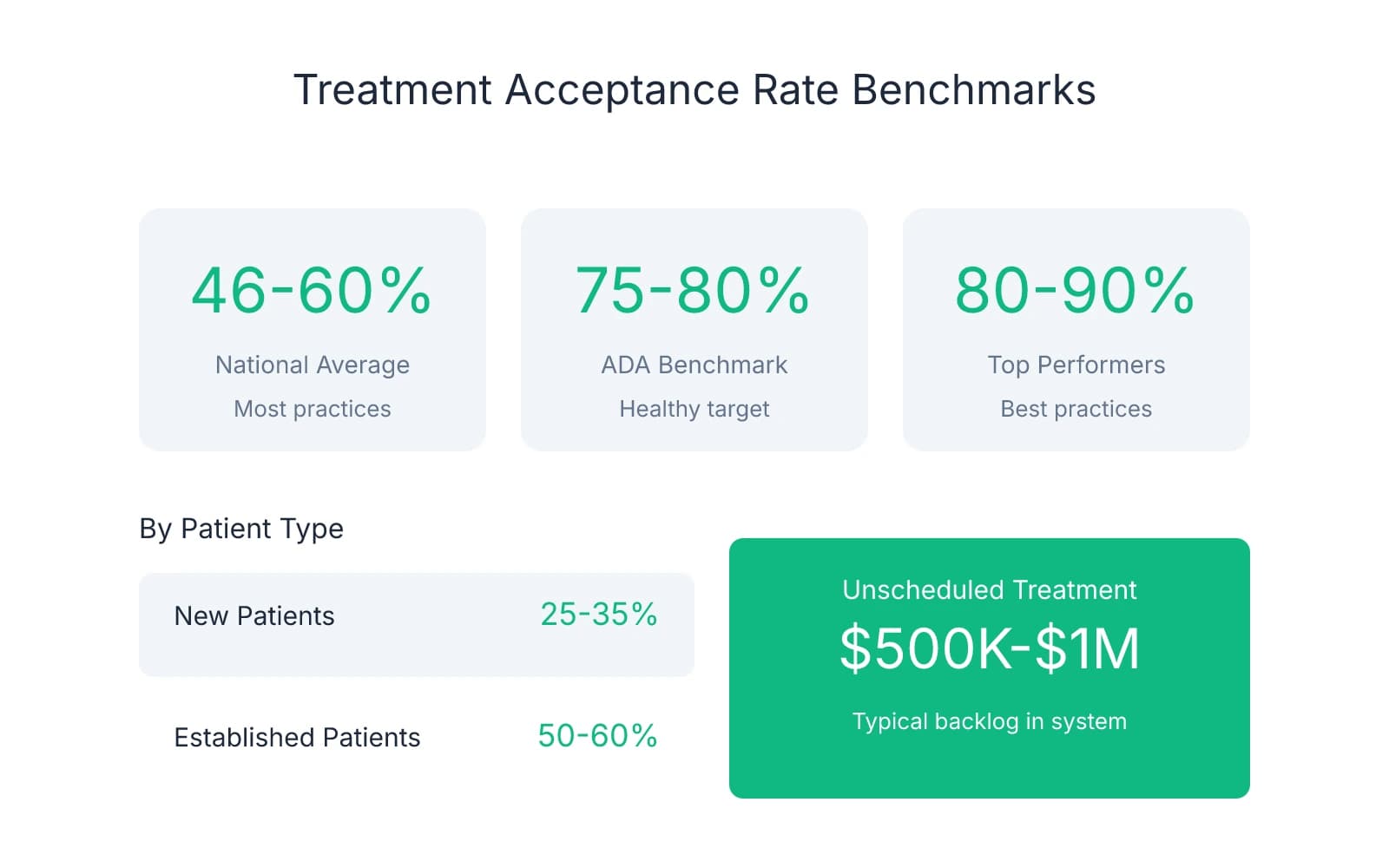
Top-performing practices consistently achieve 80-90% acceptance rates, while the American Dental Association suggests 75-80% as a healthy benchmark for general practices. The gap between average and excellent represents hundreds of thousands of dollars in treatment that either gets scheduled or sits in the system indefinitely.
One distinction that matters: acceptance rates vary significantly by patient type. New patient acceptance typically runs 25-35%, while established patients accept treatment at 50-60%. A practice with a high percentage of new patients will naturally show lower overall acceptance than one built on long-term relationships—even if both have equally strong communication systems.
This is where patient mix becomes a diagnostic tool. If a practice shows 48% overall acceptance but 70% of the patient base is new or transient, that's a different signal than one with the same overall rate but 80% established patients. The first may be doing well given its patient composition. The second has a trust problem.
What makes low acceptance particularly concerning for buyers is the unscheduled treatment sitting in the practice management system. Many practices carry $500,000 to $1 million in treatment plans that patients have been presented with but never scheduled. Some represents legitimate patient choice—people who heard the recommendation, understood it, and decided to wait. But a significant portion represents breakdowns in follow-up, financial communication, or patient confidence.
A practice consistently operating below 50% acceptance isn't just underperforming on conversion—it's likely sitting on a backlog of unscheduled care that represents either untapped opportunity or a systemic problem you'll inherit. The difference between those two scenarios comes down to why patients are saying no, and whether the issue is fixable with better systems or baked into the practice's reputation and patient relationships.
When you're reviewing metrics, compare acceptance rates across patient segments, track the trend over the past three years, and ask what percentage of presented treatment value is currently unscheduled. Those numbers will tell you whether you're looking at a practice with room to grow or one that's already maxed out its ability to convert care.
What Low Acceptance Actually Signals—And Whether It's Fixable
Low acceptance doesn't always mean the same thing. A practice converting 42% of treatment value might have outdated case presentation systems that a new owner could overhaul in six months. Or it might have a patient base conditioned to decline care for reasons that won't change when you take over. The difference between those two scenarios determines whether low acceptance represents opportunity or risk.
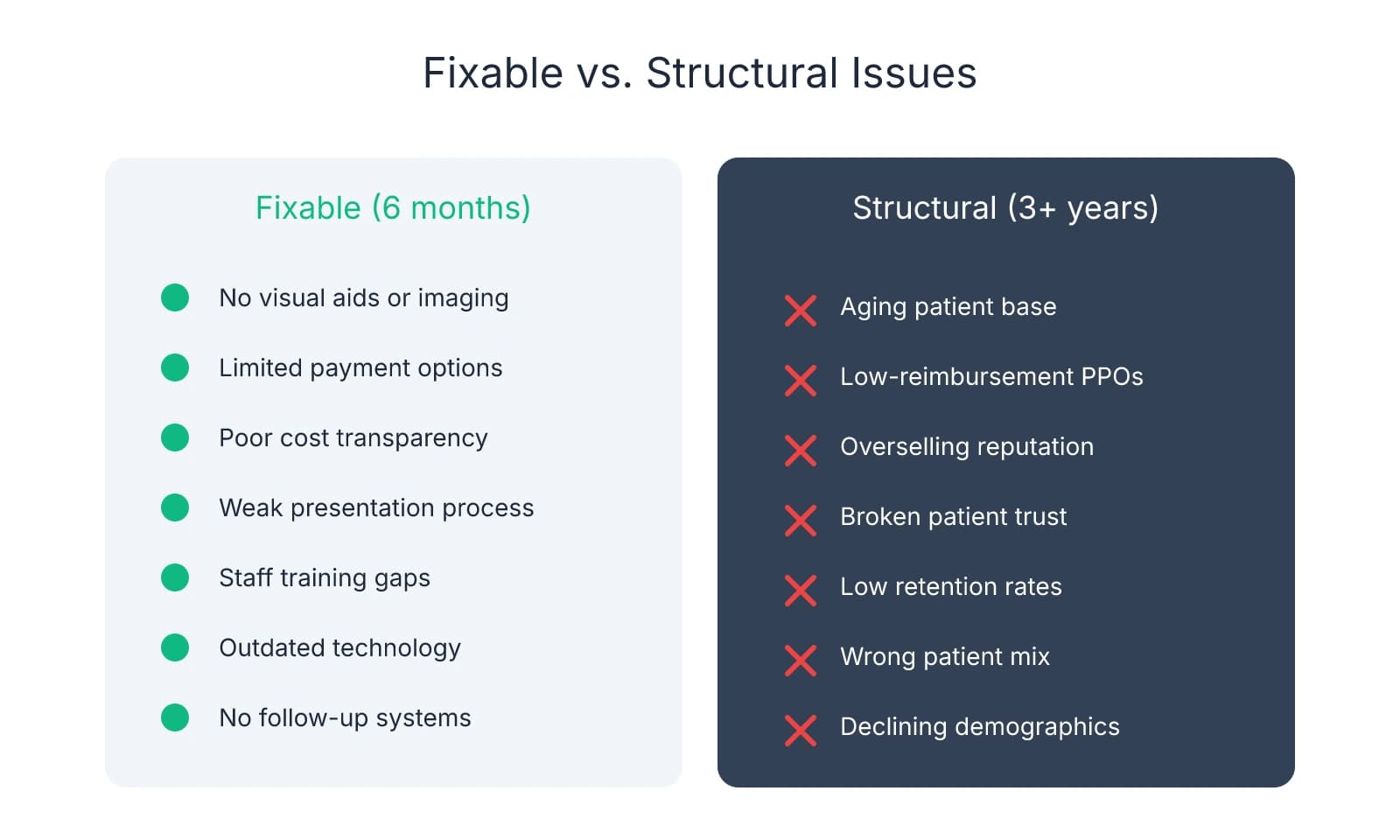
Where many buyers find room to improve: treatment presentation infrastructure. Practices that rely on verbal explanations without visual aids see acceptance rates 20-30% lower than those using intraoral cameras, digital imaging, or treatment planning software that shows patients what's happening and what's possible. If the seller has been practicing the same way for 15 years and never invested in patient education tools, you're looking at a fixable problem—one that improves with technology and training, not a complete patient base overhaul.
Payment options matter more than most sellers acknowledge. A practice that presents $8,000 treatment plans without offering third-party financing or flexible payment structures will convert less than one that makes care financially accessible. If the practice accepts insurance but doesn't help patients understand their out-of-pocket costs upfront, acceptance drops. These are operational fixes, not structural problems.
Structural issues are harder to reverse. An aging patient demographic with declining treatment needs won't suddenly start accepting comprehensive care because you bought the practice. A patient base heavily reliant on PPO plans with low reimbursement rates may be declining treatment because the out-of-pocket costs are genuinely unaffordable—and that won't change unless you renegotiate contracts or shift the payer mix over time. A practice with a reputation for overselling or aggressive treatment recommendations may have trained patients to say no reflexively, and rebuilding that trust takes years, not months.
During due diligence, request acceptance rate data segmented by provider, treatment type, and patient demographics. If one hygienist consistently presents perio treatment that patients decline while another's patients accept at 70%, that's a training issue. If crown acceptance is strong but implant acceptance is 15%, that might reflect the seller's case presentation skills for complex treatment—or it might signal that the patient base isn't a good fit for higher-end care. If acceptance is low across all providers and all treatment types, the problem is likely systemic.
One pattern that separates recoverable practices from risky ones: patient retention alongside acceptance rates. A practice with 45% acceptance but 85% annual patient retention has patients who trust the provider enough to keep coming back—they're just not saying yes to treatment yet. That's easier to turn around than one with 45% acceptance and 60% retention, where patients are both declining care and leaving. The first needs better systems. The second has a trust problem that runs deeper.
If you're evaluating a practice with low acceptance, the question isn't just whether you can fix it—it's whether the fix requires new software and training, or whether it requires replacing the patient base entirely. One of those is a six-month project. The other is a three-year rebuild. When should you walk away from buying a dental practice often comes down to whether the problems you're inheriting are operational or foundational—and acceptance rate data, when segmented properly, tells you which one you're looking at.
How to Request and Verify Acceptance Data During Due Diligence
With the context established, the next step is getting reliable data from the seller. Start by requesting a treatment acceptance report from the practice management system covering the past 12–24 months. Most modern systems—Dentrix, Eaglesoft, Open Dental—can generate this data, though you may need to specify exactly what you're asking for. Request the report segmented by provider, treatment category (restorative, perio, endo, prosthetics), and patient type (new vs. established). If the seller claims they don't track acceptance or can't pull the report, that's a signal in itself—it means the practice has been operating without visibility into one of its core conversion metrics.
The raw acceptance percentage only tells you part of the story. Cross-check it against the unscheduled treatment report to see how much diagnosed treatment is sitting in the system without scheduled appointments. A practice showing 60% acceptance with $200,000 in unscheduled treatment plans has a different profile than one showing 60% acceptance with $50,000 unscheduled. Pull both reports and compare the ratio—it reveals whether low acceptance reflects patient choice or broken systems.
Ask the seller to walk you through their treatment presentation process. How do they explain treatment options? Do they use intraoral cameras, digital X-rays, or treatment planning software to show patients what's happening? What payment options do they offer—third-party financing, in-house payment plans, or insurance-only? Do they present treatment the same day it's diagnosed, or do they schedule a separate consultation? Low acceptance in a practice with no visual aids, no financing options, and no structured presentation process is easier to fix than low acceptance despite strong systems already in place.
Treatment acceptance doesn't exist in isolation. Evaluate it alongside patient retention, hygiene reappointment rate, and new patient conversion to understand whether the practice has built strong patient relationships overall. A practice with 85%+ annual retention and 90%+ hygiene reappointment but only 50% treatment acceptance has patients who trust the provider enough to keep coming back—they're just not saying yes to restorative care yet. That's a different risk profile than one with 50% acceptance, 65% retention, and 70% hygiene reappointment, where patients are declining treatment and leaving. Hygiene reappointments can reveal patterns in who's accepting treatment and whether the practice has built the foundational trust necessary for comprehensive care.
When you're reviewing acceptance data, look for trends over time. If acceptance has been declining steadily over the past three years, that may signal an aging patient base, deteriorating systems, or a seller who's mentally checked out. If acceptance spiked two years ago and then dropped, ask what changed—did the practice lose a key team member, stop offering financing, or shift to a different patient demographic?
One cross-check many buyers overlook: compare acceptance rate to production per patient visit. A practice with low acceptance but high production per visit may be cherry-picking the patients most likely to say yes and not presenting treatment to everyone. A practice with high acceptance but low production per visit may be presenting small treatment plans that patients find easy to accept but that don't move the revenue needle. Both patterns reveal something about how the practice operates and whether the current numbers are sustainable under new ownership.
Before you finalize the purchase, confirm that the seller's acceptance data aligns with what you observed during your site visit or working interview. If the data shows 70% acceptance but you saw multiple patients decline treatment during your time in the practice, dig deeper. The numbers may be calculated differently than you expect, or the seller may be presenting data selectively. The right questions to ask when looking to acquire a dental practice include how acceptance is measured, who tracks it, and whether the calculation includes all presented treatment or only treatment above a certain dollar threshold.
Treatment acceptance rate won't make or break a deal on its own, but it's one of the clearest forward-looking indicators you have. It tells you whether the practice has built systems that convert patient trust into scheduled care—or whether patients show up, hear the recommendation, and leave without acting. When you combine acceptance data with retention, reappointment, and unscheduled treatment reports, you get a complete picture of whether the practice can grow under your ownership or whether you're inheriting a patient base that's already maxed out.
Sources & References
The data and claims in this article are drawn from the following sources. We prioritize government data, peer-reviewed research, and established industry publications to ensure accuracy.
- How to Measure and Improve Case Acceptance Rate - Teero— teero.comIndustry
- 4a. Key Performance Indicators (KPIs) | American Dental Association— ada.orgIndustry
- Dental Treatment Acceptance Rate Statistics (29 Key Insights) - Clerri— clerri.comIndustry
- Dental Case Acceptance Rate | 50-60% National Avg | Dentx— dentx.caIndustry
- Dental Case Acceptance: How to Improve Patient Acceptance Rate— truelark.comIndustry
- $500,000 to $1 million in treatment plans— dentahub.ca
- 3 Factors That Influence Case Acceptance in Your Dental Practice— www.jarvisanalytics.comIndustry
- How to use your dental practice data to increase your treatment ...— us.dental-tribune.com
Frequently Asked Questions
Find Practices With Strong Treatment Acceptance
Treatment acceptance rates reveal the true health of a dental practice beyond what sellers disclose. Explore practices with proven patient acceptance metrics on Minty Marketplace, or get expert guidance evaluating practice fundamentals with Minty Plus.