Why New Dental Staff Take Too Long to Get Productive

Co-Founder, Minty Dental
In Summary
- "Time to productivity" means the point at which a new hire can independently handle their core responsibilities without constant supervision or correction — not just showing up and completing tasks.
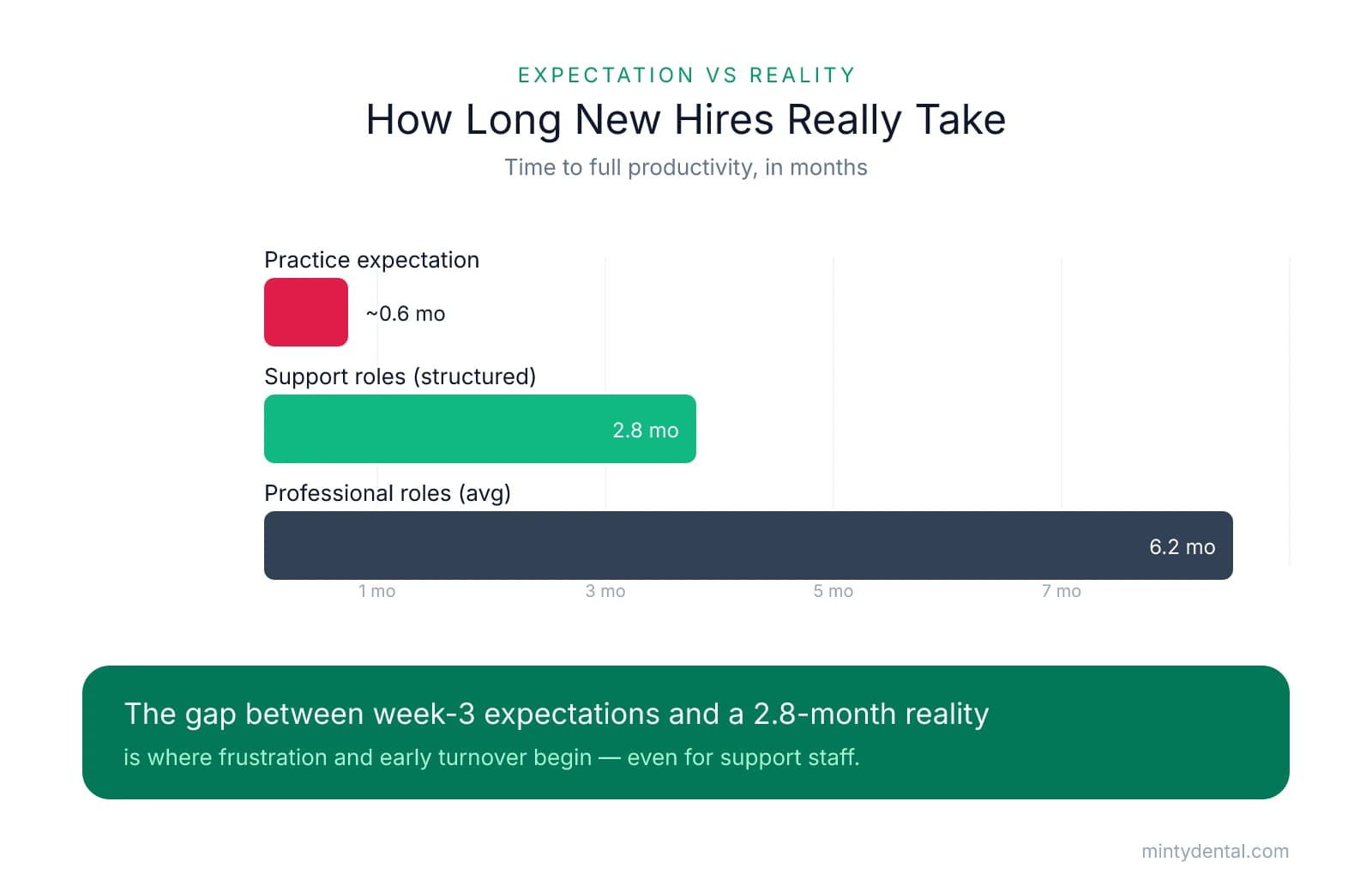
- Cross-industry data puts average time to full productivity at 6.2 months for professional roles; operations and support roles are closer to 2.8 months, but only with structured onboarding in place.
- Most dental practices expect full output by week two or three — that gap between expectation and reality is where frustration and early turnover originate.
- 20% of employee turnover happens within the first 45 days, and 60% of those early departures cite inadequate or disorganized training as the primary reason.
- When a new hire is still struggling at 60 to 90 days, the problem is almost always what happened after the hire, not the hire itself.
Slow Ramp-Up Is Almost Always an Onboarding Problem, Not a Hiring Problem
Time to productivity is the point at which a new hire can handle their core responsibilities independently, without needing constant guidance, correction, or someone checking their work. That's it. Not perfect performance, not full efficiency — just genuine independence in the role.
When a front-desk hire is still fumbling insurance verifications at week six, or a new dental assistant is consistently slowing down the chair rather than supporting it, the instinct is to wonder whether you made the right hire. That instinct is usually wrong. The more useful question is what happened between their first day and now.
Cross-industry benchmark data compiled from SHRM, Brandon Hall Group, and the Association for Talent Development puts average time to full productivity at 6.2 months for professional roles. Operations and support roles — the category that most dental support staff fit — land closer to 2.8 months. That's the optimistic end of the range, and it comes with a condition: structured onboarding has to be in place. Without it, support roles drift toward the longer end of the curve.
Most dental practices don't get close to that kind of structure. A new hire gets a brief office tour, a walkthrough of the practice management software, and an introduction to whoever has time to help them. By week two or three, the expectation is full output. That's not a training plan — it's an assumption that competence will fill the gap on its own.
It doesn't. And the cost shows up quickly. Around 20% of all employee turnover happens within the first 45 days, and roughly 60% of those early departures identify inadequate or disorganized training as the primary reason they left. That pattern holds across industries, and there's no reason to think dental practices are insulated from it. If anything, the clinical complexity and patient-facing pressure of a dental office make the stakes higher, not lower.
The structural gap that drives dental staff turnover often starts in the first few weeks, when new hires are left to piece together how the practice actually works from whatever they can observe between patients. The frustration that surfaces at 60 or 90 days usually has roots in decisions made on day one. Recognizing that shifts the problem from "did we hire the right person" to "did we set them up correctly" — and that second question has answers you can act on.
The Three Gaps That Slow New Dental Hires Down
Most slow ramp-ups aren't random. When you look at where dental onboarding breaks down, the same three gaps appear consistently. Identifying which one your practice has is more useful than any generic advice about "better onboarding."
Gap 1: No role clarity
A new hire who doesn't know what "doing well" looks like at 30, 60, and 90 days is working without a target. In many practices, chairside protocols, scheduling expectations, and production benchmarks exist in the owner's head, not in writing. The new hygienist is expected to absorb them by observation.
Ambiguity here isn't a minor inconvenience. It's one of the more consistent drivers of early disengagement across healthcare roles. When people don't know whether they're meeting expectations, they tend to assume the worst, and that anxiety either pushes them toward the exit or keeps them hesitant and slow. The ADA's onboarding guidance is direct on this: onboarding must include a review of the position's responsibilities and performance objectives, along with who is responsible for each part of training. That's a baseline, not a differentiator.
Gap 2: No team integration beyond the dentist
This one is easy to miss because owners often think of onboarding as something they personally do. You walk the new hire around, introduce them to the team, explain how you like things run. That's a start, but it leaves the most important relationships to chance.
A hygienist's or assistant's daily experience is shaped far more by the front desk, the treatment coordinator, and the rest of the clinical team than by the dentist. Whether the new hire feels like they belong, whether they know who to ask when something isn't covered in the handbook, whether they feel comfortable speaking up in a huddle, all of that is determined by peer relationships. Onboarding that only covers the owner-to-new-hire relationship skips the part that actually determines whether someone feels connected enough to stay. The ADA recommends assigning a staff mentor with a similar role, such as hygienist to hygienist or assistant to assistant, for exactly this reason. Whether your office manager is actively coordinating that integration or leaving it to happen organically makes a real difference.
Gap 3: No staged feedback
A single 90-day review is the most common feedback structure in dental practices, and it's the least useful one. The window when uncertainty is highest, when a new hire most needs to know whether they're on track, is the first three to four weeks. Waiting 90 days to have that conversation means the disengagement has already started.
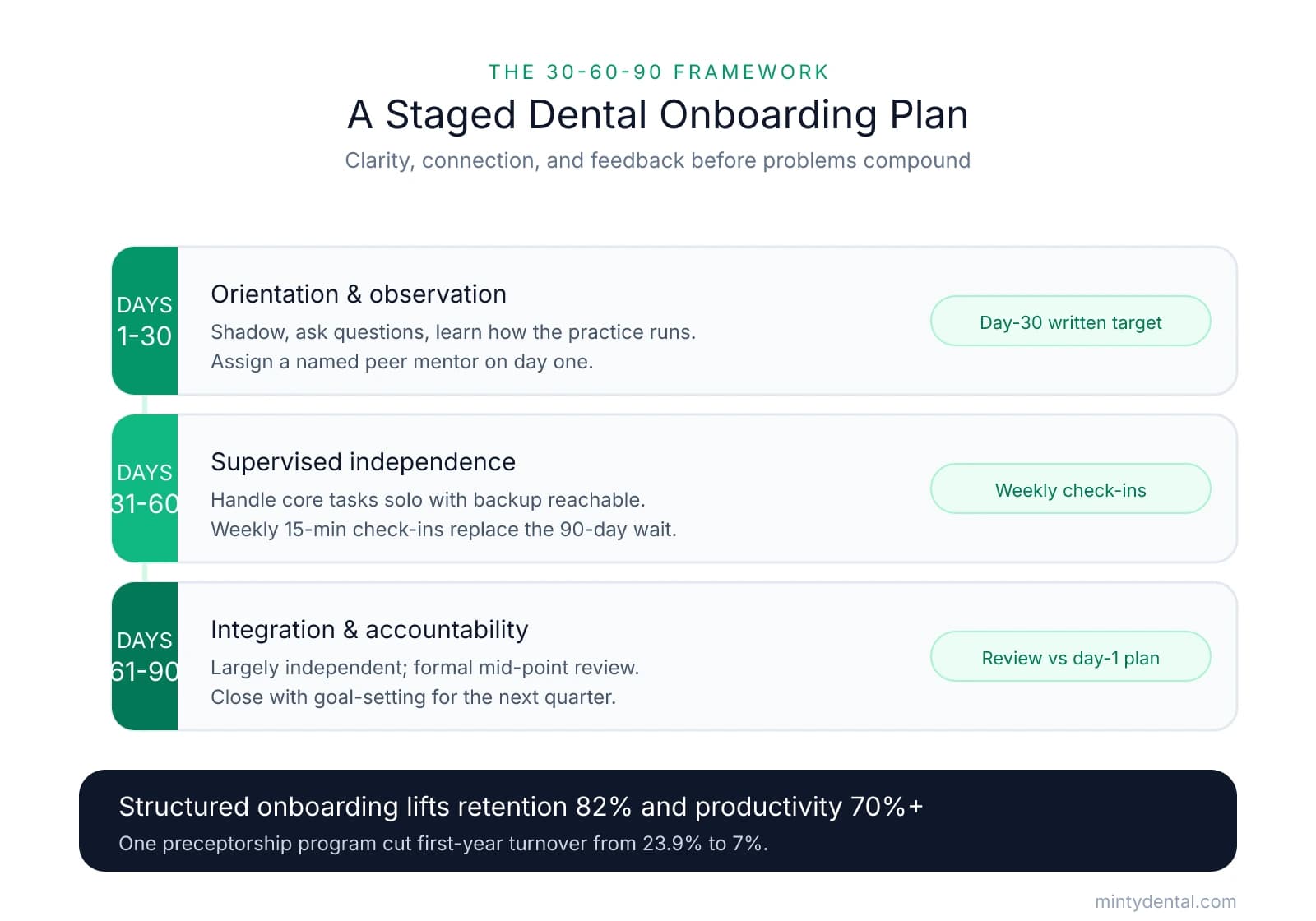
A 2023 systematic review of 55 healthcare worker retention studies found that structured onboarding and mentoring were consistently linked to lower turnover. One hospital-based preceptorship program cut first-year turnover from 23.9% to 7%. The setting was nursing, but the mechanism is the same: replacing an unstructured first year with defined support, named check-ins, and staged responsibility changes outcomes. Structured onboarding programs improve new hire retention by 82% and productivity by over 70%, which helps explain why the gap between orientation-only and structured approaches is so large.
| Typical dental onboarding | Structured onboarding | |
|---|---|---|
| Role clarity | Verbal explanation on day one | Written benchmarks for 30, 60, 90 days |
| Team integration | Introduction to the owner and a quick tour | Assigned peer mentor; coordinated team introductions |
| Feedback timing | Single review at 90 days | Weekly or biweekly check-ins in the first month |
Most practices have at least one of these gaps. Many have all three.
A 30-60-90 Day Onboarding Framework for Dental Practices
The three gaps above have a common fix: a structured ramp-up plan that gives new hires clarity, connection, and timely feedback before problems compound. What follows is a practical framework you can adapt for your practice. Clinical and front-desk roles move through the same phases but with different focal points at each stage.
Days 1 to 30: Orientation and observation
This phase is about foundation, not output. The new hire should be shadowing, asking questions, and learning how your practice actually operates before they're expected to perform independently.
On day one, assign a named peer mentor in a similar role: an experienced hygienist for a new hygienist, a seasoned front-desk coordinator for a new scheduling hire. This is not the office manager's job to absorb on top of everything else, and it's not something the dentist can adequately cover between patients. The ADA recommends assigning a staff mentor with a similar role for exactly this reason. Peer mentors can answer the questions new hires are too cautious to ask the owner.
Also on day one: hand the new hire a written one-page outline of what success looks like at day 30. For a clinical hire, that might be comfortable with your sterilization protocol, familiar with the schedule flow, and shadowed at least 20 patient appointments. For a front-desk hire, it might be able to answer phones independently, complete insurance verification with backup available, and know your scheduling software well enough to book without help.
Days 31 to 60: Supervised independence
The new hire starts handling their core responsibilities solo, but a backup is always reachable. The mentor shifts from active shadowing to being available when something unexpected comes up.
Weekly check-ins replace the one-conversation-at-90-days approach. These don't need to be long: 15 minutes with the mentor or office manager to review what's working, what's still shaky, and what to focus on next. This is also when role-specific benchmarks enter the conversation. For hygiene, that might mean reviewing how the column is filling and reappointment rates. For front desk, phone conversion and scheduling efficiency become the relevant targets.
Front-desk hires should be handling insurance verification independently by mid-month two. Clinical hires need more variability here. For new-grad hygienists especially, some practices allow up to seven months before transitioning to a full patient load, adjusting the timeline based on skill development rather than a fixed calendar date.
Days 61 to 90: Integration and accountability
By this point, the new hire should be largely independent. The formal mid-point review happens here, measured against the written expectations from day one, not against a general impression. If you set specific benchmarks in that first-week document, this conversation has clear reference points on both sides.
The review should close with goal-setting for the next quarter: what does strong performance look like at six months? This keeps momentum going and signals to the new hire that their place in the morning huddle and the broader team is established, not provisional.
When to Diagnose a Fit Problem vs. an Onboarding Problem
The question most owners are actually asking when a new hire is still struggling at 60 or 90 days isn't "how do I improve my onboarding process" — it's "did I hire the wrong person?" That's a fair question, but it's the second question to ask, not the first.
Before you conclude the hire was wrong, check whether the process was in place. If your practice never had a written 30-60-90 plan, never assigned a peer mentor, and never held a structured check-in before the 90-day mark, then the onboarding is the variable you haven't controlled for yet. You can't evaluate whether someone is a poor fit when they've been working without clear expectations, a named point of contact, or timely feedback. Fix the process first.
If a structured process was genuinely in place and the new hire still isn't tracking, then fit becomes a legitimate question. The signals that distinguish one from the other are specific enough to be useful.
A fit problem tends to look like this: the new hire isn't improving despite clear, repeated feedback. They're making the same errors across multiple weeks, not novel mistakes on unfamiliar tasks. They're disengaged even when expectations are explicit and support is available. The issue isn't confusion about what's expected — it's something else.
An onboarding problem looks different. The new hire seems capable but uncertain, hesitating on tasks you'd expect them to handle. They ask the same questions repeatedly, which usually means there's no single source of truth for them to consult independently. Their performance varies depending on which team member they're working with — inconsistency across people is almost always a sign of unclear expectations, not inconsistent ability.
Getting this diagnosis wrong in either direction is expensive. Replacing a dental assistant or front-desk team member costs roughly $22,000 to $34,000 using SHRM replacement-cost benchmarks. A hygienist replacement can exceed $100,000 when lost production during the vacancy is included. Letting a genuinely poor fit linger carries its own costs too: in patient experience, team morale, and the compounding disruption that tends to accelerate turnover across the rest of the practice.
The practical next step is an audit against the three gaps covered earlier. Before your next conversation about whether this hire is working out, answer three questions: Did they have written benchmarks for 30, 60, and 90 days? Did they have a named peer mentor in a similar role? Did they receive structured check-ins in the first four weeks? If the answer to any of those is no, you're not yet in a position to diagnose a fit problem — you're looking at an onboarding problem that's still unresolved.
Sources & References
The data and claims in this article are drawn from the following sources. We prioritize government data, peer-reviewed research, and established industry publications to ensure accuracy.
- Cross-industry benchmark data compiled from SHRM, Brandon Hall Group, and the Association for Talent Development— voxbooster.com
- Why New Hires Leave in the First 90 Days - HR Collaboration Group— hrcollaborationgroup.comIndustry
- Onboarding New Employees | American Dental Association— ada.orgIndustry
- 2023 systematic review of 55 healthcare worker retention studies— pubmed.ncbi.nlm.nih.gov
- Structured onboarding programs improve new hire retention by 82% and productivity by over 70%— brandonhall.com
- Dental Hygienist: What to Expect as You Begin Your Dental Career— mydental.orgIndustry
- Dental Staff Turnover: The Shocking Cost by Role | DMD— dentalmasterydynamics.comIndustry
Stop Letting Onboarding Gaps Slow Your Practice Down
Operational inefficiencies like slow staff onboarding are often symptoms of a bigger systems problem. Minty helps independent practices build the infrastructure that gets everyone performing at full speed.