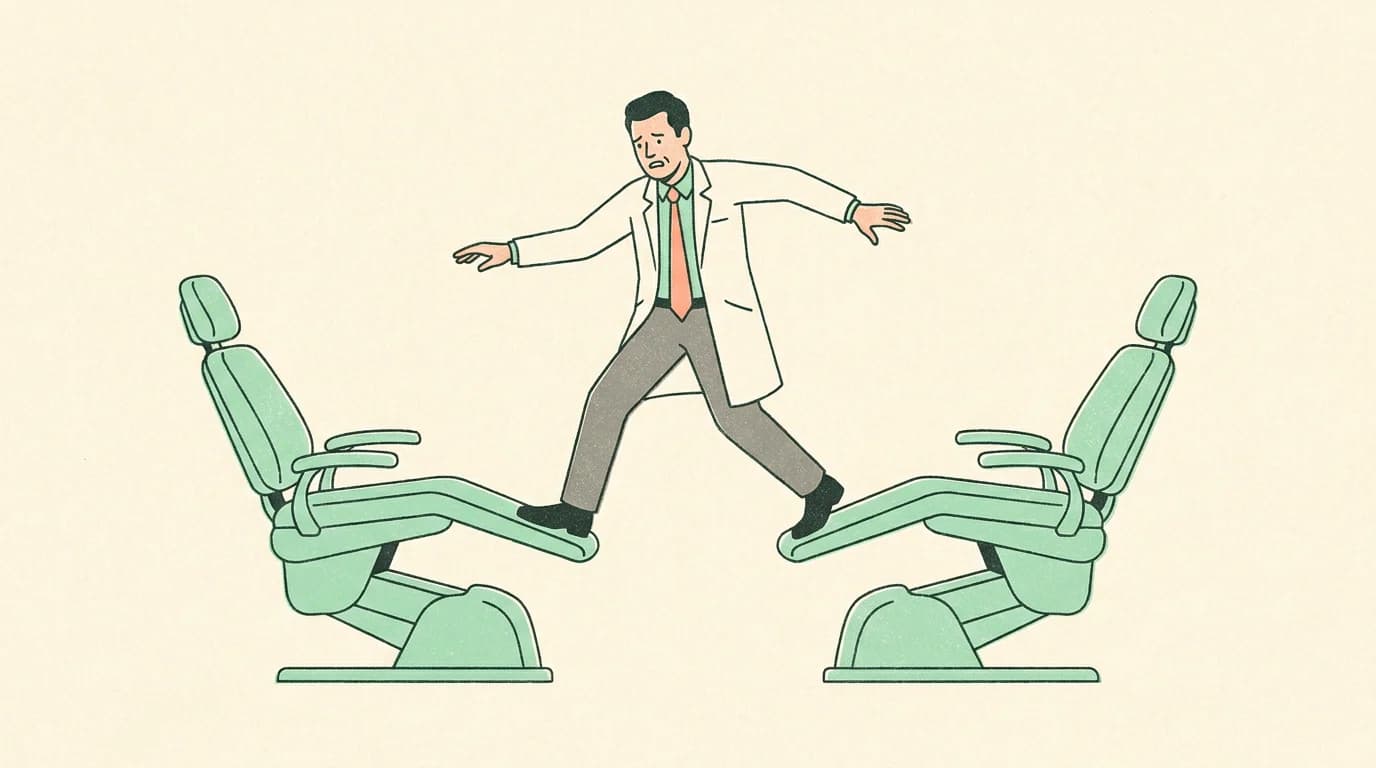
Is Your Dental Office Manager Managing or Just Staying Busy?

Co-Founder, Minty Dental
In Summary
- Most dental office managers are promoted from strong front desk or admin roles and are given a new title without a redefined job, so they keep doing the work that made them valuable before.
- Visible busyness (handling insurance, patient complaints, scheduling gaps, and team questions) can create the illusion of management because the owner sees how hard the person is working.
- True management is measured by outcomes and systems: the practice runs better because of processes the manager built and maintains, not because the manager personally intervenes in everything.
- A practice that depends on one person solving every problem is fragile, which lowers both owner independence and practice value.
- Evaluating the difference relies on specific KPIs and accountability structures rather than gut feel or how full the manager's day appears.
Activity and Management Are Not the Same Thing in a Dental Practice
A dental office manager can spend every hour of the day working hard without actually managing the practice. Answering phones, resolving insurance denials, filling schedule gaps, and fielding team questions all keep a person busy, but activity and management measure different things. Management is defined by outcomes and the systems that produce them, not by hours logged or tasks completed.
This confusion usually starts with how the role gets filled. Most office managers are promoted from a strong admin or front desk position, because they understand insurance better than anyone, know how to handle a difficult patient, and can step into almost any front-office seat when someone calls out. The owner recognizes that value, hands over a new title and often a raise, and sends the person back to doing exactly what earned the promotion. What rarely happens is a clear conversation about what managing the practice now means. The result is a pattern practice consultants describe as the "glorified front desk employee": someone who personally handles insurance, patient complaints, scheduling gaps, and staff questions all day, every day.
This pattern is often not the manager's fault. It reflects how the role was defined, or left undefined, at the moment of promotion.
Why busyness looks like management: When the owner can physically see how hard the manager is working, it creates the impression that the practice is being managed well. A manager whose value comes from being the person who can solve every problem will naturally keep solving problems instead of building systems that prevent them.
The distinction carries real weight for practice value and owner independence. A practice that runs on one person's daily heroics is fragile, because performance drops the moment that person is out, distracted, or overloaded. Building an operation that functions without constant intervention is central to reducing how much the practice depends on any single individual.
Four KPIs That Reveal Whether Your Manager Is Producing Results
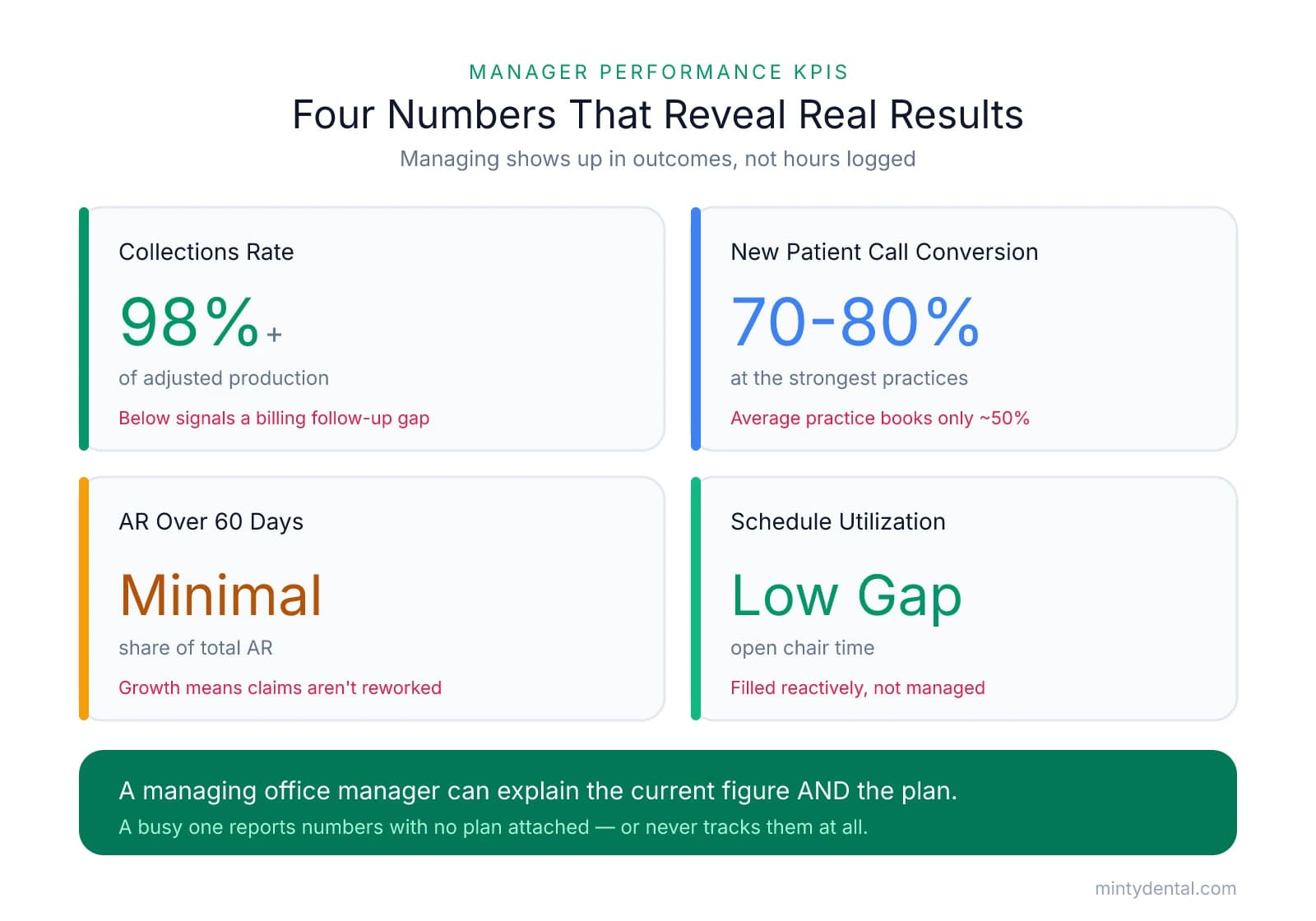
The difference between a manager and a busy employee shows up in numbers rather than effort. A true office manager owns a small set of measurable outcomes, reviews them on a regular cycle, and can explain both the current figure and what is being done to improve it. The four KPIs below are the ones most directly tied to whether the practice is being managed, and each one doubles as a diagnostic question you can ask without turning it into a confrontation.
| KPI | Benchmark | What a weak result signals |
|---|---|---|
| Collections rate | 98%+ of adjusted production | Revenue is being produced but not captured; billing follow-up is inconsistent |
| AR over 60 days | Minimal share of total AR | Claims and patient balances are not being worked systematically |
| New patient call conversion | 70-80% at top practices | Front-desk phone handling has no oversight or coaching |
| Schedule utilization | Low open chair time | The schedule is filled reactively, not managed proactively |
Collections rate: A practice that isn't collecting at least 98% of billable or adjusted production has a policy or follow-up gap. A managing office manager reviews this weekly, identifies whether a dip came from a specific payer, a write-off pattern, or unbilled production, and acts. A busy one either doesn't track it or reports the number without a plan attached.
AR aging: Accounts receivable is one of the three metrics an office manager should own, because uncollected production directly reduces profitability. Growing balances in the 60-90+ day buckets usually mean claims aren't being reworked and patient statements aren't being followed. Knowing what an AR aging report should look like gives you a reference point when you ask your manager to walk you through the current one.
New patient call conversion: The average practice books only about half of its new-patient callers, while the strongest offices convert 70 to 80%. A manager who knows this number is listening to calls and coaching the front desk; one who has never measured it is losing new patients at the phone without realizing it.
Schedule utilization: A manager who can report open chair time and the dollar value of diagnosed but unscheduled treatment is managing capacity. One who cannot is leaving the schedule to fill itself.
Behavioral Signals That Separate Managers from Doers
KPIs alone are not enough. Day-to-day behavior also shows whether the manager is managing in the fuller sense.
Systems versus heroics. A managing office manager documents processes and trains the team to follow them, so critical tasks do not live in one person's head. A useful test is what happens when the manager takes a week off. If the practice becomes vulnerable because one person is the only one who knows how to handle key tasks, knowledge is concentrated rather than embedded in systems. Concentrated knowledge feels like reliability, but it usually signals that the manager is solving problems personally instead of building processes that prevent them.
Proactive versus reactive. A doer brings the owner problems after they have escalated. A manager identifies trends early and arrives with a proposed solution. A concrete signal is how information reaches you: a managing office manager runs a structured daily or weekly huddle and brings data to the owner without being asked. When the only updates you receive are the fires that grew too large to ignore, the manager is reacting to the practice rather than steering it.
Accountability versus friendship. Holding team members to performance standards sometimes means having difficult conversations. A manager who avoids those conversations to preserve relationships is maintaining peace at the cost of performance. This dimension depends partly on the owner. A manager cannot hold authority without visible owner support, so reversing a manager's decision in front of the team quietly removes it. The manager also has to be willing to use that authority once it is backed. Consistent accountability tends to reduce the resentment that drives staff turnover, because standards apply evenly.
Use these questions to structure a conversation, not a performance improvement plan:
- Can you show me last month's collections rate and explain any movement?
- What is our current AR over 60 days, and how is it being worked?
- How many new-patient calls came in last month, and how many converted?
- What is our biggest scheduling gap right now, and what is the plan to close it?
- If you were out for a week, what would break, and what have you documented to prevent that?
- Which team member is furthest from expectations, and how are you addressing it?
The quality of the answers, not only the figures, shows whether the manager is tracking, interpreting, and acting on the data.
How to Restructure the Role Once You Know Where the Gap Is
The purpose of the evaluation is to close the gap between the role as it is currently practiced and the role as the practice needs it to function. Most gaps trace back to unclear expectations rather than a lack of capability or motivation, which means the fix is usually structural. Three scenarios cover nearly every situation.
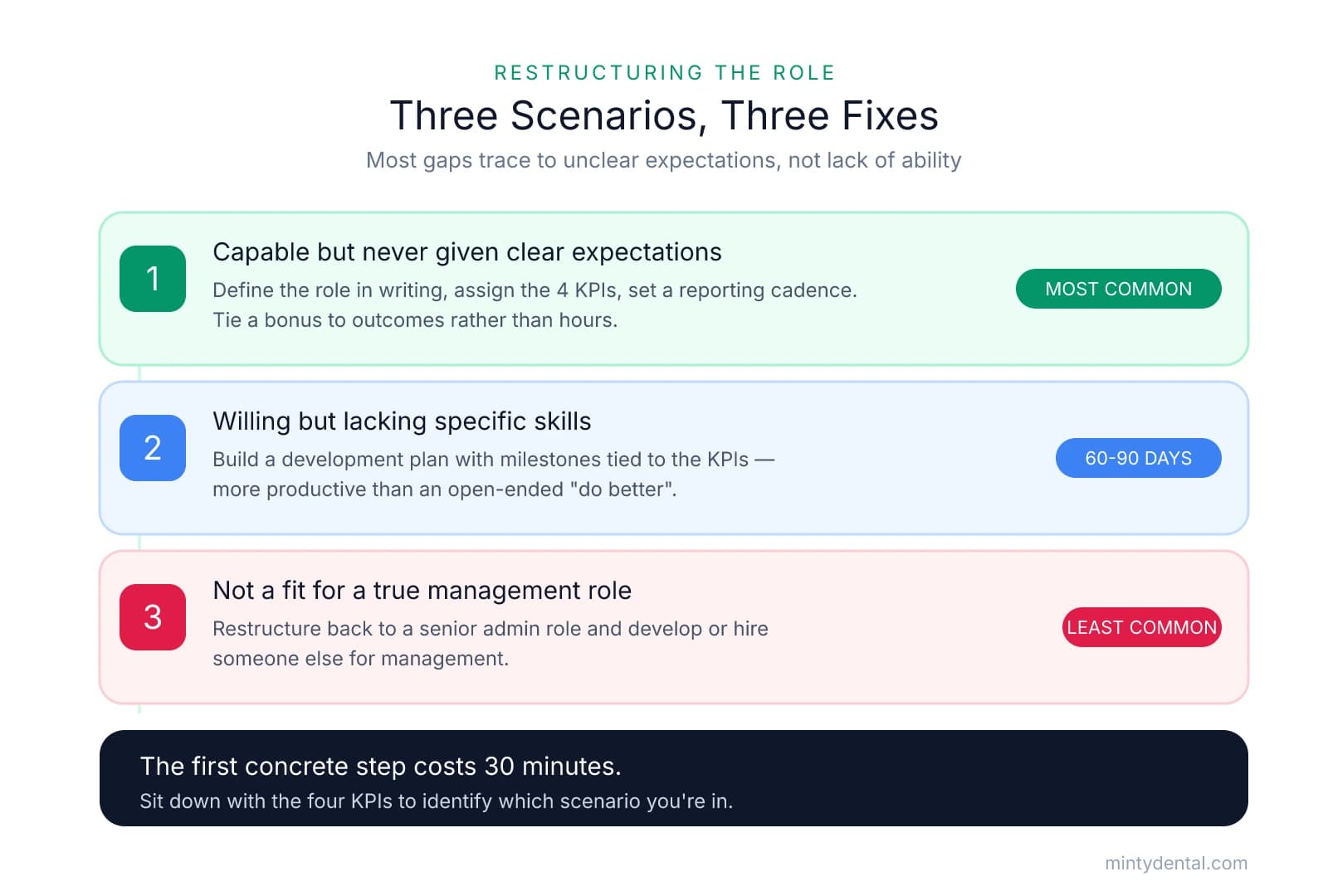
Scenario 1: Capable but never given clear expectations. This is the most common case, and it follows directly from how the role was filled. The manager has the ability but was never told what managing meant, which KPIs to own, or how often to report. The fix is to define the role in writing, assign ownership of the four KPIs, and establish a reporting cadence. A weekly or monthly review works for most practices, with newer managers benefiting from more frequent feedback than established ones. A well-designed bonus tied to collections rate, AR aging, schedule utilization, and new patient conversion aligns what the manager does with what the practice needs, because compensation follows outcomes rather than hours worked. Keeping bonus discussions and formal performance reviews as two separate conversations helps both stay useful.
Scenario 2: Willing but lacking specific skills. Here the manager wants the role but has gaps in areas such as reading financial reports, running structured team meetings, or handling accountability conversations. A 60 to 90 day development plan with specific milestones tied to the KPIs gives the manager something concrete to work toward, which is more productive than an open-ended request to do better.
Scenario 3: Not a fit for a true management role. In a smaller number of cases, the person is a strong administrator who does not want or cannot grow into management. Restructuring the position back to a senior admin role and developing or hiring someone else for management may serve everyone better. Most situations fall into the first two categories, so this outcome is less common.
The first concrete step costs 30 minutes. Sit down with the manager, bring the four KPIs, and use the discussion to identify which scenario you are in and what the role needs next.
Sources & References
The data and claims in this article are drawn from the following sources. We prioritize government data, peer-reviewed research, and established industry publications to ensure accuracy.
- How to Turn Your Dental Office Manager Into a True Leader— dentalpracticeheroes.com
- 4a. Key Performance Indicators (KPIs) | American Dental Association— ada.orgIndustry
- Key Metrics for the Office Manager - Oral Health Group— www.oralhealthgroup.comIndustry
- 50% of Your New-Patient Calls Never Get Booked— painfreedentalmarketing.com
- What every dental practice manager wishes their dentist knew about ...— www.oralhealthgroup.comIndustry
- 4a. Key Performance Indicators (KPIs) | American Dental Association— ada.orgIndustry
Ready to optimize your practice management?
Effective office management is crucial to practice success, but many owners struggle to evaluate whether their team is truly driving results. Minty's Operations service handles the business side of your practice, from billing and staffing to performance metrics, so you can focus on patient care.