Financing Options for Buying a Dental Practice

Co-Founder, Minty Dental

In Summary
- Dentists are low-risk borrowers, so down payments range from 0-20% depending on loan type and buyer qualifications—not a universal 20% standard
- Student loan debt doesn't disqualify you, but your credit score and debt-to-income ratio directly affect approval odds and interest rates
- Five main financing paths exist: SBA loans, conventional bank loans, seller financing, equipment financing, and hybrid structures—each with different tradeoffs
- The right choice depends on your financial profile, the practice's financials, and your closing timeline
- Lenders structure deals around production history and practice cash flow more than personal savings
The Financing Landscape Is More Flexible Than Most Buyers Realize
Walk into most dental practice acquisitions assuming you need 20% down and flawless credit, and you'll miss half the options available. Dentists are considered low-risk borrowers—default rates in the dental industry sit well below other small business sectors, and practice cash flow tends to be predictable. That perception opens doors that stay closed for other professions.
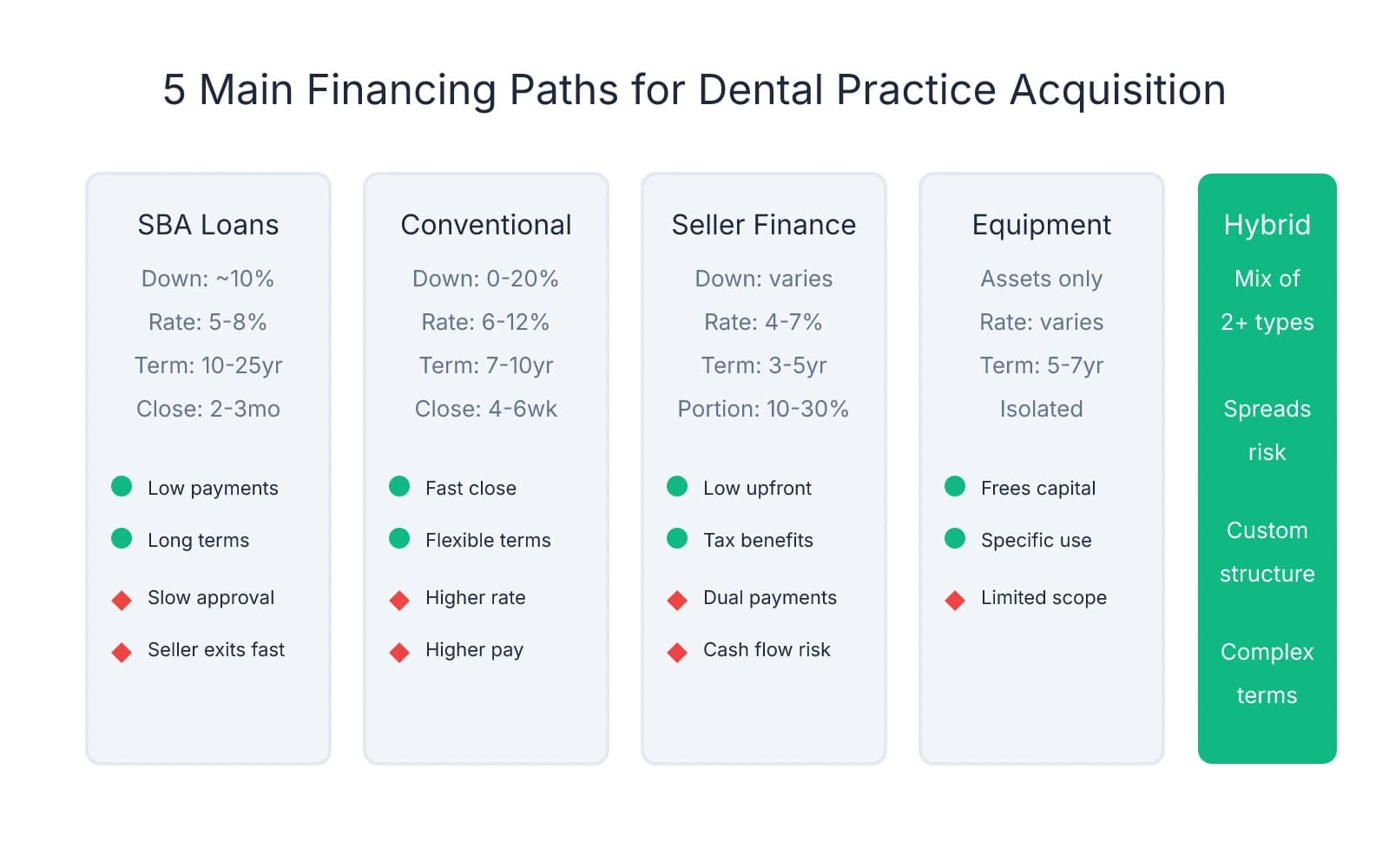
Down payment requirements aren't fixed. They range from 0% to 20% depending on the loan structure, the practice's financials, and your qualifications. Some conventional lenders offer zero-down financing for established practices with strong revenue history. SBA loans typically land around 10% down. Seller financing can eliminate the down payment entirely if the seller carries part of the note.
One concern that stops buyers before they start: student loan debt. The average dental graduate carries close to $300,000 in education debt, and many assume that disqualifies them from taking on another loan. It doesn't. Lenders care more about your debt-to-income ratio and credit score than the raw dollar figure. If your monthly obligations sit below 40-45% of gross income and your credit score clears 680, most lenders will work with you.
The five main financing paths: SBA loans offer longer terms and lower down payments but come with slower approval timelines. Conventional bank loans move faster and often require less paperwork, but typically ask for higher down payments. Seller financing lets you negotiate terms directly with the seller, which can mean lower upfront cash but higher interest rates. Equipment financing isolates the practice's physical assets and can free up working capital. Hybrid structures combine two or more of these approaches.
The right choice depends on three factors: your financial profile (credit score, liquidity, existing debt), the practice's financials, and your timeline. If you need to close in 30 days, SBA loans won't work. If you have six months and want the lowest possible interest rate, they might be your best option.
Understanding how much cash you actually need upfront changes which financing path makes sense. Matching the loan structure to your situation can save tens of thousands in interest or preserve cash flow when you need it most.
SBA Loans vs. Conventional Loans: What the Tradeoffs Actually Look Like
The two most common financing routes—SBA 7(a) loans and conventional bank loans—look similar on paper but behave differently in practice. Both can fund the full purchase price and require personal guarantees, but the structure behind each creates tradeoffs that affect your approval timeline, monthly cash flow, and control over the transition.
SBA 7(a) loans offer terms up to 10 years for equipment and working capital, and up to 25 years for real estate. Down payments typically sit around 10%, and interest rates range from 5-8%. That combination translates to smaller monthly payments, which matters when managing cash flow in year one. But approval stretches 2-3 months, requires detailed financial documentation, and comes with government guarantee fees that add roughly 2-3% to the loan amount upfront.
For real estate purchases, SBA 504 loans extend terms to 25 years with fixed rates. The structure splits the loan between a conventional lender (50%), a Certified Development Company (40%), and your down payment (10%), keeping your equity requirement low while locking in predictable payments.
The part most buyers miss: SBA loans require sellers to exit almost immediately after closing. The government's position is that you're buying the business to run it yourself. That creates a continuity problem—patients expect familiar faces, staff need time to adjust, clinical handoffs take longer than a week. When the seller walks out on day one, retention rates drop.
Conventional dental practice loans move faster. Approval timelines run 4-6 weeks, and lenders who specialize in dental acquisitions often require less documentation. Down payments range from 0-10% for buyers with strong credit, though some lenders ask for 15-20% if the practice's financials are weaker. Interest rates sit higher—typically 6-12%—and terms are shorter, often 7-10 years. That means higher monthly payments, but you own the practice outright sooner and pay less total interest.
The flexibility conventional lenders offer around seller transitions is where the real value sits. Most allow 60-90 days of structured handoff time, with the seller staying on as an employee or consultant. That gives you time to build relationships with patients, learn the practice's systems, and address operational issues before you're flying solo. For practices where the seller's reputation drives referrals, that transition window can be the difference between retaining 90% of revenue and watching 20% walk out.
SBA loans make sense in three situations: if you're a first-time buyer with limited liquidity and need to preserve cash, if the practice's financials are weaker, or if you're buying real estate alongside the practice.
Conventional loans make sense when the practice is strong, your credit is solid, and the seller's involvement matters. If the practice generates consistent cash flow above $500K annually, if your credit score clears 720, and if you have 10-15% liquid to put down, conventional lenders will compete for your business. The faster close matters when competing against other buyers. And if the practice depends on the seller's clinical reputation, the ability to structure a 60-90 day transition can protect the revenue you're paying for.
Seller Financing and Hybrid Structures: When the Seller Becomes Your Lender
Seller financing means the seller lends you part of the purchase price directly instead of requiring full payment at closing. Typically, the seller carries 10-30% of the total price, structured as a promissory note with payments over 3-5 years. If you're buying a $600,000 practice, the seller might finance $120,000 at 5% interest, with monthly payments starting after your bank debt service.
Three situations drive sellers to agree to this structure. First, tax deferral through installment sales lets them spread capital gains recognition over multiple years—particularly valuable for sellers in high tax brackets. Second, when a seller believes in your ability to succeed, carrying a note signals confidence to other lenders. Third, when bank financing falls short, seller financing bridges the gap.
Interest rates on seller notes typically run 4-7%, slightly above prime. Payments are usually structured to begin after your primary loan's monthly obligation, protecting cash flow early on. Most seller notes include personal guarantees, and some sellers require collateral. The note sits in second position behind your bank loan.
Earnout structures take this further by tying part of the purchase price to post-sale performance. Instead of a fixed note, a portion becomes contingent on the practice hitting specific revenue or profit targets after you take over. Earnouts rarely exceed 40% of the total price and typically resolve within three years. For buyers, this shifts risk: if the practice underperforms, you pay less. For sellers, it creates dependency on outcomes they no longer control.
The risk for buyers shows up when cash flow tightens. If the practice dips below projections—maybe the seller's production was propping up revenue—you're still paying both the bank and the seller while trying to stabilize operations. That dual obligation can drain working capital faster than a single loan.
Hybrid structures combine bank financing, seller notes, and buyer equity to spread risk. A common split: the bank finances 70-80%, the seller carries 10-20%, and you contribute 10% down. This improves approval odds because the seller's willingness to carry part of the note tells the bank they believe in the practice's stability. It also reduces your upfront cash requirement.
Where hybrid deals create friction: if the practice underperforms and you need to renegotiate terms, you're managing two creditors with different priorities. The bank wants its monthly payment regardless of revenue fluctuations. The seller might be more flexible—or might not. Working capital adjustments that hit 90 days after closing can compound this problem.
Seller financing makes the most sense when your credit or liquidity doesn't qualify you for full bank financing but the seller trusts your clinical skills, when the practice's financials are strong but inconsistent, or when you're buying from a mentor and the relationship supports a longer-term financial arrangement.
Positioning Yourself for Approval: What Lenders Actually Evaluate
Lenders evaluate specific, controllable metrics. Understanding what they're looking for lets you position yourself months before you apply. The difference between a 5.5% rate and a 7.5% rate often comes down to decisions you made a year earlier about credit card balances, student loan payments, and how much cash you kept liquid.
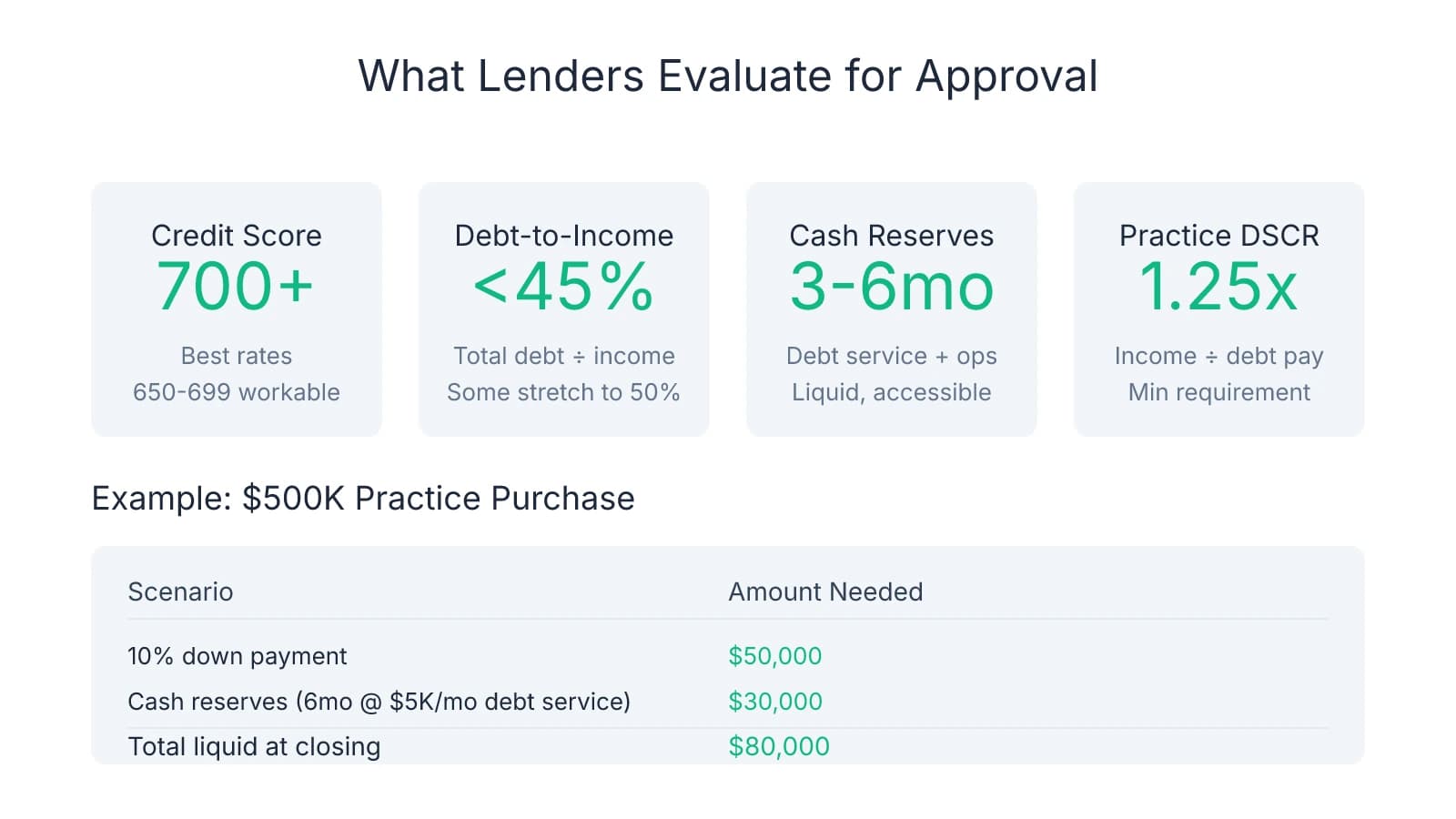
Credit score sits at the top. Lenders prefer scores above 700, which unlocks the best rates and most flexible terms. Scores between 650-699 are workable but expect higher interest rates or stricter requirements. Below 650, you're looking at co-signers, larger equity contributions, or outright denial. The gap between 680 and 720 can translate to half a percentage point on your rate, which over a $500,000 loan means paying $15,000-20,000 more in interest.
Debt-to-income ratio (DTI) measures your total monthly debt payments divided by gross monthly income. Lenders want this below 40-45%, though some stretch to 50% if your credit score is high and the practice's cash flow is strong. Student loan debt doesn't disqualify you, but high monthly payments relative to income create a tighter margin for approval.
Liquidity requirements vary, but most lenders want to see 3-6 months of debt service payments in cash reserves, plus enough working capital to cover payroll, supplies, and overhead during transition. If your monthly loan payment will be $5,000, lenders expect $15,000-30,000 liquid after closing—not tied up in retirement accounts, but accessible in checking or savings.
The practice's financials matter as much as your personal profile. Lenders calculate the debt service coverage ratio (DSCR)—the practice's annual net income divided by the annual debt payment. Most lenders require a DSCR of 1.25x or higher, meaning the practice generates $1.25 for every $1 of debt service.
Six to twelve months before you plan to apply, pull your credit reports from all three bureaus and dispute any errors. Pay down high-interest debt, especially credit cards—lenders care more about utilization than total balances. Avoid large purchases that increase your debt load.
Build cash reserves deliberately. Calculate how much you need to add monthly to hit your target. For a $500,000 practice with 10% down and $30,000 in reserves, you need $80,000 liquid at closing.
Get pre-approved before shopping for practices. Pre-approval tells you your borrowing capacity, lets you focus on practices you can afford, and positions you to move quickly. Sellers take buyers with financing lined up more seriously. In competitive markets, the difference between a 30-day close and a 90-day close can be the difference between winning the deal and losing it.
Most first-time buyers face predictable obstacles—credit issues they didn't know existed, DTI ratios higher than expected, liquidity shortfalls during underwriting. The buyers who clear these hurdles treated approval as a process they controlled. Talk to a lender before you start shopping. Know your numbers. Fix what's fixable.
Sources & References
The data and claims in this article are drawn from the following sources. We prioritize government data, peer-reviewed research, and established industry publications to ensure accuracy.
- The Truth about Dental Practice Loans— ada.orgIndustry
- Terms, conditions, and eligibility | U.S. Small Business Administration— www.sba.govGovernment
- SBA vs. Conventional Loan Solutions: A Simple Comparison— oakstreetfunding.com
- Navigating Types of Dental Transactions & the Financial Terms to ...— mblawfirm.comIndustry
- Considerations for Earnouts in Acquisitions - BMO— commercial.bmo.com
- Financing A Dental Practice: Frequently Asked Questions— panaceafinancial.comIndustry
- Dental Practice Financing – Apply With Confidence— dentaltransitions.comIndustry
Frequently Asked Questions
Ready to finance your dental practice acquisition?
Explore financing options with confidence. Minty Plus provides expert guidance through every step of your dental practice acquisition, from evaluating loan structures to closing your deal.