How to Present Patient Financing Without Feeling Pushy

Co-Founder, Minty Dental

In Summary
- Cost is the single most common reason patients decline or defer dental treatment, with dental care facing cost-barrier rates two to three times higher than other healthcare categories.
- 58% of Americans believe dental care is not affordable, and more than half say they would delay care if the cost reached $1,000 or more.
- Roughly 1 in 4 U.S. adults delays or forgoes needed care due to cost, with dental among the most frequently postponed categories.
- The typical practice introduces financing only after a patient objects to price, which is the worst possible moment and is what makes the conversation feel pushy.
- Presenting financing as a standard payment option from the start reframes it as patient service rather than a sales response.
Presenting Financing as a Standard Payment Option Turns a Cost Barrier Into a Clinical Yes
When a patient hears a treatment fee and flinches, most front-desk teams respond by mentioning financing. It feels logical in the moment. It is also, almost always, too late.
By the time a patient pushes back on price, they have already started mentally withdrawing from the treatment plan. The financing offer that follows lands not as helpful information but as a pressure move, a signal that the practice noticed the hesitation and is now working to close them. That sequence is what produces the "pushy" feeling practices want to avoid, and it has nothing to do with financing itself.
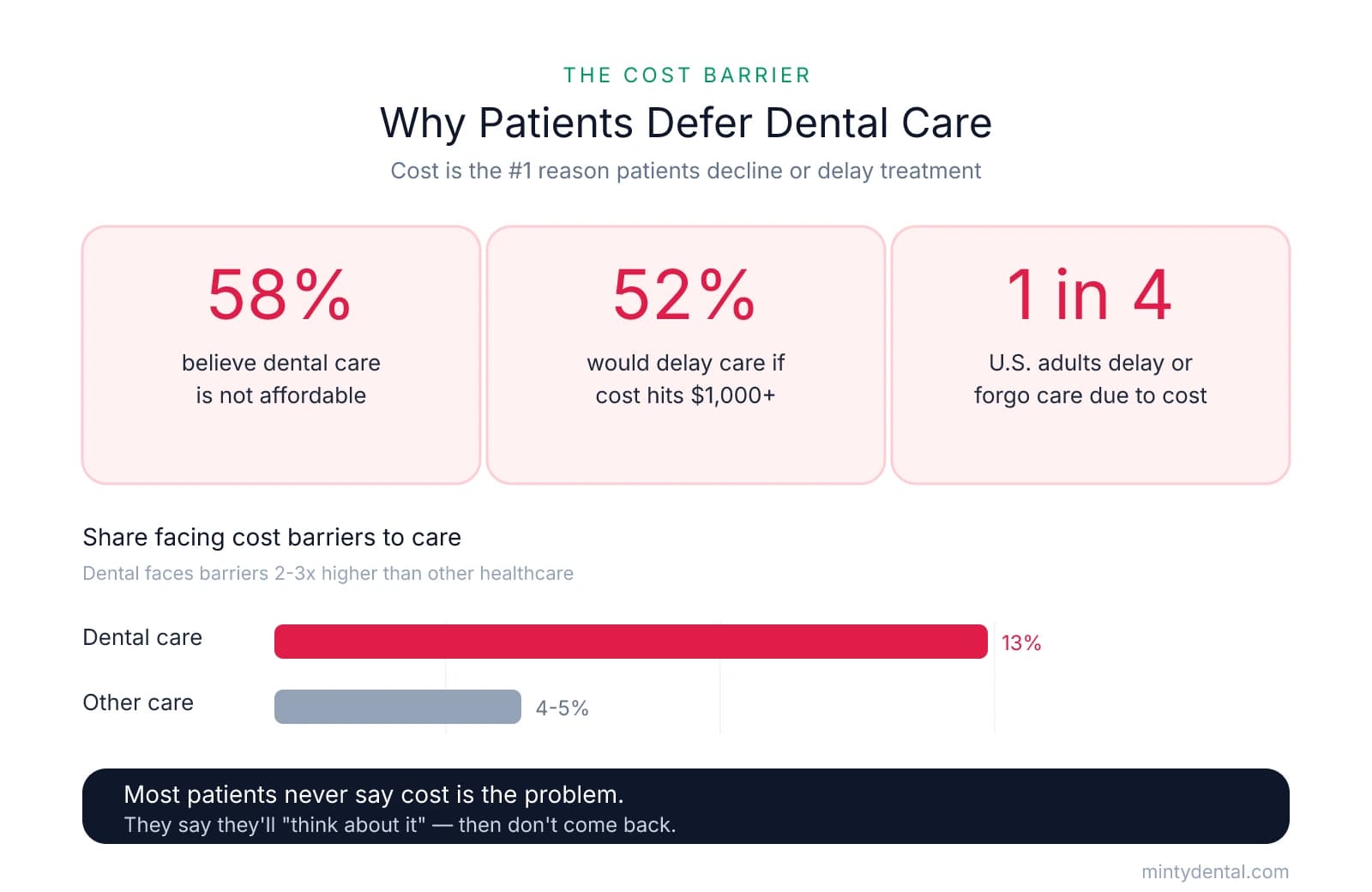
The underlying cost problem is substantial. Around 13% of the U.S. population faces cost barriers to dental care, compared to roughly 4 to 5% for other healthcare categories, according to ADA Health Policy Institute data. A separate Synchrony Dental Lifetime of Care Study found that 58% of Americans believe dental care is not affordable, and 52% said they would hold off on care if the cost reached $1,000 or more. At that threshold, a single crown or a straightforward implant restoration is already above the line where more than half your patients are likely to hesitate.
Roughly 1 in 4 U.S. adults delays or forgoes needed care due to cost, with dental among the most frequently postponed categories. These are not patients who don't value their oral health. They are patients who genuinely don't know how to make the numbers work, and most of them won't ask you to help them figure it out.
That's the real problem with the reactive approach. Patients who are cost-sensitive rarely volunteer it. They say they'll "think about it" or "check their schedule," and then they don't call back. If your team only brings up financing after a visible objection, you're only reaching the patients comfortable enough to push back out loud. Everyone else leaves.
Presenting financing proactively, as a normal part of explaining the financial side of a treatment plan, removes the implication that the patient can't afford the care. It positions monthly payment options the same way you'd explain insurance coverage: this is how people typically handle costs here, and here are your choices. That framing matters. A patient who hears about financing before they've calculated whether they can afford it experiences the information differently than one who hears it as a response to their hesitation.
If your case acceptance feels lower than it should be, the sequence of your financial conversation is often where the breakdown actually lives. The rest of this guide is about how to fix that sequence, what language to use, and how to make sure your team can deliver the conversation consistently.
Where the Financing Conversation Belongs in Your Workflow
The timing and structure of the financing conversation determines whether it feels like service or pressure. Most of the awkwardness practices experience comes not from discussing money, but from discussing it at the wrong moment, in the wrong room, with the wrong person.
Think of it as three distinct stages.
Before the appointment. List your financing options on your website and in the new-patient intake packet. This doesn't need to be elaborate. A line on the new patient page noting that flexible monthly payment options are available does real work before the patient ever sits in your chair. They arrive knowing that cost flexibility exists, which means the conversation later isn't a surprise, and it isn't charged. A written policy that details the options available and the protocols for having financing discussions with patients helps keep the conversation consistent, not just dependent on someone remembering to bring it up.
At the financial presentation. When your financial coordinator sits down with the patient, the total investment, insurance estimate, and out-of-pocket amount should all come out together, followed immediately by payment options. Not "here's what you owe, do you need any help with that?" but rather a single, continuous explanation: "Your portion after insurance comes to $3,200. We can do that as a lump sum, or most patients spread it out. With our financing option, that's around $107 a month over 24 months." That's one presentation, not a price reveal followed by a rescue offer.
Monthly framing as standard practice. Patients make affordability decisions in monthly terms, not lump sums. Quoting $107 a month alongside $3,200 total is not minimizing the fee. It's giving the patient the number that's actually useful to them. Most household budgeting happens at the monthly level, and a patient who would hesitate at $3,200 often has no trouble with $107. Presenting financing before the patient asks signals transparency rather than discomfort with money and removes the implication that you noticed them struggling.
Separating clinical and financial roles. The dentist's job is the clinical recommendation. The moment a doctor starts navigating co-pays and payment plans in the operatory, two things happen: the clinical message gets diluted, and the patient starts mentally calculating instead of listening. The handoff matters as much as anything else here. Something like "Sarah at the front will walk you through all your payment options" keeps the doctor in the clinical lane and gives the patient a clear next step. The financial coordinator then handles the payment conversation privately, without the dentist present, which reduces pressure on both sides considerably. Practices that invest in making this same-day treatment workflow feel smooth typically find that the role separation is one of the first things to get right.
Here's how the same $3,200 crown and implant plan plays out under each approach:
| Reactive Workflow | Proactive Workflow | |
|---|---|---|
| Before appointment | No mention of financing | Website and intake packet reference payment flexibility |
| Clinical presentation | Doctor reviews treatment plan | Doctor reviews treatment plan only |
| Financial presentation | Coordinator states $3,200; waits for response | Coordinator presents total, insurance, out-of-pocket, and monthly option together |
| Financing introduced | After patient hesitates or says "let me think about it" | As part of the initial payment explanation |
| Patient experience | Feels like a sales response to their reluctance | Feels like standard practice information |
| Likely outcome | Patient leaves to "think about it" | Patient has what they need to decide that day |
The difference isn't the financing product. It's the sequence.
Choosing Between Third-Party Financing and In-House Payment Plans
Two structural types cover most of what practices use: third-party financing, where an outside lender funds the treatment and pays the practice upfront, and in-house payment plans, where the practice essentially becomes the lender itself. The choice between them affects your cash flow, your administrative workload, and which patients you can actually say yes to.
Third-Party Financing: CareCredit vs. Sunbit
Third-party options transfer the collection risk entirely to the lender. The practice gets paid upfront, typically within a few business days, and the lender handles billing, collections, and default risk. The trade-off is a merchant fee, generally somewhere in the 3 to 8% range depending on the product and promotional term length. For most practice owners, that fee is a straightforward cost of doing business compared to the alternative of chasing unpaid balances.
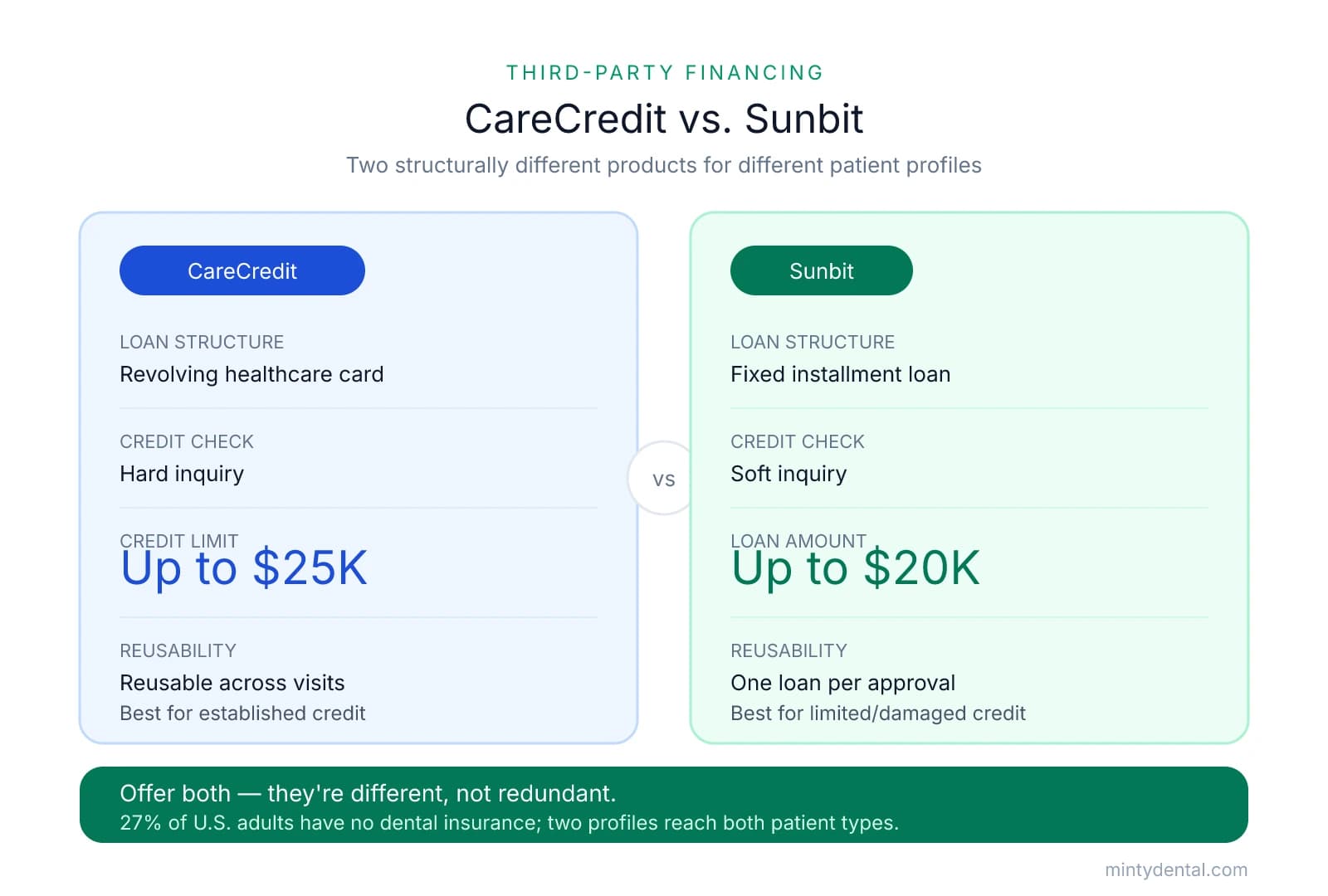
CareCredit and Sunbit are the two most common options in dental, and they're genuinely different products serving different patient profiles.
| CareCredit | Sunbit | |
|---|---|---|
| Loan structure | Revolving healthcare credit card | Fixed installment loan |
| Credit check | Hard inquiry | Soft inquiry |
| Credit limit / loan amount | Up to $25,000 | Up to $20,000 |
| Reusability | Reusable across visits and providers | One loan per treatment approval |
| Approval profile | Better for patients with established credit | Designed for limited or damaged credit histories |
CareCredit works like a specialized credit card: once approved, the patient has an ongoing credit line they can use at your practice and at other healthcare providers. Approval requires a hard credit inquiry. Sunbit is a fixed loan tied to a specific treatment, approved through a soft credit check that doesn't affect the patient's credit score. Its underwriting uses alternative data, which tends to produce higher approval rates for patients who wouldn't qualify for a traditional card.
Roughly 27% of American adults have no dental insurance, which means a meaningful portion of your patient base is already doing out-of-pocket math before they schedule. Offering two products with different approval profiles gives you a realistic shot at reaching both the patient with good credit and the one who's been turned down elsewhere. A single product leaves the second group without an option.
In-House Payment Plans: Simpler, but With Real Exposure
In-house plans are straightforward to explain to patients: pay a portion now, the rest over time, directly to the practice. The problem is that the practice absorbs all the collection risk, and the regulatory picture is more complicated than most owners realize.
In-house payment plans extending beyond 90 days may trigger Regulation Z of the federal Truth in Lending Act, which requires formal disclosures about credit terms and can effectively give the practice the status of a lender. Most dental offices aren't set up to manage that compliance load. If your collection rate is already under pressure, adding a population of self-financed balances compounds the problem, something worth reviewing if you're already seeing aging AR build up in the 90-plus-day bucket.
State-Level Requirements Add Another Layer
Some states have layered additional requirements on top of federal rules. Illinois now requires dentists, employees, and agents to provide a specific written disclosure to patients in at least 14-point font before any third-party financing application is discussed, and explicitly prohibits staff from completing or submitting an application on a patient's behalf. If you operate in Illinois, that disclosure has to happen before the conversation starts, not after.
Check your state dental board for any equivalent requirements before finalizing your intake workflow.
What Most Practices Should Actually Do
Unless you have a dedicated billing team and clear written policies governing payment terms, repayment timelines, and default procedures, in-house plans are hard to run well. Most private practices are better served by one or two third-party products that cover different credit profiles. CareCredit and Sunbit together cover a wide range because they're structurally different, not redundant. Adding a third option like Cherry can make sense in practices with a high volume of cosmetic or elective treatment, but two well-chosen products handle most situations without overcomplicating the patient conversation.
Training Your Team So the Conversation Is Consistent
The "pushy" feeling almost never originates with the patient. It originates with the team. When staff are uncomfortable discussing money, they delay the conversation, soften it into near-invisibility, or skip it entirely and wait for the patient to ask. By the time financing gets mentioned, the context has already made it awkward. The patient picks up on the discomfort, and the interaction turns transactional in exactly the way everyone was trying to avoid.
The fix is less about scripts and more about normalizing the conversation through repetition. Develop written financial policies specifying which options are offered, who presents them, and what language to use so there's no ambiguity about when or whether the topic comes up. When the conversation is defined in writing, it stops feeling like a judgment call each team member makes on the fly.
Language matters here in a specific way. "Do you need help with financing?" implies the patient can't afford the treatment. It puts them in the position of admitting a limitation. Replace it with something closer to "We offer a few different ways to pay, let me walk you through them," and the dynamic shifts. Now you're presenting a menu, not responding to a problem. Present payment options to every patient, not just those who seem to hesitate. Guessing who "needs" financing based on appearance or behavior is both unreliable and unfair. Presenting it universally removes the awkwardness entirely because it signals that this is simply how the practice operates.
Consistency matters more than perfection. A practice where every team member uses the same neutral, matter-of-fact language about payment options creates a patient experience that feels organized and trustworthy. One coordinator who presents options confidently and another who hedges and apologizes creates inconsistency that patients notice, even if they can't name it. Whether your office manager is actively shaping that consistency or just reacting to problems as they come up is worth examining, and the difference between those two modes shows up in outcomes like case acceptance and collections.
The most practical tool for building that consistency is a brief monthly role-play. Ten minutes at a team meeting, one person playing the patient, another walking through the financial presentation. It doesn't need to be formal or filmed. What it does is surface language problems before they happen with real patients, build muscle memory for the handoff from the clinical conversation to the financial one, and give newer team members a model to follow. Teams that practice the conversation treat it matter-of-factly. Teams that never practice it treat it like an interruption.
Here's the one audit question worth asking before anything else: at what point in a typical visit does your team first mention payment options? If the answer is "after the patient asks about cost" or "after they push back on the fee," map out your current workflow and mark the exact moment payment options appear. If that moment is reactive, that's where the change starts.
Sources & References
The data and claims in this article are drawn from the following sources. We prioritize government data, peer-reviewed research, and established industry publications to ensure accuracy.
- Patient Financing Options | American Dental Association— ada.orgIndustry
- Dental Lifetime of Care Study: Impact of Costs on Care Decisions— www.carecredit.comIndustry
- Roughly 1 in 4 U.S. adults delays or forgoes needed care due to cost— kff.org
- Patient Financing Options | American Dental Association— ada.orgIndustry
- Dental Financing Scripts: How to Present CareCredit, Sunbit, and ...— sunrisedentalsolutions.comIndustry
- Third-Party Financing Provision of the Dental Practice Act - IDFPR— idfpr.illinois.govGovernment
- QUICKcast: 8 Hacks to Present Financing Like a Pro— www.dentalmanagers.comIndustry
- Ways to Add Financing Discussions to Dental Front-Office Training— www.carecredit.comIndustry
Turn Financing Conversations Into Case Acceptance Wins
Offering flexible payment options is just one piece of running a thriving independent practice. Minty helps practice owners streamline the business operations that support better patient experiences.