Clinical Readiness for Dental Practice Ownership: What You Need

Co-Founder, Minty Dental

In Summary
- Clinical readiness is a threshold, not a ceiling: if you can perform the practice's core services, have demonstrated $400K–$600K+ annual production, and manage complications without refunds or redos, you've cleared the bar
- Lenders prioritize 12–24 months of consistent production over years of experience—a dentist two years out producing $500K annually is a stronger candidate than someone five years out producing $300K
- Procedural competency means matching your skill set to the practice's revenue model: audit the production breakdown during due diligence and decide whether you'll refer out gaps, bring in help, or delay to train
- Business skills—patient communication, staff management, financial literacy—determine whether you retain patients and stay profitable, but they're learned on the job, not prerequisites for buying
Clinical Readiness Is a Threshold, Not a Ceiling
Most associates treat clinical readiness as a moving target. That's backward. The question isn't whether you feel ready—it's whether you meet the baseline standard lenders, patients, and practice transitions require.
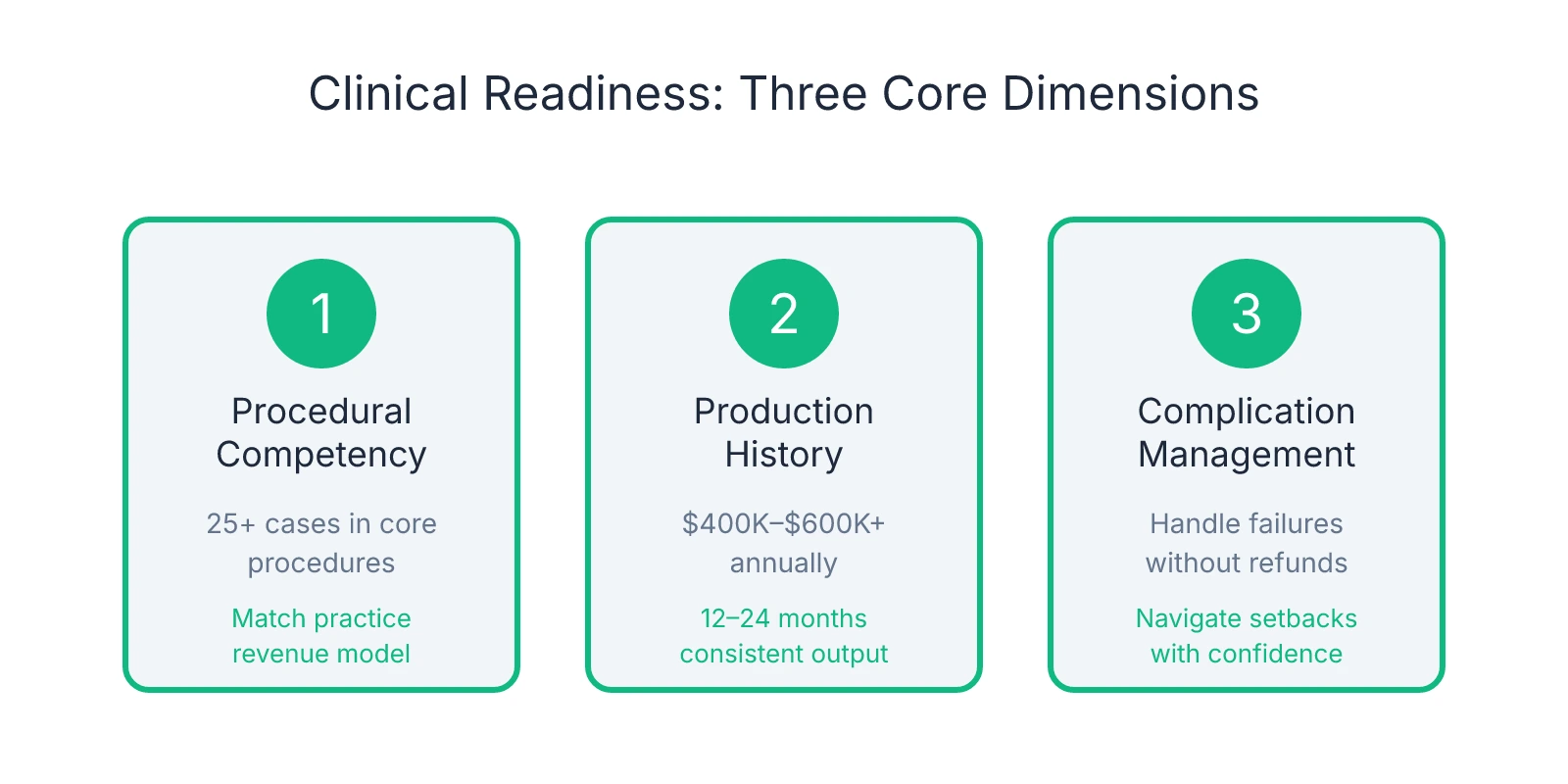
That standard is lower than most associates assume. Clinical readiness breaks into three measurable dimensions: procedural competency, production history, and complication management. If you can perform the core services the practice offers, you've demonstrated earning capacity as an associate, and you can handle clinical failures without issuing refunds or redoing cases at no charge, you've cleared the bar. Mastery comes later, but it's not a prerequisite for buying.
Procedural competency means you can deliver the services patients expect from the practice you're buying. If the practice generates 40% of revenue from crowns and bridges, you need volume in those procedures. One benchmark: completing at least 25 cases in any procedure you plan to offer regularly. That's enough repetition to manage complications without learning on high-stakes cases in your own practice.
Production history is the clearest signal lenders evaluate. If you've consistently produced $400K–$600K annually as an associate, you've demonstrated the capacity to generate revenue. Banks don't care whether you're the fastest clinician—they care whether your production supports the debt service. If your numbers align with the practice's revenue model, you've met the threshold.
Complication management is where confidence diverges from competency. Every dentist faces failed restorations and post-op complications. The question is whether you can manage those outcomes without financial loss. If you can navigate complications, communicate with patients through setbacks, and adjust your clinical approach without panic, you're operationally ready.
The timing of ownership reflects this reality. According to the ADA Health Policy Institute, 21% of dentists who graduated between 2016 and 2020 owned practices within 3–7 years of finishing school, while 33% of 2011–2015 graduates reached ownership at the same career stage. The gap isn't clinical skill—it's financial readiness, market timing, and access to capital. Clinical competency is rarely the bottleneck.
Where associates get stuck is conflating readiness with confidence. You won't feel fully prepared until you've owned a practice for a year. The clinical bar for ownership is a threshold you cross, not a ceiling you reach. If you meet the three dimensions above, the question shifts from "Am I ready?" to "Can I finance it?"—explored in buying a practice with significant student debt.
What Lenders Actually Require: Production History Over Years of Experience
When underwriting a practice acquisition loan, lenders analyze your production reports more than your CV. The question they're answering: "Can you generate enough revenue to service this debt?"

Many associates assume they need five years of experience before lenders will take them seriously. In reality, banks typically want to see 12–24 months of consistent production—ideally in the $400K–$600K+ annual range—regardless of how long you've been out of school. If you're two years into practice producing $500K annually, you're a stronger candidate than someone five years out producing $300K with gaps in their work history.
Production demonstrates earning capacity. If you've consistently generated $40K–$50K per month as an associate, that pattern suggests you can replicate or exceed that output as an owner. The loan amount, practice revenue, and your historical production need to align—if the practice generates $800K annually and you've been producing $600K as an associate, the math works. If your production sits at $250K and the practice does $1.2M, lenders will question whether you can maintain that revenue.
What counts as "consistent" production? Lenders look for steady monthly output without major gaps. Seasonal dips are normal, but if your production drops to zero for three months because you switched jobs, that raises questions. One pattern that strengthens applications: working in multiple settings and maintaining production across those environments. It signals adaptability.
Years of experience can't substitute for weak production numbers. A dentist seven years out producing $350K annually will face more scrutiny than a recent graduate producing $500K. Lenders care about trajectory—if your production has been climbing steadily over 18–24 months, that's a stronger signal than flat output over five years.
Some buyers purchase practices 1–2 years out of school if their production supports the loan. If you're generating $450K annually and the practice is listed at $500K with $600K in revenue, the deal can work. The limiting factor is usually down payment and cash reserves, not clinical experience.
Documenting production for lender review requires W-2s, pay stubs, and production reports from your current employer. W-2s confirm total compensation but don't show production. The clearest evidence is a production report showing monthly or quarterly output. Most practice management systems generate these automatically. If your employer won't provide one, reconstruct it from your own records.
If your production history is thin, one approach is waiting six months to build a stronger track record before applying. Lenders evaluate recent performance more heavily than distant history, so a solid 12-month stretch of consistent production outweighs a longer but inconsistent record.
The Procedural Competency Question: Can You Deliver What the Practice Offers?
The clinical readiness question most buyers ask—"Am I good enough?"—misses the actual risk. The question lenders, patients, and practice transitions care about: Can you perform the procedures this practice is already billing for?
You're not evaluating whether you're a skilled dentist in the abstract. You're auditing whether your procedural experience matches the practice's revenue model. If the practice generates 35% of collections from crown and bridge work and you've placed 200+ crowns as an associate, you're aligned. If 40% of revenue comes from implant placement and you've never placed an implant, you have a gap—and that gap affects both revenue projections and transition risk.
Start by requesting a production breakdown during due diligence. Most practice management systems can generate a report showing revenue by procedure code over the past 12–24 months. You're looking for the top 5–10 procedure categories and their percentage of total collections. Compare that to your own procedural volume. If the numbers align, you're operationally ready. If they don't, you need a plan.
Where buyers often find misalignment: practices that generate significant revenue from procedures they don't perform. Common examples are implant placement, Invisalign, complex endodontics, and sleep apnea appliances. If 20% of the practice's revenue comes from implants and you refer those cases out, you're looking at an immediate revenue drop unless you address it.
You have three options when facing a procedural gap. First, refer out and accept the revenue loss. If the practice generates $800K annually and 15% comes from procedures you don't perform, you're projecting $680K in year one unless you replace that volume. The risk is that patients who valued those services may leave entirely rather than accept a referral.
Second, bring in an associate or specialist to cover the gap. If implants represent 25% of revenue, hiring a part-time associate who places implants preserves that income stream while you build the skill. This works when the procedure volume justifies the cost. Some buyers negotiate with the seller to stay on as a referring doctor for specific procedures during the transition.
Third, delay the purchase to gain skills. If you're serious about offering a procedure the practice depends on, completing at least 25 cases as an associate gives you enough repetition to manage complications. Below that threshold, you're still navigating the learning curve, which increases the risk of failures, remakes, and refunds.
Procedural gaps aren't deal-breakers if you have a plan, but they affect how you model revenue and structure the transition. One scenario many buyers overlook: practices where the seller's reputation is tied to a specific service. If the seller is known locally for Invisalign and you don't offer it, patients may leave even if you refer them to a trusted provider.
Where this analysis becomes critical: buying a practice that offers procedures you don't perform. If the gap is significant—say, 30%+ of revenue—you're not just buying a practice, you're buying a transition project. The alternative is targeting practices whose production mix already aligns with your skill set, which shortens the ramp-up period and reduces early-stage risk.
Beyond Clinical Skills: The Business Competencies That Determine Success
Clinical competency gets you approved for a loan. It proves you can deliver the procedures patients expect and generate the revenue needed to service debt. But it doesn't predict whether you'll retain patients, keep your team intact, or stay profitable past year one. Those outcomes depend on business skills most associates underestimate.
The gap shows up in predictable ways. A clinically excellent dentist loses 30% of the patient base in six months because treatment plan presentations feel rushed. Another struggles with staff turnover because conflicts go unaddressed. A third hits revenue targets but can't explain why the practice isn't profitable. These aren't clinical failures—they're business failures.
Patient communication determines case acceptance and retention—not just clinical skill. Many new owners assume that presenting a comprehensive treatment plan means walking through every procedure in detail. That overwhelms patients. One effective approach: present the full plan in under one minute, then open dialogue. "Ms. Jones, I see you have several teeth that need fillings, one tooth that would need a root canal and crown, and periodontal disease that would be addressed by the hygienist. Your insurance covers a portion of these procedures. My treatment coordinator will go over the financial details. What questions do you have?" That takes 30 seconds and creates space for patients to ask what matters to them.
Where this skill matters most: high-value cases. If you present a $15K full-mouth reconstruction by listing every procedure code, the patient hears noise. If you frame it as "We're going to restore function and eliminate the pain you've been managing for two years—here's the sequence and timeline," they hear a plan. Case acceptance isn't about clinical excellence—it's about clarity and trust.
Staff management is where most new owners lose respect early. The pattern that prevents resentment: address conflicts immediately, praise publicly, correct privately. If a team member shows up late repeatedly, waiting two weeks to bring it up signals that standards are negotiable. If you correct someone in front of patients or other staff, you've damaged trust. The alternative is direct, private conversation the day the issue surfaces: "I noticed you were 20 minutes late this morning—what's going on?"
Many buyers inherit teams where the previous owner avoided conflict entirely, which means unresolved tension and unclear expectations. One early step that builds credibility: evaluating staff dynamics before closing so you know which relationships need attention. Addressing issues early—through one-on-ones, resetting expectations, or replacing staff who won't adapt—prevents the slow erosion of morale that kills practices.
Financial literacy is the skill gap that surprises the most new owners. You can hit your revenue targets and still lose money if you don't understand overhead. Most dental practices operate at around 72% overhead, meaning 28 cents of every dollar collected is profit before owner compensation. If your overhead climbs to 80%, your profit margin compresses to 20%—and that's before debt service. Many new owners track collections obsessively but never audit their cost structure.
The distinction that matters: fixed vs. variable costs. Rent, loan payments, and insurance are fixed. Lab fees, supplies, and hygienist wages are variable—they scale with production. If your revenue drops 15% one quarter, your variable costs should drop proportionally. One exercise: pull three months of expenses and categorize every line item as fixed or variable. That tells you where you have leverage to cut costs if revenue dips.
Most new owners develop these skills on the job. The mistake is waiting to feel ready across all dimensions before pursuing ownership. If you're clinically competent and your production supports the loan, the business skills are learnable. You'll make mistakes in year one, but those mistakes rarely sink the practice if you're willing to adjust.
The best time to buy is when your production supports the debt and you have a plan to develop the business competencies you'll need. Clinical readiness gets you in the door. Business skills determine whether you stay.
Sources & References
The data and claims in this article are drawn from the following sources. We prioritize government data, peer-reviewed research, and established industry publications to ensure accuracy.
- 5 Skills for Practice Owners - New Jersey Dental Association— www.njda.orgIndustry
- Demystifying the Practice Loan Process | American Dental Association— ada.orgIndustry
- Demystifying the Practice Loan Process | American Dental Association— ada.orgIndustry
- Demystifying the Practice Loan Process | American Dental Association— ada.orgIndustry
Frequently Asked Questions
Ready to transition from associate to owner?
Owning a dental practice requires more than clinical skills—it demands business acumen and strategic planning. Minty Plus provides hands-on guidance to help clinically-ready dentists navigate acquisition and build a thriving practice.