Buying a Dental Practice That Was Previously Owned by a DSO

Co-Founder, Minty Dental

In Summary
- A DSO-owned practice can mean full corporate ownership or a management services agreement (MSA) — the distinction affects what you're actually buying and who holds leverage in the deal
- DSOs are projected to represent 30–40% of the dental market by 2030, meaning DSO-divested listings will become increasingly common for individual buyers
- The most common reasons a DSO exits a location include underperformance relative to platform targets, portfolio rationalization during PE recapitalization, and geographic retreat — each carries a different risk profile
- Negotiating with a corporate seller is slower, more document-heavy, and often requires multiple approval layers — there's no retiring dentist with legacy motivation on the other side of the table
- The first question worth answering on any DSO-divested listing is why they're selling this specific location — that answer shapes everything else
DSO-Owned Practices Are a Different Kind of Deal — With Different Risks
A previously DSO-owned practice is one where a Dental Service Organization — rather than an individual dentist — has been operating or controlling the business. That can take two forms. In a full-ownership model, the DSO purchased the practice's assets outright and employed the clinical staff directly. In a management services agreement (MSA) model, a dentist technically retained ownership of the professional entity while the DSO controlled billing, HR, marketing, and operations under a long-term contract. For a buyer, the distinction matters: in an MSA structure, untangling the DSO's contractual claims on the practice's revenue and operations can add significant complexity to the transaction.
What both models share is a corporate seller — and that changes the nature of the deal in ways many first-time buyers don't anticipate. There's no retiring dentist who built the practice over 30 years and wants to see it go to someone who'll take care of the patients. DSO sellers are institutional. Decisions move through approval layers. Negotiations are slower, more document-heavy, and driven by financial targets rather than personal relationships. Colten Butler, a dentist who purchased a DSO-operated practice in Greensboro, North Carolina, described dealing with a DSO that had itself been acquired by another DSO, which had been acquired by another — three layers of corporate structure between him and a straightforward transaction. He spent roughly double what he expected in legal fees before the deal closed.
Understanding why a DSO is exiting a specific location is one of the most revealing signals available to a buyer. The most common reasons include:
- Underperformance relative to platform targets — the location didn't hit the revenue or margin benchmarks the DSO's private equity backers required
- Portfolio rationalization during PE recapitalization — when a DSO raises a new round of capital or prepares for a sale, underperforming or non-core locations get trimmed
- Geographic retreat — a DSO consolidating around regional hubs may exit markets where it lacks density
- Compliance or operational issues — less common, but worth investigating if the practice has had regulatory scrutiny or high staff turnover
Each exit reason carries a different risk profile. A location shed during portfolio rationalization may be perfectly healthy — just too small for a platform operator. A location exited for underperformance requires a much harder look at whether the problem was DSO management or something structural about the practice itself.
This distinction matters more now than it did five years ago. According to industry projections, DSOs could represent 30–40% of the dental market by 2030 — which means DSO-divested listings will become a routine part of the acquisition landscape for individual buyers. Knowing how to evaluate them on their own terms, rather than applying the same framework you'd use for a solo-doctor sale, is increasingly a core competency for anyone serious about practice ownership.
How to Read the Financials When a DSO Was Running the Books
DSO-operated practices produce financial statements that can look deceptively healthy — or deceptively weak — depending on how you read them. Applying a standard solo-practice due diligence framework without adjustment is where many buyers run into trouble. The numbers aren't wrong, exactly; they're just answering a different question than the one you need answered.
Three financial realities are worth working through carefully before making an offer.
1. Management Fees Are Suppressing the Real Profitability
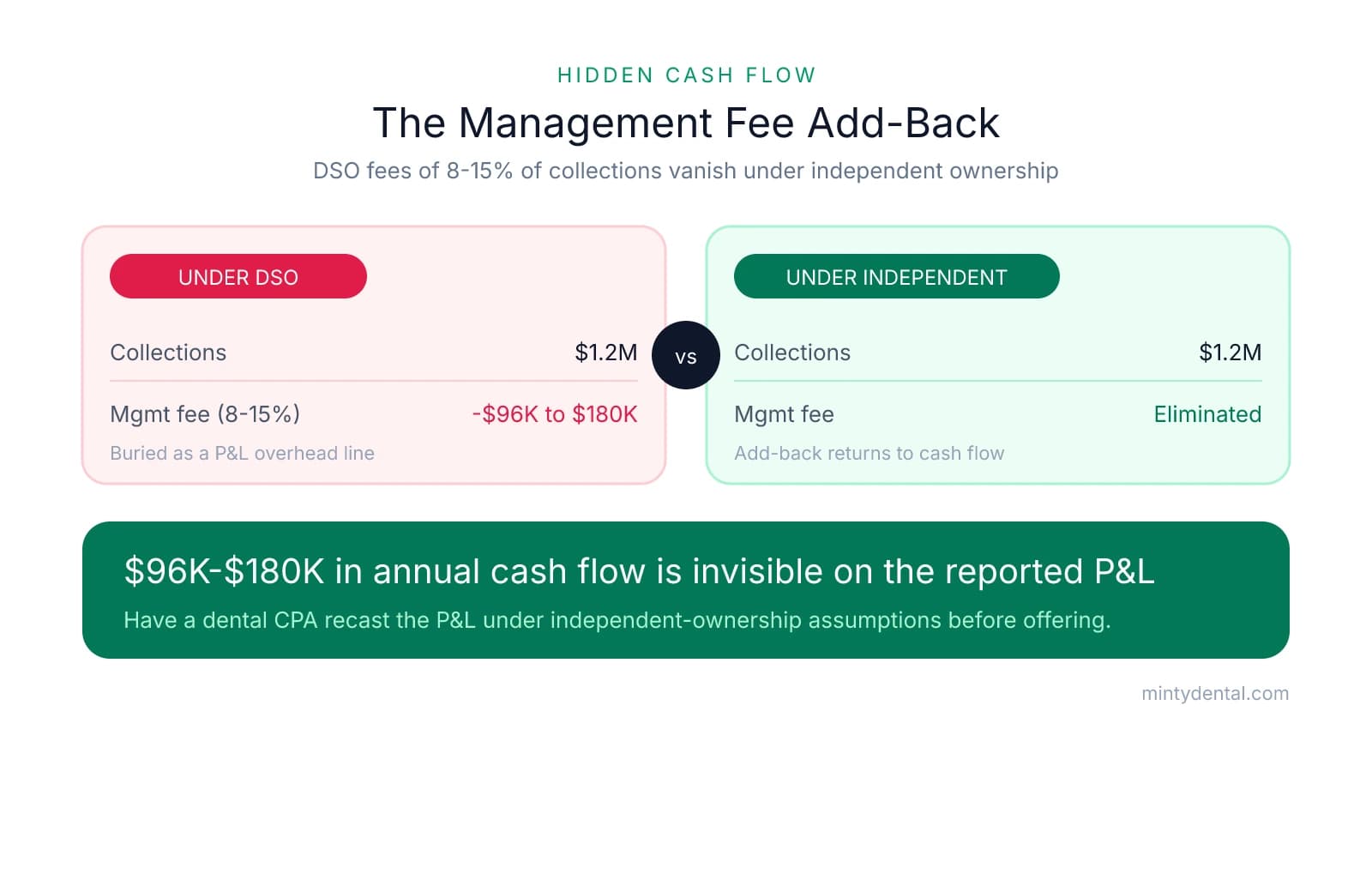
DSO management fees — typically 8–15% of collections — appear as an overhead line item on the P&L. Under independent ownership, that line disappears entirely. If you're evaluating a practice generating $1.2M in collections, that's potentially $96,000–$180,000 in annual cash flow that isn't visible in the reported numbers until you add it back.
This is the most straightforward recast adjustment, but it's easy to miss if you're reading DSO financials the same way you'd read a solo-practice P&L. The management fee add-back should be one of the first line items your dental CPA reconstructs under independent ownership assumptions.
2. Some DSO Cost Advantages Won't Transfer — and Some Costs Will Appear From Nowhere
DSO platforms often negotiate bulk supply pricing, centralized billing, and shared HR infrastructure that individual owners can't replicate. When those arrangements end at closing, supply costs may rise. At the same time, allocated corporate expenses — IT licensing, centralized HR, shared marketing overhead — will disappear from the books, but the underlying needs don't. You'll be paying for those functions independently, often at higher per-unit cost.
| Cost Category | Under DSO Ownership | Under Independent Ownership |
|---|---|---|
| Dental supplies | Lower (bulk purchasing) | Higher (individual vendor pricing) |
| Billing/collections | Centralized, allocated cost | In-house or outsourced — new line item |
| HR/payroll admin | Shared platform cost | Independent vendor or staff time |
| IT/software | Allocated corporate cost | Direct licensing and support costs |
| Management fee | 8–15% of collections | Eliminated entirely |
Model both directions before drawing conclusions about profitability.
3. Production Numbers May Be Masking Patient Attrition
DSOs often run practices to production targets, which can inflate gross collections in the short term while quietly eroding the patient base underneath. Look for active patient counts over the past three years, hygiene reappointment rates, and new patient volume trends. High no-show rates can be another signal — they often reflect a patient relationship that was transactional rather than retained.
One operational cost that frequently catches buyers off guard: the practice management software used by the DSO may not transfer at closing. Colten Butler's experience — a $10,000 software transition he didn't see coming — is more common than most listings disclose. Budget for it, and factor in the operational disruption of a mid-stream system switch when evaluating the practice's technology stack.
The standard recommendation is to request at least three years of financials and have a dental CPA recast the P&L under independent ownership assumptions before making an offer. DSO-structured financials have specific add-back patterns and allocated cost structures that a generalist dental CPA may not recognize on sight. Look for someone who has worked through DSO transactions specifically.
The Goodwill Question: What Actually Transfers When a DSO Sells
Once you've worked through the financial recast, the next question is harder to quantify but arguably more important: what does the patient base actually represent?
Personal goodwill vs. enterprise goodwill: In a solo-doctor sale, goodwill is largely personal — patients chose that practice because of their relationship with the dentist. Enterprise goodwill, by contrast, is loyalty to the location, the brand, and the systems. DSO-owned practices are supposed to carry enterprise goodwill. In practice, many carry neither. High associate turnover, corporate branding, and production-focused care models often produce a patient base that's inertial rather than loyal — they haven't left, but they're not attached. As CBIZ notes, goodwill in a dental practice reflects patient loyalty, brand reputation, and quality of care — all of which can erode quietly under institutional ownership without showing up in collections data.
Assessing Patient Loyalty Directly
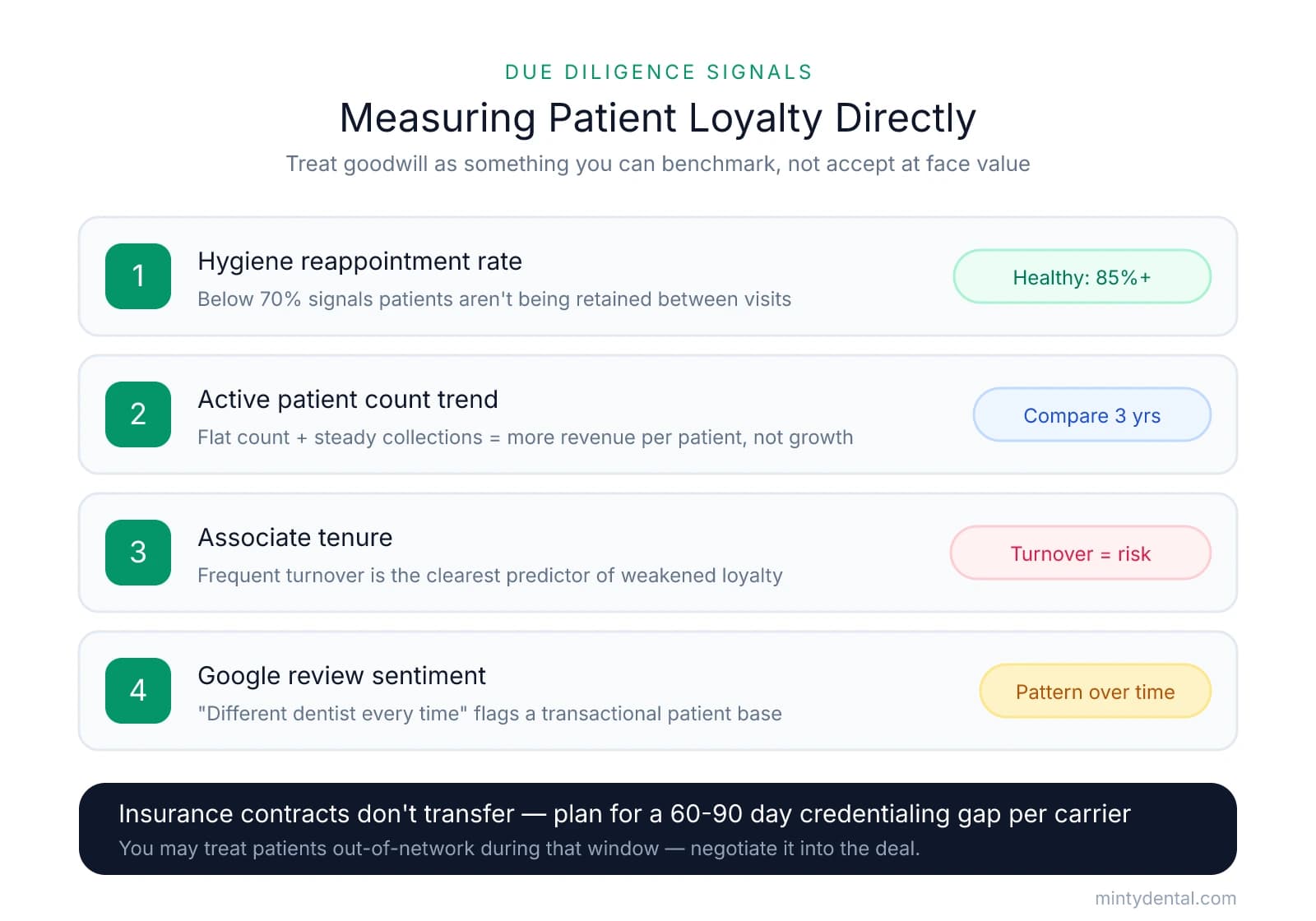
Rather than accepting the goodwill valuation at face value, treat patient loyalty as something you can measure:
- Hygiene reappointment rate — a healthy independent practice typically runs 85%+; rates below 70% suggest patients aren't being retained between visits
- Active patient count trend — compare the last three years; a flat or declining count while collections held steady often means the DSO was extracting more revenue per patient, not growing the base
- Associate tenure — frequent turnover is one of the clearest predictors of weakened patient loyalty
- Google review sentiment — look at the pattern over time, not just the aggregate score; reviews mentioning "different dentist every time" or "feels like a corporate office" are direct signals about the patient experience
A patient retention guarantee negotiated into the purchase agreement is one structural protection worth exploring — though in a DSO transaction, getting the seller to agree to one requires more negotiation than in a solo-doctor deal.
The Insurance Credentialing Gap
One complication that catches many buyers off guard: insurance contracts are credentialed to the individual dentist, not the practice entity. When a DSO sells, those contracts don't transfer — you start from zero with every carrier. As American Practice Consultants notes, the average credentialing timeline runs 60–90 days per carrier, during which you may be treating patients out-of-network. That's a real revenue gap that needs to be planned for, and potentially negotiated into the deal structure through a price adjustment or seller-funded escrow. The insurance credentialing gap is manageable when you see it coming — the risk is assuming the contracts transfer cleanly.
The Staff Transition
DSO-trained staff often know their jobs well — but within a specific operational context. The shift to independent ownership requires deliberate culture-setting from day one. Some staff will welcome the change; others may struggle with the ambiguity of a smaller, less structured environment. Plan for that transition explicitly.
The absence of a seller-dentist transition period compounds all of this. In a solo-doctor sale, a 60–90 day handoff gives patients a chance to meet the new owner before the relationship fully transfers. A DSO has no individual doctor to stay on — you carry the full weight of patient retention from closing day forward. That reality should shape both how you structure the deal and how conservatively you model first-year cash flow.
Making the Deal Work: What to Negotiate and How to Protect Yourself
The evaluation work above — recasting the financials, stress-testing goodwill, mapping the credentialing gap — only creates value if it translates into negotiating leverage.
DSO Sellers Often Price at a Discount — and You Can Push Further
DSO-divested practices frequently trade below comparable solo-doctor sales. There's no personal goodwill premium, no legacy motivation, and no seller who spent 30 years building something they want to protect. A DSO exiting a location has a financial target to hit and a timeline to meet — buyers with clean financing and a clear offer can often move faster than the DSO expects, and that speed has real value to a motivated corporate seller.
Beyond the baseline discount, the gaps you've documented during due diligence become quantified negotiating points. Vague concerns don't move DSO legal teams; documented costs do:
- Credentialing gap — estimate 60–90 days of out-of-network revenue exposure per major carrier and attach a dollar figure
- Software transition cost — if the DSO's practice management system doesn't transfer, get vendor quotes before closing and present them as a line-item reduction
- Patient attrition risk — if the active patient count has been declining or associate tenure is low, model a conservative retention scenario and use it to justify a price adjustment
- Staff uncertainty — if key employees are flight risks, factor in replacement and training costs
- Deferred maintenance or equipment — anything flagged during the physical walkthrough belongs in the negotiation, not the post-closing budget
For a deeper look at structuring these adjustments formally, negotiating price down after due diligence findings follows the same logic — document the gap, quantify the cost, and present it as a deal-structure issue rather than a complaint.
Get Your Own Attorney — Not a Generalist
DSO sellers arrive with experienced corporate legal teams and purchase agreements drafted to their advantage. DSOs want to buy your practice for the lowest valuation possible, which means their agreements are structured accordingly — and a generalist may miss DSO-specific provisions around non-competes, transition obligations, and representations and warranties that a dental transactional attorney would flag immediately. Hiring a dental-specific attorney before you reach the purchase agreement stage — not after you've already received their draft — is one of the more straightforward protections available.
Plan the First 90 Days Before You Close
The operational moves that matter most after closing need to start before closing:
- Submit credentialing applications before day one — most carriers take 60–90 days; starting at closing means two months of out-of-network exposure
- Prepare staff communication in advance — the team should hear from you directly, with clarity about what's changing and what isn't, before rumors fill the gap
- Send patient outreach within the first week — a personal letter from you as the new owner, emphasizing continuity of care, is one of the highest-return investments you'll make in year one
The Upside Is Real
DSO corporate ownership frequently leaves clinical quality, patient experience, and community trust on the table. Production-focused models, high associate turnover, and impersonal branding create a gap that an engaged independent owner can close relatively quickly. Patients who stayed out of inertia can become genuinely loyal — often faster than the baseline numbers would suggest — when the experience meaningfully improves. Buyers who go in clear-eyed about the risks, and structured to address them, are often well-positioned to capture that upside.
Sources & References
The data and claims in this article are drawn from the following sources. We prioritize government data, peer-reviewed research, and established industry publications to ensure accuracy.
- industry projections— dentalclaimsupport.com
- Your Checklist for Calculating Dental Practice EBITDA— tuskpracticesales.comIndustry
- Dental Practice Goodwill: How to Identify, Measure, and Value It— www.cbiz.comIndustry
- Due Diligence 101: What Every Dental Practice Buyer ...— ameriprac.comIndustry
- Article: Top 5 Mistakes Dentists Make When Selling to a DSO— dentaltransitions.com
Ready to acquire your DSO-backed dental practice?
Navigating a DSO transition requires specialized expertise in contract review, patient retention, and operational restructuring. Minty guides you through every step of acquiring a DSO practice, from initial due diligence to seamless ownership transition.