Buy a Dental Practice or a House First?

Co-Founder, Minty Dental

In Summary
- Practice loans and home mortgages run on completely different lending tracks — practice loans are evaluated on the practice's cash flow, not your personal debt-to-income ratio
- The typical dentist entering practice ownership carries roughly $400,000 in student loan debt; after adding a practice loan, total debt at closing often reaches around $1 million
- Dental practice loans carry a default rate of less than 1%, which is why specialized lenders routinely offer 100% financing even to buyers with significant student debt
- Buying the practice first protects your liquidity for the down payment and lets your new owner income dramatically improve your mortgage application
- Dentist-specific mortgage programs change the calculus further — making the practice-first sequence even more advantageous for most buyers
The Sequencing Decision Comes Down to How Each Loan Actually Works
Most dentists approach this question as a debt-tolerance problem: add up the student loans, the practice loan, and a potential mortgage, and ask whether the total feels manageable. That framing leads to the wrong analysis — and often the wrong decision.
The more useful question is about sequencing and liquidity: which order preserves your ability to qualify for both loans, on the best possible terms, without leaving you cash-poor at the moment you need reserves most?
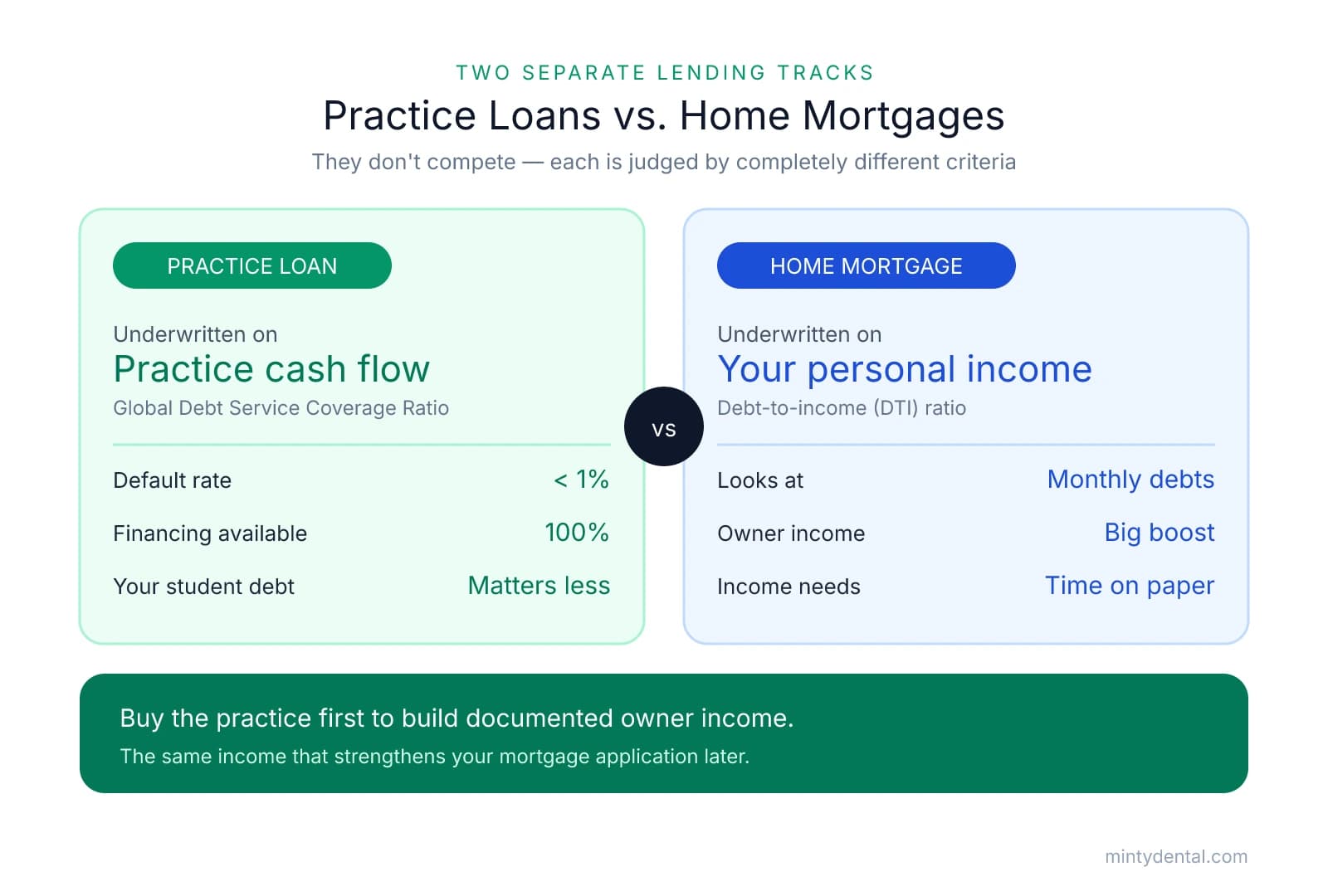
To answer that, you need to understand something most buyers don't fully appreciate until they're in the middle of a transaction: practice loans and home mortgages are evaluated by completely different criteria. They don't compete with each other the way two personal loans would. They run on separate tracks.
Practice loans are underwritten on the practice — not on you. When a dental lender evaluates your acquisition loan, the primary question is whether the practice generates enough cash flow to service its own debt. This is measured through the Global Debt Service Coverage Ratio (GDSCR), which compares the practice's net operating income to its total debt obligations. Your student loan balance matters less than you might expect, because the lender's confidence is anchored in the practice's revenue history — not your personal financial profile. Understanding what banks actually look for when financing a dental practice makes this distinction concrete.
This is also why specialized dental lenders can offer 100% financing to buyers carrying six figures in student debt. Dental practice loans: default rates in this lending category sit below 1%, which gives lenders the confidence to underwrite based on practice cash flow rather than requiring the borrower to look pristine on paper.
The debt stack that results can look alarming from the outside. According to Panacea Financial via ADA News, the typical dentist carries roughly $400,000 in student loan debt at the time of practice purchase — and after adding the acquisition loan, total debt at closing commonly reaches around $1 million. But that number is evaluated through the practice's cash flow lens, not through a mortgage lender's DTI calculator.
Home mortgages work the opposite way. A residential lender looks at your personal income, your monthly debt obligations, and the ratio between them. Practice ownership income — once it's documented — can make you a dramatically stronger mortgage applicant. But that income needs time to appear on paper.
That asymmetry is what makes sequencing matter. Buying the practice first lets you build documented owner income before you apply for a mortgage. It also preserves the liquidity that practice lenders expect to see at closing — cash reserves that a home down payment would otherwise consume. Both dynamics favor the same order.
The rest of this article works through each mechanic in detail, so you can test the logic against your own numbers.
Why Buying a House First Can Quietly Undermine Your Practice Loan
For most buyers, the risk of buying a home first isn't obvious until a practice lender walks them through the numbers. The issue isn't that homeownership disqualifies you — it's that it quietly erodes two things practice lenders care about most: liquid reserves and clean cash flow math.
The liquidity problem most buyers don't see coming
Practice lenders typically require roughly 10% of the loan amount in liquid reserves at closing. On an $800,000 acquisition, that's $80,000 — held in cash, stocks, bonds, or accessible accounts. As Panacea Financial notes in their liquidity guide for practice buyers, home equity explicitly does not count toward this figure. Neither do retirement accounts.
That distinction matters more than most buyers realize. When you put $80,000 into a home down payment, you haven't preserved wealth — you've converted liquid assets into an illiquid one that practice lenders can't use in their calculation. The money still exists, but it's no longer working for you in the context of a practice loan.
This isn't just a qualification hurdle. The liquidity requirement exists because year one of practice ownership is operationally unpredictable. Credentialing gaps can delay insurance reimbursements for weeks. Staff turnover often surfaces early. Deferred equipment repairs have a way of appearing right after closing. The unexpected costs new practice owners face in months two through twelve are real, and cash reserves are what absorb them without forcing you into a difficult position.
The mortgage payment adds a fixed obligation before the practice stabilizes
A mortgage payment shows up in the global debt service coverage ratio calculation — the same metric lenders use to evaluate whether the practice can carry its own debt. Adding a fixed monthly housing obligation before the practice is generating consistent income tightens that math. It doesn't necessarily block approval, but it reduces the buffer lenders want to see between income and obligations.
The case for renting during the acquisition period
The "but I need somewhere to live" objection is completely reasonable — and renting is the answer most financially optimal buyers land on. Renting for 12–18 months during the acquisition and early ownership period costs something, but that cost is modest compared to the risk of arriving at a practice closing under-reserved, or having a mortgage payment compress your cash flow before the practice has found its footing.
A useful way to think about it: the liquid reserves you need to buy a dental practice are the same assets a home down payment consumes. Protecting those reserves — even temporarily — is often the move that makes both transactions possible.
How Practice Ownership Actually Improves Your Mortgage Options
That protective framing is only half the picture. Buying the practice first doesn't just guard your mortgage options — it actively upgrades them.
Two mechanisms drive this.
The income jump is substantial — and it directly expands what you can borrow
Associate income typically runs $150,000–$180,000 per year. Practice ownership changes that math significantly. An owner generating $1 million in collections at 60% overhead nets roughly $440,000 — before accounting for additional tax advantages available to business owners. That's not a marginal improvement; it's a different income category entirely.
Mortgage qualification is largely a function of documented income. A higher, stable income means a larger loan you can qualify for, a more favorable debt-to-income ratio, and more negotiating leverage with lenders. The home you can realistically buy as a practice owner is often meaningfully better than what you could have accessed as an associate — even accounting for the practice loan on your balance sheet.
If you want to baseline where you're starting from, the W2 vs. 1099 calculator can help you see how your current compensation structure affects net income before ownership.
Dentist mortgage programs change the terms of the home purchase itself
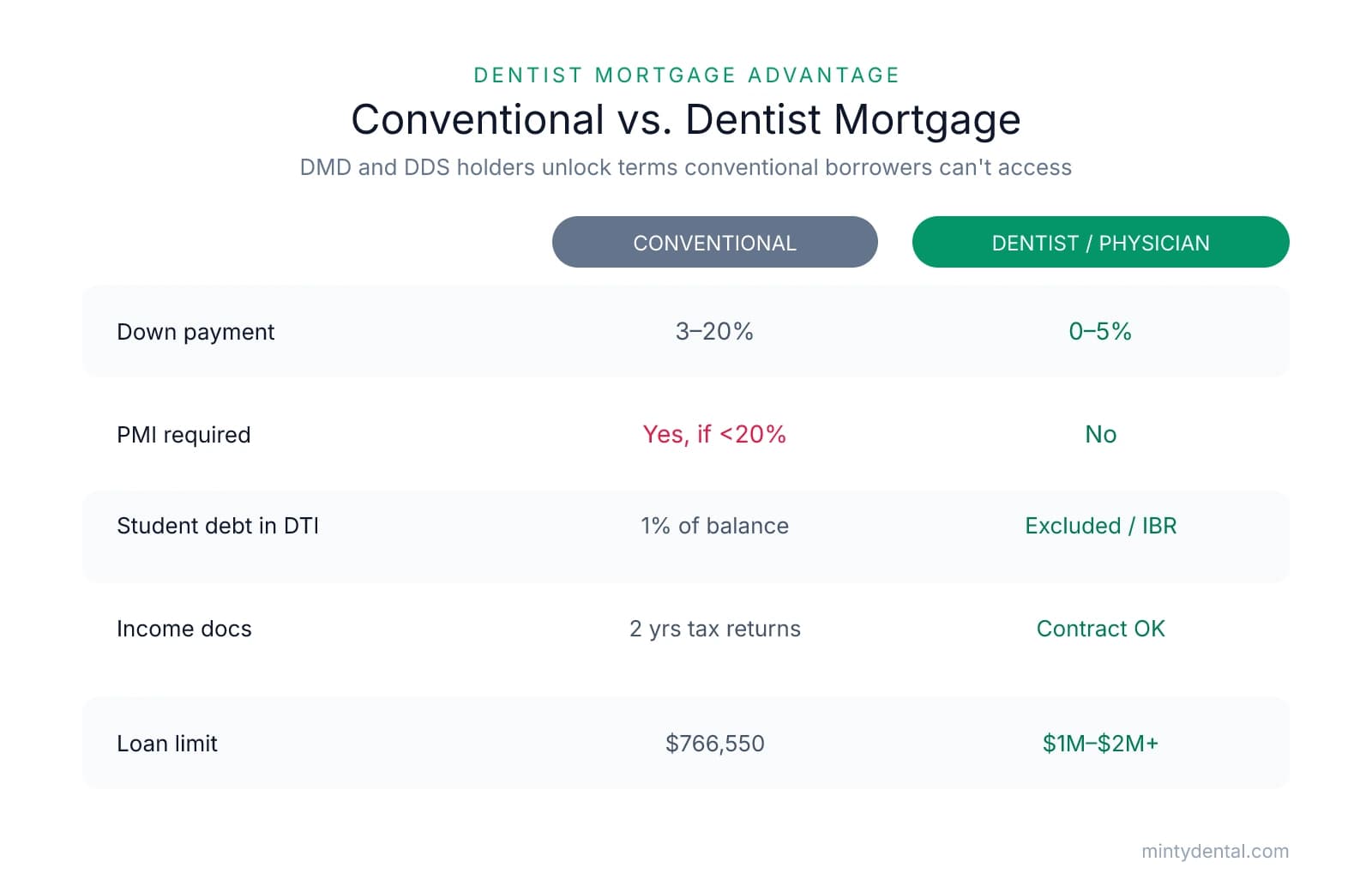
DMD and DDS holders qualify for dentist and physician mortgage programs that conventional borrowers can't access. The differences are significant:
| Feature | Conventional Mortgage | Dentist/Physician Mortgage |
|---|---|---|
| Down payment | 3–20% | 0–5% |
| PMI required | Yes, if <20% down | No |
| Student debt in DTI | 1% of balance or actual payment | Excluded or IBR payment used |
| Income documentation | 2 years of tax returns | Employment contract or shorter history often accepted |
| Loan limits | $766,550 (conforming) | $1M–$2M+ |
Per the SalaryDr physician mortgage guide, these programs offer 0% down with no PMI on loans up to $2 million — and critically, student loan debt is excluded or reduced in DTI calculations. For a dentist carrying $400,000 in student loans, that exclusion alone can be the difference between qualifying and not.
As Treloar & Heisel notes, many dentists assume their practice loan makes homeownership impossible — when in reality, lenders evaluating dentist mortgage applications focus on income trajectory and cash flow, not total debt balance.
One timing consideration worth planning around
Conventional mortgage lenders typically require two years of self-employment tax returns before they'll count your practice income. Dentist mortgage programs often have more flexibility — accepting a shorter income history or even an employment contract in some cases. This matters for sequencing: if you apply for a home mortgage in year one of ownership, a dentist-specific lender is likely your better path. By year two or three, your documented income opens up conventional options as well.
The practical takeaway is that "practice first, house later" isn't a sacrifice. For most buyers, it's the sequence that produces better loan terms, a larger qualifying income, and a home purchase made from a position of financial strength rather than constraint.
When Buying the House First Actually Makes Sense
The case for practice-first sequencing is strong for most buyers — but "most" isn't "all." There are real scenarios where buying the home first is the financially sound call, and recognizing them is what turns this from a general recommendation into a decision you can apply to your own situation.
Scenario 1: Your liquid reserves comfortably survive a down payment
The core risk of buying a home first is converting liquid assets into home equity that practice lenders can't count. But if your reserves are large enough that a down payment still leaves you well above the 10% liquidity threshold, that risk largely disappears. The question isn't whether the home purchase happens first — it's whether it depletes the buffer. If you're sitting on $300,000 in liquid assets and a down payment leaves $200,000 intact, the sequencing concern mostly resolves itself.
Scenario 2: Your partner's W2 income anchors the mortgage independently
A spouse or partner with stable employment income is one of the more underappreciated variables in this decision. If their W2 income qualifies the household for the mortgage on its own, the self-employment documentation challenge becomes irrelevant — the mortgage lender doesn't need to evaluate your practice income at all, which removes the primary reason to wait.
Scenario 3: You're in a time-sensitive housing market
In high-cost metros where inventory is constrained, waiting 2–3 years to buy can mean being priced out of the neighborhood your practice location actually requires. If the opportunity cost of renting — financially and practically — outweighs the sequencing benefits, that's a legitimate reason to move on housing first. This is a judgment call that depends on local market dynamics, not a universal exception.
Scenario 4: Practice ownership is still several years away
If you're still building clinical experience, haven't identified a target market, or are working toward the savings and credit profile that practice lenders want to see, renting indefinitely has real personal and financial costs. Renting for 12–18 months during an active acquisition process is reasonable. Renting for four or five years while ownership remains hypothetical is a different calculation — and for many dentists, buying the house first makes sense when practice ownership is still 3+ years out.
Use these four questions as a decision tool — not a verdict:
- After a home down payment, do I still have 10% or more of my expected practice loan amount in liquid reserves?
- Does my partner's income qualify us for the mortgage without relying on my practice income?
- Am I realistically ready to buy a practice within 18 months, or is ownership still 3+ years away?
- Does my target practice location require me to live in a specific area where housing is genuinely time-sensitive?
If you answered yes to questions 1 or 2, the sequencing risk is low and buying the home first is defensible. If you answered no to questions 3 or 4, the case for waiting weakens considerably.
The goal isn't to optimize either purchase in isolation — it's to sequence two major acquisitions so each one strengthens the next. Practice income expands your mortgage options. Protected liquidity keeps your practice loan on track. And if you're still modeling what ownership would actually do to your take-home pay, the W2 vs. 1099 calculator is a useful place to run those numbers before committing to either sequence.
Sources & References
The data and claims in this article are drawn from the following sources. We prioritize government data, peer-reviewed research, and established industry publications to ensure accuracy.
- Ask the Expert: How much debt is too much when buying a dental ...— adanews.ada.orgIndustry
- What Is Liquidity & Why Is It Important For Practice Ownership?— members.perio.orgIndustry
- Physician Mortgage Loans: 2026 Complete Guide | SalaryDr Blog— www.salarydr.comIndustry
- Can Dentists Get a Mortgage If They Have a Big Practice Loan?— treloaronline.comIndustry
- Should you buy a house or a dental practice first? ㅤ For ... - Instagram— www.instagram.com
Ready to buy your first dental practice?
Whether you're prioritizing a practice or a home, understanding the financial path matters. Minty's acquisition experts guide you through practice ownership step-by-step, helping you navigate loans, timelines, and long-term wealth building.