Buying a Dental Practice When You'll Need to Fire the Associate

Co-Founder, Minty Dental

In Summary
- An associate's production is a financial variable embedded in the deal price — if they generate 25–30%+ of collections, the practice you're buying is materially smaller than the one being priced.
- Review the associate's contract before signing an LOI: at-will vs. fixed-term status, notice periods, change-of-control clauses, non-compete transferability, and tail coverage obligations all affect your exposure.
- Rerun the valuation on revenue you can realistically retain; the gap between asking price and adjusted value often justifies a $200K–$400K price reduction.
- If a seller resists a price cut, deal structure — escrow holdbacks or earnouts — can accomplish much of the same protection.
- How you execute the termination after closing determines whether careful pre-closing preparation holds: timing, communication, and a covered schedule matter as much as the contract terms.
The Associate Is a Financial Variable, Not Just a Personnel Problem
Associate-dependent revenue risk: When a dental practice employs an associate who a buyer intends to terminate, the associate's production isn't just a staffing issue — it's an unpriced financial variable embedded in the deal. Until that revenue is isolated, quantified, and stress-tested against the valuation, the buyer doesn't yet know what they're actually purchasing.
This situation comes up more often than most buyers expect. Sometimes the fit is clearly wrong from the first conversation. Sometimes the buyer plans to work the chair themselves and doesn't need a second provider. Whatever the reason, it's completely reasonable to want to move forward without the current associate — but the financial implications deserve a clear-eyed look before the deal structure is set.
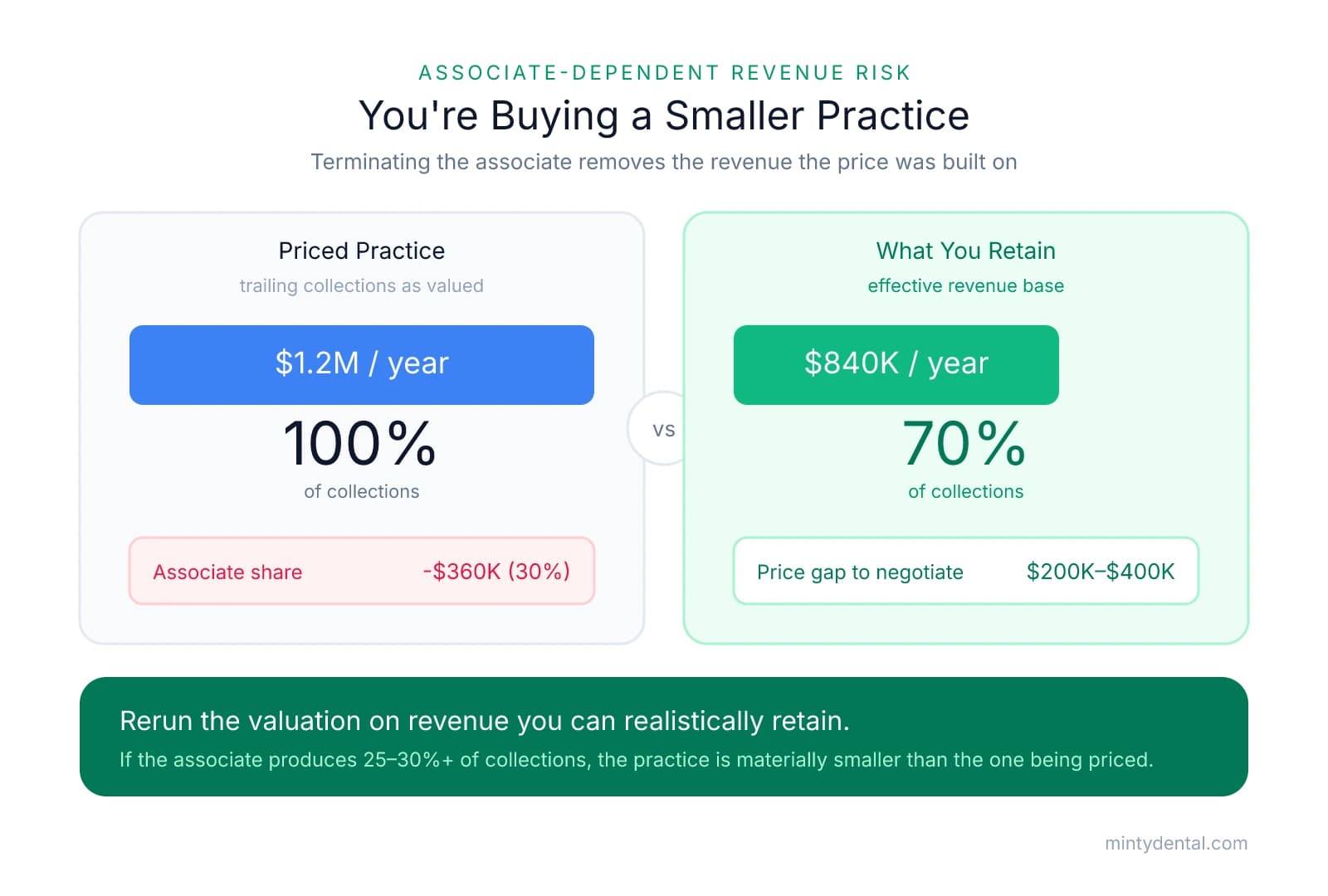
The most important number to pull early is the associate's share of total collections. If that figure sits above 25–30%, the revenue they generate is material enough to affect the practice's cash flow, debt service coverage, and ultimately its valuation. A pattern worth paying attention to: most practice valuations are built on trailing collections that include the associate's full production. A buyer who plans to eliminate that production is, in practical terms, buying a smaller practice than the one being priced.
This mirrors a risk category that experienced buyers already watch closely — owner-dependent revenue. The same logic applies here. Just as a practice where the seller produces 90% of collections carries transition risk, a practice where the associate produces 30–40% carries termination risk. Both deserve a haircut in the underwriting.
The cost side adds another layer. In general dentistry, collections-based associate compensation typically runs 30–35% of what the associate produces, per Focus Financial benchmarks. Removing the associate does eliminate that expense — but it also eliminates the revenue, and those two numbers rarely cancel each other out cleanly, especially when fixed costs remain constant.
This is why the associate's situation belongs in due diligence, not the post-closing to-do list. Before an LOI is signed or a price is finalized, three things are worth knowing: what the associate's contract says (particularly around termination notice and any change-of-ownership provisions), how long they've been with the practice and what patient relationships they hold, and exactly what percentage of collections flows through their chair. The answers don't necessarily kill the deal — but they should shape the price, the structure, and the timeline.
What to Look for in the Associate's Contract Before You Close
Once you've quantified the associate's revenue contribution, the next step is understanding what the contract actually allows you to do — and what it will cost you to act. This is where many buyers hand things off to their attorney and move on, but it's worth knowing what you're asking them to look for.
Here's a practical checklist of the provisions that matter most.
1. At-will vs. fixed-term employment
This is the single most important variable in how cleanly a termination can be executed. Most associate agreements in the US are at-will, meaning either party can end the relationship with proper notice. Fixed-term contracts — say, a two-year agreement with defined renewal terms — are less common but do exist, and they create meaningful exposure if the term hasn't expired by closing. As the ADA's employment agreement guide notes, termination provisions control notice obligations, final pay, and post-employment restrictions — all of which become your problem the moment you take ownership.
| Factor | At-Will Contract | Fixed-Term Contract |
|---|---|---|
| Termination flexibility | High — notice period only | Low — may owe remaining term |
| Notice requirement | Typically 30–90 days | Per contract; often 60–90 days minimum |
| Buyer's exposure | Limited | Potentially significant |
| Most common structure | Yes | Less common |
2. Notice period requirements
Even at-will contracts typically require 30–90 days' written notice before termination. A 90-day notice clause means you may owe the associate continued pay and scheduling for three months post-closing — even if you've already decided they won't be staying. That's a real cost to build into your deal budget.
3. Change-of-control and assignment clauses
Some associate agreements explicitly address what happens when the practice is sold. Others are silent. In an asset purchase — the most common structure for individual buyers — you generally do not automatically assume the associate's employment agreement. But silence in the purchase agreement can create implied obligations. Your attorney should address this explicitly in the asset purchase agreement, not leave it to interpretation after closing.
4. Non-compete and non-solicitation provisions
A pattern worth paying attention to: non-competes in associate agreements are typically written to protect the seller, not a future buyer. If you terminate the associate post-closing, that non-compete may not prevent them from opening a competing practice nearby or contacting patients directly. Before closing, confirm whether the non-compete language transfers to you as the new owner — and if it doesn't, factor that patient attrition risk into your valuation. A well-structured malpractice history review often surfaces related documentation worth cross-referencing here.
5. Malpractice tail coverage obligations
When an associate is terminated, someone has to pay for tail coverage on any claims arising from their prior work at the practice. This obligation is often overlooked in deal budgeting, but tail coverage costs can run $5,000–$20,000 or more depending on the associate's specialty, tenure, and insurer. Check whether the contract assigns this cost to the employer or the associate — if it lands on the employer, that's you.
The goal of this review isn't to find a reason to walk away. It's to arrive at closing with a clear picture of your obligations, your timeline, and your exposure — so none of it becomes a surprise three months later.
How to Price the Risk Into Your Offer
With the associate's contract reviewed and their revenue contribution quantified, the question shifts from what's the risk to how do I price it. Most buyers feel stuck between overpaying and walking away — but there's a middle path that experienced acquirers use regularly: adjust the structure, not just the headline number.
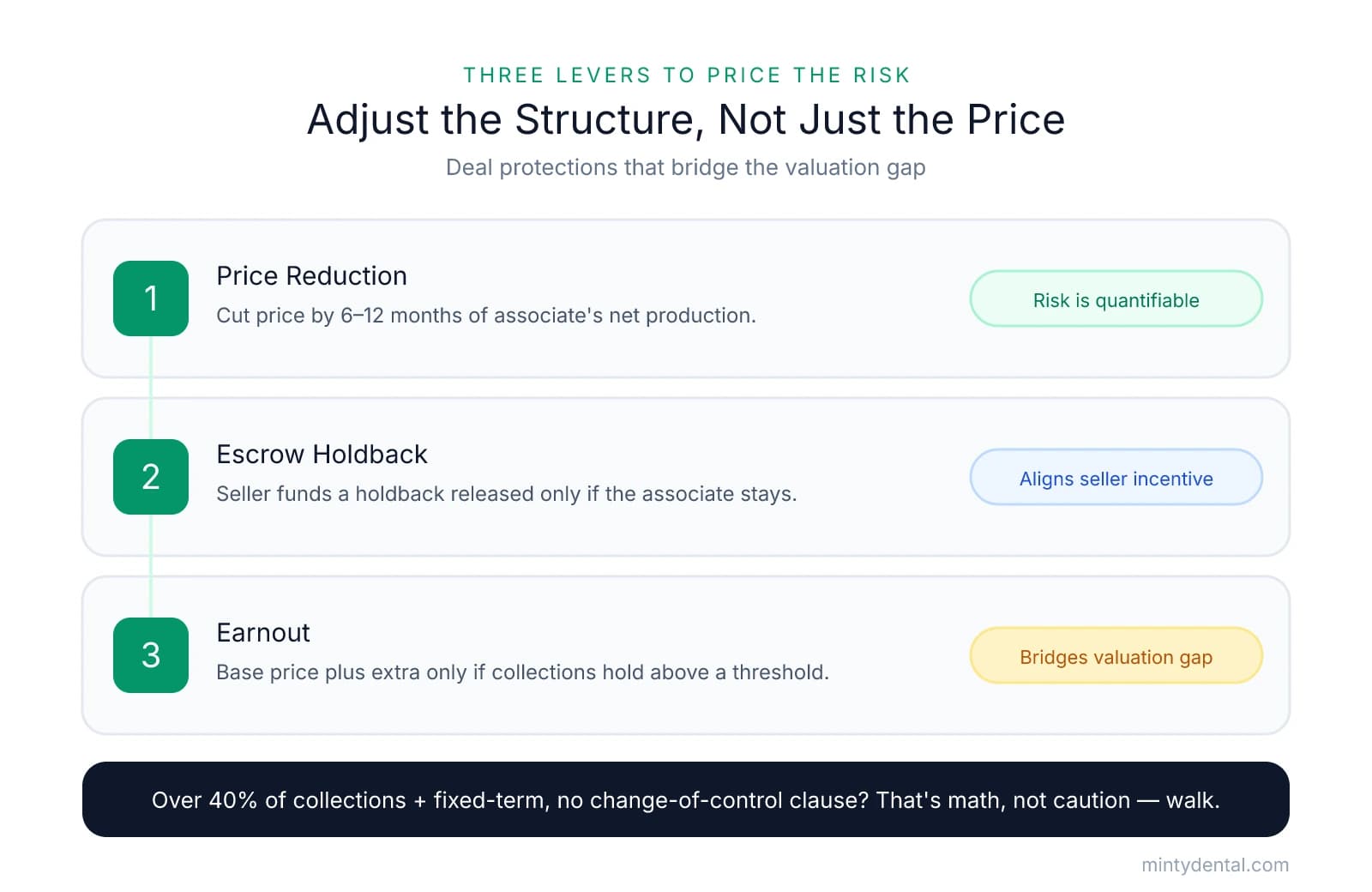
You have three practical levers here.
Lever 1: Rerun the Valuation on Retained Revenue
The asking price was almost certainly calculated on trailing collections that include the associate's full production. If the associate generates 30% of collections and you're planning to terminate them, you're not buying that practice — you're buying a meaningfully smaller one.
One step worth taking before you counter: rerun the valuation using only the revenue you can realistically retain or replace. If the practice collects $1.2M annually and the associate accounts for $360K of that, your effective revenue base is closer to $840K. Applied to a standard collections-based multiple, that gap can represent $200K–$400K in purchase price — a defensible basis for a price reduction, not a negotiating tactic.
As Auxo Capital Advisors notes in their valuation framework, provider concentration is one of the factors that compresses multiples in actual transaction underwriting. An associate producing 30–40% of collections is exactly the kind of concentration risk that justifies a lower multiple, not just a lower base.
Lever 2: Negotiate Deal Protections
If the seller resists a price reduction, deal structure can accomplish much of the same thing.
| Protection | How It Works | Best Used When |
|---|---|---|
| Price reduction | Reduce purchase price by 6–12 months of associate's net production (collections minus compensation) | Buyer plans to absorb or replace the schedule; risk is quantifiable |
| Escrow holdback | Seller funds a holdback released only if the associate stays through a defined transition period | Seller believes associate will stay; aligns seller incentive with smooth handoff |
| Earnout | Buyer pays base price plus additional consideration only if post-closing collections hold above a threshold | Seller and buyer disagree on revenue retention; bridges the valuation gap |
A seller-funded escrow is often the most straightforward ask. It doesn't require the seller to accept a lower price upfront — it simply ties a portion of their proceeds to the outcome they're confident will happen anyway.
Earnouts are more common in DSO transactions but can be adapted for private deals. As the Oral Health Group explains, an earnout lets buyers and sellers disagree on valuation while still closing — the buyer pays a base price, and additional consideration flows only if collections meet a defined threshold post-closing. When a seller is confident the practice will retain revenue after the associate departs, an earnout puts that confidence on paper.
Lever 3: Know When to Walk
If the associate produces more than 40% of collections and holds a fixed-term contract with no change-of-control clause, the risk profile may be too concentrated to price around. A 40% revenue haircut, combined with termination exposure and potential patient attrition, can make debt service coverage difficult to model at any reasonable price adjustment — and that's not caution, it's math.
Walking away from a deal that doesn't pencil is a legitimate outcome. The goal of this framework is to make sure that decision is made with clear numbers, not discovered after closing.
Executing the Termination: Timing, Tone, and Patient Continuity
Getting the financial structure right before closing matters enormously — but how you execute the termination after closing determines whether that careful preparation actually holds. This is where many buyers undo good pre-closing work through poor timing or rushed communication.
Timing: Why 30–60 Days Is Usually Worth the Cost
Even when the decision to terminate is clear, moving too fast tends to create the exact chaos you're trying to avoid. A 30–60 day transition period — even with an associate you've already decided won't stay — gives you time for patient handoffs, schedule continuity, and a separation that doesn't alarm the team or trigger patient calls asking what's going on.
The cost of that transition period is real but bounded: associate compensation for another month or two. What you're buying is an orderly schedule wind-down, completed treatment plans, and a staff that sees the new owner handling a difficult situation professionally — worth more than the payroll cost in most cases.
Moving too slowly carries its own risk. Keeping a disruptive associate around for months while the team watches creates staff uncertainty, divided loyalties, and the kind of low-grade dysfunction that's hard to unwind. The goal is a clean, defined endpoint, not an indefinite limbo.
Communication: What You Say Matters as Much as When You Act
The ADA's case study on staff departures after practice sales illustrates how quickly a poorly managed transition cascades — staff anxiety becomes patient attrition, and patient attrition becomes a practice that's harder to stabilize than the original associate risk ever was. The departure itself rarely causes the damage. The framing does.
A clear, confident message from the new owner — delivered to staff before patients hear anything — signals stability. Vague or abrupt announcements tend to fill the information vacuum with speculation. Staff should hear directly from you that the transition is planned, the schedule is covered, and the practice is moving forward.
Non-Solicitation: Know What You Have Before You Need It
Before the termination conversation happens, review the associate's non-solicitation clause carefully. As dental contract attorneys note, non-compete and non-solicitation provisions interact with termination circumstances in ways that aren't always obvious — and whether those protections transfer to you as the new owner depends on how the purchase agreement was structured. If the associate attempts to redirect patients after departure, you need to know whether you have enforceable coverage before that situation arises, not after.
Production Absorption: Plan Before You Terminate
Walking into the termination without a plan for the associate's schedule creates immediate revenue pressure. The options — extending your own hours, beginning a replacement hire, or temporarily reducing the schedule to a sustainable level — each have tradeoffs, but any of them is better than discovering the gap on day one. Evaluating how the broader staff will absorb schedule changes before closing gives you a clearer picture of what's realistic.
Staff Dynamics: Your First Real Signal as an Owner
The rest of the team will form their first genuine impression of you based on how this termination unfolds. A fair, professional separation signals that the new owner is decisive and trustworthy. A chaotic or vindictive one — regardless of how justified — creates the staff turnover risk that follows.
The practices that come through an associate departure cleanly share one thing: the buyer treated it as a planning problem before closing, not a personnel problem after. The termination itself is almost never the hard part. The hard part is arriving at it with a clear timeline, a covered schedule, and a team that trusts the person now running the practice.
Sources & References
The data and claims in this article are drawn from the following sources. We prioritize government data, peer-reviewed research, and established industry publications to ensure accuracy.
- The Economics of Bringing on an Associate Dentist | Focus— focuspartners.com
- Dentist Employment Agreements: A Guide to Key Legal ...— ada.orgIndustry
- Dental Practice Valuation Multiples: 2026 Guide | Auxo— auxocapitaladvisors.comIndustry
- Earnouts in dental practice acquisitions: What you need to know— www.oralhealthgroup.comIndustry
- Dentist Employment Agreements: A Guide to Key Legal ...— ada.orgIndustry
- Dental Associate Contract Termination | Robert Chelle— reviewdentalcontracts.comIndustry
Ready to acquire with confidence?
Navigating associate transitions and staffing challenges is a critical part of practice acquisition due diligence. Minty's buying experts guide you through every step of evaluating team dynamics and managing personnel changes from search to closing.