Buying a Dental Practice on an H-1B Visa: What to Know

Co-Founder, Minty Dental
In Summary
- The H-1B Modernization Final Rule, effective January 17, 2025, explicitly permits H-1B holders to own 100% of a U.S. business entity and sponsor their own visa through that entity — for the first time in the program's history
- The old standard (the 2010 Neufeld Memo) made self-owned H-1B businesses nearly impossible; the new rule replaces it with a "bona fide job offer for a specialty occupation" test that dentistry satisfies cleanly
- A DDS or DMD is a directly related degree for specialty occupation purposes — clinical dental practice is one of the clearest qualifying roles under USCIS standards
- The September 2025 Presidential Proclamation adding a $100,000 fee applies only to new petitions for workers currently outside the U.S. — existing H-1B holders already in the country are not affected when extending or amending status
- Buying a practice on H-1B is achievable, but requires coordinating three things simultaneously: immigration counsel, a dental attorney, and a lender who understands visa-holder acquisitions
H-1B Practice Ownership Is Now Structurally Possible — With the Right Setup
The core legal change: As of January 17, 2025, an H-1B visa holder can own 100% of a U.S. dental practice entity and hold H-1B status sponsored through that same entity. This is explicitly permitted under the H-1B Modernization Final Rule — not a workaround or gray area — and for many H-1B dentists, it changes the ownership timeline entirely.
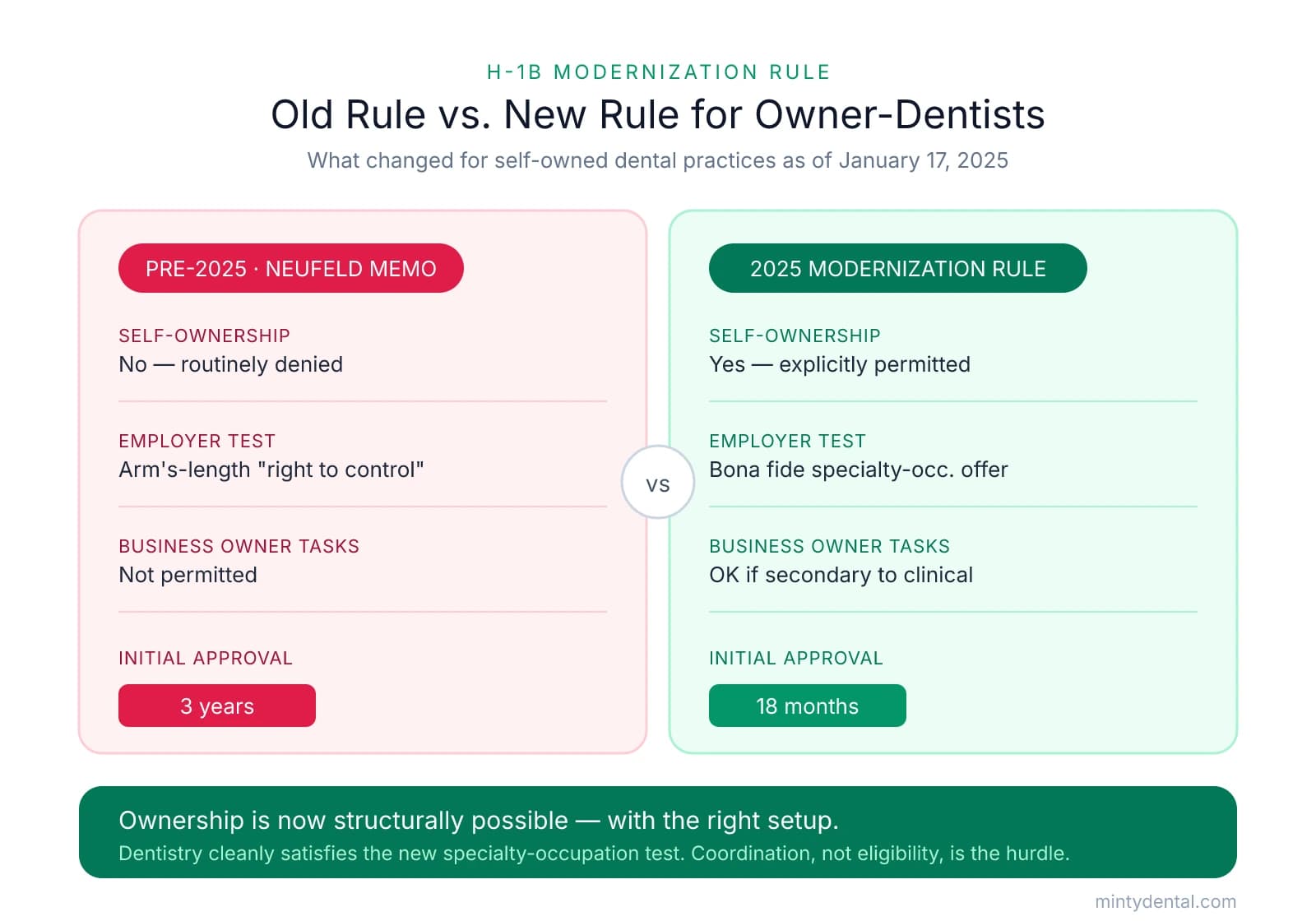
The assumption that practice ownership must wait until a green card arrives was largely accurate under the old framework. The 2010 Neufeld Memo required demonstrating an arm's-length employer-employee relationship with meaningful outside oversight of the H-1B worker — a standard that was nearly impossible to satisfy for a dentist who owned the practice outright. Self-sponsored petitions through owner-controlled entities were routinely denied.
The 2025 rule replaces that with a simpler test: a bona fide job offer for a specialty occupation. Dentistry clears this bar without much effort. A DDS or DMD is a directly related degree, clinical practice requires highly specialized knowledge, and USCIS has long recognized dentistry as a qualifying specialty occupation.
One nuance worth understanding: the September 2025 Presidential Proclamation introduced a $100,000 fee for new H-1B petitions, but this applies specifically to workers currently outside the United States seeking new status. If you're already in the U.S. on a valid H-1B and pursuing an amendment or extension through your new practice entity, that fee structure does not apply. It's also worth noting that H-1B carries dual-intent status — you can pursue a green card concurrently without jeopardizing your visa.
What the new rule doesn't change is the coordination required. Buying a practice on H-1B means solving three interlocking problems simultaneously: structuring the entity correctly for immigration compliance, satisfying state dental board requirements on ownership, and convincing a lender to finance the acquisition. A pattern worth paying attention to across these deals is that the buyers who succeed aren't necessarily the ones with the strongest financials — they're the ones who assembled the right advisory team early and kept all three workstreams moving in parallel.
How to Structure the Practice Entity to Satisfy USCIS
Owning 100% of the practice entity is now permitted — but ownership alone doesn't satisfy USCIS. The rule still requires evidence of a genuine employer-employee relationship, meaning the entity must have some documented mechanism to control the dentist's employment: the authority to set terms, supervise performance, and theoretically terminate the position. For a sole owner, that creates an obvious structural problem — and solving it is where most of the legal work happens.
The Board of Directors Solution
The most widely used approach is establishing a Board of Directors (or advisory board) with documented authority over the dentist's employment terms — even when the dentist is the sole shareholder. The board doesn't need to be large or independent in a corporate governance sense, but it does need to exist on paper with real authority reflected in the operating agreement and employment agreement.
A February 2025 approval from SKN Law Firm illustrates how this works in practice. The immigration attorney worked alongside the client's business attorney to establish a Board of Directors and develop a framework that clearly demonstrated employer-employee separation. Formation documents, employment agreements, and board resolutions were all drafted in coordination before closing. The petition was approved through Premium Processing within weeks.
That coordination piece matters more than most buyers expect. Deciding to form the LLC before making an offer gives your attorneys time to build the governance structure correctly from the start, rather than retrofitting it under deadline pressure.
The Time-Split Requirement
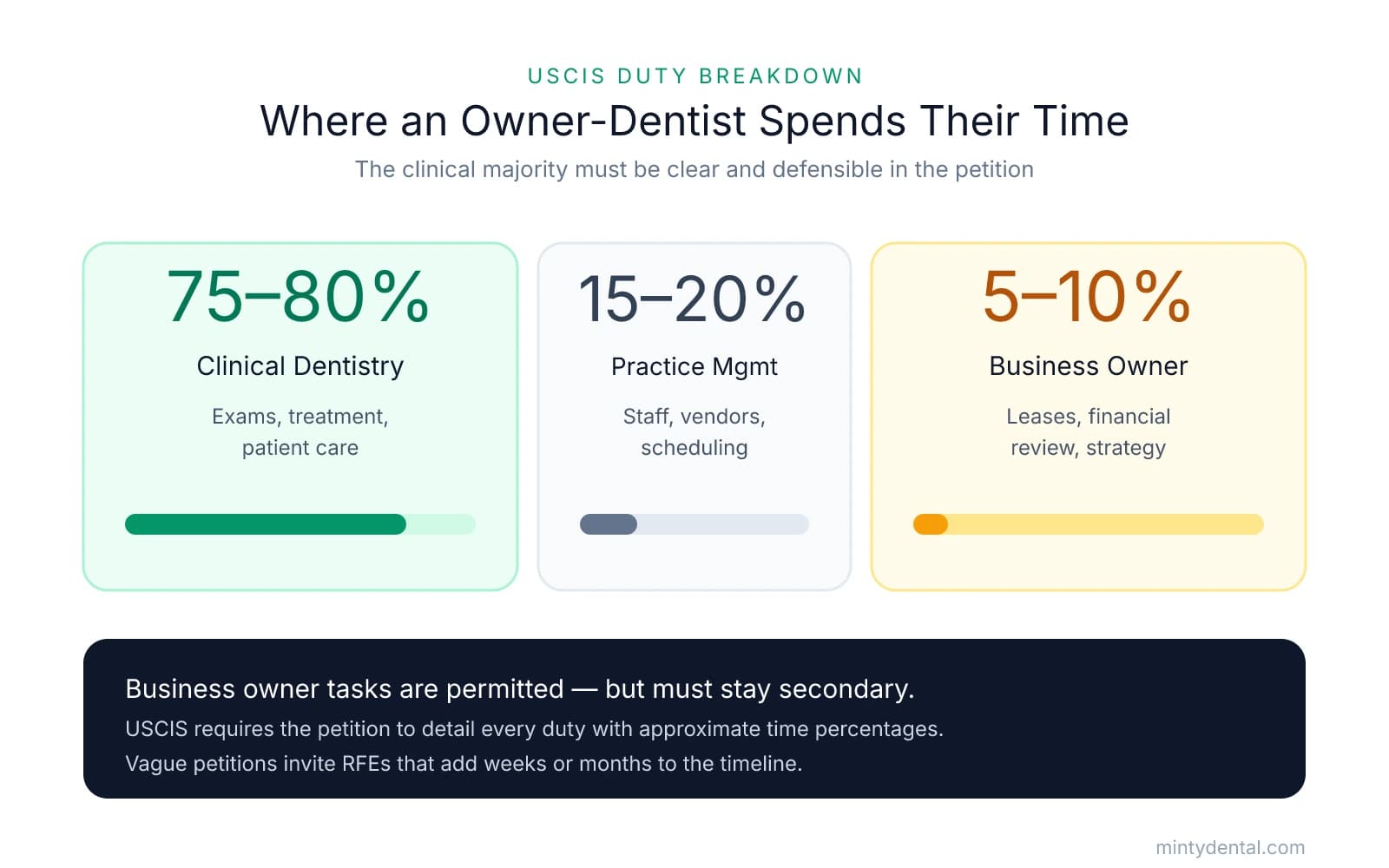
The 2025 rule explicitly permits business owner tasks — signing leases, negotiating contracts, managing staff — but these must remain secondary. USCIS requires the petition to detail every duty the dentist will perform with approximate time percentages. Vague petitions invite Requests for Evidence (RFEs), which add weeks or months to the timeline.
A reasonable starting framework for most general practice acquisitions:
- Clinical dentistry (examinations, treatment, patient care): 75–80%
- Practice management (staff oversight, vendor relationships, scheduling): 15–20%
- Business ownership tasks (lease signing, financial review, strategic decisions): 5–10%
The exact split will vary, but the clinical majority must be clear and defensible.
The 18-Month Approval Window
For self-owned entities, the initial H-1B approval is limited to 18 months — not the standard 3 years granted to employer-sponsored petitions. The first extension is also capped at 18 months. Subsequent extensions can run up to 3 years, within the standard 6-year total cap.
| Pre-2025 (Neufeld Memo) | 2025 Modernization Rule | |
|---|---|---|
| Self-ownership allowed | No — routinely denied | Yes — explicitly permitted |
| Employer-employee test | "Right to control" (arm's-length oversight required) | Bona fide job offer for specialty occupation |
| Board of Directors requirement | Effectively mandatory and difficult to satisfy | Required, but workable with proper structuring |
| Initial approval period | 3 years (employer-sponsored) | 18 months (self-owned entity) |
| Business owner tasks | Not permitted | Permitted if secondary to specialty occupation duties |
The 18-month window has direct implications for lenders — a topic the next section addresses in detail. What matters at the entity formation stage is that the governance structure, employment agreement, and duty breakdown are finalized before closing. Amending the petition afterward is possible, but it adds cost, delay, and USCIS scrutiny at a moment when you'd rather be focused on running the practice.
What Lenders Need to See From an H-1B Buyer
That 18-month initial approval window is exactly where lender conversations get complicated. Dental practice loans typically run 7–10 years — and a lender looking at an H-1B with 18 months of remaining authorized stay is being asked to underwrite a decade of repayment against work authorization that expires in under two years. Understanding how lenders think about that gap is the first step toward closing it.
The good news: dental practice lending is one of the most lender-friendly sectors in commercial finance. According to the ADA, dental practices carry a default rate of less than 1%, which makes specialty dental lenders genuinely motivated to find a path forward — including for H-1B buyers. The challenge isn't convincing lenders that dental practices are safe investments. It's giving them enough confidence in your specific authorization timeline to move forward.
Start With Dental-Specific Lenders
General commercial banks rarely have the underwriting experience to evaluate visa complexity alongside practice cash flow. Dental-specific lenders — the ones who understand what collections, overhead ratios, and EBITDA margins look like in a healthy practice — are far more likely to have seen H-1B borrowers before and have an internal framework for evaluating them. Starting with three or four specialty dental lenders, rather than your personal bank, meaningfully improves your odds.
The SBA vs. Conventional Distinction
This is a critical fork in the road for H-1B buyers. SBA 7(a) loans — one of the most common financing vehicles for dental acquisitions — require the borrower to be a U.S. citizen or lawful permanent resident. As an H-1B holder, you don't qualify. Conventional dental practice loans don't carry this restriction, making them the primary financing path for most H-1B buyers. The SBA vs. conventional loan comparison covers the full tradeoffs.
What Strengthens Your File
A few factors tend to move the needle most with lenders evaluating H-1B borrowers:
- A filed or approved I-140: Probably the single strongest signal you can provide. An approved I-140 demonstrates a credible, documented path to permanent residency — giving lenders confidence that your work authorization extends well beyond the current H-1B approval period. Even a filed I-140 carries weight.
- Sufficient authorized stay or a clear extension plan: Lenders generally want to see at least 2–3 years of remaining authorized stay, or a written explanation of your extension and green card timeline. A short runway paired with an I-140 and a clear AC21 portability strategy reads very differently than a short runway without context.
- A financially strong practice: For H-1B buyers, the practice's financial profile carries more weight than in a straightforward acquisition. Strong collections, healthy EBITDA, and a clean due diligence package give lenders more room to work through visa complexity.
Disclose Early
One pattern that tends to derail otherwise viable deals: buyers who wait until late in underwriting to mention their visa status. Surprises at that stage create friction that's hard to recover from. Disclosing H-1B status in the first conversation allows the lender to route the deal correctly from the start and structure terms that account for the authorization timeline. Transparency here isn't a vulnerability — it's what keeps the process moving.
Planning Your Green Card Timeline Around Practice Ownership
Closing on a practice is the beginning of the immigration strategy, not the end of it. Treating the green card timeline as a parallel workstream — not something to revisit once the practice is running smoothly — tends to serve H-1B dentist-owners well. The sooner the I-140 petition is filed, the more runway you create.
H-1B dual intent: H-1B explicitly permits concurrent pursuit of permanent residency. Applying for a green card does not signal abandonment of nonimmigrant intent and does not put your H-1B status at risk. You can — and generally should — pursue both tracks simultaneously.
Three Green Card Pathways Worth Knowing
EB-2 NIW (National Interest Waiver) is the most relevant pathway for most dentist-owners because it allows self-petition — no employer sponsorship, no PERM labor certification. The catch is that the bar is higher than many expect: general workforce shortage alone is not sufficient. USCIS requires a showing of substantial merit and national importance. Cases that tend to succeed involve serving a documented underserved community (HRSA-designated shortage areas are particularly strong), bringing specialized clinical expertise, or implementing innovative practice models. If your practice is in or near a dental health professional shortage area, that context is worth building into the petition from day one.
EB-2/EB-3 with practice sponsorship is slower but available. The practice entity can sponsor you as the dentist-owner, but this route requires PERM labor certification — typically adding 12–18 months before the I-140 can even be filed. For buyers from countries without significant visa backlogs, this may still be viable. For buyers from India or China, where EB-2 and EB-3 priority dates can lag by a decade or more, the NIW self-petition is almost always the better starting point.
EB-1C (Multinational Manager/Executive) applies to a narrower group — dentists who previously held managerial or executive roles at a dental group or DSO abroad. Worth exploring if that background applies, but not the primary pathway for most buyers.
Why Filing the I-140 Early Matters
An approved I-140 — even without a current priority date — unlocks AC21 portability: the ability to extend H-1B status beyond the standard 6-year cap in one- or three-year increments. For buyers from high-backlog countries, this protection can mean the difference between maintaining lawful status for another decade or facing a hard stop. The optimal time to file is as soon as the practice is structured and generating income. Waiting until the last year of authorized stay compresses your options significantly.
The Three Advisors, In Sequence
Most buyers who successfully close on H-1B engage their team in this order:
- Immigration attorney — assess your green card pathway, structure the H-1B petition through the practice entity, and identify I-140 timing
- Dental/business attorney — draft entity documents, employment agreements, and board governance that satisfy both USCIS and state dental board requirements
- Dental-specific lender — evaluate financing options with full visibility into your visa timeline and I-140 status
The sequence matters. Immigration structure shapes entity formation, and entity formation shapes what the lender underwrites. Starting with the lender before the immigration framework is in place often means restarting conversations after the entity is restructured. It's a more coordinated process than a typical dental acquisition — but for buyers who treat the advisory team as a single integrated process rather than three separate conversations, it's a solvable one.
Sources & References
The data and claims in this article are drawn from the following sources. We prioritize government data, peer-reviewed research, and established industry publications to ensure accuracy.
- Key Changes to the H-1B Visa Program: Self-Employment, Lottery ...— www.afslaw.comIndustry
- H-1B Entrepreneur Petition for Self-Owned Dental Practice— sknlawfirm.comIndustry
- Talk to 3 Banks: The First Step in Buying a Dental Practice— ada.orgIndustry
- Terms, conditions, and eligibility | U.S. Small Business Administration— www.sba.govGovernment
- EB-2 NIW: A Pathway to a Green Card for Dentists— www.colombohurdlaw.comIndustry
- “U.S. Work Visa and Green Card Options for Dentists: H-1B, TN, EB ...— www.greencardlink.comIndustry
Ready to own your dental practice?
Navigating visa requirements while acquiring a practice requires expert guidance. Minty's team specializes in helping dentists through every step of practice ownership, from initial search to closing.