Buying a Pediatric vs. General Dental Practice: Key Differences

Co-Founder, Minty Dental
In Summary
- Pediatric dental practices serve a defined age cohort — patients age out by their late teens, creating a structural patient churn that general practices don't face
- The real customer in a pediatric practice is the parent, not the child — marketing, retention, and trust-building all target a different decision-maker than in general dentistry
- U.S. pediatric dentistry industry revenue is forecast to reach $12.6 billion by 2024, growing at a 3.9% CAGR — a healthy market, but one tied directly to child population trends
- The number of practicing pediatric dentists nearly doubled between 2001 and 2018, meaning buyers are entering a more competitive specialty than existed a decade ago
- These structural differences affect how practices are valued, staffed, and marketed — understanding them before evaluating a deal is what separates a good acquisition from a costly mismatch
Pediatric and General Practices Are Different Businesses, Not Just Different Patients
A pediatric dental practice is a specialty practice providing oral healthcare exclusively to patients from infancy through adolescence — typically up to age 18 or 21 — with dentists completing an additional two-year residency beyond dental school to address the behavioral and developmental needs of young patients.
That clinical definition understates what makes these practices genuinely different to own. The more important distinction is structural: pediatric and general practices operate on fundamentally different business models, and those differences show up in cash flow, valuation, staffing, and long-term risk in ways that aren't always obvious when evaluating a deal.
The most consequential structural difference is the patient relationship model. In a general practice, a patient acquired at 30 could still be in your chair at 70. In a pediatric practice, every patient has an expiration date — children age out in their mid-to-late teens, and the practice has to continuously replenish that cohort just to maintain its active patient base. That built-in churn dynamic has direct implications for how you should read a practice's new patient numbers during due diligence.
There's a second layer worth understanding: in pediatric dentistry, the actual customer isn't the patient — it's the parent. Every marketing dollar, every front-desk interaction, every recall system is ultimately aimed at a decision-maker who isn't sitting in the chair. That makes location demographics more complex to evaluate, since you're not just looking at population density but at household composition, school district boundaries, and family formation trends.
None of this makes pediatric practices a worse investment. According to IBISWorld, U.S. pediatric dentistry industry revenue is forecast to reach $12.6 billion by 2024, growing at a 3.9% CAGR. But that growth comes with a more competitive landscape: per the American Academy of Pediatric Dentistry, the number of practicing pediatric dentists nearly doubled between 2001 and 2018. Buyers entering the specialty today are doing so in a market with meaningfully more supply than existed a decade ago.
How Payer Mix and Valuation Differ — and Why It Changes Your Due Diligence
Those structural differences feed directly into the question that matters most to any buyer: what is this practice actually worth, and what risks are embedded in that number?
Valuation Benchmarks: Where the Two Practice Types Land
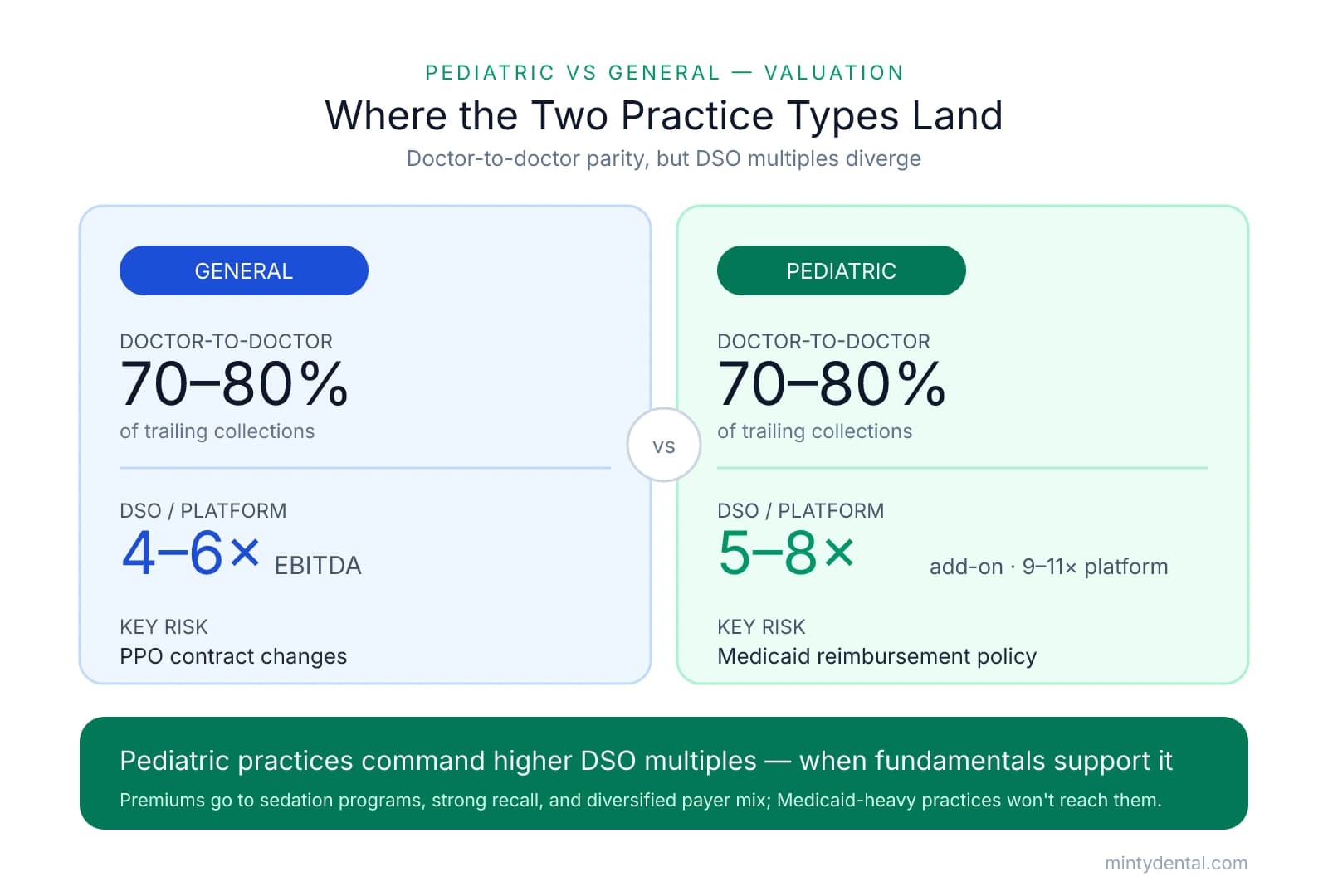
At the doctor-to-doctor level, pediatric and general practices trade in similar territory — both typically transact at 70–80% of trailing three-year collections, with the final number shaped by profitability, patient retention, and local market dynamics. That surface-level similarity can be misleading, though, because the risks embedded in those collections differ significantly depending on where the revenue comes from.
When DSOs and private equity platforms enter the picture, pediatric practices can command meaningfully higher multiples. According to FOCUS Investment Banking's 2025 pediatric dentistry valuation update, add-on acquisitions typically trade at 5–8× EBITDA, with premium valuations awarded to practices with sedation programs, strong recall infrastructure, and diversified payer mixes. Platform-level pediatric DSOs trade even higher, at 9–11× EBITDA. A Medicaid-heavy practice without sedation capabilities won't approach those multiples.
| General Practice | Pediatric Practice | |
|---|---|---|
| Doctor-to-doctor multiple | 70–80% of collections | 70–80% of collections |
| DSO/platform multiple | 4–6× EBITDA | 5–8× EBITDA (add-on); 9–11× (platform) |
| Typical overhead | 60–65% of collections | 60–65%+ (higher with sedation) |
| Primary payer mix risk | PPO contract changes | Medicaid reimbursement policy |
| Payer mix premium driver | Fee-for-service concentration | Commercial + Medicaid diversification |
Medicaid Dependency: The Risk Most Buyers Underweight
Many pediatric practices serve a significant Medicaid population — which is worth understanding before you interpret a revenue figure. Medicaid reimbursement rates vary dramatically by state and can be reduced through legislative action with little warning. A practice collecting 60% or more of its revenue from Medicaid is exposed to a policy risk that simply doesn't exist in a PPO-heavy general practice. The revenue looks stable on a trailing P&L, but its durability depends on decisions made in a state capitol, not in your operatory.
One step worth taking early in due diligence: request a payer mix breakdown by revenue, not just patient count, then model what a 10–15% Medicaid reimbursement cut would do to annual collections. If the practice can't absorb that scenario without threatening debt service, that's a material risk. Minty's guide to buying a Medicaid-heavy practice walks through how to evaluate that exposure in more detail.
Practices with diversified payer mixes — commercial insurance, Medicaid, and some fee-for-service — consistently command stronger multiples and present a more defensible revenue base. That diversification is worth paying for; the question is whether the asking price already reflects it.
Sedation Infrastructure: Premium Driver and Cost Center
Sedation capabilities are a genuine valuation premium in pediatric practices — they expand the patient population a practice can serve and are a key differentiator for DSO buyers. But sedation also represents a capital cost, ongoing compliance burden, and staffing requirement that buyers need to evaluate independently of the revenue it generates. A practice with sedation revenue baked into its trailing collections needs to be assessed with those operational costs fully understood — overhead benchmarks of 60–65% can climb quickly when sedation staffing and facility requirements are factored in.
Clinical Fit, Licensing, and the Staff Culture You're Buying Into
With valuation and payer mix addressed, the next layer of due diligence is one that many buyers — especially those coming from general dentistry — tend to underestimate: whether you're operationally and clinically equipped to run what you're buying.
What General Dentists Can and Can't Do
There's no ownership restriction preventing a general dentist from purchasing a pediatric practice. What isn't transferable is the specialist designation itself. Per AAPD ethics guidelines, a general dentist who acquires a pediatric practice cannot advertise as a pediatric specialist or imply specialty training they haven't completed — doing so creates both regulatory and reputational exposure worth taking seriously before finalizing branding or marketing plans.
Sedation is a separate and more operationally complex issue. Permits are state-specific, often tied to the individual practitioner rather than the facility, and may require additional training hours, equipment inspections, or reapplication under new ownership. Given that sedation infrastructure is frequently a valuation premium driver, buyers should verify exactly which permits the practice currently holds, who holds them, and what the transfer or reapplication process looks like in that state before closing.
Behavior Management Is a Distinct Clinical Skill
Pediatric dentistry involves a specific behavioral toolkit — tell-show-do sequencing, nitrous oxide titration, managing anxious or non-cooperative young patients — that isn't standard in general dentistry training. What tends to happen when buyers underestimate this gap is that the transition period feels rushed, and both clinical confidence and parent trust suffer as a result.
A longer seller transition — 90 to 120 days rather than the 30 to 60 days typical in general practice acquisitions — is worth negotiating in pediatric deals. The extended overlap gives you time to develop comfort with the behavioral and clinical rhythms of the practice while allowing parents to observe continuity before the seller steps away. One practical step many buyers skip: observe at least one full day of patient care before closing. The pace, noise level, and behavioral demands of a pediatric practice are genuinely different from a general practice.
Staff Culture Is Part of What You're Acquiring
In most pediatric practices, dental assistants and front desk staff are the primary relationship holders with parents — who often trust the team as much as, sometimes more than, the dentist. That dynamic makes staff retention especially critical here.
As the ADA notes in its guidance on patient retention, retaining existing staff is one of the most reliable ways to retain patients through a transition. In a pediatric context, where parent relationships are built over years of consistent interactions with the same faces, that principle carries even more weight. A thorough evaluation of staff dynamics before closing — not just credentials and tenure, but how the team functions and what they value — is worth building into your due diligence timeline.
How to Decide: A Framework for Choosing Between Pediatric and General
The valuation mechanics, payer mix risk, sedation licensing, and staff culture covered above all feed into four questions worth answering clearly before making an offer on either practice type.
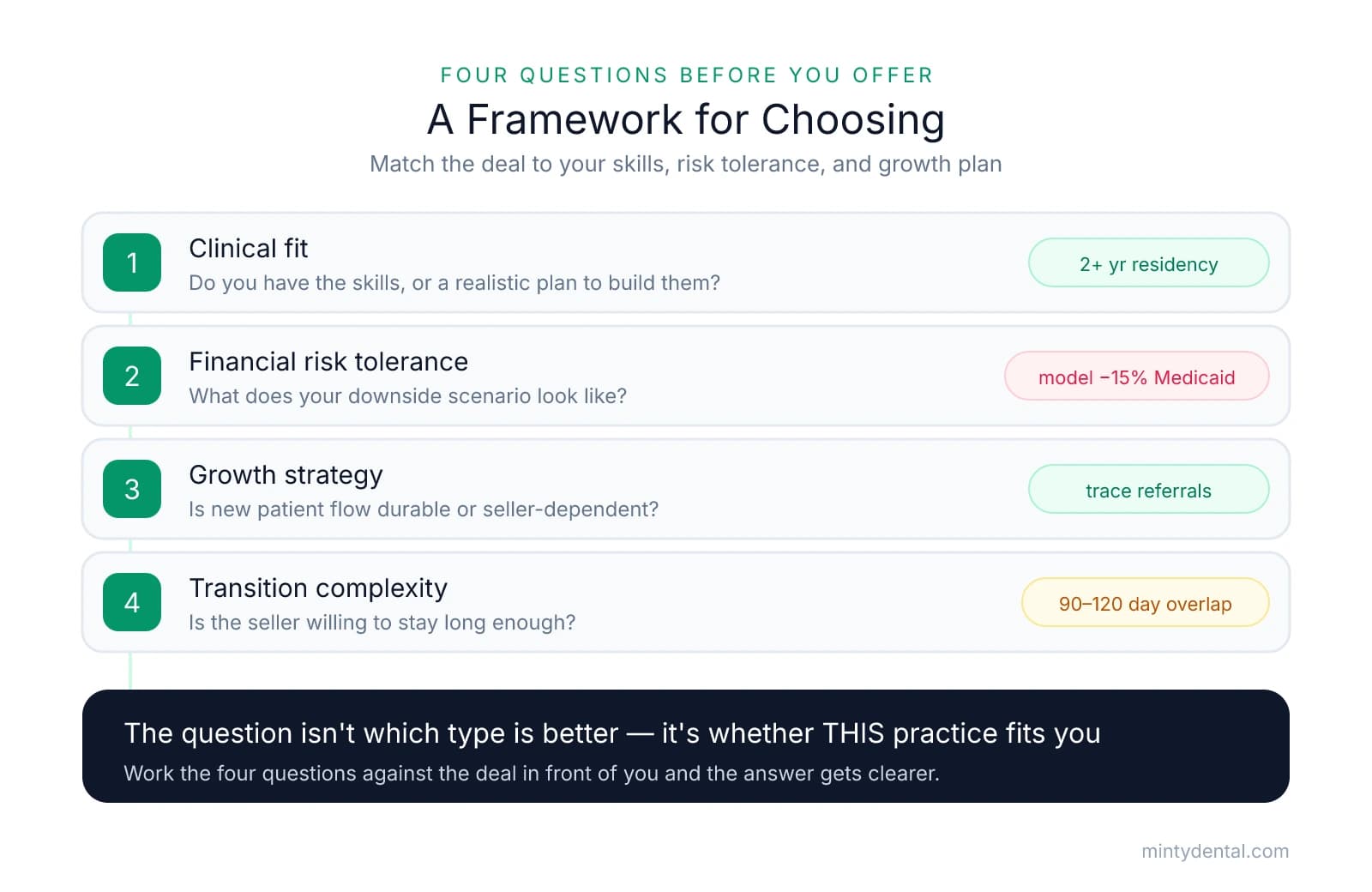
1. Clinical fit: Do you have the skills, or a realistic plan to build them?
Have you treated pediatric patients regularly as an associate, and do you currently hold the sedation permits the practice uses? If the answer to either is no, that's not disqualifying — but it does mean factoring in the cost and timeline of additional training before you can operate at full capacity. Pediatric dentists complete two or more years of residency training beyond their DDS or DMD, covering child psychology and physical development alongside clinical procedures — a scope that matters when evaluating whether your existing training translates.
2. Financial risk tolerance: What does your downside scenario look like?
Pull the payer mix breakdown by revenue — not patient count — and ask: what would a 15% Medicaid reimbursement reduction do to your debt service coverage ratio? Run that scenario before making an offer, not after. If you're comparing income scenarios between a pediatric and general acquisition, the associate pay calculator can help you model the difference between what you'd earn as an associate versus what ownership actually nets you under different revenue assumptions.
3. Growth strategy: Is new patient flow durable or seller-dependent?
Ask for the practice's new patient rate and trace where those patients come from. Referrals from pediatricians, schools, and community programs tend to transfer with the practice. Referrals built on the seller's personal relationships often don't. That distinction should influence both your offer price and your transition plan.
4. Transition complexity: Is the seller willing to stay long enough?
In pediatric acquisitions, 90–120 days of structured seller overlap is worth negotiating. Confirm that key staff members are committed to staying through the transition — losing two or three long-tenured assistants in the first month can accelerate patient attrition faster than almost any other factor.
General practices offer more flexibility — broader patient demographics, more diverse revenue streams, and a less specialized staff culture — which is why they tend to be a lower-risk first acquisition for most buyers.
Pediatric practices can be exceptional acquisitions when the clinical fit is real, the payer mix is defensible, and the transition is structured carefully. The recession-resistant demand, long patient retention windows, and strong DSO exit interest are genuine advantages — but only when the fundamentals support them.
The right question isn't which practice type is better. It's whether this specific practice matches your clinical background, your financial risk tolerance, and your growth plan. Work through these four questions against the deal in front of you, and the answer tends to get clearer.
Sources & References
The data and claims in this article are drawn from the following sources. We prioritize government data, peer-reviewed research, and established industry publications to ensure accuracy.
- Pediatric Dentists in the US Industry Analysis, 2024— www.ibisworld.comIndustry
- Pediatric Dentists vs. General Dentists - What's the Difference— noblepediatricdental.comIndustry
- Dental Practice Valuations: The Complete Guide for 2023 Values— largepracticesales.comIndustry
- Pediatric Dentistry Practice Valuation: 2025 Update— focusbankers.comIndustry
- Average Dental Practice Overhead: Benchmarks and Insights— overjet.comIndustry
- Business Metrics for the Pediatric Dental Practice— aapd.orgIndustry
- How to Retain Patients When Buying or Joining a Practice— www.ada.orgIndustry
- Your right to choose: parents' preferences toward a pediatric dental ...— pmc.ncbi.nlm.nih.govGovernment
Frequently Asked Questions
Ready to acquire your ideal dental practice?
Whether you're drawn to pediatric dentistry's specialized focus or general practice's broad patient base, finding the right practice requires expert guidance. Minty's acquisition specialists help you navigate the entire buying process—from identifying practices that match your vision to closing the deal.