Dental Associate Not Producing Enough: A Diagnostic Guide

Co-Founder, Minty Dental

In Summary
- Associates in general practice typically produce $1,600 to $2,000 per day, roughly 25 to 30 percent less than an experienced owner-operator, so a lower number is not automatically a problem.
- New associates usually need a ramp-up window of 3 to 6 months; production gaps in the first 60 to 90 days often reflect how many patients they were assigned rather than clinical capability.
- Before drawing conclusions, calculate the daily break-even threshold the associate must clear (their chair overhead plus compensation) and compare it against 90 days of trailing production data by provider.
- Separate a production problem (total output is low) from a collections problem (output is fine but write-offs and adjustments erode net revenue), because the fixes are different.
- Once you know the size and cause of the gap, you can target systems, scheduling, clinical, or compensation issues instead of guessing.
Calculate the Real Gap Before Deciding There Is a Problem
Associate production benchmarks in general practice: Associates typically produce $1,600 to $2,000 per day, roughly 25 to 30 percent less than an owner-operator. A number below the owner's is expected, so the first task is to determine whether the associate is falling short of what the arrangement actually requires, not what the owner personally produces.
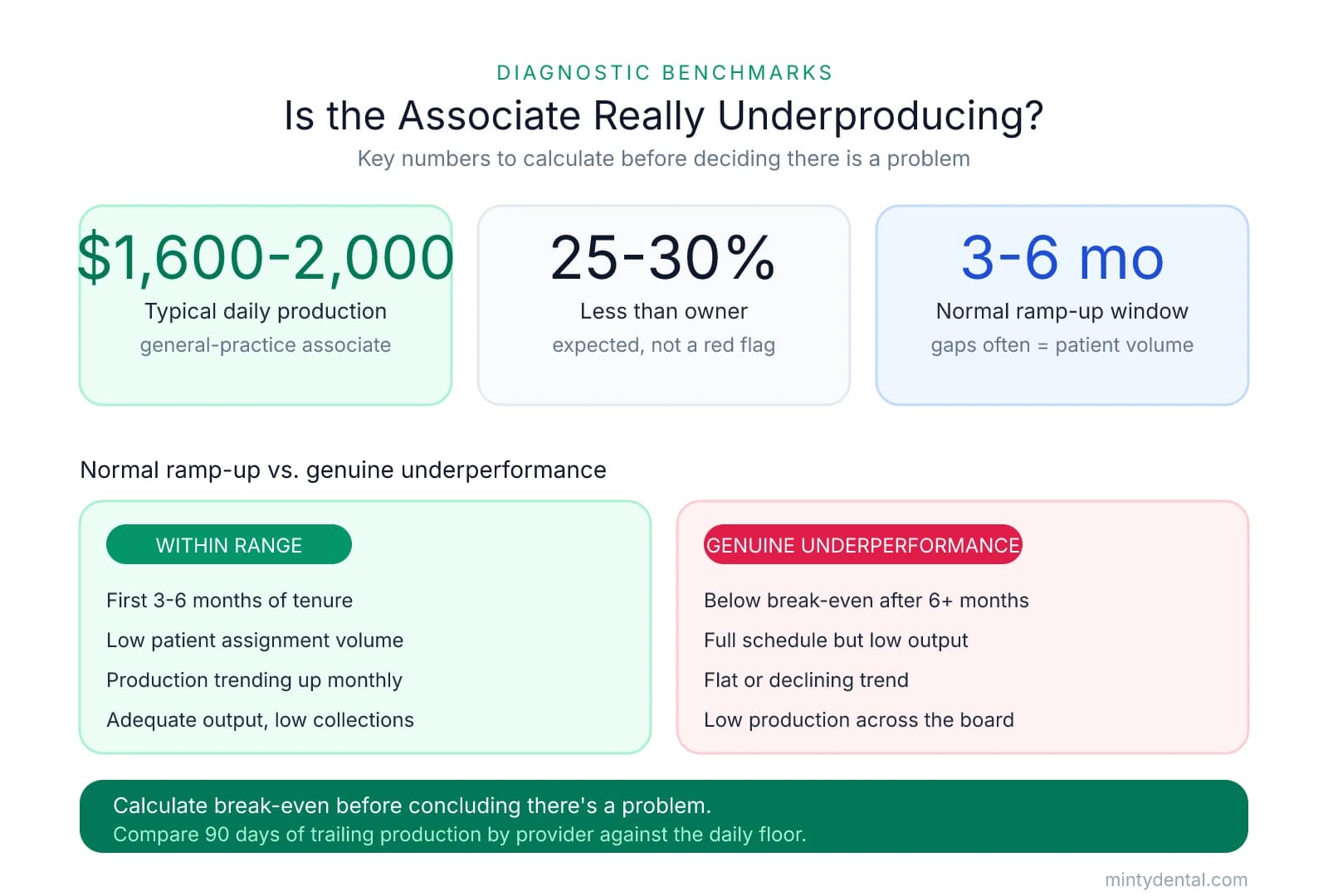
Start with the break-even threshold, which is the daily production floor the associate needs to clear for the arrangement to be financially neutral. Add the associate's compensation to the overhead allocated to their chair (staff, supplies, lab, and facility costs tied to their operatory), then divide by the number of clinical days worked. In practices running above 65 percent overhead, a 30 percent production split can leave the owner retaining almost nothing, so the break-even number is often higher than owners expect. A compensation calculator can help you model the split against different production levels.
Next, pull 90 days of trailing production data by provider from the practice management system. This gives you actual output rather than impressions, and it lets you see the trend across months instead of reacting to one slow week.
Compare the result against normal ramp-up variance before deciding intervention is warranted. A window of 3 to 6 months is typical for a new associate, and early gaps often reflect patient assignment volume rather than clinical ability.
| Within normal ramp-up range | Genuine underperformance |
|---|---|
| First 3 to 6 months of tenure | Below break-even after 6+ months |
| Low patient assignment volume | Full schedule but low output |
| Production trending upward monthly | Flat or declining trend |
| Adequate production, low collections | Low production across the board |
A production problem means total output is low, while a collections problem means output is adequate but write-offs and adjustments erode net revenue. The remedies differ, and the same reasoning that governs whether adding an associate made financial sense applies to diagnosing the gap now.
Four Root Causes of Low Associate Production — and How to Tell Them Apart
Low associate production usually traces back to one of four distinct causes, and each one shows up differently in the data. A useful first move is to compare the associate's production per patient visit against your own. If per-visit production is similar but total output is lower, the constraint is volume, which points to scheduling. If per-visit production is lower, the issue is more likely clinical or case acceptance.
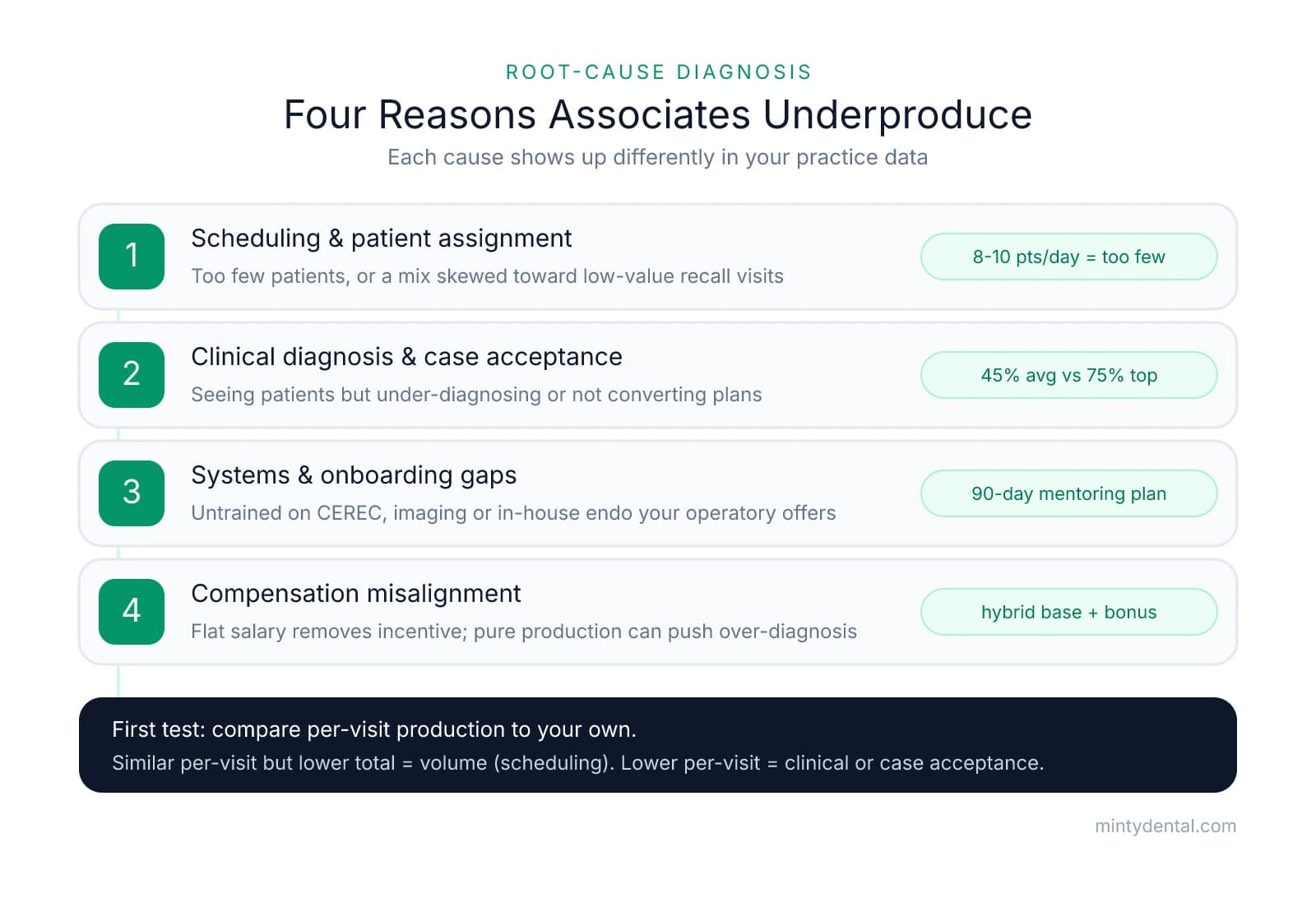
1. Scheduling and patient assignment. The associate may not be seeing enough patients, or the right mix of them. Check whether their schedule includes a steady flow of new patient exams and hygiene handoffs, since most practices generate the bulk of treatment plans from the new patient exam. An associate seeing 8 to 10 patients per day made up mostly of recall appointments will structurally underperform regardless of clinical skill, because recall visits carry limited restorative production.
2. Clinical diagnosis and case acceptance. Here the associate is seeing patients but either diagnosing conservatively or failing to convert treatment plans. Pull their presentation-to-acceptance ratio from the practice management system. The industry average sits around 45 percent, while top performers reach 75 percent. A gap here more often reflects how treatment need and cost are communicated than a deficit in clinical ability, and reviewing their approach to case acceptance conversations tends to reveal where plans stall.
3. Systems and onboarding gaps. A new associate who was never trained on the practice's protocols, technology, or treatment philosophy will lag until that gap closes. If the practice runs CEREC, digital imaging, or in-house endo that the associate did not use in school or a prior office, they may not present those options at all. The signal is diagnoses that stop short of what your operatory can deliver, such as a four-surface resin planned where a same-day crown fits the clinical picture.
4. Compensation structure misalignment. The incentive model may not reward the behaviors you want. A flat salary removes financial motivation to pursue higher-value treatment, while a percentage-of-production model aligns incentives but can create pressure to over-diagnose. Common formulas range from percentage of collections to percentage of production, and each shapes behavior differently. Modeling your structure against different production levels in a pay calculator can show whether the incentive is doing what you intended.
Targeted Interventions: What to Do Based on the Root Cause
Once you have identified the primary cause, match the response to it directly.
Scheduling and patient assignment. Audit the associate's schedule template for the past 30 days, counting new patient exams, hygiene handoffs, and restorative blocks by day. A productive associate day typically includes at least two to three restorative appointments alongside one to two new patient exams, because a good day mixes valuable doctor production with opportunities to present treatment. If the template skews toward recall and single-visit work, adjusting patient assignment policies so new patients and larger cases route to the associate can close a volume gap without adding marketing spend. This applies when per-visit production is already comparable to yours.
Clinical diagnosis and case acceptance. Case acceptance is a trainable skill rather than a fixed trait, so the intervention centers on communication tools. Co-diagnosis using an intraoral camera lets patients see their own conditions on screen, which tends to make the need concrete before cost enters the conversation. Bringing the treatment coordinator into the financial discussion before the patient leaves the chair also reduces the number of plans that stall at the front desk. These steps help most when presentation-to-acceptance ratios are the weak point rather than raw patient volume.
Systems and onboarding gaps. A structured 90-day mentoring plan closes the distance between what the associate was trained on and what your operatory delivers. A workable version includes weekly chart reviews, defined production milestones by month, and explicit training on any in-office technology the associate did not use previously, such as CEREC or in-house endo. Side-by-side case observation during the first weeks lets the associate see how you present and sequence treatment. This approach fits associates whose diagnoses stop short of available treatment options.
Compensation structure misalignment. If the associate is on a flat salary and production has stayed flat, adding a production bonus above a defined threshold creates upside while preserving income security. A hybrid base-plus-production model rewards higher-value treatment without the over-diagnosis pressure a pure percentage model can introduce. This fits situations where the clinical skill and schedule are sound but the incentive does not reward the behavior you want.
Document each intervention and the associate's response in writing, because a clear performance record protects the practice and shows exactly what was tried if the relationship eventually needs to end.
When to Have the Direct Conversation — and When to Part Ways
If targeted interventions have run their course and the gap persists, two decisions remain: how to hold a direct performance conversation, and how to decide whether the relationship should end.
Approach the performance conversation as a documented review built around data. Bring three items: 90 days of production reports by provider, the production expectation stated in the original offer or associate agreement, and a written summary of the interventions already attempted and how the associate responded to each. Presenting the gap against a specific, previously agreed number keeps the discussion factual rather than personal, and giving the associate room to respond often surfaces context you did not have, such as an unresolved scheduling constraint.
Close the conversation with a defined improvement timeline. A window of 60 to 90 days with specific monthly production milestones gives the associate a concrete target and gives you a clear accountability point. Vague timelines make it difficult to determine later whether progress actually occurred. Document the plan in writing and have both parties acknowledge it, because a clear performance record protects the practice if separation becomes necessary.
If production has not improved after a documented improvement period and the cause is not a fixable systems issue, compare the associate's total compensation cost, including salary, benefits, and malpractice coverage, with their net collections. When that cost consistently exceeds roughly 35 percent of net collections, the arrangement is likely losing money against practice overhead. At that point, continuing to invest usually costs more than a structured exit.
Before any termination conversation, review the associate agreement in detail. Notice periods, non-compete geography and duration, and patient non-solicitation terms all affect how and when the practice can act, and these provisions vary widely in enforceability. Owners who plan the exit around the contract, rather than around it, tend to avoid disputes later.
A structured exit with a defined transition period and a clear patient handoff plan protects patient retention and reduces the chance of patients following the associate to a competing office. Some underperformance reflects a poor fit rather than a bad hire, and handling the departure professionally preserves the working relationship and the practice's patient base at the same time.
Sources & References
The data and claims in this article are drawn from the following sources. We prioritize government data, peer-reviewed research, and established industry publications to ensure accuracy.
- How Much Should a General Dentist Produce Per Day?— www.mgeonline.com
- Dental Associate Compensation: Models That Protect Margins— nstarfinance.comIndustry
- 3 reasons why your associate isn't producing | DrBicuspid.com— drbicuspid.com
- Dental Case Acceptance Rate for DSOs - Henry Schein One— www.henryscheinone.com
- Options for associate compensation— www.dentaleconomics.comIndustry
- Low Production: 6 Quick Fixes for Dentists - The MGE Blog— www.mgeonline.com
- How to Document an Underperforming Employee in ...— hrforhealth.comIndustry
- 6 Things to Consider When Terminating a Dental Associate— www.dmcounsel.com
Ready to optimize your practice's production?
Struggling with associate performance impacts your bottom line. Minty's operations team specializes in streamlining practice management, from staffing efficiency to revenue optimization, so you can focus on clinical excellence.