Dental Practice Non-Solicitation Clause: What It Covers

Co-Founder, Minty Dental

In Summary
- A non-solicitation clause bars the seller from actively approaching the practice's patients, staff, or referral sources after closing — regardless of where they practice next
- Goodwill (patient relationships, staff continuity, referral networks) represents 60–80% of a dental practice's purchase price; the non-solicitation clause is the primary legal protection for that investment
- Non-solicitation clauses restrict targeted outreach to specific people — not geography — making them more reliably enforceable than non-competes in many states
- Courts treat sale-of-business restrictive covenants more favorably than employment non-competes, because the buyer paid consideration specifically for the goodwill being protected
- The FTC's 2024 non-compete rule was blocked and remains unenforceable; even if revived, sale-of-business covenants operate under a separate legal standard
The Non-Solicitation Clause Protects What You're Actually Paying For
A non-solicitation clause in a dental practice purchase agreement is a contractual provision that bars the seller from actively approaching the practice's existing patients, employees, or referral sources after the sale closes — regardless of where the seller chooses to practice next.
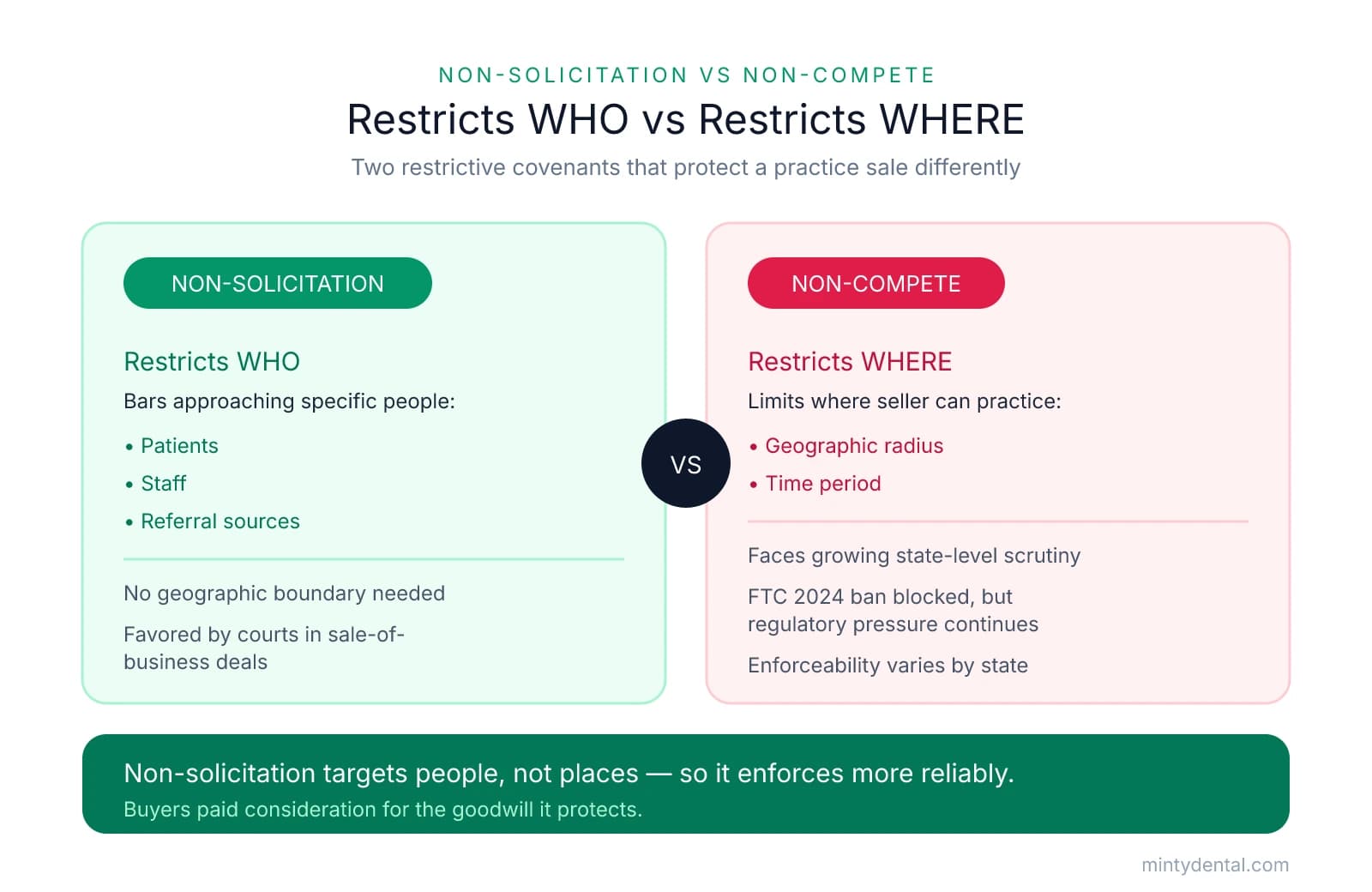
That distinction — regardless of where — is what separates it from a non-compete, and it's worth understanding clearly before you sign anything.
When you buy a dental practice, the physical assets (chairs, X-ray equipment, instruments) are rarely what justify the price. According to US Dental Practices, goodwill typically represents 60–80% of a practice's total purchase price. That goodwill is made up of patient loyalty, staff continuity, and referral relationships — things that exist in people's habits and trust, not in the equipment room. The non-solicitation clause is the legal instrument designed to keep that value from walking out the door with the seller.
Here's where many buyers lose ground: they treat the non-solicitation clause as standard boilerplate — something the broker filled in, something the attorney will handle. What tends to happen instead is that the language gets copied from a template, the three protected categories get lumped together in a single vague sentence, and the gaps don't surface until the seller has already called your front desk staff about a new opportunity down the street.
Non-solicitation vs. non-compete — the practical difference:
- A non-compete restricts where the seller can practice — typically defined by a geographic radius and time period
- A non-solicitation restricts who the seller can approach — patients, staff, referral sources — with no geographic boundary required
That structural difference matters enormously in practice. Non-competes face increasing legal scrutiny at the state level, and while the FTC's 2024 rule banning non-competes was blocked by a federal court and remains unenforceable as of 2025, the regulatory pressure on geographic restrictions isn't going away. Non-solicitation clauses sidestep much of that friction — courts have consistently treated sale-of-business restrictive covenants more favorably than employment-style restrictions, because the buyer paid real consideration for the goodwill being protected. You can read more about how non-competes fit into the broader picture in this buyer-focused breakdown of dental practice non-compete clauses.
The rest of this article breaks down the three categories a well-drafted non-solicitation clause must address — patients, staff, and referral sources — and where generic language tends to leave buyers exposed in each one.
Three Things a Non-Solicitation Clause Must Cover — and How Each One Works
Most purchase agreements include some version of a non-solicitation clause. The question worth asking isn't whether it's there — it's whether it actually covers the three categories that matter. Here's what each one protects, where standard language tends to fall short, and what to verify before you sign.
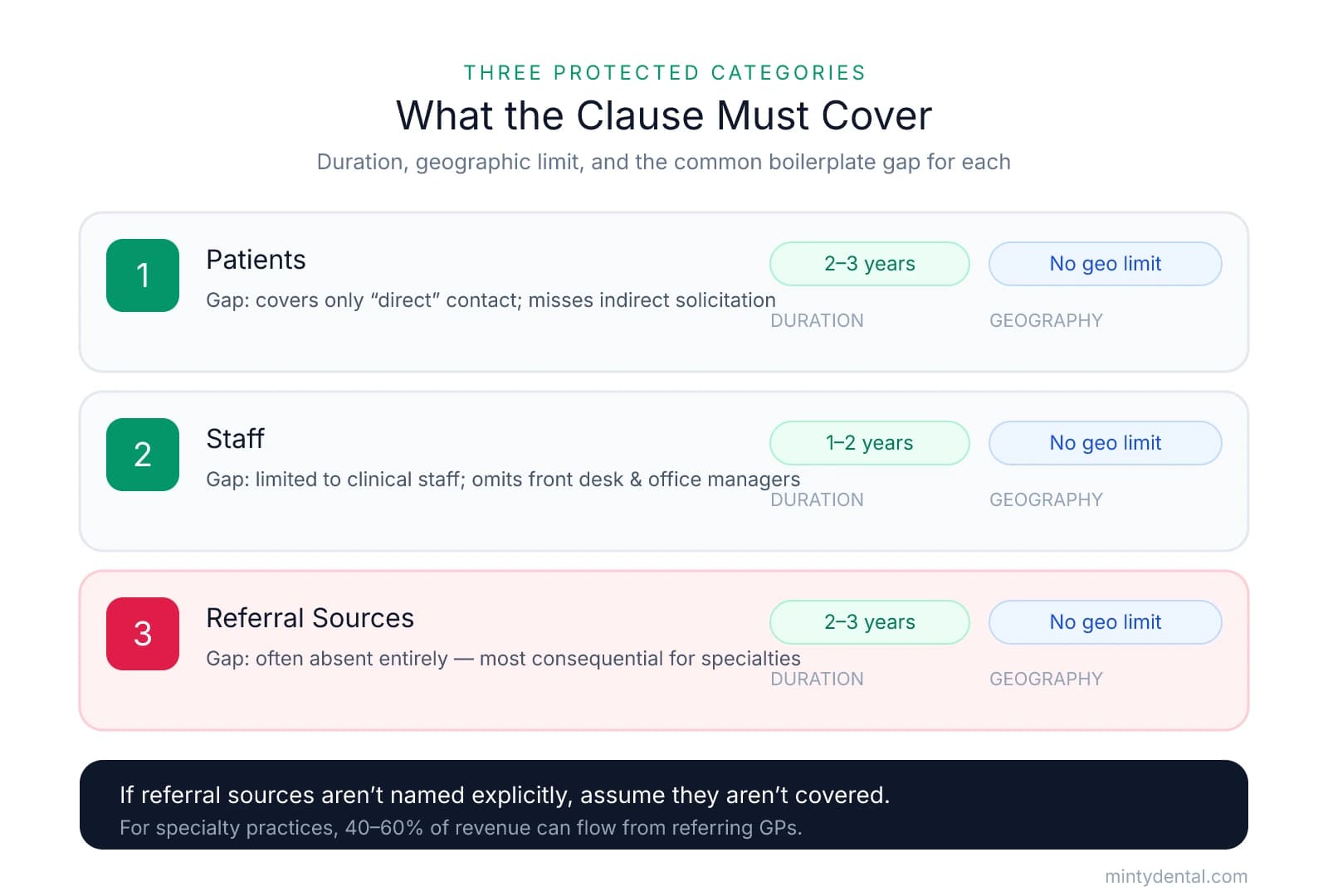
| Protected Category | Typical Duration | Geographic Limit Required? | Common Gap in Boilerplate Language |
|---|---|---|---|
| Patients | 2–3 years | No | Covers only "direct" contact; misses indirect solicitation |
| Staff | 1–2 years | No | Limited to clinical staff; omits front desk and office managers |
| Referral Sources | 2–3 years | No | Often absent entirely from the clause |
Patients
The clause should prohibit the seller from initiating contact with former patients — by phone, email, social media, or through any third party acting on their behalf. That last part matters: "direct and indirect" solicitation language closes the door on a seller who asks a mutual colleague to pass along a new practice address.
One nuance courts consistently recognize: a patient has the right to choose their own dentist. No contract can prevent a patient from following a seller to a new location if that's their preference. What the clause can do is prohibit the seller from being the one who reaches out first. That's the line the law draws, and it's the line your clause needs to hold.
Some agreements go further — prohibiting the seller from treating former patients even if the patient initiates contact. These broader provisions are enforceable in some states but not others, so whether to request this language depends on your jurisdiction and how concentrated the practice's patient base is. If patient attrition is a concern, the patient retention guarantee is a complementary protection worth exploring alongside the non-solicitation clause.
Staff
A seller who takes the lead hygienist and office manager on their way out can disrupt operations as effectively as losing a block of patients. The non-solicitation clause should cover all staff categories — not just clinical roles — and the ODA has noted that some contracts now go beyond solicitation to prohibit hiring former staff even if the employee initiates contact.
That stronger standard is worth requesting. Language that only bars the seller from recruiting staff leaves a gap: a seller can simply make themselves available and let key employees come to them.
Referral Sources
This is the category many buyers overlook — and for specialty practices, it's often the most consequential. If you're acquiring an endodontic, periodontic, oral surgery, or orthodontic practice, a meaningful share of revenue flows from referring general dentists. Those relationships are part of what you paid for, and as Dental CPAs notes, they're owned by the practice — not the seller personally.
The clause should explicitly name referral sources as a protected category and prohibit the seller from contacting referring GPs to redirect cases to a new location. Critically, this protection requires no geographic component — a seller can undermine referral relationships by phone or email from anywhere in the country. The risks this creates for specialty practices are worth understanding in detail, particularly how referral-dependent revenue affects valuation and stability after a transition.
If your agreement's non-solicitation clause doesn't name referral sources explicitly, assume they aren't covered.
Where Standard Non-Solicitation Language Falls Short
Having a non-solicitation clause is the baseline — what it actually says is where most of the risk lives. Many buyers assume the clause is solid because it exists, only to discover during a dispute that the language doesn't cover the specific behavior they're trying to stop. A dental-specific attorney reviewing the agreement before closing will typically catch these gaps. Here's what they're looking for.
Vague definition of "solicitation"
Many clauses prohibit solicitation without defining it, and courts have drawn a surprisingly narrow line. The distinction that tends to matter is generic versus targeted: a seller announcing their new practice on Facebook or LinkedIn — without naming former patients or directing the post at specific individuals — may not qualify as prohibited solicitation under loose language. Courts in Illinois and other jurisdictions have generally found that generalized social media activity doesn't constitute solicitation, while posts or messages targeted at specific former patients or staff do.
The fix is explicit language: the clause should cover indirect solicitation and any social media activity directed at former patients, staff, or referral sources — not just phone calls and emails.
Missing referral source language
As noted above, referral sources are the category most often absent from standard templates. For a general dentist buying a solo practice, this gap may be manageable. For a buyer acquiring a specialty practice where 40–60% of revenue flows from referring GPs, it can be devastating.
No liquidated damages provision
Without pre-agreed damages, proving the financial impact of a breach means litigation — expensive, slow, and uncertain. Some well-drafted agreements specify per-patient damages (for example, $5,000 for each patient treated in violation of the clause). That structure makes enforcement practical: the buyer doesn't have to reconstruct lost revenue patient by patient, and the seller has a concrete deterrent.
No injunctive relief clause
Monetary damages after the fact may not be enough if the seller is actively poaching patients mid-transition. An injunctive relief provision allows a buyer to seek a court order stopping the behavior quickly — without waiting for a full trial. In DentalCorp Health Services Ltd. v. [Seller], 2023 MBKB 75, a Manitoba court granted exactly this — a temporary injunction against a seller who had breached their non-compete and non-solicitation obligations, halting the conduct while the full case proceeded. That outcome was only possible because the agreement supported emergency relief.
Clause only in the employment agreement
If the seller stays on post-closing as an associate and the non-solicitation language appears only in the post-closing employment agreement, it may expire when that employment period ends — leaving the buyer unprotected for the full intended term. The non-solicitation clause must appear in the purchase agreement itself, with its own independent duration running from the closing date regardless of how long the seller stays on.
These aren't obscure edge cases — they're the gaps that dental-specific legal counsel routinely flags before closing. Standard templates are written to get deals done, not to anticipate every enforcement scenario.
Reviewing the Non-Solicitation Clause Before You Sign
Before signing the purchase agreement, it's worth being able to answer "yes" to each of the following questions. If any answer is "no" or "I'm not sure," that's the conversation to have with your dental attorney before closing — not after.
1. Does the clause explicitly name all three categories — patients, staff, AND referral sources? A clause that covers patients but omits referral sources leaves a significant gap, particularly for specialty practices. Each category should appear by name, not bundled into a single vague sentence.
2. Is "solicitation" defined — and does the definition cover indirect outreach and social media activity directed at former patients or staff? As covered earlier, courts have generally found that generalized social media announcements don't constitute solicitation. Your clause should close that gap explicitly, covering targeted digital outreach alongside phone and email contact.
3. Does the non-solicitation language appear in the purchase agreement itself — not only in a post-closing employment agreement? If the clause lives only in the seller's employment agreement, it may expire when that employment period ends. The protection should run from the closing date, independent of how long the seller stays on.
4. Is there a liquidated damages provision with a specified per-patient or per-employee amount? Pre-agreed damages make enforcement practical. Without them, proving financial harm means litigation — slow, expensive, and uncertain. A specific dollar figure per patient or employee gives both sides a concrete deterrent.
5. Does the clause include an injunctive relief provision? Monetary damages after the fact may not be enough if a seller is actively redirecting patients mid-transition. An injunctive relief provision allows you to seek a court order quickly, without waiting for a full trial.
6. Does the clause bind the seller's controlled entities and family members — not just the seller personally? A seller who routes outreach through a spouse, a family LLC, or a new practice entity they control can technically comply with a clause that only names them individually. The language should extend to anyone acting on the seller's behalf.
7. For specialty practices: does the referral source protection specifically name the categories of referring providers? General language about "referral sources" may not be enough. Naming the relevant provider types — general dentists, oral surgeons, pediatric dentists — removes ambiguity about who is covered.
One thing worth keeping in mind: even a well-drafted non-solicitation clause works best when paired with a structured seller transition period. The legal protection and the relational handoff reinforce each other — patients and referral sources who've had time to build trust with you are far less likely to follow the seller regardless of what the contract says. Restrictive covenant provisions should also be reviewed alongside compensation, malpractice insurance, and termination terms to understand how these clauses interact and affect overall professional and financial exposure. Understanding how to structure that transition — including what to negotiate in the seller's post-closing employment agreement — is the natural next step once the non-solicitation language is locked in.
Sources & References
The data and claims in this article are drawn from the following sources. We prioritize government data, peer-reviewed research, and established industry publications to ensure accuracy.
- Dental Practice Goodwill: How It's Valued and Why It Matters— usdentalpractices.com
- FTC Announces Rule Banning Noncompetes— www.ftc.govGovernment
- UNDERSTANDING NON-SOLICITATION CLAUSES IN ...— www.oda.orgIndustry
- When to Sign a Non-Compete When You Sell Your ...— dentalcpas.comIndustry
- Biting or Toothless? What Dentists Need to Know About ...— ddslawyers.com
- Dentist Non-Compete Review | Robert Chelle— reviewdentalcontracts.com
Ready to acquire a dental practice?
Understanding non-solicitation clauses is crucial when evaluating a dental practice purchase. Minty's acquisition experts guide you through every aspect of practice agreements, including restrictive covenants, to ensure you're making an informed investment.