When Does Adding a Dental Associate Make Financial Sense?

Co-Founder, Minty Dental

In Summary
- The decision to hire an associate rests on whether the practice can financially support a second provider without weakening the owner's margin, not on how busy the schedule feels.
- Two common timing errors drive poor outcomes: hiring before patient demand can fill an associate's schedule, and hiring years after production has been capped and revenue foregone.
- General practitioner dentist income averaged $207,980 in 2024, while practice expenses grew 4.9 percent against 1.4 percent revenue growth over a five-year period, so owners absorb more overhead per dollar collected.
- A two-week absence at a practice collecting $90,000 per month costs roughly $45,000 to $50,000 in foregone production and continuing overhead.
- Three questions structure the decision: Is the practice at capacity? Do the numbers work? Does the hire serve the owner's longer-term goals?
The Financial Case for an Associate Depends on Timing More Than Intent
The decision to add an associate is often triggered by a feeling: the schedule is full, new patients wait three or four weeks, and the owner is tired in a way that collections do not fully offset. That feeling is a useful signal, but it is not the basis for the decision. What determines whether the hire works is whether the practice's financial structure can carry a second provider without eroding the owner's take-home margin.
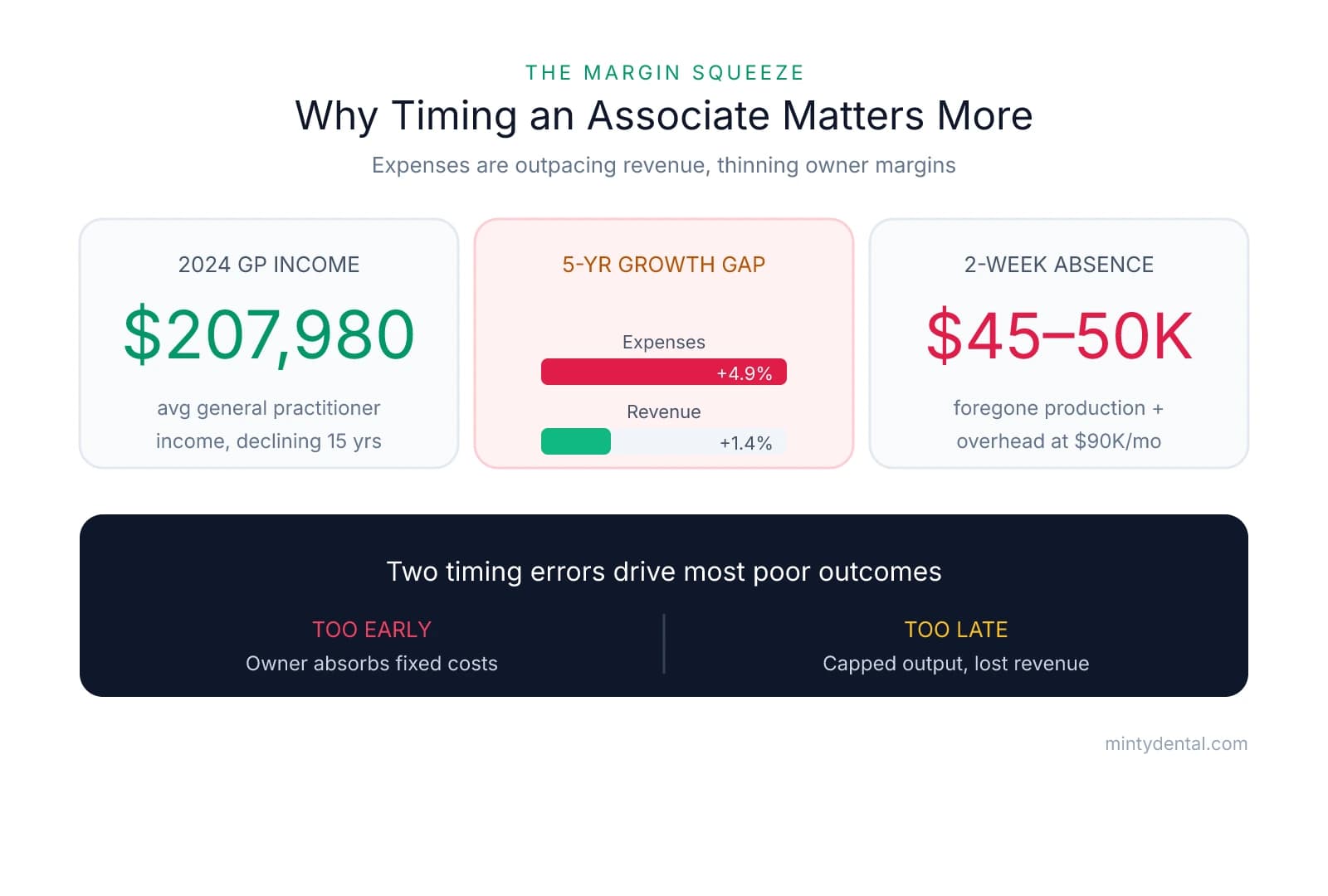
Two timing errors account for most disappointing outcomes. Hiring too early puts an associate in a practice that cannot feed them a full schedule, so the owner absorbs a new provider's fixed costs while patient demand catches up. Hiring too late means years of capped production, foregone revenue, and personal time surrendered to protect collections. Both are timing problems rather than intent problems.
The margin environment makes timing more consequential than it was a decade ago. Average general practitioner income was $207,980 in 2024, and inflation-adjusted earnings have been declining for 15 years as a result of expenses outpacing revenue. Over a recent five-year period, practice expenses grew 4.9 percent while revenues grew only 1.4 percent, so owners retain less of each dollar collected. A poorly timed associate hire can accelerate that squeeze instead of relieving it.
Owner dentists work roughly five more hours per week than associates on average, and a two-week absence at a practice collecting $90,000 per month costs approximately $45,000 to $50,000 once foregone production and continuing overhead are counted. That cost is why many owners consider a second provider, but the relief only materializes when the numbers support it and overhead is already under control, a topic worth examining before adding any new fixed cost.
Capacity Signals That Indicate the Practice Is Ready
The practice should already have more demand than the current provider team can serve. The most reliable version of a "yes" is an associate who steps into existing patient flow rather than one hired to build a base from scratch. A practice that depends on the associate to generate their own demand faces a longer, riskier ramp-up, because the owner carries the associate's fixed costs while the new schedule slowly fills.
Active patient base, not total records. The number that predicts whether a schedule will fill is the active patient count: patients seen for treatment within the last 18 to 24 months. Patients of record who have not visited in more than two years are not contributing to capacity problems and should be excluded from the count. Total records overstate the real base, and many owners assess readiness on that inflated figure. As a planning range, a full-time associate typically needs roughly 800 to 1,300 active patients to support a sustainable schedule, with the exact figure depending on payer and treatment mix.
Three flow and capacity benchmarks help confirm the demand is present:
- New patient flow. Kesner recommends 35 to 40 new patients per month before adding an associate, because volume below that level may leave the associate struggling to fill chair time and can endanger profitability once the added cost is on the books.
- Hygiene backlog. Hygiene booked four to six weeks out indicates the practice is generating more recall and diagnostic volume than the current provider team can absorb, which feeds restorative demand an associate could take on.
- Case acceptance. A rate of 80 percent or higher is a reasonable threshold before hiring. A low acceptance rate means the practice is already leaving diagnosed revenue unscheduled, and adding a provider does not fix that gap. Practices below this level often see more return from improving acceptance first than from adding chair time.
The strongest single signal is diagnosed but unscheduled treatment. It shows demand exists and that chair time, not patient interest, is the constraint. Owners can also check whether hygiene has the capacity to keep feeding restorative work, since an underused hygiene department limits how much an associate can produce.
Use this checklist against your own numbers. Readiness is indicated when most items hold true:
- Owner schedule consistently full
- Hygiene booked four to six weeks out
- New patient wait exceeds two to three weeks
- Treatment being delayed or referred out for lack of chair time
- 35 or more new patients per month
- 80 percent or higher case acceptance
Meeting most of these suggests the practice can feed an associate.
The Break-Even Math Every Owner Should Run Before Hiring
After capacity is established, determine whether the practice can carry a second provider profitably. Break-even for an associate is the monthly collections at which the revenue they generate covers the fixed costs of adding them, with nothing left over yet. Below that number, the associate costs the owner money. Above it, the associate begins contributing to profit.
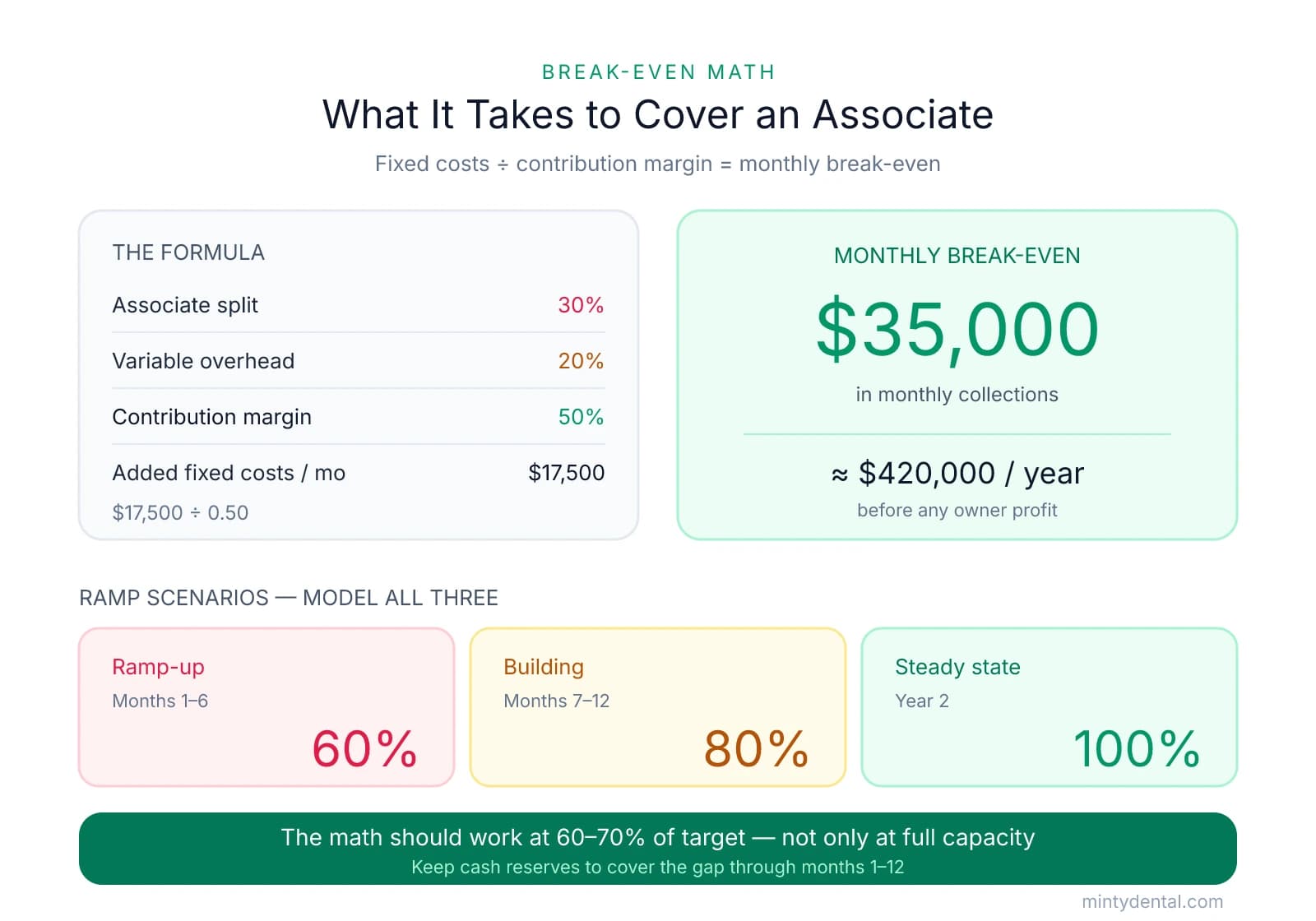
The formula: divide the added fixed monthly costs by the contribution margin, where contribution margin equals 1 minus the associate's compensation percentage minus the practice's variable overhead percentage.
Consider a practice paying 30% of collections to the associate against 20% variable overhead (supplies, lab fees, and payer-driven adjustments). That leaves a 50% contribution margin. If the associate adds $17,500 per month in fixed costs, break-even is $17,500 divided by 0.50, or $35,000 per month, roughly $420,000 in annual collections.
Added fixed costs are the ones owners most often underestimate. Model each of these before running the numbers:
- Payroll taxes and benefits
- Recruiting and onboarding
- Additional assistant coverage
- Credentialing and malpractice
- Incremental supplies and lab fees
- Increased management and administrative time
The margin trap sits inside the compensation percentage. At 70% practice overhead and a 30% associate compensation split, 100% of associate production is allocated, leaving the owner near zero. At 72% overhead, the owner loses money on every dollar the associate produces. This is why bringing overhead under control matters before, not after, the hire.
One factor works in the owner's favor and is often left out of the math. The associate's patient base typically generates $150,000 to $220,000 in annual hygiene production, which flows to the practice at hygiene margins rather than associate-split margins. Crediting that hygiene revenue to the associate's economic contribution changes the picture materially, so it belongs in any honest break-even model.
Because associates rarely produce at full capacity on day one, model three ramp scenarios rather than a single steady-state number:
| Scenario | Period | Production level |
|---|---|---|
| Ramp-up | Months 1 to 6 | 60% of target |
| Building | Months 7 to 12 | 80% of target |
| Steady state | Year 2 | Full target |
The practice needs cash reserves to cover the gap during months 1 through 12, when collections trail full-schedule projections.
Compensation structure shapes the risk. Collections-based pay aligns incentives better than gross production pay, because the associate shares exposure to PPO write-offs and non-payment rather than earning on billed amounts the practice never collects. Modeling these structures side by side is easier with the associate pay calculator, which shows how base, percentage, and threshold choices change the owner's retained margin.
How a Well-Timed Hire Affects Practice Independence and Exit Value
The third question in the decision sequence looks past the break-even point to what the hire does for the practice as an asset. A well-timed associate changes the structure of the business in two ways that matter beyond monthly cash flow.
Owner independence. When one dentist produces the majority of revenue, the practice is fragile. Any absence, illness, or slowdown in the owner's schedule flows directly to collections. An associate who carries a real share of production reduces that dependence and makes the business more transferable, which is the same structural change that reduces a practice's reliance on any single person. A buyer inherits a functioning provider layer rather than a job that only works when the seller shows up.
Exit value. The valuation method shifts with that structure. Most solo practices under $1.5 million in revenue are valued on Seller's Discretionary Earnings at 2 to 4 times, while practices that demonstrate operational profitability independent of the owner can attract EBITDA-based buyers such as DSOs and strategic acquirers at 4 to 7 times. A functioning associate layer is one of the clearest signals that revenue is not entirely owner-dependent, which is why associate depth is a common lever when owners work to raise practice value before a sale.
Succession planning. Many owners hire an associate as a future buy-in candidate. The ramp-up period doubles as a trial partnership, giving both sides time to test fit before any equity changes hands. This creates a built-in exit path that does not depend on finding an outside buyer.
One risk deserves attention. An associate who outproduces the owner, or whose departure would materially damage collections, creates its own valuation problem, because buyers will underwrite the risk that the associate leaves after closing. That concern is real enough that it changes how buyers evaluate deals where the associate produces more than the owner.
If capacity, break-even economics at current overhead, or a clear strategic reason is missing, the hire is likely premature.
Before making any offer, run the break-even calculation with actual overhead and projected associate production. The math should work at 60 to 70 percent of the associate's target production, not only at full capacity, so the practice can absorb a slower ramp without eroding the owner's margin.
Sources & References
The data and claims in this article are drawn from the following sources. We prioritize government data, peer-reviewed research, and established industry publications to ensure accuracy.
- Dental Practice Research - American Dental Association— www.ada.orgIndustry
- Should You Add a Dental Associate? | TransitionOne— transitionone.netIndustry
- Hiring an Associate Dentist: Timing & Key Metrics for Success— whalencpa.comIndustry
- When to Hire an Associate: A Guide for Private Practice ...— parkhurstconsulting.comIndustry
- Dental Associate Compensation: Models That Protect Margins— nstarfinance.comIndustry
- SDE vs EBITDA for Dental Practice Valuation Guide— professionaltransition.comIndustry
Ready to expand your practice capacity?
Adding an associate is a major financial decision that requires careful planning and operational expertise. Minty's operations team helps independent practices optimize staffing, billing, and profitability to make smart growth decisions.