Dental Insurance Downcoding and Bundling: How It Cuts Pay

Co-Founder, Minty Dental

In Summary
- Downcoding means a carrier substitutes a lower-cost procedure code for the one you submitted; bundling means it collapses a separately billable procedure into another and pays the second line at $0.
- Both result in a contractual write-off for in-network dentists — the patient cannot be balance-billed for the difference.
- Common examples include posterior composites paid at amalgam rates and core buildups absorbed into the crown fee with no separate payment.
- Carrier policies that drive these adjustments typically live in the provider manual or online portal, not the participation agreement you signed — you often won't see them until the EOB arrives.
- The ADA has identified undisclosed downcoding as claims payment abuse, and considers both practices distinct from legitimate contract provisions when they are not disclosed in advance.
Downcoding and Bundling Are Two Distinct Ways a Carrier Pays Less Than You Billed
When an EOB comes back showing a different code than the one you submitted, or a zero-dollar line next to a procedure you know you performed, the instinct is to assume a billing error. Sometimes it is. More often, though, the carrier applied a policy that was never mentioned during credentialing and isn't visible in your participation agreement. The two mechanisms responsible for most of these situations have formal names and formal definitions, and understanding the distinction matters because they show up differently on the EOB and require different responses.
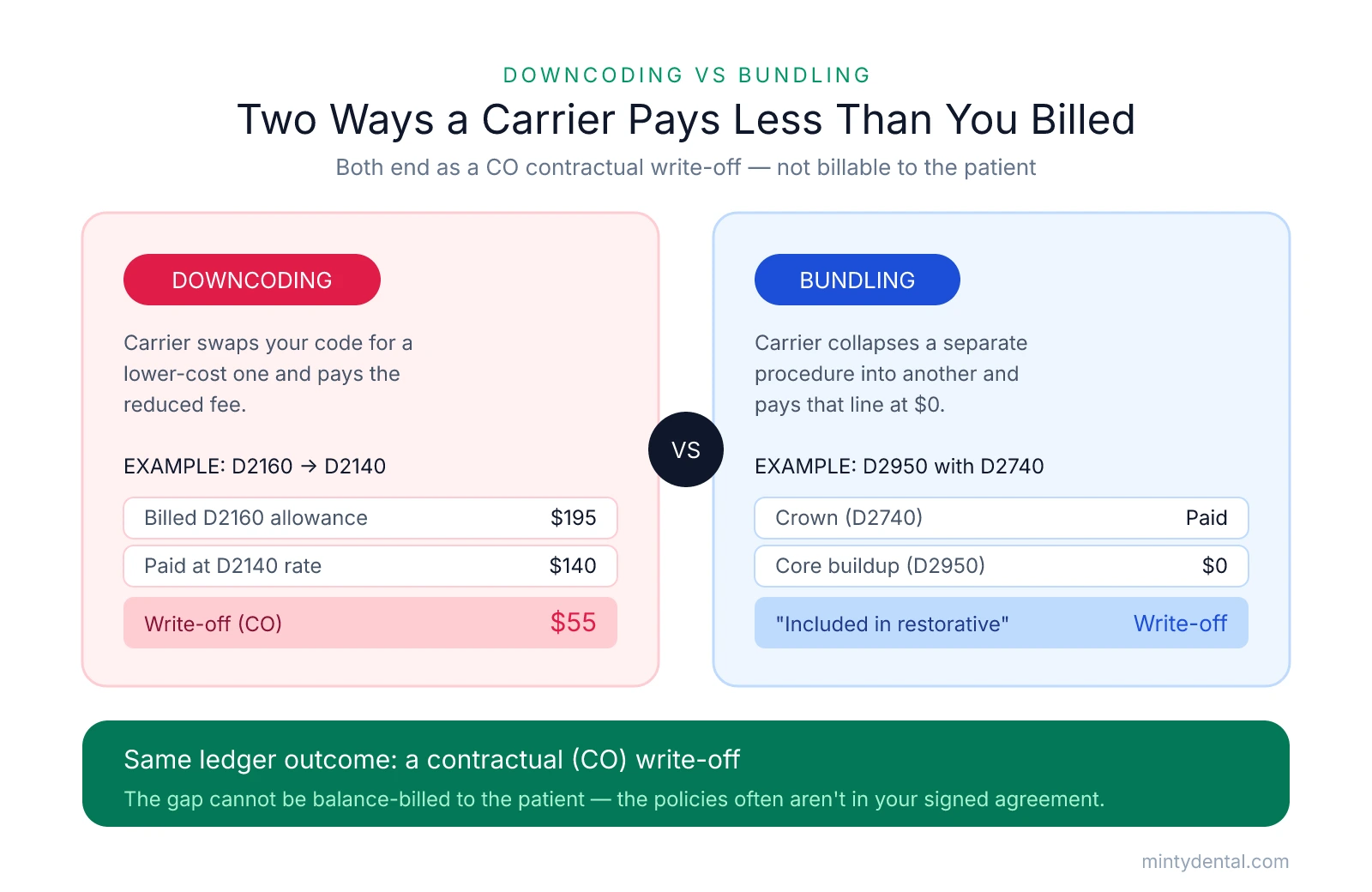
Downcoding is "a practice of third-party payers in which the benefit code has been changed to a less complex and/or lower cost procedure than was reported except where delineated in contract agreements," as defined by the ADA. In plain terms: you bill D2160, the carrier pays it as D2140 and reimburses at the lower fee. The clinical decision — which code accurately described what you did — was yours. The financial decision to pay for something simpler was the carrier's.
Bundling is "the systematic combining of distinct dental procedures by third-party payers that results in a reduced benefit for the patient/beneficiary," under the ADA's definition. Here the submitted code stays on the EOB, but the payment is $0, with a remark that the procedure is "included in" another on the same claim. Nothing was denied in the traditional sense. The carrier simply decided one fee already covers both.
Both result in the same ledger outcome for an in-network practice: a contractual write-off. The CO adjustment group code on the EOB signals that the difference between what you billed and what was paid is a plan-defined reduction, not a patient liability. You cannot collect the gap from the patient. That distinction matters when you're reviewing write-off reports and trying to decide whether a shortfall is recoverable. If you're seeing payments consistently below your contracted fee schedule, downcoding and bundling are two of the more common reasons.
The policies that authorize these adjustments are typically buried in the carrier's provider manual or clinical editing rules published in an online portal, not the participation agreement itself. Many carriers do not disclose their bundling or downcoding policies even during contract negotiation, leaving dentists and patients with no way to anticipate the reimbursement until the EOB arrives.
A brief example of each illustrates how the numbers move. Suppose you place a three-surface posterior composite and submit D2160. The carrier's fee schedule allows $195 for D2160 but $140 for D2140. The EOB returns D2140 with a $140 payment. The $55 difference is coded as a CO adjustment. You write it off. That's downcoding. (These are hypothetical figures for illustration.)
For bundling, consider D2950 (core buildup) billed the same day as D2740 (porcelain crown). The carrier pays the crown fee and returns D2950 at $0 with a remark that the buildup is included in the restorative procedure. Data from 32 practices spanning more than 170 payers found that D2950 billed to Cigna was bundled into the crown on 46.2% of submitted lines across 16 practices, with the buildup paid at $0 on each of those claims. That's not an occasional adjudication quirk; it's a published clinical editing rule applied systematically.
The ADA has classified undisclosed downcoding as a form of claims payment abuse since 2016, specifically when carriers apply it without prior disclosure in the contract. That classification gives practices a basis for appeal that goes beyond a simple billing dispute.
The Most Common Procedure Pairs Where Downcoding and Bundling Appear
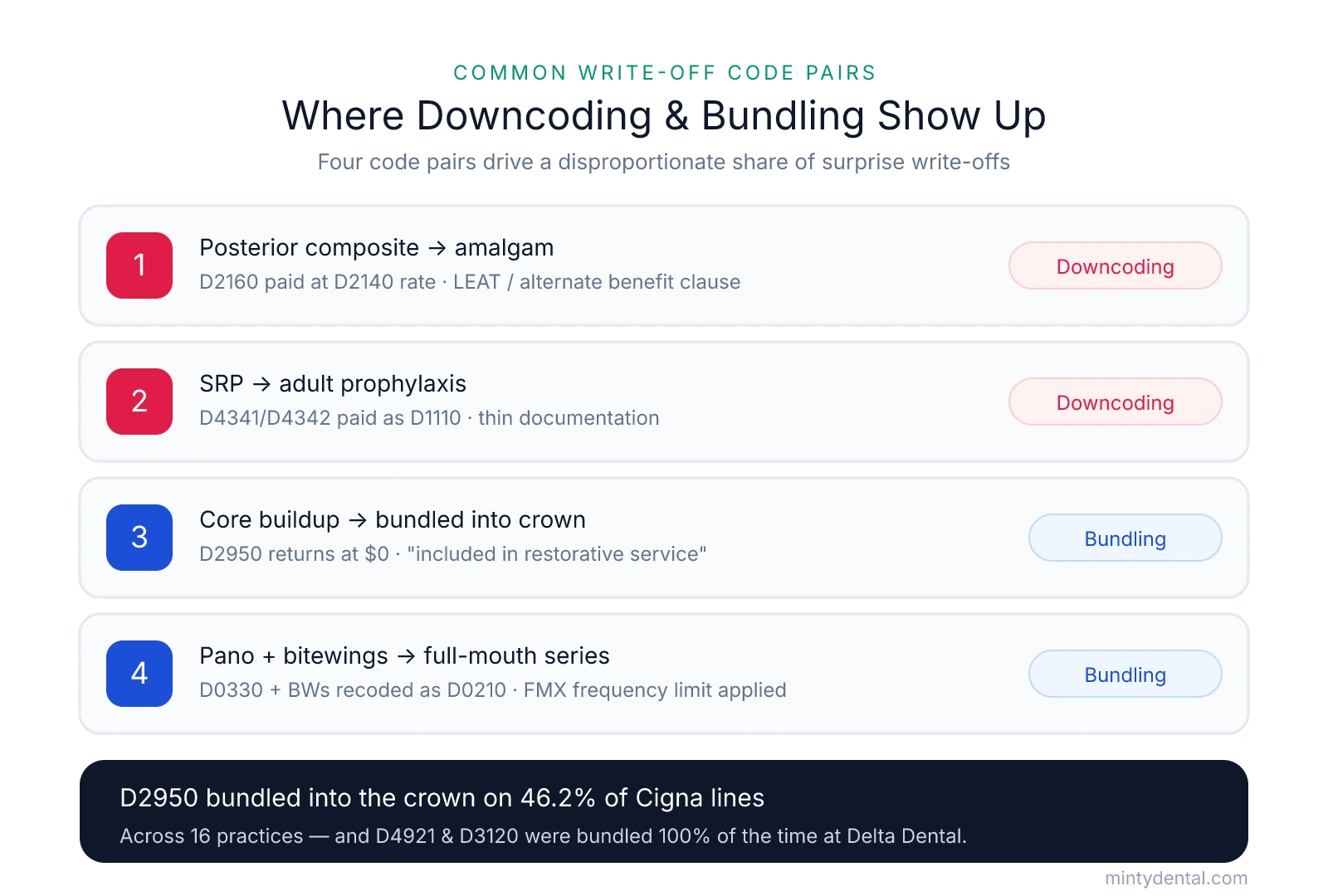
The four code pairs below account for a disproportionate share of unexpected write-offs in most general practices. Each one has a distinct mechanism driving the reduction, and each shows up on the EOB in a characteristic way.
| Code Submitted | Code Paid | Mechanism | Typical EOB Language | In-Network Consequence |
|---|---|---|---|---|
| D2160 posterior composite | D2140 amalgam allowance | LEAT/alternate benefit clause | "Benefit based on least costly alternative" | Composite-to-amalgam rate difference is a write-off |
| D4341/D4342 SRP | D1110 adult prophy | Downcoding, insufficient documentation | "Benefit paid at prophylaxis level" | Full SRP fee minus prophy allowance is a write-off |
| D2950 core buildup | $0 (included in crown) | Bundling policy | "Procedure included in restorative service" | Entire buildup fee is a write-off |
| D0330 + bitewing series | D0210 FMX | Bundling, reclassification | "Radiographs combined as full-mouth series" | FMX frequency limitation applied; excess is a write-off |
Posterior composite to amalgam (D2160 to D2140). This is the classic LEAT scenario: composite-to-amalgam substitution is the most frequently cited example of LEAT clause administration. When a plan's alternate benefit clause covers only the least expensive professionally acceptable treatment, it pays the amalgam allowance on a composite claim, listing the amalgam code in the paid column. For an in-network dentist, the difference between the composite and amalgam contracted rates is a contractual write-off. The patient chose the composite; the plan paid for the amalgam equivalent.
SRP downgraded to prophylaxis (D4341/D4342 to D1110). This one is usually documentation-driven rather than a standing policy. Carriers require clinical attachment loss data, radiographic bone loss evidence, and a periodontal diagnosis narrative to adjudicate SRP at the higher rate. When charting notes are thin or the narrative doesn't travel with the claim, adjudicators default to the prophy code. The write-off here is the difference between your contracted SRP rate and the prophy allowance, which can be substantial given how much further apart those two fees sit.
Core buildup bundled into the crown (D2950 with D2740). Many carriers treat the buildup as integral to crown preparation and will not pay it separately unless the tooth meets a specific structural threshold. Delta Dental, for instance, requires documentation of 50% or greater tooth structure loss before allowing a separate buildup benefit. Without that, D2950 returns at $0. As noted earlier, Cigna bundled the buildup into the crown on 46.2% of D2950 lines submitted across 16 practices in one dataset. It's worth checking your own write-off reports specifically for same-day D2950 and crown combinations.
Panoramic plus bitewings reclassified as FMX (D0330 + D0272/D0274 to D0210). Radiograph bundling is among the most common bundling complaints the ADA receives: several films are combined and recoded as a full-mouth series, then subjected to the plan's FMX frequency limitation, which is often one per five years. The diagnostic problem is that a panoramic image, with its inherent distortion, doesn't substitute for periapical films in many clinical contexts, but the carrier pays as though it does. If the patient had an FMX within the limitation period, the reclassified claim may pay at $0 entirely.
When no documentation will change the outcome. Some codes are bundled on every single claim at specific carriers, regardless of what you send. Data from 37 practices across more than 170 payers found that D4921 gingival irrigation and D3120 indirect pulp cap were bundled 100% of the time at Delta Dental, across every practice and every date in the dataset. For those combinations, the carrier has a published rule that leaves no payable configuration. Knowing which code-carrier pairs fall into this category saves time you would otherwise spend on appeals with no path to payment, and it's worth factoring into your write-off percentage analysis when those procedures come up frequently in your practice.
How to Find Downcoding and Bundling in Your Own Records
On the EOB, start with two specific signals. A paid code that differs from the submitted code is the clearest marker of downcoding, while a line item returned at $0 with remark language like "included in another procedure" or "paid as part of restorative service" is the bundling signal.
The adjustment group code tells you who bears the difference. CO (Contractual Obligation) means the write-off is a plan-defined reduction and cannot be billed to the patient. PR (Patient Responsibility) means the patient owes the balance. OA (Other Adjustment) covers miscellaneous situations that don't fit either category. CO-45, the standard PPO fee schedule adjustment, is expected on every in-network claim; it's the gap between your full fee and your contracted rate. A code substitution adjustment under CO is different. That reduction may be disputable if the contract's alternate benefit language doesn't specifically authorize the substitution the carrier applied.
In the PMS, the write-off or adjustment report is where patterns surface. Run the report filtered by procedure code and payer, and look at same-carrier behavior across multiple dates. D2950 consistently posting at $0 from one carrier while paying normally from another tells you something is systematic. Composite codes from a specific carrier paying at amalgam rates across a dozen claims is a pattern worth documenting. A one-off anomaly might be a data entry issue; the same adjustment appearing on every eligible claim from one payer is a policy. If your write-off percentage by payer looks unusually high on certain codes, drilling into which adjustments are driving it is a useful starting point for a payer mix analysis.
If you're evaluating a contract before signing, ADA members can submit unsigned agreements for review of these provisions through the ADA's Contract Analysis Service. It won't tell you what a carrier will pay in practice, but it can flag alternate benefit language and bundling provisions before you're bound by them.
When to Appeal, When to Accept, and When the Contract Is the Real Problem
Your response to a downcoding or bundling pattern depends on whether the adjustment has contractual authority behind it.
Appeal when the carrier acted without that authority. If the participation agreement and provider manual don't contain an alternate benefit clause or bundling provision that covers what just happened, the carrier substituted or collapsed a code on its own initiative. The ADA has characterized this as claims payment abuse since 2016, specifically because the policy wasn't disclosed before you became bound by the contract. A written appeal should include the clinical record, full periodontal charting where relevant, radiographs, and a narrative that cites the CDT code definition for what you submitted. Code to what you did, not to what you expect the carrier to pay, and appeal when adjudication doesn't match the clinical record.
Accept when the contract explicitly says so. If the provider manual states that D2950 is integral to the crown procedure or that the least expensive alternative clause applies to posterior composites, the write-off is contractual and the balance cannot be billed to the patient. The productive response is to use the pre-treatment estimate process to inform patients before treatment, so the out-of-pocket responsibility is clear before you pick up a handpiece. The write-off is real but expected, and it belongs in your production-to-collection analysis rather than your appeals queue.
Escalate to the contract level when the pattern is systematic. If a carrier consistently bundles or downcodes high-volume codes, the fee schedule you agreed to doesn't reflect what that carrier actually pays you. A D2950 that returns at $0 on nearly half of crown claims, or a composite fee that's always paid at the amalgam rate, means your effective reimbursement on those procedures is materially lower than the schedule implies. That's a payer mix and write-off percentage problem, not a billing problem, and it belongs in the same analysis as your net reimbursement per plan.
If you practice in Louisiana, New Jersey, Tennessee, or Utah, state law limits certain downcoding and bundling practices by carriers, which gives you additional leverage in both appeals and contract discussions. Owners in other states are working from contract language alone.
The specific record to pull next is your write-off report filtered by payer and procedure code, sorted by frequency. If the same CO adjustment appears on the same code from the same carrier across dozens of claims, that's not a billing problem you can fix. It's a question of whether that carrier's effective reimbursement still justifies participation, which connects directly to whether a PPO transition is worth modeling for that plan. Systematic bundling and downcoding on high-volume codes is exactly the kind of quiet revenue drag that doesn't show up in a headline fee schedule comparison but does show up in your collections.
Sources & References
The data and claims in this article are drawn from the following sources. We prioritize government data, peer-reviewed research, and established industry publications to ensure accuracy.
- Bundling and Downcoding— www.ada.orgIndustry
- What is bundling vs unbundling in dental billing?— kaylie.aiIndustry
- Least Expensive Alternative Treatment Clause— www.ada.orgIndustry
- Downcoding— ada.orgIndustry
- States enact dental benefit legislation— www.sfdda.orgIndustry
See What Your PPO Actually Pays Per Procedure
Downcoding and bundling show up as write-offs on the ledger, but the fee schedule sets the ceiling before any of that happens. Run a Rate Check to see where your PPO fees stand in your area and whether a group fee schedule could raise that starting point.