Dental Insurance Paid Less Than Your Fee Schedule: Why It Happens

Co-Founder, Minty Dental
In Summary
- A dental insurance underpayment occurs when the allowed amount on the EOB is below your contracted fee, with no remittance code explaining the gap.
- Underpayments are not denials: the claim is paid and closed, so the PMS shows no open balance and no one flags it for review.
- The CO-45 adjustment code is the normal contractual write-off on every in-network claim, but when the payer allows less than your contracted fee, the CO-45 is simply larger than it should be by exactly the amount you were shorted.
- A posting team that writes off whatever the remittance shows absorbs that difference silently, with no error code and no alert.
- More than half of dentists reported low reimbursement rates as a top concern heading into 2026, making it more important than ever to catch every dollar the contract actually entitles you to.
Underpayments Hide Inside the CO-45 Write-Off, Not in Denied Claims
A dental insurance underpayment is a specific thing: the allowed amount on the remittance is below the contracted fee in your PPO agreement, and nothing on the EOB explains why. No remark code pointing to a frequency limit, no alternate benefit provision, no deductible. The payer simply applied a lower allowed amount than the contract requires, paid accordingly, and closed the claim.
That definition matters because it rules out a lot of situations that feel like underpayments but aren't. When a patient's deductible reduces the plan's payment, the allowed amount is still correct and the patient owes the balance. When a plan pays a composite at the amalgam rate because of an alternate benefit clause, that's a plan provision. Those lower payments have remittance codes that explain them. A true underpayment has no such explanation.
What makes underpayments easy to miss
A denied claim produces an open balance. Someone on your team has to touch it. An underpayment produces a closed claim with a payment, and in most practice management systems, a closed claim with a payment looks exactly like a correctly paid claim. There is nothing in the PMS to flag.
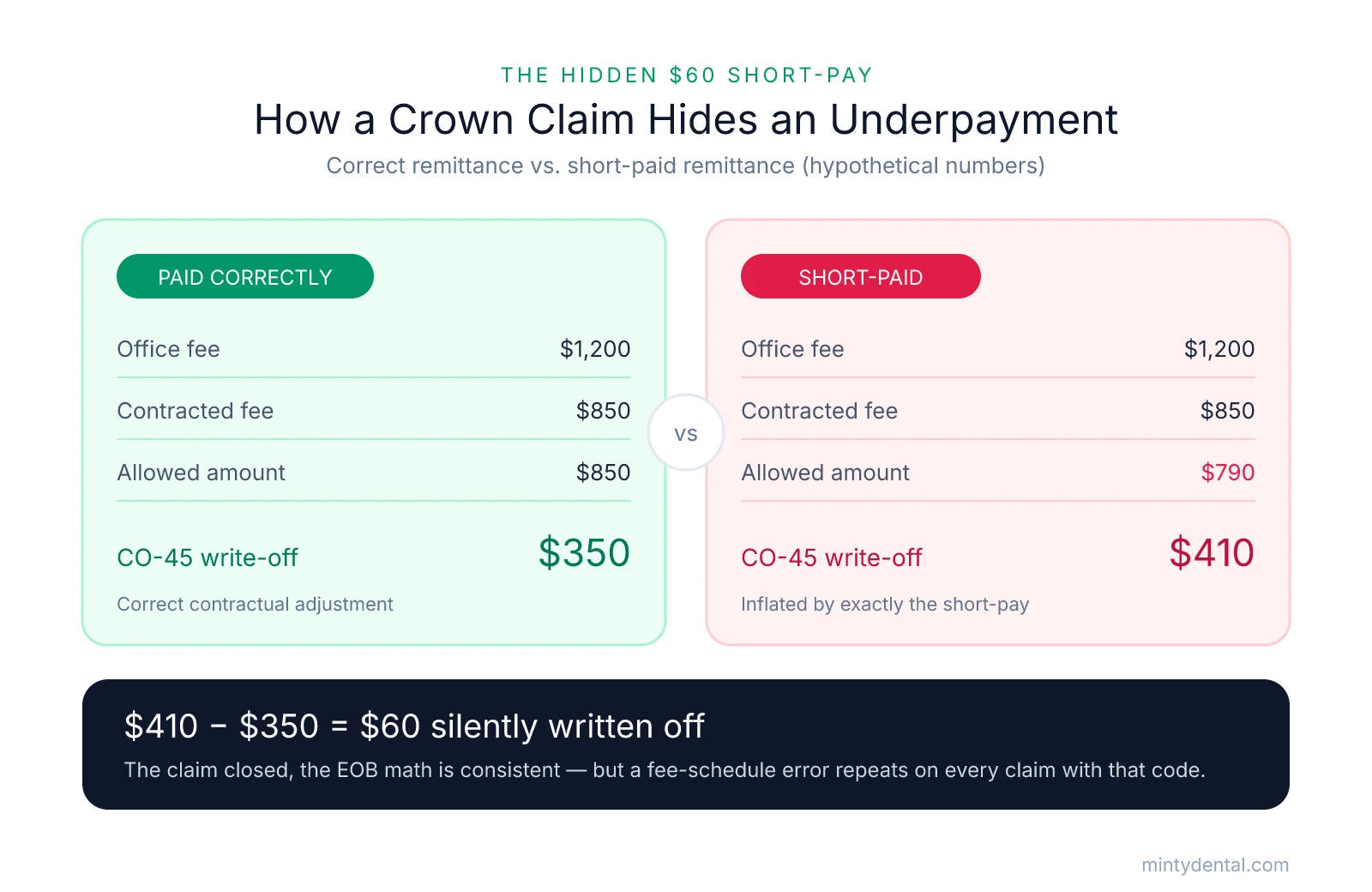
The mechanism that hides it is CO-45. That code appears on virtually every in-network line item and simply means your charge exceeds what the fee schedule allows. On a correctly paid claim, the CO-45 adjustment equals the difference between your office fee and the contracted fee, and you write it off. On a short-paid claim, the CO-45 adjustment is larger than it should be by exactly the amount the payer owes you. If your billing team posts whatever the remittance shows, that extra write-off disappears into your adjustments column without a trace.
A worked example (hypothetical numbers)
Say you submit a crown claim. Your office fee is $1,200. Your contracted fee with the PPO is $850, so the correct CO-45 write-off is $350, and the patient's portion comes out of the remaining $850 based on their plan. But the remittance comes back with an allowed amount of $790 instead of $850. The plan pays its share of $790, the patient owes their portion of $790, and the CO-45 adjustment on the remittance is $410.
If your team posts that remittance as presented, you've written off $410 when the contract entitled you to write off only $350. The $60 difference is an underpayment, and it's now sitting inside your contractual adjustment total. Nothing broke. The claim closed. The math on the EOB is internally consistent. You're just $60 short, with no alert telling you so.
That $60 is small on one claim, but payer fee schedule errors typically apply to every claim with that CDT code from that payer until someone catches it.
More than half of dentists named low reimbursement rates and delayed or denied payments as a top concern heading into 2026, and reimbursements have not kept pace with rising overhead, staffing, and supply costs. In that environment, a systematic short-pay that runs undetected for months is a meaningful problem. If your write-off percentage is trending higher than your contract mix would predict, inflated CO-45 adjustments from underpayments are one place to look.
What Counts as an Underpayment — and What Doesn't
Reading the group code first saves a lot of wasted effort. CO means the practice absorbs the adjustment; PR means the patient owes the balance. If you skip that step and route a PR-coded deductible through an appeals process, you've filed a dispute against a correctly adjudicated claim.
Most payments that feel low are explained by plan provisions, and those explanations show up in the remittance codes. A patient's deductible (PR-1) or coinsurance (PR-2, PR-3) reduces what the plan sends, but the allowed amount is untouched and the patient owes the rest. An exhausted annual maximum (PR-119) works the same way: the plan stops paying, the patient is responsible for the remainder, and the allowed amount was never wrong. Frequency limits and plan exclusions follow the same logic. These are not underpayments because they don't change what the contract says the allowed amount should be.
Alternate benefit or Least Expensive Alternative Treatment (LEAT) clauses fall into the same category. When a plan pays a posterior composite at the amalgam rate, this works as a plan provision, not a coding error or an underpayment. The plan isn't disputing your procedure; it's applying a benefit design that covers the least expensive clinically acceptable alternative. That's worth appealing in some situations (particularly when the EOB language implies you miscoded), but it isn't an underpayment unless you dig one layer deeper.
That secondary layer is where it gets interesting. If the plan downgrades your composite to amalgam and the allowed amount for the amalgam code is itself below your contracted fee for that code, the gap between what was paid and what the contract requires for that downgraded code is a real underpayment. The LEAT clause is legitimate; the short-pay against the substituted code is not.
Genuine underpayments fall into three patterns. The first is an allowed amount below your contracted fee with no remittance code explaining the shortfall — CO-45 is present, but the allowed amount is simply wrong. The second is CO-97 bundling, where the payer combines procedures into a single payment that the contract treats as separately billable; each situation needs to be evaluated against the contract before filing a dispute. The third is a claim processed out of network for a provider who is credentialed in-network, often the result of leased-network routing where your contract was accessed by a payer you didn't directly sign with; the fix is a reprocessing request with credentialing documentation, not a standard appeal.
How to Find Underpayments: A Targeted Audit by Payer and Code
The comparison that matters is not your billed fee versus what the payer sent. It's your contracted fee versus the allowed amount on the EOB. Those are three distinct numbers, and you need all three:
- Billed fee: what you submitted on the claim
- Contracted fee: what your signed PPO agreement says the payer must allow for that CDT code
- Allowed amount: what the payer actually allowed on the remittance
The gap between the contracted fee and the allowed amount is a potential underpayment. The gap between your billed fee and the contracted fee is your expected contractual write-off. Mixing those two up is where audits go wrong.
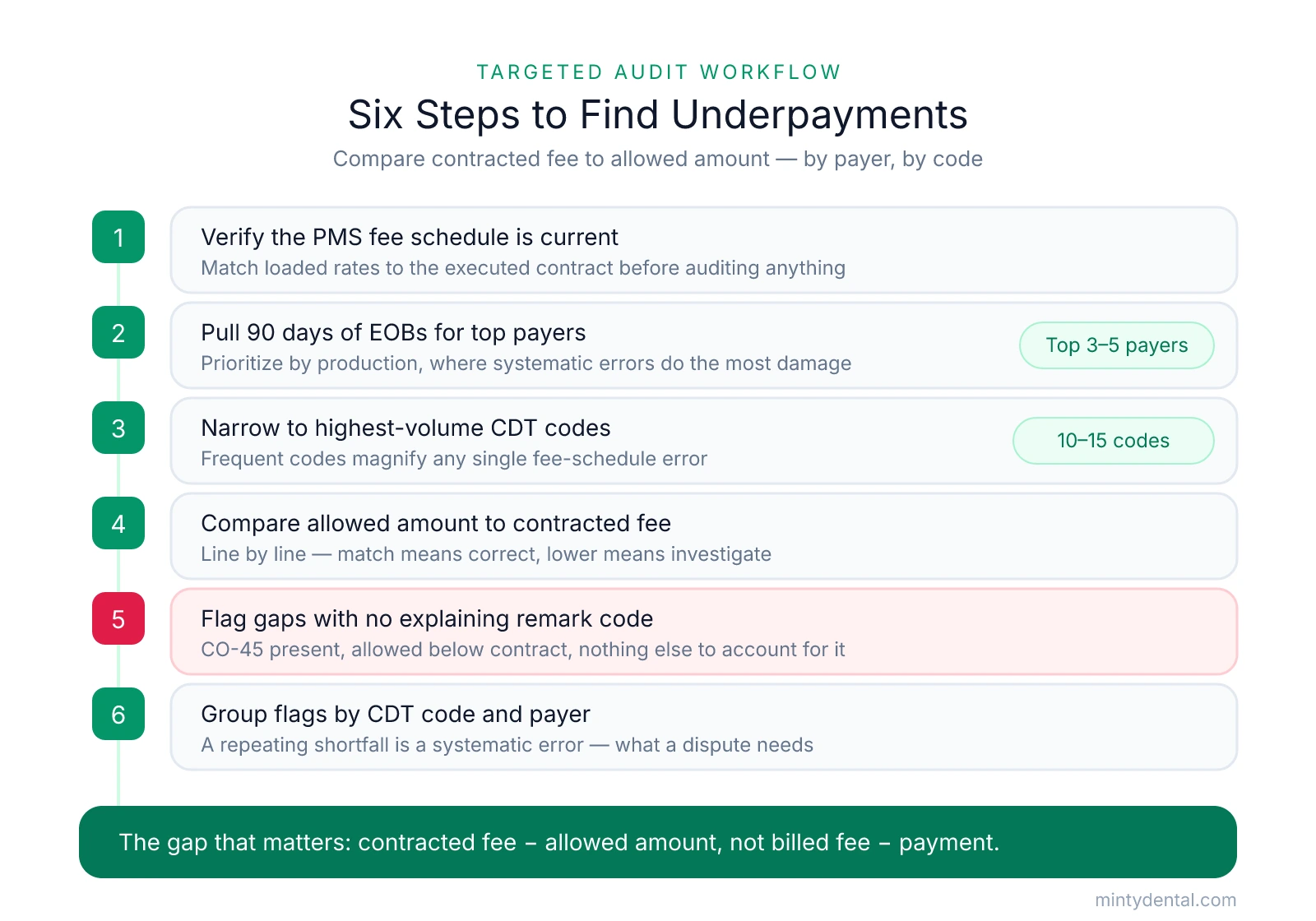
Step 1: Verify the fee schedule loaded in your PMS is current for each payer.
This is the step most practices skip, and skipping it makes every downstream comparison meaningless. If your PMS still has last year's contracted fees, you'll flag correctly paid claims as underpayments and miss real ones. PPO fee schedules can update annually or on other carrier-specific cycles, and the update often happens without any notification to the practice. Pull the executed contract or the carrier's most recent schedule confirmation and verify the loaded rates match before you audit anything.
Step 2: Pull 90 days of EOBs for your top 3 to 5 payers by production.
Auditing every payer at once isn't practical and doesn't tell you much. Start with the payers that generate the most production, because systematic fee schedule errors there cause the most damage. If you're not sure which payers to prioritize, a payer mix analysis by production will rank them quickly.
Step 3: Narrow to your 10 to 15 highest-volume CDT codes.
Evaluating your top procedures by payer is where the real revenue analysis lives, and it's also where systematic errors concentrate. A fee schedule error on a code you bill twice a week costs far more than the same error on a code you bill twice a year. Focus there first.
Step 4: Compare the allowed amount to the contracted fee, line by line.
For each claim line, look up the contracted fee for that CDT code and that specific payer. If the allowed amount matches, the claim is paid correctly. If the allowed amount is lower, move to Step 5.
Step 5: Flag lines where the allowed amount is below the contracted fee and no remittance code explains the gap.
A PR-1 deductible or a remark code pointing to a frequency limit or alternate benefit means the lower payment has an explanation. What you're looking for is a CO-45 write-off with an allowed amount that's simply below your contracted rate and nothing else on the remittance to account for the difference.
Step 6: Group your flags by CDT code and payer.
A single short-paid claim might be a processing error. The same shortfall on the same code across a dozen claims from the same payer is a systematic fee schedule error on their end. That pattern is what you're building toward, because it's also what a written dispute needs to demonstrate.
One additional leak to check while you're in the data: if your billed fee for any code is lower than your contracted fee for that payer, the payer will only allow up to what you billed. You collected less than the contract entitled you to, and the difference is gone with no dispute available. Update your office fee schedule in the PMS before the next claim goes out.
Disputing Underpayments: What to Send, to Whom, and by When
Before anything else: check the appeal window. Every PPO contract sets a deadline measured from the date of the EOB, not the date of service, and missing it closes the claim permanently regardless of how clear the underpayment is. UHC commercial is commonly cited at 65 days — the shortest among major commercial payers — though the exact figure varies by participation agreement, so verify yours. Aetna, BCBS, and Cigna commonly use 180-day windows for reconsideration, but confirm the stage-specific deadlines in each contract because Aetna, for example, sets a shorter window for the step after an initial reconsideration decision. Track these deadlines by payer in a separate column, not by memory.
Reconsideration vs. formal appeal
Most fee schedule underpayments start as reconsiderations, not formal clinical appeals. A reconsideration asks the payer to reprocess a claim because of a fee schedule mismatch or a processing error. It doesn't require you to argue a clinical decision; you're pointing to a contract and asking the payer to pay what it says. If the reconsideration fails, or if the payer denies that an error occurred, that escalates to a formal written appeal. Know which process you're initiating, because they sometimes route to different departments and have different timelines.
What to include in the dispute package
A complete package for a fee schedule underpayment contains four things: the specific claim numbers and dates of service, the EOB or ERA showing the allowed amount the payer applied, the relevant page of your signed fee schedule showing the contracted rate for that CDT code with that payer, and a plain statement of the discrepancy. Something like: "The contracted fee for D2740 is $850. The allowed amount on claim 123456 dated March 12 was $790. The difference of $60 was written off as a CO-45 adjustment and should be recovered." No clinical narrative needed. The contract is the argument.
Dispute in batches, not one call at a time
If your audit turned up the same shortfall on D2740 across 30 claims from the same payer, one letter with a numbered claim list is both more efficient and more persuasive than 30 individual calls. It signals a systematic problem and makes it harder for the payer to treat each instance as a one-off processing error.
A phone call is not an appeal. A proper appeal requires a written request, and phone conversations don't create the paper trail you need if the dispute escalates. Put the word "appeal" in the subject line of your written submission so it routes to the right department rather than sitting in a general correspondence queue.
If the payer's internal process doesn't resolve it, your state insurance commissioner's office is a legitimate escalation path. Regulators take systematic underpayment patterns seriously, and filing a complaint sometimes moves a stalled dispute faster than another round of internal correspondence.
The connection to your collection rate
Undetected underpayments suppress net collections, so if your collection rate is trending below where it should be, systematically comparing allowed amounts to contracted fees by payer and code is one of the more targeted places to look.
Sources & References
The data and claims in this article are drawn from the following sources. We prioritize government data, peer-reviewed research, and established industry publications to ensure accuracy.
- Dear ADA: Reimbursement rates | American Dental Association— adanews.ada.orgIndustry
- Downcoding | American Dental Association— ada.orgIndustry
- PPO Fee Schedule Audit: Find Underpaid Codes | IDPS— idpracticesolutions.comIndustry
- Exact Deadlines by Payer (Aetna, BCBS, UHC, Cigna & More)— muni.healthIndustry
- Downcoding | American Dental Association— ada.orgIndustry
See Where Your PPO Crown Fee Stands Today
If your audit turns up allowed amounts that do not match your contracted fees, the first question is whether your loaded fee schedule reflects what your contract actually negotiates. A Rate Check shows where your crown fee sits for your area and what a group fee schedule arrangement could change.