How to Transition a Dental Practice from PPO to Fee for Service

Co-Founder, Minty Dental
In Summary
- Going fee-for-service means terminating your in-network participation agreement, not simply raising fees. Patients can still submit claims as out-of-network.
- PPO contractual adjustments cost the average dental practice 30 to 45% of production, compounding the effect of rising overhead costs.
- Average GP net income has declined significantly over the past 14 years after adjusting for inflation, with practice expenses outpacing revenue growth.
- Nearly 1 in 3 dentists planned to resign from at least one PPO in 2025, making this a mainstream business decision rather than a fringe strategy.
- The most common failure mode is sequencing: practices drop the wrong plan first, drop before negotiating, or never calculate how many patients they can afford to lose.
The Right PPO-to-FFS Sequence Prevents the Revenue Crater Most Practices Fear
Going fee-for-service means one specific thing mechanically: you terminate your in-network participation agreement with a carrier. Once you do that, the carrier no longer controls your fee schedule. Your patients with that insurance can still file claims and receive whatever out-of-network benefits their plan provides, but your practice collects at your full fee rather than the contractually reduced rate. That distinction matters because it shapes how you communicate with patients and how you model the financial impact before you act.
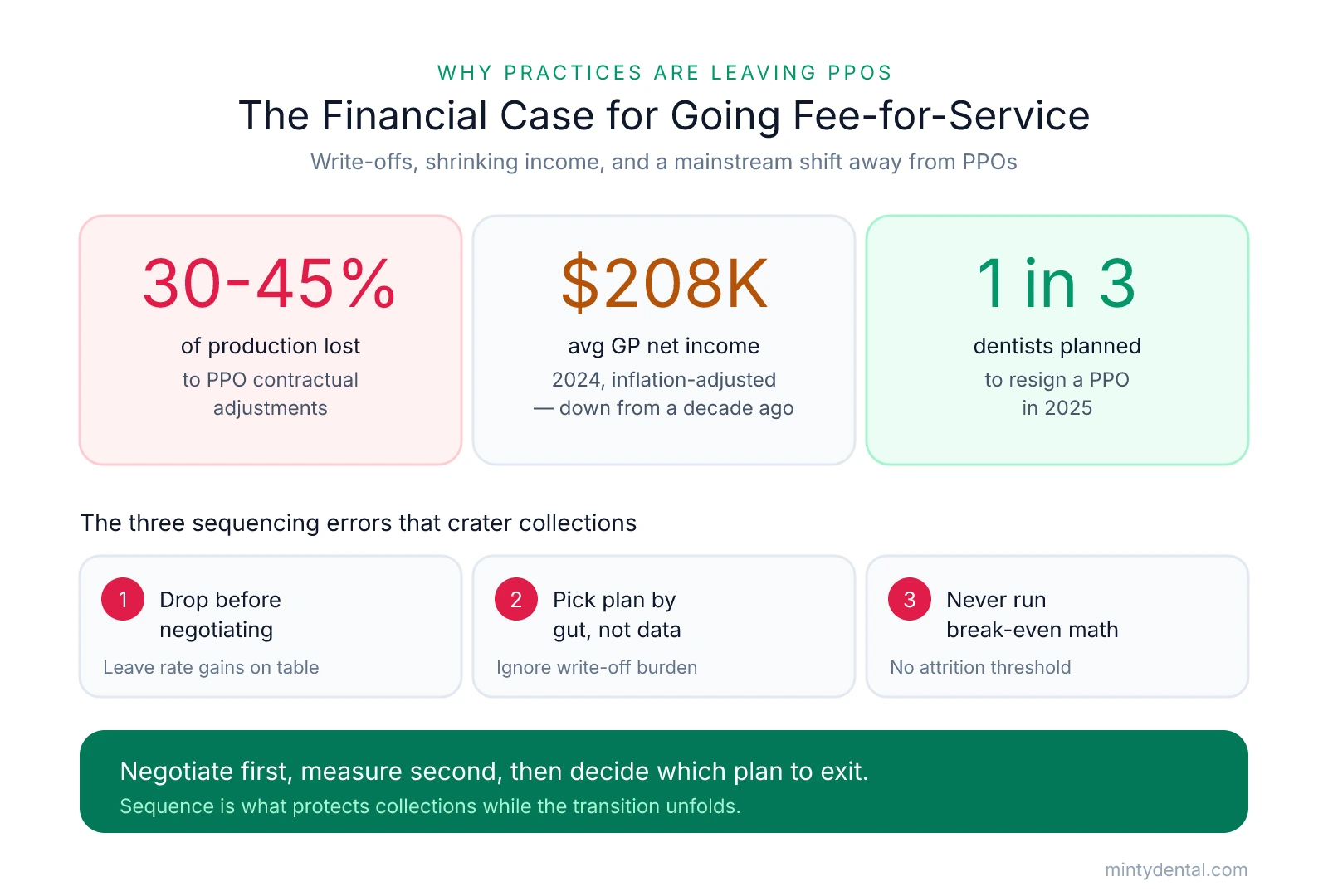
The motivation to make this move is easy to understand when you look at the numbers. PPO contractual adjustments reduce the average practice's realized revenue by 30 to 45% of production, according to a 2026 meta-analysis synthesizing data from more than 100 industry and peer-reviewed sources. That figure compounds when you factor in claim denials, downcoding, and reimbursement rates that have stayed flat while supply and labor costs have risen sharply. The result is a practice that produces at one level and collects at a substantially lower one, with overhead marching in the opposite direction.
The income data reinforces this pressure. Average GP net income has fallen to roughly $208,000 in 2024 after adjusting for inflation, down from significantly higher levels a decade ago, with practice expenses outpacing revenue growth year over year. PPO write-offs are not the only cause, but they are a structural one, the kind that recurs with every claim regardless of how efficiently the practice runs.
Owners who recognize this pattern are acting on it. Nearly 1 in 3 dentists planned to resign from at least one PPO plan in 2025, which means this is no longer a niche philosophical stance. It is a mainstream operational decision, comparable to renegotiating a lease or restructuring a staffing model.
The problem is not that owners lack motivation. It is that the transition frequently underperforms because of how it is sequenced. Practices that lost significant revenue during a PPO exit typically made one of three errors: they dropped a plan before attempting to negotiate better rates with that carrier, they chose which plan to exit based on gut feel rather than write-off data, or they never calculated how many patients they could afford to lose before collections would actually improve. Any one of those errors can turn a sensible long-term strategy into a short-term collections problem that rattles the whole practice.
Before resigning from any contract, most practices have meaningful room to improve reimbursement rates through negotiation, which changes the financial case for dropping entirely. After negotiation, break-even retention math tells you what patient attrition is actually acceptable for a given plan. And ranking plans by write-off burden, patient volume, and replaceability tells you which to exit first. The sequence is what protects collections while the transition unfolds.
Run the Break-Even Math Before You Drop Anything
To find your break-even retention threshold, take what you currently collect from a given plan and divide it by what that same production would generate at your full fee. The result is the percentage of patients you must retain at full fee for collections to hold flat after you go out of network. Every patient above that threshold is additional revenue.
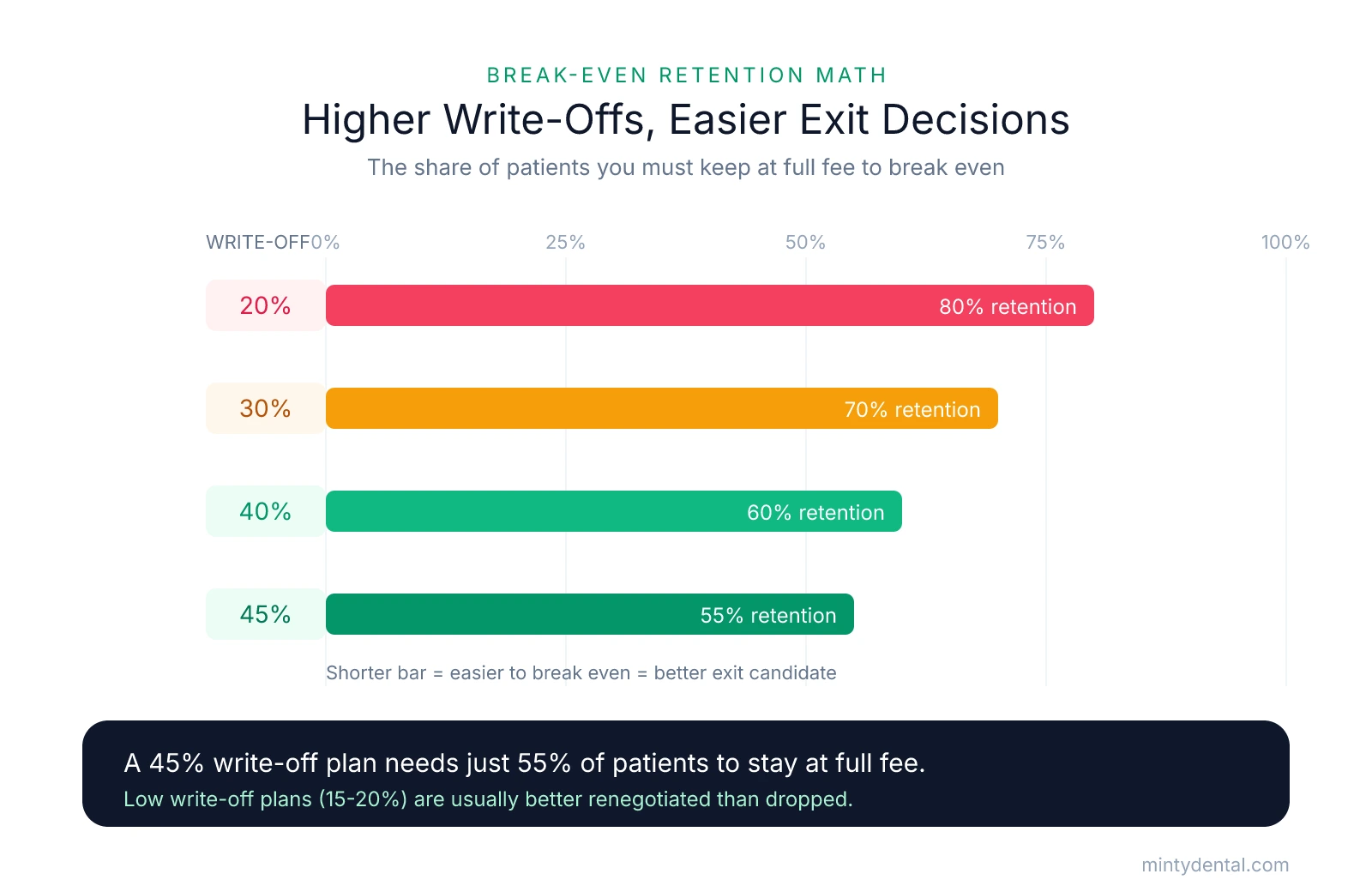
A hypothetical example makes this concrete. Say a carrier applies a 40% write-off to your submitted fees, meaning you collect 60 cents on the dollar for every procedure billed to that plan. Divide 60 by 100 and your break-even retention threshold is 60%. You can lose up to 40% of that carrier's patients entirely, replace none of them, and still collect the same dollars from the ones who stay. If your patient communication is strong, you'll typically do better than that.
The table below shows how this relationship holds across common write-off rates:
| Write-Off Rate | What You Collect Per Dollar Billed | Break-Even Retention Threshold |
|---|---|---|
| 20% | $0.80 | 80% |
| 30% | $0.70 | 70% |
| 40% | $0.60 | 60% |
| 45% | $0.55 | 55% |
A 45% write-off plan is often the easiest exit decision on paper. You only need to hold onto just over half of those patients at full fee. A 20% write-off plan is a different story: you'd need to retain 80% at full fee to break even, which is a much narrower margin for patient attrition.
That threshold difference drives the ranking logic. Plans with the highest write-off rates have the lowest break-even thresholds, which means they carry the least financial risk to exit and the most upside when patients stay. Plans with low write-offs, say 15 to 20%, have thresholds high enough that exiting them often produces a net negative, particularly if those patients have strong loyalty to their in-network benefits. Those plans are usually better candidates for renegotiation than exit.
Across more than 4,000 dental practices, the plans dentists most want to drop are often the ones that simply need renegotiation — and that renegotiation can meaningfully shift the math, with one national carrier moving from 56% to 70% of full fee on the same production, worth roughly $21,000 per year without a single additional patient. That kind of movement changes where a plan sits on your ranking and may remove it from the exit list entirely. The sequence is negotiate first, measure second, then decide.
One more thing to audit before you execute any termination: shared network agreements. Many PPO contracts contain clauses that allow the carrier to share your fee schedule with other payers you've never directly credentialed with or negotiated. These arrangements can silently enroll your practice into additional networks paying lower rates, with the revenue impact often running $20,000 to $50,000 per year in additional write-offs. The trap at termination is that resigning from one contract does not automatically sever the shared relationships attached to it. Pull your EOBs and look for unfamiliar payer names before you send any termination letter, so you know exactly which network relationships you're actually ending.
Build the Bridge Before You Burn the Contract
Break-even math tells you which plan to exit first, but it doesn't tell you whether your practice is ready to execute that exit without a collections dip. Three things need to be in place before you send any termination letter: a schedule running near capacity, an in-house membership plan, and a non-PPO source of new patients.
Schedule capacity first. If your schedule has consistent open chair time, dropping a PPO removes volume without a replacement source. That's not a transition, it's just a revenue cut. The exit should happen when the schedule is full enough that losing some percentage of a plan's patients creates manageable breathing room rather than a gap that erodes production. If you're running 15 to 20% open time, address that first, whether through hygiene recall systems, reactivation campaigns, or other demand-side fixes. A full schedule gives you the buffer that makes the break-even math work in practice, not just on paper.
Build the membership plan before you need it. An in-house membership plan is the single most effective tool for keeping newly out-of-network patients in the practice. When a patient's insurance no longer applies, they need a reason to stay that's grounded in value rather than habit. A well-structured membership plan gives them one: a defined annual fee, covered preventive care, and a discount structure that makes treatment financially approachable without requiring an insurer. Practices that phase down PPOs over three to five years while simultaneously building membership plans consistently retain 70 to 85% of their patient base, compared to far higher attrition rates when practices drop plans without any bridge in place.
Annual membership fees typically run $300 to $500 per patient. Before you set pricing, model the revenue math: if 200 patients from a dropped plan convert to membership at $350 per year, that's $70,000 in predictable annual revenue before any treatment is billed. Layer in the full-fee production from those patients and the financial picture often looks better than the PPO arrangement it replaced. The Minty guide on setting up an in-house membership plan covers structure and pricing in more detail.
Establish a non-PPO new patient pipeline. PPO directory listings are a passive acquisition channel, meaning they deliver patients without any active effort from the practice. When you exit a plan, that channel closes. Online reputation, patient referral systems, and content visibility need to be generating inquiries before the first termination takes effect, not after. A referral network built on specialist relationships and patient advocacy is the most durable replacement because it isn't tied to any directory or payer relationship.
One point that's easy to overlook: when patients hear about an insurance change in the operatory, they go home and check. If your website still lists the plan you just terminated, or your Google Business Profile still shows "we accept" language for that carrier, the contradiction does the damage rather than the news itself. Patients default to what they can read at midnight over what they heard from your hygienist. The insurance page, GBP services section, and any "in-network with" language on the site need to be updated at the moment of patient notification, not weeks later.
Executing the Exit: Termination, Patient Communication, and Monitoring
Before you send a termination letter, pull the actual contract for the plan you're exiting and read the notice requirements. Most PPO agreements require 60 to 90 days written notice, but the more consequential clause is the auto-renewal provision. Some contracts roll over automatically at the anniversary date, and if you miss the notice window, you're locked in for another full term. Sending termination on day 61 when the contract required 90 days of advance notice before renewal means you've just extended your commitment by a year. Know the window, then calendar it.
Once you've submitted written notice to the carrier, notify your patients before the carrier does. Carriers sometimes send EOB language or coverage letters that reach patients before the practice has said anything, and patients who learn about the change from an insurance company rather than their dentist understandably feel blindsided. The most effective communication isn't a letter, though you'll send one. It's a chairside conversation during the patient's next appointment. Tell the patient what changes, what stays the same, and what options they have. What changes is their out-of-pocket cost for some procedures. What stays the same is their care, their provider, and their relationship with the practice. What they have available is your membership plan, whatever out-of-network benefits their plan provides, and patient financing if they're facing a larger treatment plan. Patients who understand all three of those things before they leave the chair are far less likely to disenroll than patients who receive a letter and have questions no one has answered.
The reason this conversation works when a letter alone doesn't comes down to trust. Patient loyalty is closely linked to perceived value of care, including factors like the quality of the relationship and confidence in the provider, not just insurance coverage status. A patient who genuinely trusts their dentist will weigh the cost of staying differently than a patient who chose the practice because it appeared in a carrier directory. That relationship is your primary retention asset during the exit.
After termination takes effect, resist the urge to move immediately to the next plan on your ranking list. Drop one plan, then let the practice run for three to six months before making another exit decision. During that window, track three numbers every month: collections per plan (not just production, which can look fine while write-offs accumulate), new patient source mix to confirm your non-directory pipeline is still generating volume, and hygiene reappointment rate as the clearest leading indicator of whether patients who stayed are staying engaged. If those three numbers hold, your actual retention is tracking at or above your break-even threshold and you can move to the next plan with confidence. If one of them softens, you'll know before the annual P&L tells you something went wrong.
A full transition from heavily PPO-dependent to predominantly fee-for-service typically takes three to five years when done in stages. That timeline is a feature, not a limitation. It's what allows each exit to stabilize before the next one creates a new adjustment period. The practice that's done this correctly at the end of year five looks structurally different: fewer write-offs, predictable membership revenue, a schedule driven by patient relationships rather than directory listings, and collections that reflect what the practice actually produces.
The next record to inspect is your current termination notice period for the first plan on your ranking list. Compare it against the contract renewal date, confirm you're outside any auto-renewal window, and work backward to set a notice date. That single calendar entry is where the execution actually begins.
Sources & References
The data and claims in this article are drawn from the following sources. We prioritize government data, peer-reviewed research, and established industry publications to ensure accuracy.
- [PDF] Dental PPO Collection Loss Analysis— cdr.lib.unc.eduAcademic
- Is the profession struggling? ADA study reveals dentists' revenue, net ...— dentaleconomics.comIndustry
- Dropping PPO Plans: 3 Critical Numbers to Run First— ppoadvisors.comIndustry
- Shared Network Agreements Dental: 5 Hidden Traps Costing You ...— ppoadvisors.comIndustry
- Proven Guide To Reducing Dental Insurance Dependence— dentalpracticeinsider.orgIndustry
- How To Drop A PPO Plan Without Losing Your Best Patients - Practiwrite— practiwrite.comIndustry
- Patient loyalty is closely linked to perceived value of care— ncbi.nlm.nih.gov
- 6 Steps to Successfully Dropping Your Favorite PPO - AADOM— www.dentalmanagers.com
Cut Write-Offs Without Cutting Your Patient Base
Dropping PPO plans reshuffles your revenue mix and your front-desk workflows at the same time. Minty Operations helps independent practice owners manage the billing and communication systems that keep collections stable through a fee-for-service transition.