How to Fill Open Time in Your Dental Schedule Without Discounting

Co-Founder, Minty Dental

In Summary
- The average dental practice runs a 15-20% no-show rate, which translates to roughly $120,000 to $240,000 per year in lost production for a typical practice.
- The cost of an empty slot is larger than the missed fee alone because fixed overhead such as staff wages, rent, equipment depreciation, and utilities continues whether or not a patient is in the chair.
- Discounting to fill open time can violate insurance contract terms, attract price-motivated patients who cancel again, and signal to existing patients that standard fees are negotiable.
- Three non-discount systems address open time at its source: intentional schedule design, a fast-fill waitlist, and the unscheduled treatment report.
Open Chair Time Costs More Than the Missed Appointment, and Discounting Makes It Worse
The average dental practice experiences a 15-20% no-show rate, which means roughly one in six scheduled appointments goes unfilled. For a typical practice, that pattern costs $120,000 to $240,000 per year in lost production, and practices with no-show rates above 15% tend to run measurably lower profitability than those holding rates below 8%.
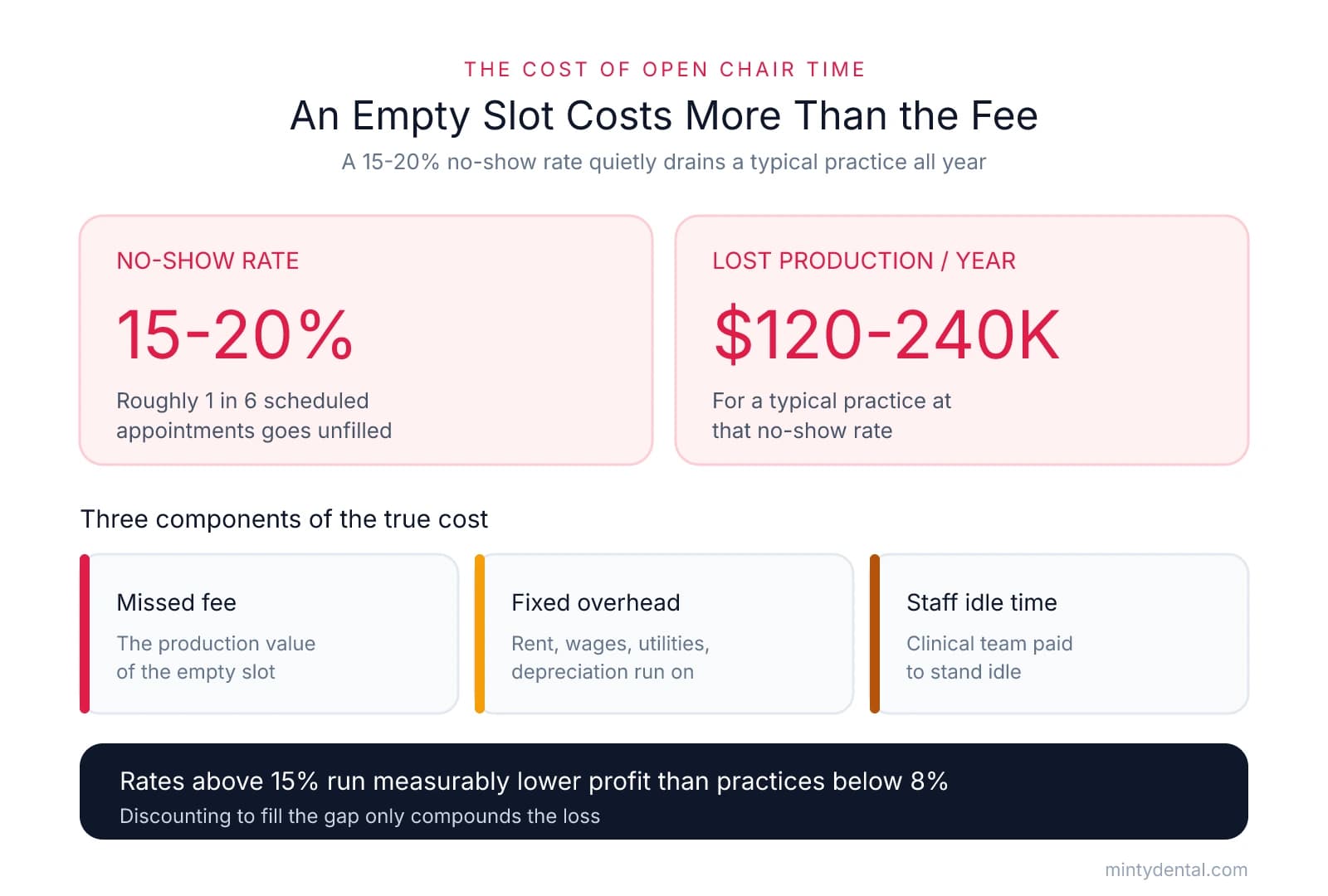
The true cost of an empty slot has three components: the missed production fee, the fixed overhead that runs regardless of whether the chair is occupied, and the staff utilization loss when clinical team members are paid to stand idle. To estimate your own figure, add the average production value of the slot to the hourly overhead the practice absorbs during that time. Because rent, wages, equipment depreciation, and utilities continue whether or not a patient shows, the loss is not limited to the fee on the treatment plan. A useful comparison is your practice production per hour, since that number reflects both the revenue and the cost structure a single open hour represents. Owners who want to work through the underlying math can start with production-per-hour benchmarks.
Discounting to fill that time tends to create three compounding problems.
- Contract and compliance exposure. Any fee adjustment must be reported to the patient's benefit plan, and failure to notify the carrier can be considered fraud even when it results from a simple oversight. Some carrier contracts also treat discounts as a change to your filed fee.
- Patient mix. Discounts tend to attract patients whose primary motivation is price rather than continuity of care, and this group is more likely to cancel again.
- Fee erosion. Repeated discounts signal to the existing base that the standard fee is negotiable, which makes future collections harder.
Structural Prevention: Design the Schedule to Reduce Gaps Before They Happen
Block scheduling reserves specific time windows for specific procedure categories rather than booking whatever appointment type calls first into whatever slot is open. Most schedules are assembled reactively, one appointment at a time, which lets high-production restorative procedures get scattered or crowded out by lower-value appointments that happened to book earlier. Two days with identical appointment counts can differ substantially in production and in how manageable the day feels, because the reactive version organizes itself by accident.
The starting point is a daily production goal. General dentists typically target between $4,600 and $6,900 per day depending on procedure mix, fee schedule, and number of operatories, with roughly $4,600 fitting a solo provider doing bread-and-butter dentistry alongside one or two hygienists. To find your own figure, divide your annual collection goal by the number of days you work. A practice targeting $1.2 million across 180 clinical days needs about $6,700 per day.
Once the daily goal is set, you can work backward to determine how many high-value blocks the day requires. If one restorative block produces roughly $2,000, a $6,000 goal implies three protected restorative windows, with hygiene, new patients, and short-notice needs arranged around them.
| Dimension | Reactive day | Block-scheduled day |
|---|---|---|
| High-production restorative | 1 crown, booked mid-afternoon | 3 restorative blocks in prime morning slots |
| Hygiene | Scattered, some overlapping | Grouped, balanced across hygienists |
| New patients | Wherever a slot opened | Reserved early-day windows |
| Emergency/short-notice | Squeezed in, disrupting flow | Dedicated buffer blocks |
| Typical gaps | Unpredictable idle stretches | Absorbed by buffer blocks |
| Daily production | Below capacity | At or near goal |
Emergency and short-notice blocks serve two functions. They absorb same-day needs without pushing planned procedures off the schedule, and when a cancellation occurs elsewhere, the buffer block gives the front desk a natural place to move a waiting patient without redesigning the day.
The daily checkpoint that keeps the system working is the morning huddle. Reviewing the schedule about 24 hours out lets the team spot gaps before patients arrive and assign responsibility for filling any open slots. Practices weighing whether persistent gaps point to a capacity problem rather than a scheduling one can compare the tradeoffs in expanding hours versus adding an associate.
Reactive Fill: Build a Waitlist System That Works Before the Cancellation Happens
Even a well-designed schedule produces occasional gaps. Two tools convert those gaps into filled slots rather than lost production: a maintained ASAP list of patients ready to come in sooner, and a multi-channel confirmation process that signals a likely cancellation before the slot goes empty.
An ASAP or short-call list is a running record of patients who have indicated they would come in earlier than their scheduled appointment, or who have a pending treatment need and flexible availability. This is the highest-return tool for filling last-minute gaps because it turns a cancellation into a filled slot rather than idle chair time. The list only works when it stays current, which depends on a few maintenance habits:
- Add patients at checkout whenever they mention wanting an earlier date or flexibility during the week.
- Flag them in the practice management system with a preferred time window so the front desk can match a patient to the specific slot that opens.
- Review the list weekly and remove patients whose circumstances have changed, keeping it to a rolling 30 to 60 day window so contacts stay accurate.
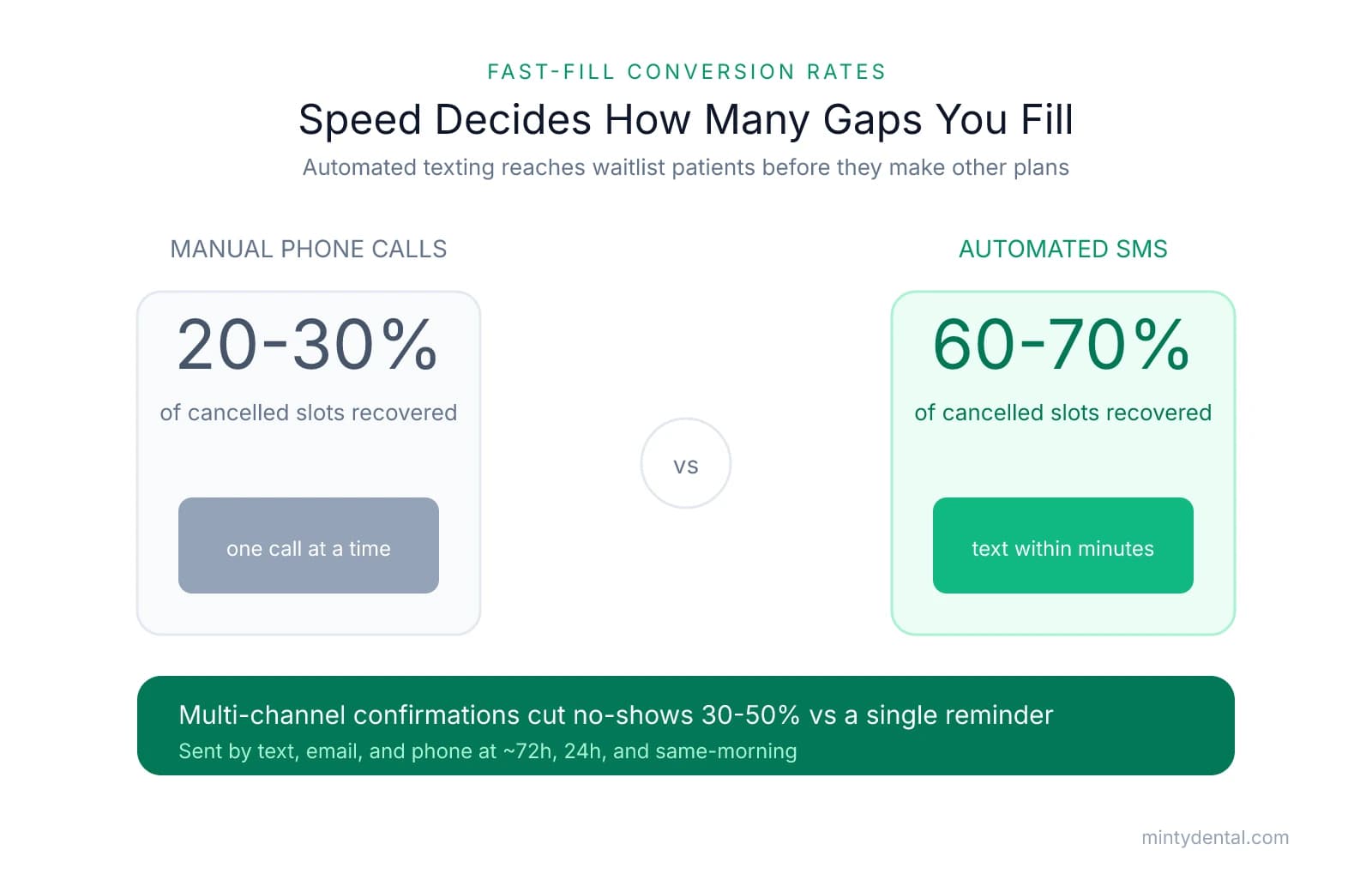
Speed determines how many of those calls convert. Automated SMS outreach recovers 60 to 70% of cancelled slots, compared to 20 to 30% for manual phone calls, primarily because a text reaches waitlist patients before they make other plans and lets them respond on their own schedule. When a gap opens, sending a matched text within minutes reaches more available patients than working down a paper list one call at a time.
Appointment reminder systems reduce no-shows, though single-channel reminders leave measurable room for improvement. Multi-channel confirmations sent by text, email, and phone at roughly 72 hours, 24 hours, and same-morning intervals tend to lower no-show rates by 30 to 50% relative to a single reminder, because different patients respond to different channels and timing.
A one-way reminder delivers information but tells the team nothing. A two-way confirmation that requires a patient response ("Reply C to confirm or R to reschedule") gives the front desk early warning when a patient does not confirm or asks to move the appointment. That signal lets the team activate the ASAP list a day ahead rather than reacting after the chair is already empty, creating the front desk capacity to fill these slots before they become open time.
Proactive Fill: Run the Unscheduled Treatment Report Your Software Already Has
The unscheduled treatment report lists patients who were diagnosed, accepted the treatment plan, and never booked the appointment. Patients on the list have already sat in your chair, heard the recommendation, and said yes. Most practices accumulate tens of thousands of dollars of accepted-but-unscheduled treatment over a couple of years, and in many cases the accepted-but-unscheduled total exceeds the annual marketing budget while sitting in a report nobody has queried.
New-patient acquisition is the comparison that makes this outreach worth prioritizing: a new patient from paid advertising costs $70 to $150 in general dentistry and more for specialty work, while a patient on this list costs a phone call.
Pulling and prioritizing the report
Dentrix, Eaglesoft, and Open Dental all produce this report under slightly different names, such as treatment plan reports, pending treatment, or treatment opportunity. If you cannot locate it, your software support line can walk you through it.
Filter for accepted treatment with no appointment attached, dated within the last 18 to 24 months. Older cases often need clinical re-evaluation, so the diagnosis may need redoing before you can rebook. Then sort by case value and work the largest cases first, since a $3,000 crown and a $180 filling both appear on the list but do not warrant the same follow-up effort.
The three reasons patients accept and never book
- Cost. This is usually unspoken. Framing the case as a monthly payment or offering a financing option recovers many patients without any fee reduction.
- Time. Offering two or three specific appointment dates removes the friction of asking the patient to call back and find their own slot.
- Fear. A follow-up that mentions sedation options or invites a no-pressure conversation reaches patients who would rarely raise the concern themselves.
Because unscheduled treatment often signals a gap in how cases are presented, practices seeing large volumes on this report may find it worth examining their case acceptance process as well.
Combine the three systems into a weekly rhythm
Rather than implementing every tactic at once, start with a manageable weekly cadence: use the morning huddle to review next-day gaps, use the ASAP list for same-week openings, and reserve one dedicated 30-minute block for unscheduled-treatment outreach.
For practices whose lists also include patients overdue for hygiene, that same outreach block can dovetail with efforts to bring back lapsed patients.
Sources & References
The data and claims in this article are drawn from the following sources. We prioritize government data, peer-reviewed research, and established industry publications to ensure accuracy.
- Predicting no-shows for dental appointments - PMC - NIH— pmc.ncbi.nlm.nih.govGovernment
- Dental No-Show Statistics & How AI Reduces Them (2026 Data) - AInora— ainora.ltIndustry
- Discounts | American Dental Association— ada.orgIndustry
- How to Fill Last-Minute Cancellations and Holes in Your Dental Schedule— schedulinginstitute.comIndustry
- How Much Should a General Dentist Produce Per Day?— www.mgeonline.com
- Fill Dental Cancellations Fast With a Smart Waitlist [Guide]— ustechautomations.comIndustry
- Appointment reminder systems are effective but not optimal - PMC— pmc.ncbi.nlm.nih.govGovernment
- How to Pull and Work Your Unscheduled Treatment Report— dentalmarketingdynamite.comIndustry
Ready to optimize your practice schedule?
Filling schedule gaps strategically requires the right systems and support. Minty's operations team helps independent practices streamline scheduling, reduce no-shows, and maximize chair time through proven processes and technology.