Expand Dental Practice Hours or Hire an Associate?

Co-Founder, Minty Dental

In Summary
- A single general dentist can typically serve 1,000 to 2,000 active patients, defined as those seen in the last 18 to 24 months.
- Hygiene booked 4 to 6 weeks out and new patient waits beyond 2 to 3 weeks are the clearest signals of genuine provider capacity pressure.
- Operational leaks like unanswered calls, low case acceptance, and unscheduled treatment can create the feeling of being at capacity without the reality of it.
- Pull three numbers before choosing a path: active patient count, new patients per month, and hygiene schedule availability.
- With practice expenses outpacing revenue growth in recent years, confirming real demand matters before adding fixed costs through either hours or a new provider.
Diagnose Whether Your Capacity Is Actually Full Before Choosing a Growth Path
Before comparing extended hours against hiring an associate, it helps to confirm that the practice is genuinely full rather than only feeling that way.
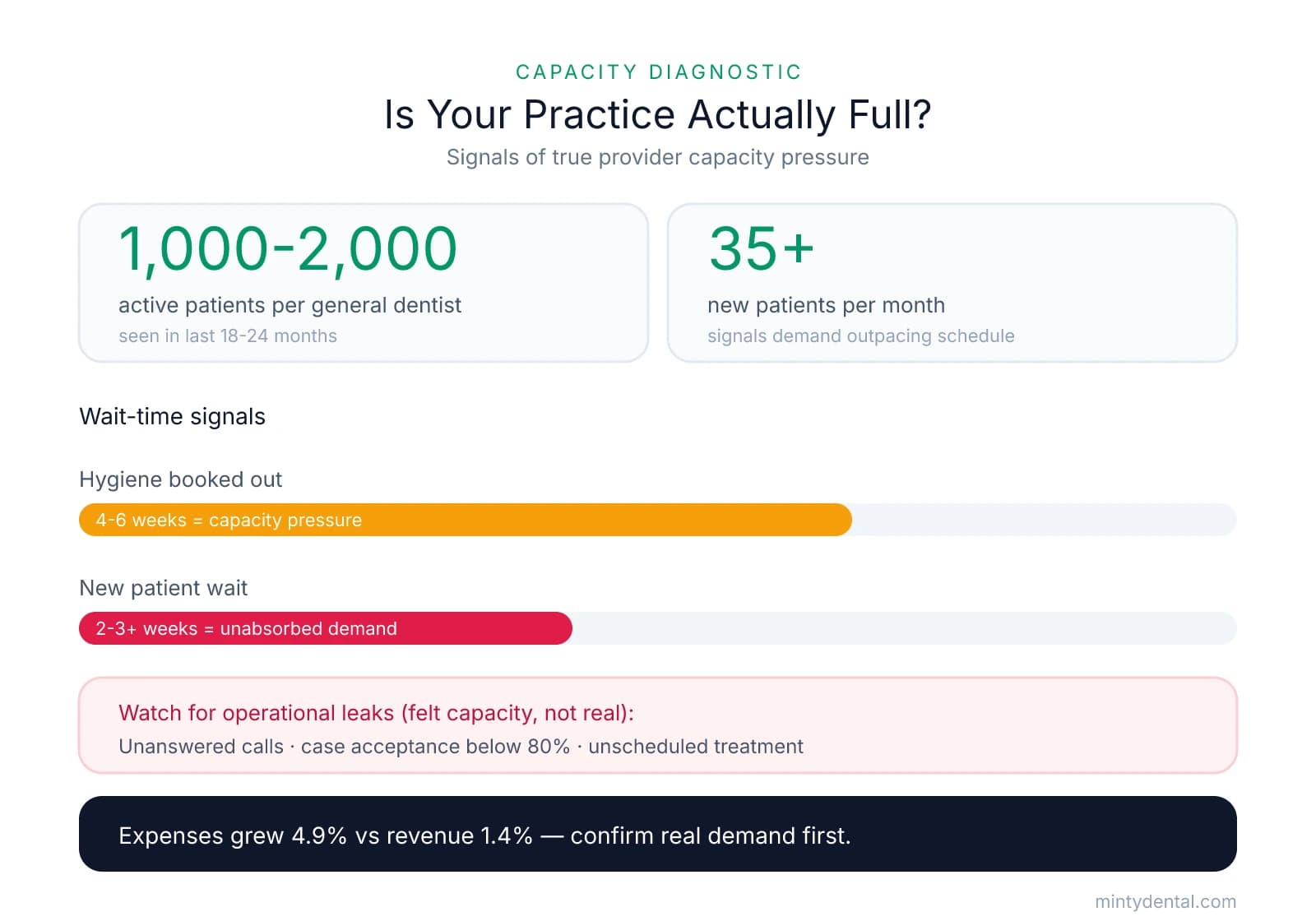
True capacity versus felt capacity: True capacity means patients cannot be seen within about three weeks of requesting an appointment because the provider's chair time is genuinely booked. Felt capacity is the sense of being maxed out that comes from a chaotic schedule, missed follow-ups, or a front desk that cannot keep pace. The two feel identical from the operatory, but they call for different responses.
A single general dentist can typically care for 1,000 to 2,000 active patients, counting only those seen in the last 18 to 24 months. Patients of record who have not visited in more than two years are not contributing to current capacity pressure, so they should be excluded from the count. When active patients approach that ceiling and hygiene is booked four to six weeks out, that combination is a reliable signal of provider capacity pressure rather than an operational problem.
New patient wait times also matter. Waits beyond two to three weeks indicate demand the current schedule cannot absorb, which is a prerequisite condition for either growth path to pay off.
Operational leaks can mimic all of this without the practice being truly full. Unanswered calls, a case acceptance rate below the 80% many advisors target, and treatment that stays unscheduled all suppress production while making the day feel packed. Practices lose more new patient opportunities than most owners expect, as covered in the review of how many calls the front desk misses, and low acceptance is often addressable, as discussed in the guide on raising case acceptance rates. Adding hours or a provider to a practice that isn't converting existing demand tends to spread the same patients thinner.
This diagnostic matters more now because practice expenses grew 4.9% while revenues grew only 1.4% over a recent five-year period, narrowing the margin for absorbing new fixed costs. Pull three data points before deciding: active patient count, new patients per month, and hygiene schedule availability.
How the Financial Mechanics Differ Between Extended Hours and an Associate Hire
Once real demand is confirmed, the two paths diverge sharply in how they affect cost structure and profit. The core difference comes down to what happens to fixed costs and how much of each new dollar reaches the owner.
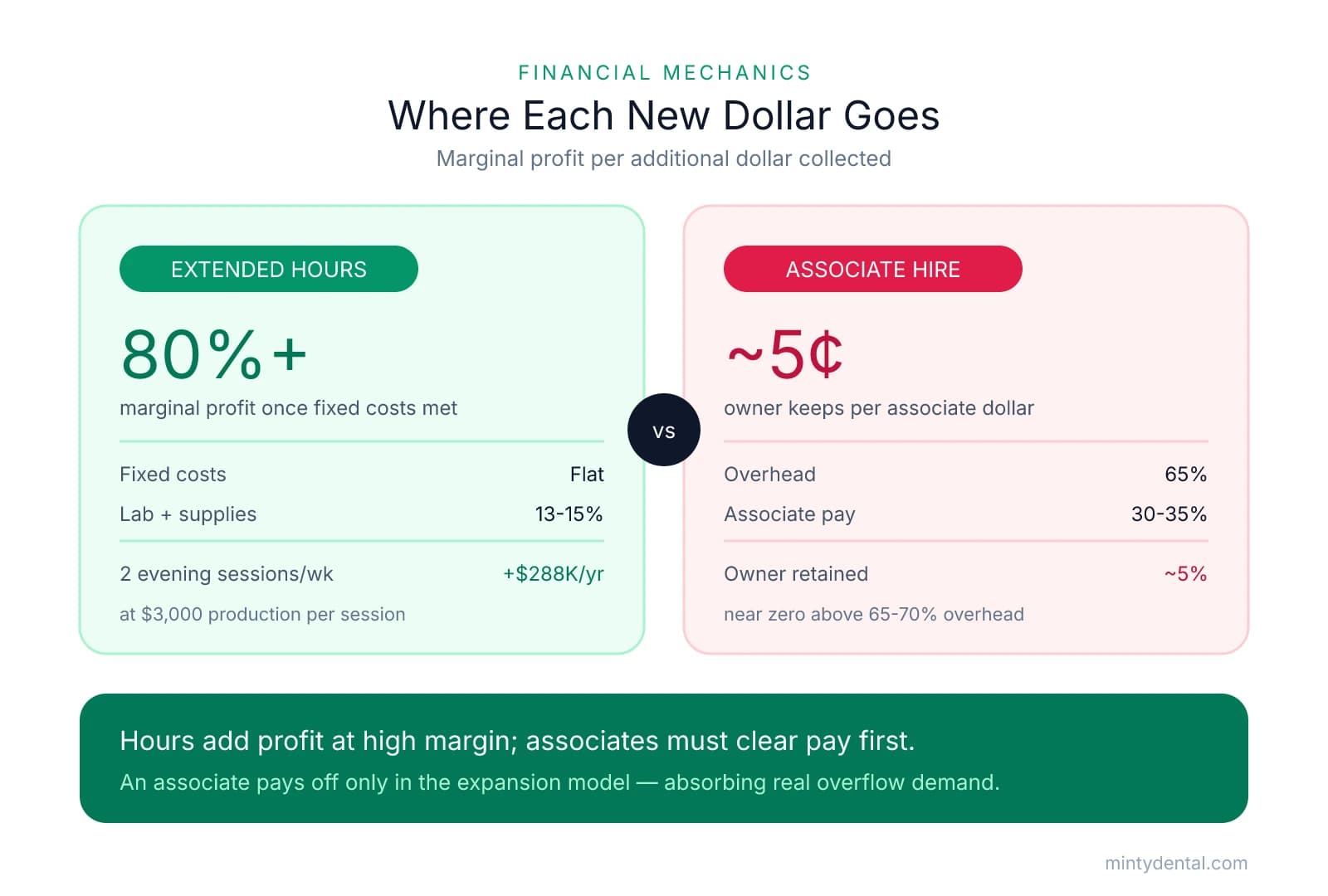
Extended hours keep fixed costs flat. The same lease, equipment, and software already cover the practice, so added sessions absorb more production without adding to those expenses. Because the first dollars each month go toward covering fixed costs, the incremental dollars produced after that point are subject mostly to variable costs. With lab and supplies averaging roughly 13 to 15% of collections, each additional dollar collected once fixed costs are met can carry marginal profitability exceeding 80%. Extended hours still require staffing, however. Filling evening or weekend sessions means paying front desk, assistant, and often hygiene coverage, which adds variable labor cost and may trigger overtime or weekend pay differentials.
Consider a practice adding two evening sessions per week at $3,000 production per session. That adds roughly $288,000 in annual production against a largely unchanged fixed cost base, but the gain depends entirely on demand consistently filling those slots.
An associate introduces a new cost that production must clear first. Collections-based compensation for general dentists typically runs 30 to 35% of collections. At 65% overhead plus 30% associate pay, the owner retains roughly 5 cents on each associate-generated dollar. In practices running above 65 to 70% overhead, that retained margin can approach zero before the owner takes any income. The full financial-sense analysis covers this threshold in more detail, and modeling different splits through an associate compensation calculator can show where the breakeven sits for a specific practice.
Whether an associate improves or compresses margin depends on which model applies:
- Expansion model: The associate absorbs genuine overflow that the owner cannot reach. This new production flows through at high marginal profitability because fixed costs are already covered, so the arrangement adds profit.
- Substitution model: The associate takes over production the owner previously performed. This compresses margin because owner production carried a higher effective rate, and paying 30% on work that was previously kept in full reduces net income.
| Dimension | Extended Hours | Associate Hire |
|---|---|---|
| Upfront cost | Low | Recruiting, credentialing, possible equipment |
| Fixed cost impact | Flat | New ongoing compensation |
| Staffing requirement | Cover added sessions | Support team plus provider |
| Revenue ceiling | Limited by owner's available hours | Higher, second producer |
| Owner time impact | High unless associate covers sessions | Lower over time |
The financial case for an associate holds when demand is genuine and the model is expansion rather than substitution.
Four Scenarios That Point Toward One Path or the Other
The financial mechanics rarely point cleanly in one direction, so it helps to locate your practice in one of these four situations. Each pairs a set of conditions with the path that tends to fit and the reasoning behind it.
-
Schedule feels full, but volume is moderate and you want to stay in the chair. When active patients sit below the capacity ceiling and new patient waits are manageable, extended hours are usually the lower-risk path. Adding evening or weekend sessions generates revenue without the recruiting, credentialing, and management load of a second provider, and the owner keeps full margin on that production rather than sharing 30% of it. This path fits owners who want more income and are willing to trade personal time for it.
-
Provider capacity is genuinely under pressure. When active patients exceed 2,000, hygiene is booked four to six weeks out, and roughly 35 or more new patients arrive each month, extended hours alone cannot absorb the volume. One owner working longer days still leaves demand unserved and risks losing new patients to the wait. An associate is the appropriate response here because a second producer expands total capacity in a way that more owner hours cannot. This is the expansion model described earlier, where new production flows through at high marginal profitability.
-
You want to reduce clinical days or build toward a transition. When the goal is fewer chairside days or an eventual sale, an associate serves that objective even if it compresses short-term margins through substitution. A practice that does not depend entirely on the owner tends to command a stronger valuation and transfer more smoothly, points developed in the guides on reducing owner dependence and increasing practice value before selling. The margin the owner gives up now buys independence and marketability later.
-
Overhead already runs above 65%. At this level, adding an associate at 30% of collections leaves almost no margin on associate production, as the earlier retention math showed. Reducing overhead first, using the priorities in the overhead reduction guide, or using extended hours as a lower-risk bridge tends to protect profitability better than layering fixed compensation onto a strained cost structure. It is also worth noting that the ADA's associate hiring assessment flags collection policies and fee schedules as levers worth adjusting before bringing on a new provider — changes that directly affect overhead ratios.
When the financial case for both paths looks roughly equal, the deciding variable is the owner's goal: more income, more time, or a more sellable practice.
A Checklist for Making the Decision and Avoiding the Most Common Mistakes
The analysis in the previous sections comes down to a sequence any owner can work through before committing to either path. Each item confirms one condition that determines whether the practice is ready for extended hours, an associate, or neither yet.
The decision checklist:
- Confirm the three demand numbers. Verify active patient count, new patients per month, and current hygiene availability. These determine which option the practice can actually support.
- Calculate current overhead percentage. Divide total operating expenses by collections. Above 65%, an associate at standard compensation leaves near-zero owner margin on associate production, so this figure often decides the question on its own.
- Classify the capacity problem as operational or provider-driven. If unanswered calls or unscheduled treatment are suppressing production, the practice is not truly full.
- Name your primary goal: income, time, or exit. When the financial case is close, this is the deciding variable.
- Run the associate break-even at your actual overhead. Confirm there is enough overflow production to clear the new compensation cost before the owner earns anything.
- Assess whether staffing can support added sessions. Extended hours require front desk, assistant, and often hygiene coverage without pushing the existing team toward burnout.
Two mistakes account for most disappointing outcomes.
The first is hiring an associate before operational leaks are fixed. When the practice cannot fill the second provider's schedule, the associate underproduces, the owner absorbs a new fixed cost without matching revenue, and the working relationship tends to sour. The diagnostic guide on associate underproduction covers how often unfilled schedules, rather than the associate's ability, drive this result. Confirming genuine overflow demand first is the most reliable way to avoid it — and it reflects why half of all associateships fail before the arrangement has a chance to succeed.
The second is expanding hours without confirming patient demand. Partially filled evening or weekend sessions add staff cost and owner fatigue without proportional revenue, and consistently empty slots erode morale over time. Reviewing recent scheduling data for how quickly new appointment requests fill helps confirm the demand exists before committing to a standing schedule change.
For many practices, the answer is not permanent. Extended hours can work as a bridge: lower risk, minimal overhead impact, and reversible if demand does not hold. That bridge gives the practice time to build the patient volume and financial cushion that make an associate hire sound. Reaching a clear-headed decision matters more than choosing either path quickly.
Sources & References
The data and claims in this article are drawn from the following sources. We prioritize government data, peer-reviewed research, and established industry publications to ensure accuracy.
- Hiring an Associate Dentist: Timing & Key Metrics for Success— whalencpa.com
- Dental Practice Research - American Dental Association— www.ada.orgIndustry
- The Economics of Bringing on an Associate Dentist | Focus Partners— focuspartners.com
- Dental Associate Compensation: Models That Protect Margins— nstarfinance.comIndustry
- Preparing for the Hire | American Dental Association— www.ada.orgIndustry
- 5 Tips to Find the Right Dental Associateship for You— www.ada.orgIndustry
Ready to scale your dental practice?
Whether you're expanding hours or bringing on an associate, growth requires more than clinical decisions. Minty's Operations service handles the business infrastructure that supports your expansion, from billing and scheduling to marketing and technology.