How to Bring Back Lapsed Dental Patients

Co-Founder, Minty Dental
Lapsed Patients Represent the Lowest-Cost Growth Channel in Your Practice
A lapsed patient is someone who has not had an appointment in 12 or more months and has nothing scheduled. This is a distinct group from patients still inside the normal 6 to 12 month recall window, and it is separate from the inactive cohort of patients who are 24-plus months out and often require heavier records cleanup before contact. Defining these three tiers before any outreach matters because each responds to different messaging and effort.
The scale of the opportunity usually surprises owners because it stays invisible until someone pulls the report. The average dental attrition rate across more than 4,000 offices runs closer to 25%, meaning roughly one in four patients is lost each year. Applied to an 800-patient practice, that can translate to 120 to 240 lapsed patients sitting in your system with no next visit booked.
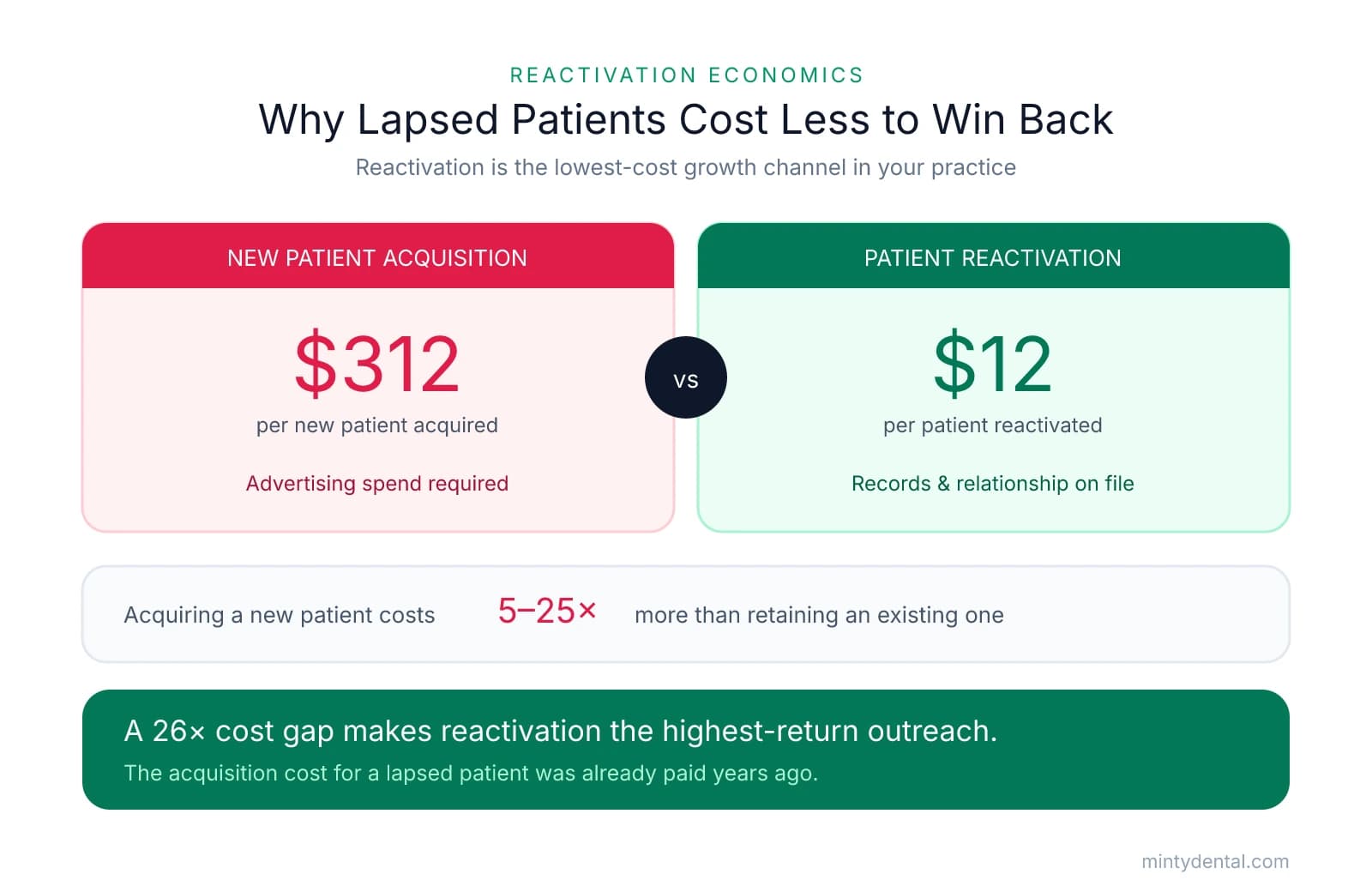
The economic case rests on acquisition cost. Acquiring a new patient runs anywhere from five to 25 times more than retaining or reactivating an existing one, and one widely cited figure puts new patient acquisition around $312 against a reactivation cost of roughly $12. The gap is wide because a lapsed patient already knows the team, has records and imaging on file, and requires no advertising spend to reach. The acquisition cost was paid years ago.
Follow-up gaps, rather than a shortage of new patients, are often the real capacity constraint. No-shows and same-day cancellations were the most commonly cited reason schedules did not reach full capacity, reported by 82% of dentists. That signal points toward reactivation systems as a higher-return investment than additional new patient marketing in many practices, and reactivated hygiene visits feed directly into whether your hygiene department is actually profitable.
One useful step right now is to run the lapsed filter in your practice management software and note the count you find.
Segment Your Lapsed Patient List Before Sending a Single Message
Once you have run the lapsed filter, the next step is pulling a full report and dividing it into tiers rather than treating every overdue patient the same way. Most systems, including Dentrix, Eaglesoft, and Open Dental, let you filter directly by last appointment date, which is the field that defines each cohort. Segmenting first matters because a patient who lapsed 14 months ago and a patient who lapsed three years ago respond to different messaging and warrant different levels of effort.
Three-tier segmentation gives each group a defined action. The distinction is based on how recently the patient was in and how much trust and recall remain intact.
| Tier | Time Since Last Visit | Characteristics | Recommended Action |
|---|---|---|---|
| Overdue | 7 to 12 months | Recent relationship, still top of mind | Standard recall system, not a reactivation campaign |
| Lapsed | 12 to 24 months | Remember the team, trust intact, records current | Priority reactivation cohort, personal outreach |
| Inactive | 24-plus months | Weaker recall, contact data often stale | One re-engagement attempt, then archive |
The 12 to 24 month cohort tends to be the highest-yield target because these patients still remember the practice, the clinical relationship has not eroded, and one well-timed message often converts. Patients past 24 months usually need heavier records work and convert at lower rates, so a single attempt before archiving keeps the campaign efficient.
Within the lapsed cohort, further prioritization improves the recovery rate. Patients with unscheduled accepted treatment plans and those with higher historical production represent the fastest path to recovered revenue, since the diagnosis and case acceptance work is already done. If case acceptance has been a weak spot generally, reviewing what to do when your case acceptance rate is too low can sharpen how you re-present that treatment.
One sub-group deserves extra touchpoints. Patients with even a single no-show carry an attrition rate near 70%, compared with about 19% for patients who never no-show, which helps predict who needs more persistent follow-up.
Before any outreach begins, clean the contact data. Outdated phone numbers and email addresses are common in records older than 18 months and will suppress response rates if left uncorrected.
Finally, calibrate the tone. Cost is the top reason about 27% of adults, roughly one in four, delay or forgo needed care, and insurance changes, scheduling friction, and dental anxiety are also common. Messaging that acknowledges these barriers, rather than assuming patient indifference, tends to land better.
Running a Multi-Touch Outreach Sequence That Actually Converts
With a clean, segmented list in hand, the outreach itself determines how much revenue you actually recover. Channel choice affects reach, but the sequence structure carries more weight than any single message.
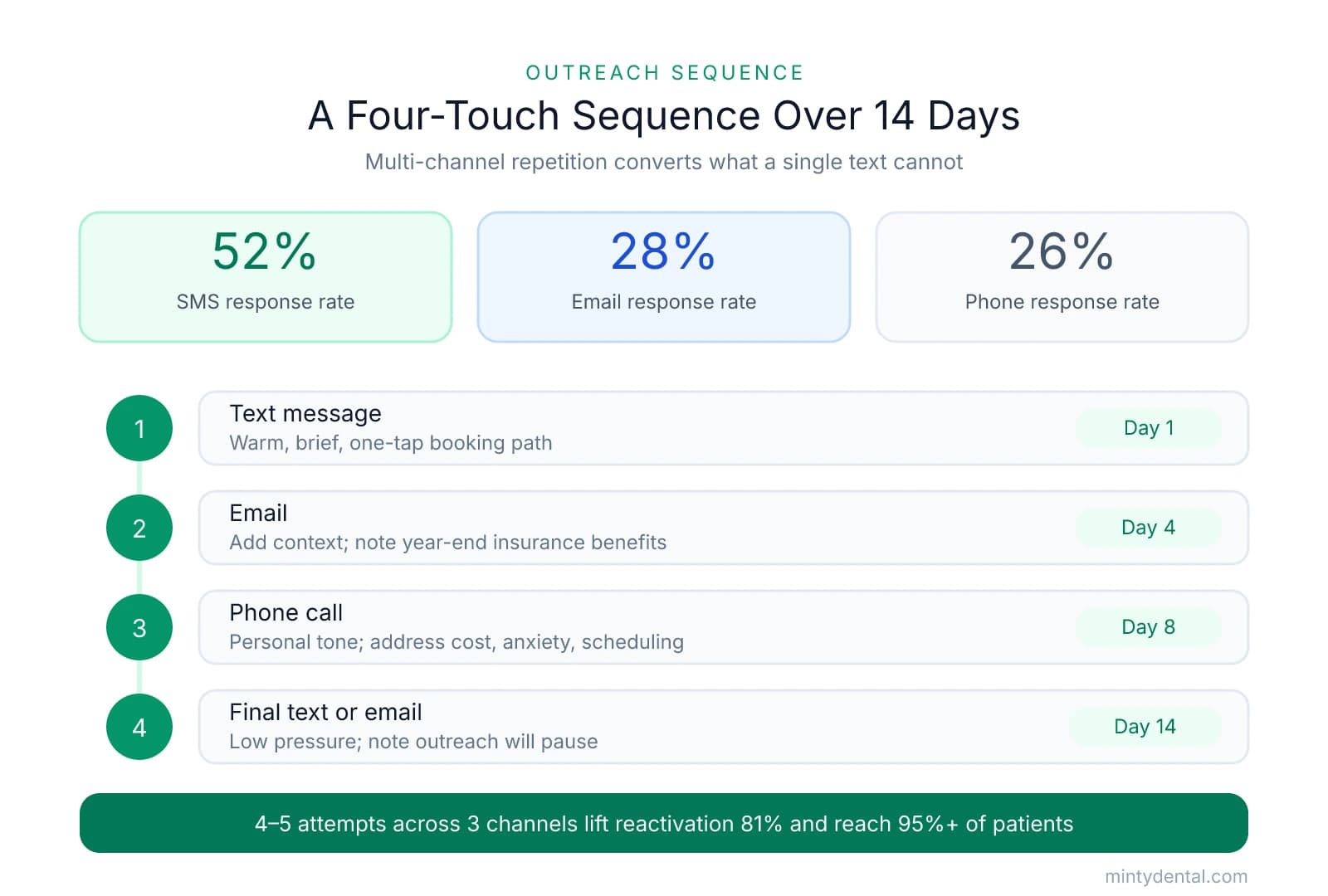
SMS leads on both reach and engagement. Text reminders generate a 52% response rate, compared with 28% for email and 26% for phone, and most texts are opened and read within minutes. Relying on text alone leaves patients uncovered. Using three different channels reaches more than 95% of lost-to-follow-up patients, and making four to five contact attempts across those channels increases reactivation rates by 81%. The practical takeaway is to combine channels and repeat contact rather than sending one text and moving on.
A four-touch sequence over 14 days gives most lapsed patients enough opportunities to respond without becoming intrusive:
- Touch 1 (Day 1), text message. Keep it warm and brief. Acknowledge that time has passed, and offer a one-tap booking path or a simple reply-to-book option.
- Touch 2 (Day 4), email. Add slightly more context. This is a fitting place to note that unused insurance benefits may reset at year end, framed as a scheduling invitation.
- Touch 3 (Day 8), phone call. A team member calls with a personal tone, prepared to address the common barriers of cost, anxiety, and scheduling friction. This human touch often converts patients who ignored the earlier automated messages.
- Touch 4 (Day 14), final text or email. Close with low pressure, and note that outreach will pause if you do not hear back. This respects the patient's decision and keeps the list clean.
Tone shapes conversion as much as timing. Empathy-first language outperforms fear-based urgency, because emphasizing consequences tends to raise anxiety and reduce trust. A message that opens with "we understand it is easy to set scheduling aside when you get busy" lands better than one listing the risks of skipped cleanings.
Incentives can help the hardest-to-reach cohort. For patients 18-plus months out, a modest discount or complimentary whitening for returning patients can improve conversion. For the 12 to 18 month group, a warm personal message is typically sufficient, so reserve incentives where they add the most lift.
Keep outreach HIPAA-compliant by limiting text and email to scheduling invitations. Message previews and subject lines should not reference specific diagnoses or treatment details, since those previews are visible on lock screens.
Communication platforms such as Weave, RevenueWell, and Lighthouse 360 can run this entire sequence automatically and remove patients from the list once they book, which keeps the system running without staff manually building call lists and supports a practice that depends less on any one person.
Preventing Re-Lapse: The Recall System That Keeps Reactivated Patients Active
Reactivation solves the current backlog of lapsed patients. A recall system prevents the same backlog from rebuilding a year later. The distinction matters because a practice that runs a strong campaign but never fixes its scheduling habits will be running the same campaign again next year on a fresh set of lapsed patients.
The most effective recall practice is booking the next hygiene appointment before the patient leaves the chair. A patient who walks out with a confirmed six-month visit never enters the lapsed cohort, which removes the need for outbound recall on that patient entirely. Practices that rely on calling patients back later, rather than pre-booking at checkout, carry a much larger reactivation workload by design.
The stakes are concentrated in hygiene. The hygiene department produces roughly 35% of total practice production directly and drives another 40%-plus indirectly through diagnosed restorative treatment, which means a weak recall system puts the majority of a practice's production base at risk. Whether that hygiene revenue is also profitable is a separate question worth reviewing alongside recall performance, since a full schedule that loses money on each visit is its own problem, as covered in whether your hygiene department is actually profitable.
The gap between average and top-performing practices is almost entirely a follow-up gap. The average practice retains 57% of its patients while top-performing practices reach 99%, a difference explained largely by systematic scheduling rather than marketing spend. The financial leverage is disproportionate to the effort, because a 5% increase in patient retention can raise profits by 25 to 95%.
Two metrics, tracked monthly, tell owners whether the recall system is holding:
- Active patients with no future appointment scheduled. A rising number signals that patients are slipping out of the recall window before staff notices.
- Percentage of hygiene patients rebooked at checkout. A low or declining figure predicts a larger lapsed backlog several months out.
Retention also compounds at sale. Buyers and appraisers treat a high, stable active patient count and a documented recall system as indicators of goodwill quality and revenue predictability, which is one of the levers that increases practice value before selling. A practice that fills its schedule through retention rather than chronic re-marketing tends to be easier to finance and to support a stronger multiple.
Sources & References
The data and claims in this article are drawn from the following sources. We prioritize government data, peer-reviewed research, and established industry publications to ensure accuracy.
- What the Data Says About Winning Back Lapsed Patients - Dialog Health— www.dialoghealth.comIndustry
- Patient Acquisition Cost Dental: New vs. Reactivated - Full Schedule— full-schedule.comIndustry
- Buying or Selling a Dental Practice, Start with an Accurate Valuation— ada.orgIndustry
- about 27% of adults, roughly one in four, delay or forgo needed care— kff.org
- 3 Ways to Make Lapsed Dental Patients Less Nervous - DenteMax— dentemax.comIndustry
- The Critical Importance of Hygiene Recall in a Dental Practice— dentalconsultingexperts.comIndustry
- Dental Practice Growth: Top 10% Secrets | Henry Schein One— www.henryscheinone.comIndustry
- Patient Reactivation ROI: Calculate Your Campaign Returns— mybcat.comIndustry
Ready to reactivate your patient base?
Bringing lapsed patients back requires consistent outreach and operational excellence. Minty's operations team handles patient communication, recall systems, and marketing campaigns so you can focus on clinical care.