How to Build a Referral Network as a New Dental Practice Owner

Co-Founder, Minty Dental
In Summary
- Roughly 73% of patients choose a dentist based on recommendations from friends and family, making referrals the largest patient acquisition channel for a new practice.
- Between 70% and 80% of new patient referrals come from your existing active patient base, so the first patients you serve become the seed of your entire network.
- Referrals produce lower acquisition cost and higher patient quality, with about 37.4% of high-quality patients arriving through referral channels.
- Three distinct channels drive referrals: patient-to-patient, professional (specialists and physicians), and community partnerships. Each requires a different activation approach.
- Most practices depend on passive goodwill rather than a repeatable system, which keeps referral volume inconsistent even when patient satisfaction is high.
Referral Networks Require Active Systems, Not Passive Goodwill
For a new practice owner, referrals are the most valuable patient acquisition channel available, both in volume and in cost. About 73% of patients choose their dentist based on recommendations from friends and family, which makes word-of-mouth the single largest source of new patients for most practices. That concentration matters more when you are starting out, because paid advertising and search visibility take time to build, while a referral from a trusted friend arrives pre-qualified.
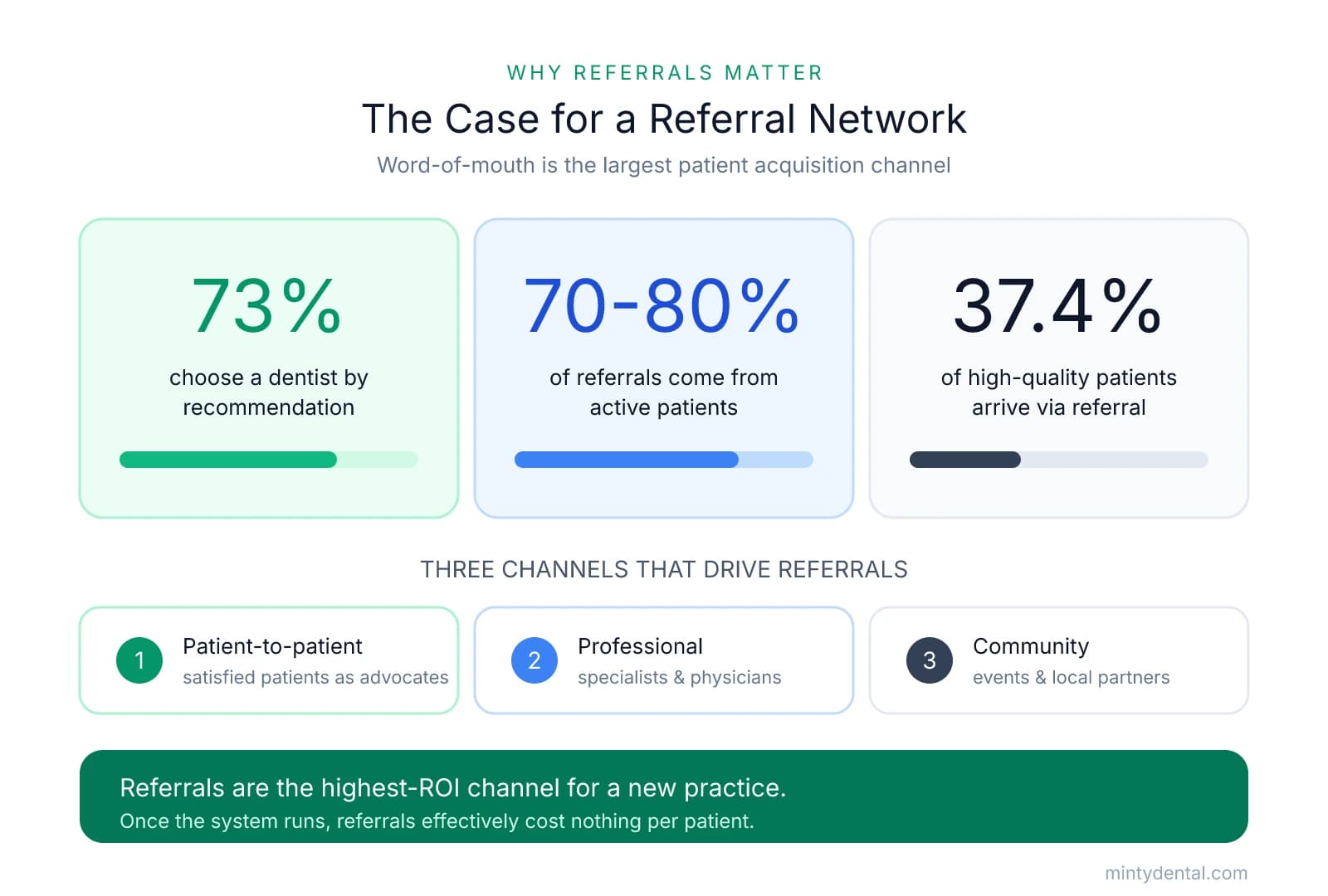
Referred patients tend to cost less to acquire and convert into better long-term relationships, and roughly 37.4% of high-quality patients arrive through referral channels, meaning patients who accept treatment, return for care, and generate stable revenue. The starting material for that network is closer than many new owners expect. Between 70% and 80% of new patient referrals come from the existing active patient base, so the patients you serve in your first months are the seed of everything that follows.
Where most practices underperform is in the method, not the goodwill. Patient satisfaction can be high while referral volume stays flat, because the practice waits for referrals to happen instead of building a repeatable process that prompts them. Keeping current patients engaged is part of the same discipline, which is why re-engaging patients who have drifted away, covered in bringing back lapsed dental patients, often overlaps with referral work.
A useful way to organize the effort is to treat referrals as three distinct channels, each with its own audience and activation steps:
- Patient-to-patient: turning satisfied active patients into consistent advocates.
- Professional: building two-way relationships with specialists and local physicians.
- Community: creating visibility through local organizations, employers, and events.
Building Patient-to-Patient Referrals: From Satisfied Patients to Active Advocates
The gap between a satisfied patient and an active advocate is usually a prompt. Most patients will not think to refer unless they are asked, even when they are genuinely happy with their care. Closing that gap comes down to three repeatable steps that a new owner can put in place during the first month of ownership.
Step 1: Standardize the ask. Build the request into checkout and post-visit follow-up so it happens for every satisfied patient rather than occasionally. A workable script at checkout is: "If you have been happy with your visit today, we would welcome you sending friends or family our way." A short post-visit message a day or two later can repeat the invitation. The point of standardizing the language is consistency, so the ask does not depend on which team member is at the front desk that day. If new patient calls are being mishandled once a referral does come in, the effort is wasted, which is why tightening front desk phone handling is worth pairing with any referral push.
Step 2: Record the referral source for every new patient. Enter who referred each patient into your practice management system as part of intake. Tracking the source over time reveals which patients refer repeatedly, so you know where to focus recognition and how well the channel is performing. Make "How did you hear about us?" a standard intake question, then record the specific name rather than a vague "word of mouth" entry.
Step 3: Recognize referrals without incentivizing them. A handwritten thank-you note or a brief personal call acknowledges the referral and reinforces the behavior. Recognition tends to work better than cash or discount incentives, which can raise compliance and anti-kickback concerns depending on your jurisdiction and payer mix. A genuine thank-you keeps the relationship on solid footing.
Referred patients tend to accept treatment at higher rates and are more likely to refer others in turn, so each active advocate compounds in value over time. The first 30 to 60 patients a new owner serves also carry outsized weight, because their experience and whether they refer will shape the practice's early trajectory. Getting the ask, the tracking, and the recognition working during that early window sets the pattern the rest of the network builds on.
Building Professional Referral Relationships: Specialists, Physicians, and Peer Dentists
Professional referral relationships run in both directions. A general dentist refers patients to specialists for treatment outside their scope, and specialists send patients back for ongoing general care. These relationships are built on clinical trust and communication reliability rather than social familiarity. Referring dentists expect timely acknowledgment of the referral, clear communication about the patient's status, and follow-up confirmation once treatment is complete, and specialists apply the same standard when deciding which general dentists to return patients to. Sending clear clinical notes, following up promptly, and returning the patient after specialty treatment is what makes a relationship reciprocal.
For a new owner with no established network, when referral options are limited, the ADA recommends reaching out to contacts from dental school, mentors, and the local dental society to identify respected specialists in each discipline. Local dental society membership and study clubs are the most efficient venues for meeting both specialists and peer dentists in the first year. Study clubs in particular mix general dentists and specialists in small groups that discuss cases and practice management, which builds the clinical familiarity that referrals depend on.
Primary care physicians and pediatricians are an underused source. They regularly see patients who need dental care but have no dentist, and a brief introduction can open a steady channel that few new owners pursue.
First 90 days: professional referral checklist
- Join your local dental society and at least one study club.
- Visit each nearby specialist in person during the first month. A short introduction or lunch establishes a face and a clinical conversation, which tends to work better than an email.
- Introduce yourself to two or three local physician or pediatric offices.
- Set up a referral log recording which specialists you refer to and which refer back, so you can see which relationships are reciprocal and which need cultivation.
What each specialist typically sends back to a general dentist:
| Specialist | Refers back to GP for |
|---|---|
| Orthodontist | Restorative work, hygiene, general maintenance |
| Oral surgeon | Restoration of implant sites, ongoing care |
| Periodontist | Restorative treatment, routine recall |
| Endodontist | Final restoration after root canal, follow-up |
Tracking both directions matters because reciprocity is what sustains the channel. Building these relationships also reduces reliance on any single referral source, which supports the broader goal of making the practice less dependent on the owner alone for new patient flow.
Tracking Referrals and Building Your 90-Day Action Plan
Without measurement, a new owner cannot tell which of the three channels is producing patients, which relationships have gone quiet, or whether volume is trending up or down. Three lightweight metrics, reviewed monthly, give you that visibility without adding significant administrative work.
- New patients by referral source. Pull this from the intake data recorded during patient scheduling. It shows the volume each channel and individual source contributes, so you can see whether patient, professional, or community referrals are carrying the load.
- Active referral sources. Count the patients and professionals who referred at least one person in the past 90 days. A shrinking count signals that a relationship needs attention before it lapses entirely.
- Referral-to-appointment conversion rate. Divide the number of referred people who become seated patients by the total referral inquiries, then multiply by 100. A low rate often points to front desk handling or scheduling friction rather than a weak referral source.
Community outreach is the third channel, and it feeds the other two. Health fairs, school screenings, and relationships with local employers and businesses build name recognition that makes both patient and professional referrals easier over time. Partnering with local schools for oral health education or free screenings and sponsoring community health fairs establishes the practice as a local resource. The returns tend to be gradual rather than immediate, so community work is best treated as a long-term investment in visibility.
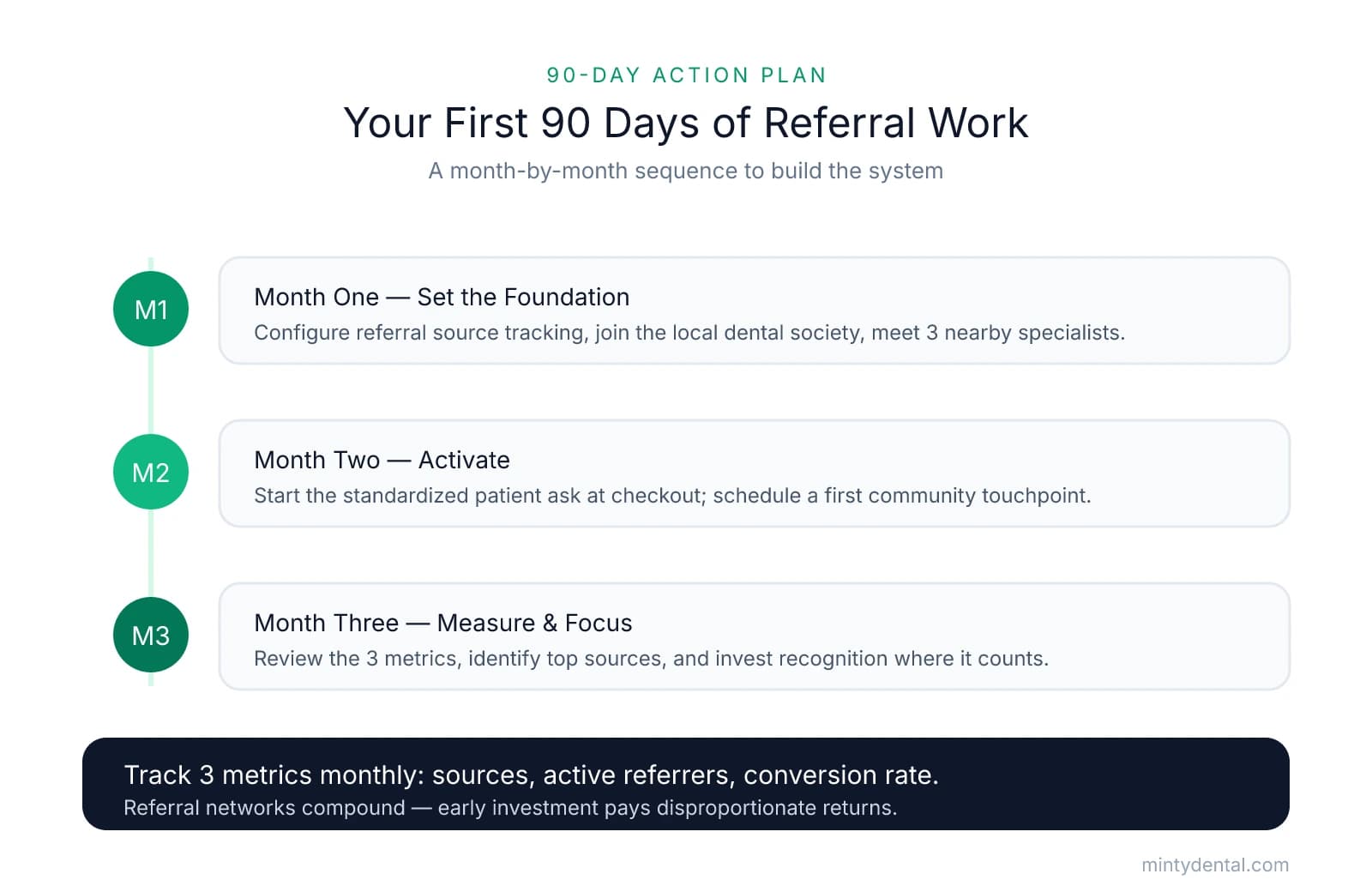
A 90-day sequence gives you a concrete starting point:
- Month one: Configure referral source tracking, join your local dental society, and introduce yourself to three nearby specialists.
- Month two: Start the standardized patient referral ask at checkout, and schedule your first community touchpoint, such as a school screening or a local business partnership.
- Month three: Review the three metrics, identify your top referral sources, and invest recognition and follow-up time in those relationships.
Referral networks compound. A patient who refers two people, each of whom refers two more, grows the base geometrically, which is why early investment pays disproportionate returns. New practice marketing budgets often run 8 to 10% of gross revenue in the first two years, and referrals effectively cost nothing per patient once the system is running, which makes them the highest-ROI component of that spend. Pairing referral growth with efficient scheduling, covered in filling open time without discounting, helps convert that volume into productive chair time.
Sources & References
The data and claims in this article are drawn from the following sources. We prioritize government data, peer-reviewed research, and established industry publications to ensure accuracy.
- Attracting New Patients to Your Dental Practice— ada.orgIndustry
- roughly 37.4% of high-quality patients arrive through referral channels— 2740consulting.com
- Between 70% and 80% of new patient referrals come from the existing active patient base— henryschein.com
- Grow Your Practice with Patient Referrals - Dentrix Magazine— magazine.dentrix.comIndustry
- The Basics of How to Track and Maximize Dental Patient Referral ...— www.jarvisanalytics.com
- Dental Specialist Referral Tracking: Strengthen Referring Dentist ...— sowingo.comIndustry
- Specialty Referrals | American Dental Association— www.ada.orgIndustry
- Study clubs offer safe spaces to learn, grow | American Dental Association— adanews.ada.orgIndustry
- The Top 8 Local Dental Marketing Tips Every Dentist Should Know— www.docseducation.com
- Dental Patient Acquisition Cost: What It Really Takes (2026 Data) - AInora— ainora.ltIndustry
Ready to grow your referral network?
Building strong referral relationships takes time and strategy. Minty's Operations service handles the marketing and patient acquisition side, freeing you to focus on clinical excellence and relationship building with other dental professionals.