How to Raise Dental Fees Without Losing Patients

Co-Founder, Minty Dental
In Summary
- Median dental practice expenses rose 7.7% between the 2013-2017 and 2018-2022 periods, while median revenue grew only 2.2% over the same span, meaning costs outpaced revenue by more than three to one.
- Recent pressure has continued: dental care prices rose about 5% year over year through mid-2024, and roughly 37% of dentists reported staff wage increases of up to 10%.
- Skipping annual fee increases erodes real purchasing power every year and eventually forces a larger, more disruptive catch-up adjustment.
- Suppressed fees lower normalized earnings, which reduces what buyers and lenders will pay for a practice regardless of top-line collections.
- A workable process starts with benchmarking against local UCR data, then implementing incremental increases and communicating them proactively.
Fee Stagnation Is a Profitability Problem That Compounds Over Time
Fee stagnation is the practice of holding fee schedules flat while the cost of running the practice continues to climb. Over time, that gap between rising expenses and static fees compresses margin whether or not production changes.
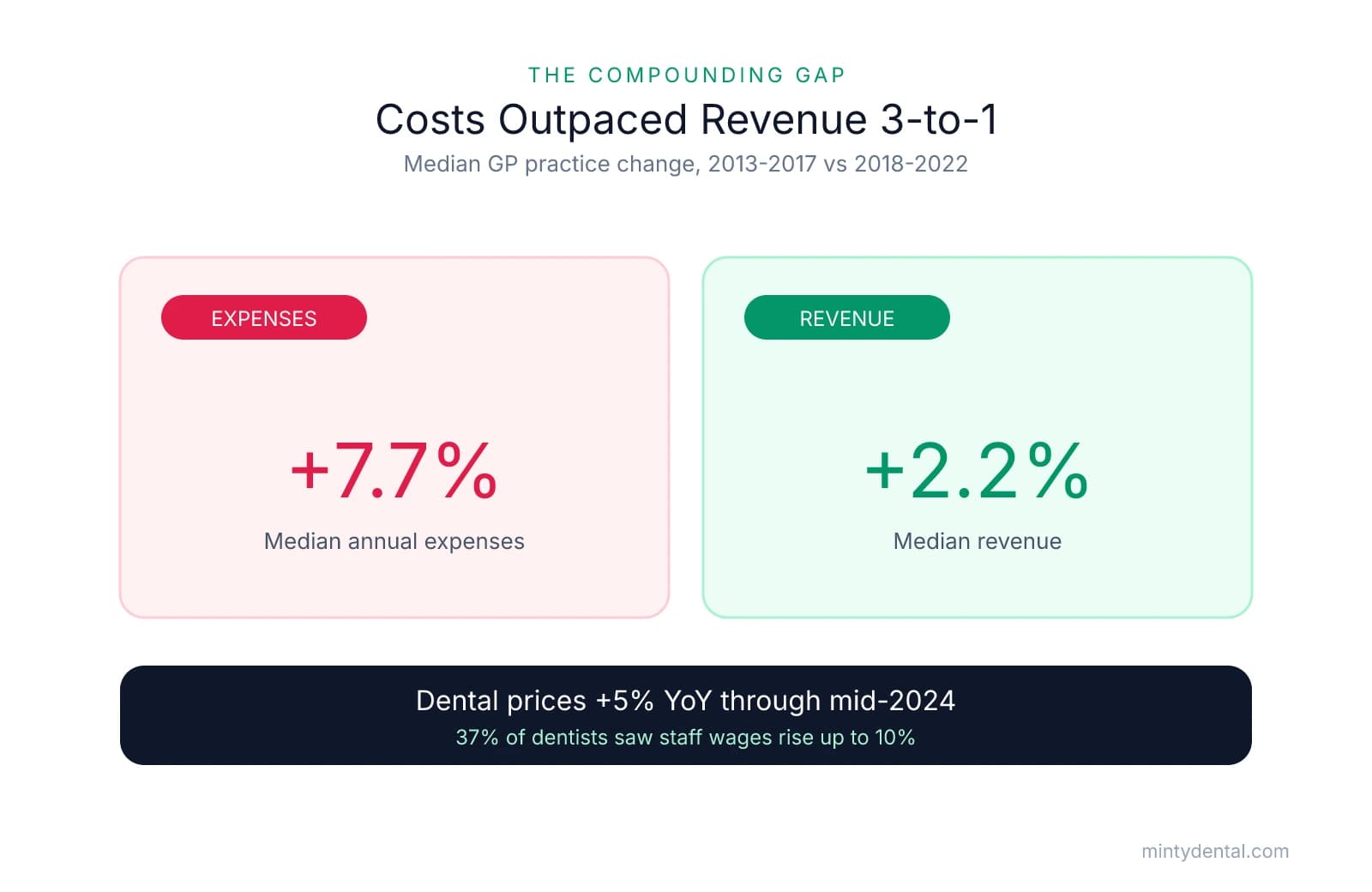
The structural evidence is visible in national data. Median annual practice expenses for general practitioner owners rose 7.7% between the 2013-2017 and 2018-2022 periods, while median revenue grew only 2.2% over the same span. Expenses outpaced revenue growth by more than three to one, which means the average practice absorbed the difference through thinner margins.
The overhead-revenue gap is the core financial problem behind fee stagnation. When expenses grow at roughly three times the rate of revenue, a practice loses profitability each year even if patient volume and collections hold steady. Closing that gap requires either cutting costs or adjusting fees.
Recent pressure has kept the gap open. The price of dental services rose about 5% between July 2023 and July 2024, and staffing costs have moved in the same direction, with roughly 37% of dentists reporting staff wage increases of up to 10%. Increasing overhead was the most-cited challenge among dentists in 2024, named by about 36% of respondents.
The effect compounds. A practice that skips a modest annual increase loses real purchasing power each year, and that erosion stays invisible until overhead crosses a threshold that forces a larger, more disruptive catch-up adjustment. Owners weighing whether the answer is fees or cost control can start by examining where overhead is concentrated.
Fee levels also flow directly into practice value. Buyers and lenders evaluate normalized earnings, not headline collections, so suppressed fees reduce the number a practice can command at sale. Two practices each collecting $1.2 million are not worth the same if one runs at 70% overhead and the other at 62%. For owners considering an eventual transition, correcting underpriced fees is one of the more direct ways to improve normalized earnings before selling.
Benchmark Your Fee Position Before Deciding How Much to Raise
Before setting a target increase, owners need a factual picture of where their current fees sit relative to the local market. That starting point is the UCR fee schedule.
UCR fees are the "usual, customary, and reasonable" benchmarks insurance companies reference when calculating maximum reimbursement for a procedure in a given area. They are not fixed by any regulatory authority. Instead, they are derived from regional claim data. FAIR Health's database covers benchmarks from the 50th to the 95th percentile across 493 geographic areas, drawing on hundreds of millions of claims.
The reason benchmarking comes first is that 7 out of 10 dental practices set UCR fees too low, with average PPO discounts running 30 to 40% of gross production. A practice cannot know how much room it has to raise fees until it sees where its charges fall against verified local data.
Use the percentile framework
Benchmarking tools report fees by zip code across a percentile range, typically the 40th to the 95th. Industry guidance generally targets the 80th to 90th percentile as a reasonable position for a competitive private practice. Sitting near the median often signals fees that lag the market. Sources include FAIR Health, Henry Schein Fee Analysis (about $150 per zip code), and DataQuest.
Start with your top 30 CDT codes
A full schedule review is unnecessary to capture most of the financial impact. A practice's top 30 CDT codes typically represent 80% or more of production, so reviewing those first concentrates the effort where it matters. A comparison table makes the gaps concrete:
| CDT code | Current fee | 50th pct | 80th pct | Gap to 80th |
|---|---|---|---|---|
| D2740 (crown) | $1,100 | $1,180 | $1,340 | $240 |
| D1110 (prophy) | $95 | $102 | $118 | $23 |
Hygiene-related codes (prophylaxis, periodontal maintenance, and x-rays) deserve particular attention, because these are the fees patients most commonly recognize and compare across offices. Owners questioning whether that department carries its weight can review how hygiene profitability is measured.
Understand the PPO nuance
Raising UCR fees does not immediately change contracted PPO reimbursements, which are fixed by agreement. However, higher UCR fees set the ceiling for renegotiation, increase patient responsibility once benefits are exhausted, and can prompt some carriers to adjust voluntarily; one Levin Group analysis found that two insurers raised reimbursements on some services after receiving the updated fee schedule.
How to Implement a Fee Increase With Minimal Patient Attrition
After benchmarking has established the gap between current fees and the target percentile, small, predictable increases applied on a regular schedule are preferable to large corrections applied every few years.
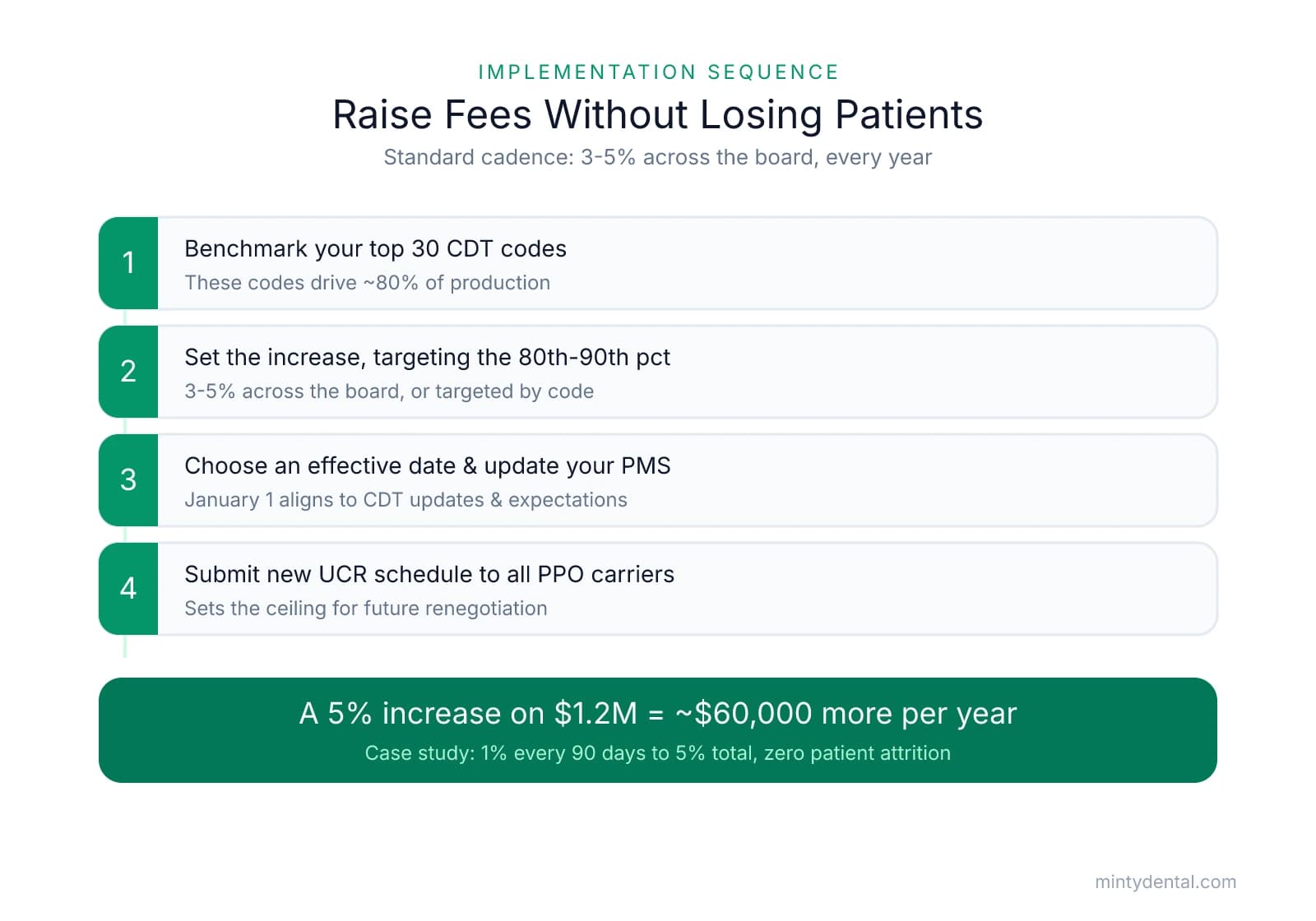
The industry-standard cadence is a 3 to 5% across-the-board increase each year. Smaller, predictable adjustments produce far less patient friction than infrequent catch-up hikes, because waiting several years and then attempting a large increase is more likely to upset patients than modest annual changes. A gradual approach also gives the practice time to observe patient reaction before committing to the full amount.
In one case study, a practice already sitting at the 86th percentile raised fees by 1% every 90 days until reaching a total of 5%, with no patient attrition and no decline in case acceptance. Patients typically recognize only hygiene-related fees, so the increases on crowns, endodontics, and other procedures went unnoticed.
The revenue effect is meaningful at scale. On a practice collecting $1.2 million, a 5% across-the-board increase generates roughly $60,000 in additional annual revenue, and when overhead stays stable, most of that flows to the bottom line. That amount could fund a new team member, a technology upgrade, or reserves without adding a single new patient.
The attrition fear deserves context. Most practices already lose a share of patients each year through relocation, insurance changes, and other life events, so fee-driven attrition from a modest annual increase tends to be negligible by comparison. Patients who leave over a $5 to $10 change on a hygiene visit were often price-sensitive and already at some risk of leaving.
For in-network procedures, the increase usually does not change what a contracted patient pays, because the PPO agreement governs that amount. It does raise the UCR ceiling that matters at contract renewal. For out-of-network and uninsured patients, the increase affects patient responsibility directly. Owners weighing whether a plan still earns its place can review how to evaluate dropping a PPO.
A workable implementation sequence looks like this:
- Benchmark your top 30 CDT codes against local percentile data.
- Calculate the gap to your target percentile.
- Set the increase amount, either 3 to 5% across the board or targeted by code.
- Choose an effective date, with January 1 aligning to CDT code updates and patient expectations.
- Update the fee schedule in your practice management system.
- Submit the new UCR schedule to all PPO carriers, even when reimbursements will not change immediately.
Preparing Your Team and Patients for the Conversation
After the schedule is updated and an effective date is set, patient communication becomes the focus. Most negative reactions trace back to surprise rather than the dollar amount itself, which means proactive communication resolves the majority of friction before it starts. Addressing price expectations early opens the conversation rather than closing it, and the same principle applies to a routine fee adjustment.
Team preparation matters more than any patient-facing notice. The front desk sees fee questions first, so staff should be able to explain the change briefly and confidently. A matter-of-fact tone reassures patients more than a defensive or apologetic one, because apology signals that the practice itself views the increase as unjustified. Over-explaining has the same effect.
A model the front desk can adapt, rather than recite word for word, sounds like this: "Our fees are adjusting at the start of the year to reflect the rising cost of providing care. Supplies, technology, and staffing have all increased. We wanted to make sure you were aware before your visit." That framing acknowledges the change, connects it to real cost pressure, and redirects to the relationship without dwelling on price.
The communication channel should match the size of the increase:
- Routine annual increases: A brief line in the appointment reminder is usually sufficient. A separate formal letter tends to draw more attention than a 3 to 5% adjustment warrants and can read as alarming.
- Larger catch-up increases or fee-for-service patients: A direct conversation at the time of treatment planning is more appropriate, since these patients feel the change on their statement.
When a patient does push back, a workable response is to acknowledge the concern, restate the value of the care relationship, and offer financing options when they fit the situation. Routinely discounting fees in response to complaints sets a precedent that trains patients to negotiate, which erodes the increase you just implemented. Presenting cost alongside value at treatment planning also supports case acceptance, a connection worth examining if acceptance rates are running low.
Predictable annual fee management supports the margins that fund staff, technology, and patient experience. Practices that maintain adequate margins can keep investing in those areas instead of relying on low fees.
Sources & References
The data and claims in this article are drawn from the following sources. We prioritize government data, peer-reviewed research, and established industry publications to ensure accuracy.
- Inflation's impact on dentistry: 6 notes | Dental News— beckersdental.comIndustry
- Inflation's impact on dentistry: 6 notes | Dental News— beckersdental.comIndustry
- UCR Fees Dental 2026: Set And Optimize Your Fee Schedule— dentalpracticeinsider.orgIndustry
- A strategic way to raise your fees - Dental Economics— www.dentaleconomics.comIndustry
- Why Now Is the Time to Raise Fees at Your Dental Practice— parkhurstconsulting.comIndustry
- Talking About Dental Fees & Payments With Your Patients - Weave— getweave.comIndustry
Ready to optimize your practice's fee strategy?
Raising fees strategically is just one piece of running a thriving dental practice. Minty's operations team handles billing, fee optimization, and patient communication so you can focus on clinical excellence and growth.