Is Adding Another PPO Worth It for Your Practice?

Co-Founder, Minty Dental

In Summary
- Credentialing with a new PPO means agreeing to that carrier's contracted fee schedule, so every procedure you perform for those patients triggers a write-off against your usual fee.
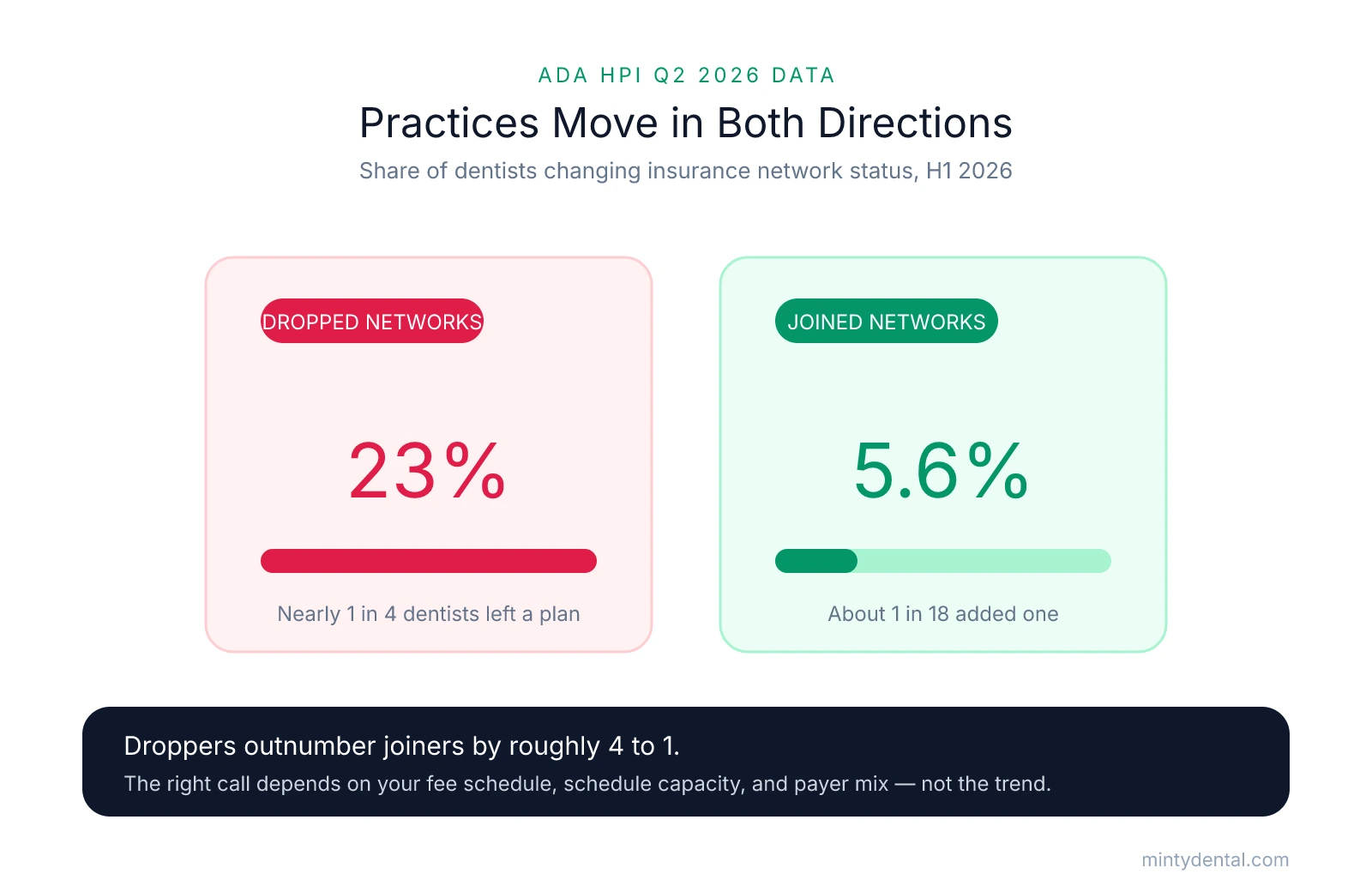
- In 2026, 23% of dentists dropped insurance networks while only 5.6% joined, showing the decision moves in both directions and depends heavily on individual practice circumstances.
- Adding a PPO only improves your bottom line if the net revenue from new patients outweighs the write-offs you absorb on every visit.
- A practice already running at or above 90% utilization is more likely to displace higher-paying patients than to add incremental revenue.
- Three variables drive the analysis: how deep the fee schedule discount is relative to your UCR, how much open time actually exists in your schedule, and what your current payer mix looks like.
Adding a PPO to an Existing Practice Is a Revenue Trade-Off, Not Just a Volume Play
When you credential with a new PPO, you're not just agreeing to accept their patients. You're agreeing to their fee schedule for every procedure, on every visit, for every patient covered under that plan. That means the moment someone with that insurance walks through your door, you've already committed to writing off the difference between what you'd normally charge and what the carrier's schedule allows. The write-off isn't negotiable after the fact, and it applies whether you perform a prophy, a crown, or an extraction.
That's the core commitment credentialing makes on your behalf, and it's worth being clear-eyed about before you fill out the application.
The case for joining a plan is straightforward in concept: you accept a lower fee per procedure in exchange for access to a patient pool you don't currently reach. Whether that trade works financially depends entirely on your specific situation, not on a general rule about PPO participation being good or bad. The ADA's Health Policy Institute Q2 2026 data makes that plain: 23% of dentists dropped insurance networks in the first half of 2026, while only 5.6% joined. Practices are moving in opposite directions, and both groups have reasons that make sense given their own numbers.
The question your practice has to answer is different from what a rep's pitch covers. A carrier's enrollment team will tell you how many covered lives are in your zip code. What they won't tell you is what those patients will pay per visit after your write-off, whether your schedule has room to absorb them, or how their arrival affects the revenue you're already collecting from better-paying plans.
Three variables actually determine whether adding a plan makes financial sense. First is the fee schedule discount: how far below your UCR does this carrier's allowable fall, and does that gap widen further for your highest-production procedures? Second is your schedule utilization: if your chairs are already full most of the week, new patients don't add revenue, they replace it. A practice running above 90% utilization that credentials with a lower-paying plan is likely trading a fee-for-service or higher-tier PPO patient for one who generates less net revenue per appointment. Third is your existing payer mix: if you're already carrying several PPO contracts with heavy write-offs, understanding how that payer mix affects your net collections is a necessary step before adding another discounted plan to the stack.
None of this means the answer is automatically no. Open chair time is real overhead, and a plan that fills it at a discount can still be worth carrying. But the math has to be done with your numbers, not with assumptions about volume.
How to Calculate the Net Reimbursement Rate for the Plan You're Considering
Before you sign anything, request the fee schedule from the carrier. Most PPOs will provide it on request during the credentialing process, before you're committed. What you want is the allowed amount for every code you commonly bill, not a summary of covered benefits. Once you have it, set your UCR fee next to the plan's contracted fee for each code, and the difference tells you your write-off per procedure.
The write-off percentage for any single procedure is:
(UCR fee - PPO fee) / UCR fee = write-off percentage
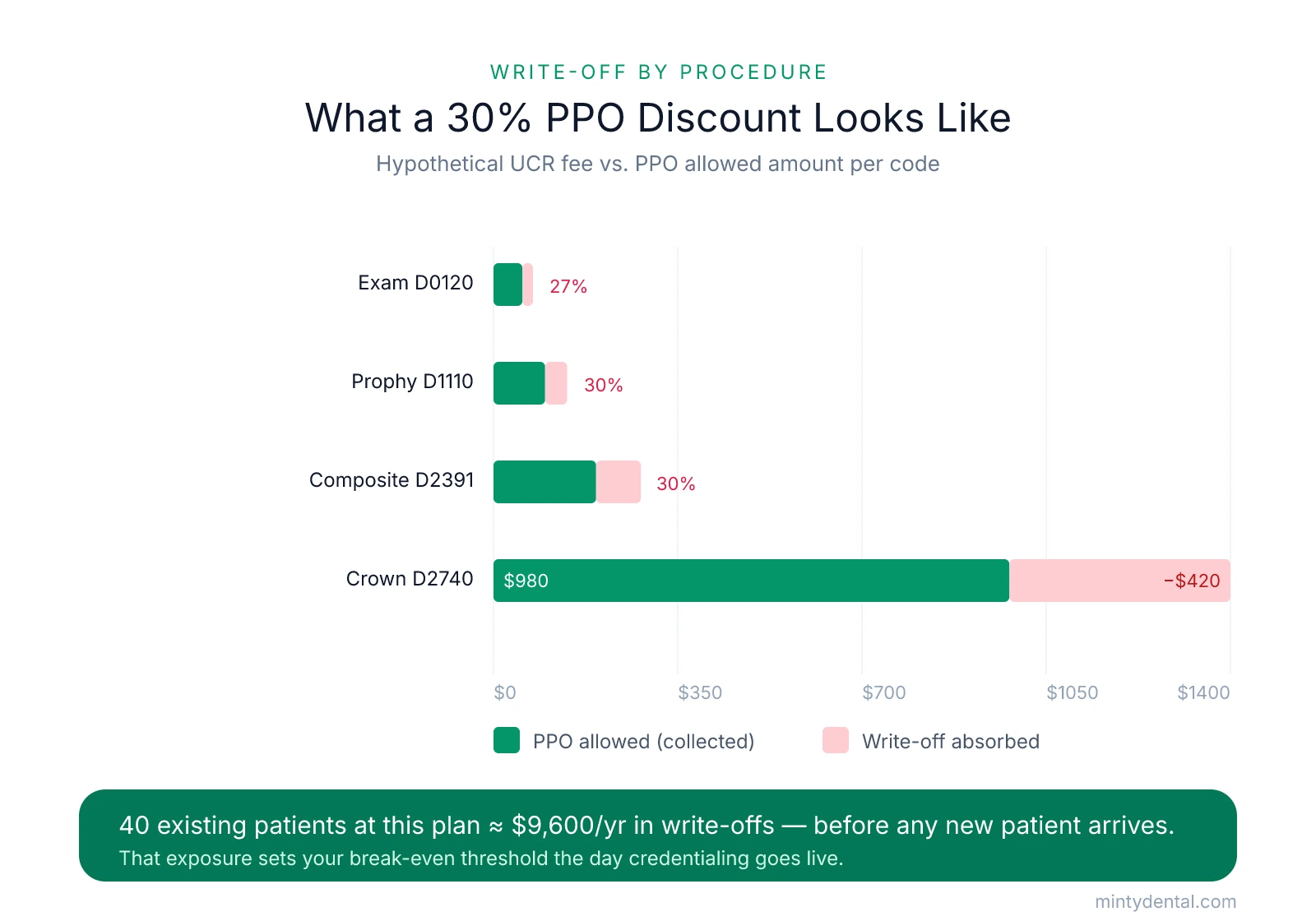
If your UCR for a full crown (D2740) is $1,400 and the plan allows $980, you're writing off $420 per crown, or 30%. That means for every crown you complete on a patient covered by this plan, you collect 70 cents on the dollar. The net reimbursement rate is what determines whether the plan is worth joining, not the headline contracted fee.
Running this across a mix of procedures gives you a more realistic picture than any single code. The table below uses hypothetical numbers to illustrate how the math looks across a typical visit combination:
| Procedure | UCR Fee | PPO Fee | Write-Off | Write-Off % |
|---|---|---|---|---|
| Periodic exam (D0120) | $75 | $55 | $20 | 27% |
| Adult prophy (D1110) | $140 | $98 | $42 | 30% |
| Composite, 1 surface (D2391) | $280 | $195 | $85 | 30% |
| Full crown (D2740) | $1,400 | $980 | $420 | 30% |
All fees are hypothetical examples only.
A hygiene visit combining the exam and prophy produces $153 in net revenue at these rates, against $215 at UCR. A restorative appointment adding one composite brings in $348 net versus $495 UCR. That per-visit gap is what you need to multiply against your expected volume to understand what this plan actually costs.
The part most practices underestimate is the write-off on existing patients. When you credential with a new plan, every current patient who already carries that insurance immediately becomes subject to the contracted rate. That's not a future problem tied to new patient growth; it starts the day your credentialing goes live. Pull your payer mix report from your practice management system and filter by the carrier's plan names. If 40 current patients carry the plan and average $800 per year in production, credentialing at a 30% discount costs roughly $9,600 per year in write-offs before a single new patient walks in. If your overall write-off percentage is already elevated across your existing plans, absorbing another layer of discounts on patients you already have compounds the problem quickly. It's also worth noting that the table rate a plan quotes is rarely the number that matters most — the weighted rate across your actual procedure mix, and ultimately your realized collections, are what determine whether the plan performs, a gap that can widen the further you get from the fee schedule into actual deposits.
That exposure sets your break-even threshold. If the plan delivers $9,600 in immediate annual write-offs on existing patients, you need enough new patients, each generating positive net revenue after their own write-offs, to cover that gap before you see any financial gain from credentialing. How many new patients that requires depends on what they produce per year and how often they accept treatment, which is why the fee schedule analysis has to come before the capacity question, not after. Historically, third-party reimbursement averaged only 66.4 to 81.1% of submitted fees by procedure, with the gap widening over time — meaning the break-even math tends to get harder, not easier, the longer a plan relationship continues.
Leased Networks and Umbrella Plans: What You're Actually Signing
Calculating your write-offs assumes you know which fee schedule applies to every claim. That assumption breaks down more often than most owners realize, because the contract you sign with one carrier may automatically extend your participation, and your fee schedule, to plans you've never heard of.
This happens through shared network or leasing provisions buried in PPO contracts. The mechanism works like this: Carrier A signs you up, then grants Carrier B access to your network participation and contracted rates under a separate arrangement between the two companies. You never credentialed with Carrier B. You never negotiated with them. But their patients can now be treated as in-network at your practice, and their claims are processed against your contracted fee, which may be lower than what Carrier A pays you.
The three participation types worth understanding before you sign anything:
- Direct contract. You negotiate directly with the carrier, and that carrier's fee schedule governs your claims. This is the cleanest arrangement for fee schedule control.
- PPO-to-PPO leasing. Your contracted participation with one carrier is shared with one or more other carriers under a leasing arrangement. Those carriers access your fee schedule, sometimes at a further discount from what you originally agreed to.
- Umbrella network. A single agreement grants multiple plans access to your fee schedule simultaneously. You may never see a full list of participating plans unless you ask for one.
Across more than 2,800 dental practices, most offices don't discover shared network agreements until an EOB audit turns up payer names they don't recognize, sometimes years after the sharing started. The revenue impact typically runs $20,000 to $50,000 per year in additional write-offs beyond what the original contract produces.
The practical issue is timing. By the time an unfamiliar payer name shows up on an EOB, you're already participating. Many contracts include opt-out provisions for specific leasing arrangements, but those windows have deadlines. Miss the window and you remain enrolled until the next opt-out opportunity, which may be a year away.
Before signing, ask the carrier directly whether the contract includes network-sharing or leasing provisions, and request a written list of all plans that would gain access to your fee schedule upon credentialing. That list tells you what you're actually agreeing to, not just the plan the rep pitched you on. If the carrier can't or won't provide it, that's information worth factoring into your decision.
One structural difference worth noting when comparing carriers: Delta Dental is the only major PPO that does not lease its network. That means your participation stays contained to the agreement you signed, without the downstream exposure of leased access by other carriers. Whether Delta Dental's fee schedule works for your practice is a separate question, but the structural predictability is a meaningful distinction when you're evaluating carriers side by side.
For a deeper look at how leased network arrangements affect reimbursement and what your EOBs can reveal, the full breakdown of dental PPO leased networks covers detection and response steps in more detail.
Making the Call: A Checklist for the Credentialing Decision
Before you submit the application, pull two reports from your practice management system: your payer mix by plan and your write-off percentage by carrier. The math takes less than an hour, and it prevents a multi-year revenue commitment you'll regret. Everything else in this decision flows from those two numbers.
On timing: Direct contracts typically process in 30 to 180 days, while credentialing through a TPA or umbrella network can take 6 to 9 months before you're fully loaded and receiving in-network payments. That gap is a cash flow gap. If you're counting on the new plan's volume to fill a revenue hole, build the realistic timeline into your projection, not the optimistic one.
Conditions that favor credentialing:
- Your schedule utilization runs below 75 to 80% and open time is consistent, not just seasonal
- The fee schedule pays at or above 80% of your UCR across your highest-volume codes
- The plan has a strong local employer base and few in-network providers nearby
- The contract is a direct agreement with no network-sharing or leasing provisions
Conditions that argue against it:
- Your schedule is already at or above 90% utilization, where new patients replace existing revenue
- The fee schedule pays below 70% of your UCR, particularly on restorative procedures where your production is concentrated
- A meaningful number of your current patients already carry this plan, triggering immediate write-offs on existing revenue
- The contract routes through a TPA, which extends the credentialing delay and may expose your fee schedule to plans beyond the one you intended to join
The decision is reversible. Most PPO contracts require 60 to 90 days' written notice to terminate participation, and exiting takes administrative effort: plan notifications, patient communication, updating your directory listings, and re-verifying that claims are processing correctly after your termination date clears. Reversible doesn't mean costless, so the analysis you do now is worth more than the cleanup later.
If you're heading in the other direction and evaluating whether to drop plans rather than add them, the sequencing and financial thresholds involved in moving from PPO to fee-for-service are a different calculation from what this article covers, but the payer mix analysis is the same starting point.
Sources & References
The data and claims in this article are drawn from the following sources. We prioritize government data, peer-reviewed research, and established industry publications to ensure accuracy.
- U.S. Dentist Workforce - 2025 update— ada.orgIndustry
- How to Calculate Your PPO Reimbursement Rate vs. Your ...— www.thedentalsignal.com
- Negotiating Reimbursement Rates with a PPO Plan— commons.ada.orgIndustry
- Shared Network Agreements Dental: 5 Hidden Traps ...— ppoadvisors.comIndustry
- Create a PPO strategy for your dental practice - Delta Dental— www1.deltadentalins.com
- Dental Credentialing Timeline: 4 Costly Delays to Expect— ppoadvisors.comIndustry
See Where Your PPO Fees Stand Before You Sign
Before you credential with another plan, check how its fee schedule compares to what practices in your area are collecting. A Rate Check shows where your current crown fee sits and what a group fee schedule could look like.