Is Owning a Dental Practice Worth It Financially?

Co-Founder, Minty Dental

In Summary
- Owner general dentists averaged $228K versus $177K for employed GPs in 2023 (ADA Health Policy Institute data), a gap of roughly $51K per year.
- A separate DentalPost survey of nearly 3,500 dental professionals puts 2024 owner GP income at $320K versus $226K for associates, reflecting a broader sample and different methodology.
- The income advantage is structural: owners keep practice profit after overhead, not just a percentage of their own production.
- The owner/associate income gap has been narrowing, and inflation-adjusted GP incomes have declined for 14 consecutive years.
- A poorly run or over-leveraged practice can pay its owner less than a good associate role would — the averages hide wide variance.
Ownership Pays More on Average — But the Gap Is Smaller Than It Used to Be
Owner dentists do earn more than associates. That part is clear across every major data source. What the numbers also show, if you read them carefully, is that the gap is narrower than the "just buy a practice" crowd tends to suggest, and it comes with real trade-offs in time, risk, and debt.
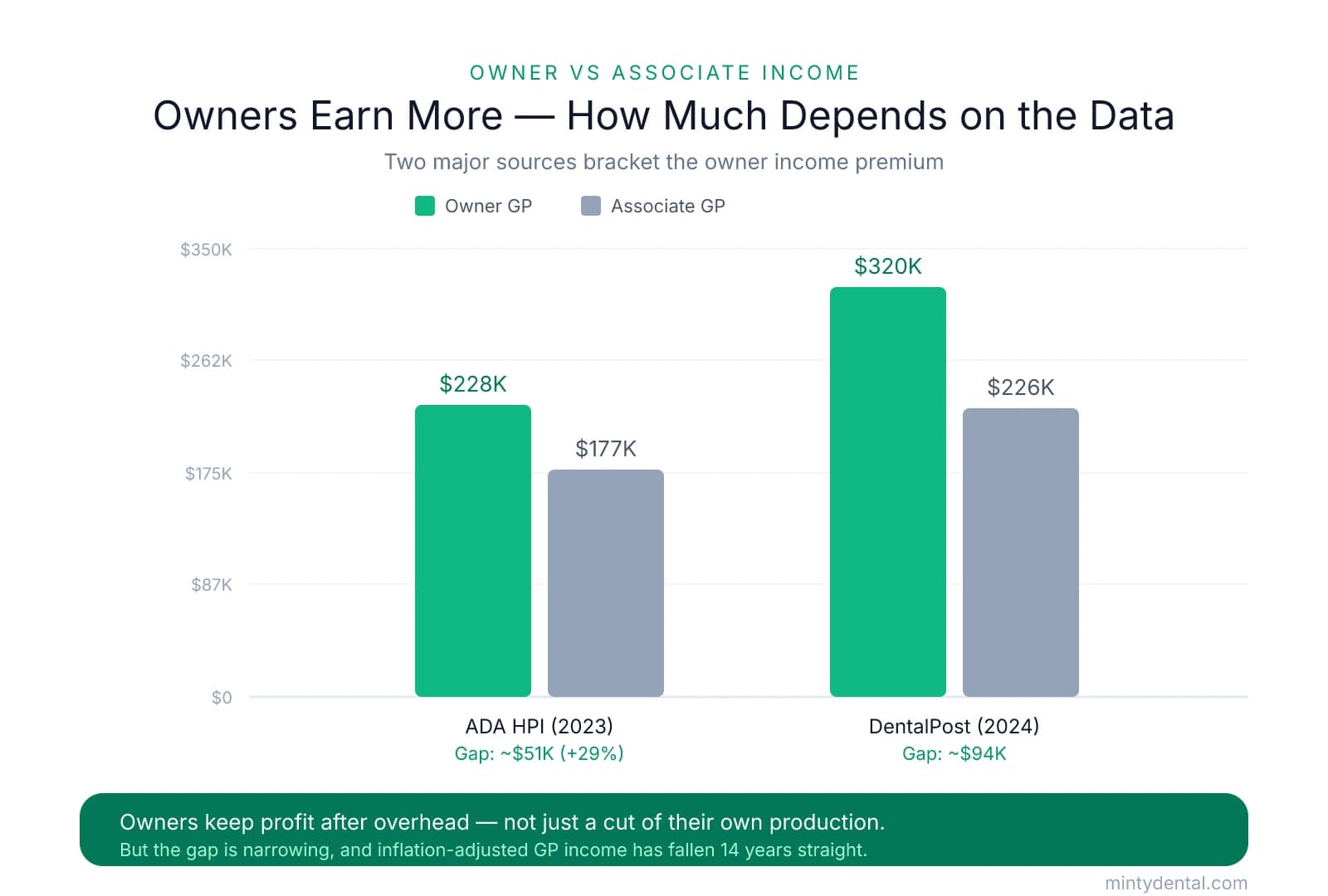
The 2023 ADA Health Policy Institute figures show average net income of roughly $228K for owner general practitioners versus about $177K for employed GPs. That's a $51K annual difference, or about 29% more for owners. The 2024 DentalPost survey of nearly 3,500 dental professionals reports owner GP income of $320K versus $226K for associates. The gap in that dataset is closer to $94K. The methodologies differ enough that you shouldn't average the two, but together they bracket a reasonable range.
| Data Source | Owner GP Income | Associate GP Income | Gap |
|---|---|---|---|
| ADA Health Policy Institute (2023) | ~$228K | ~$177K | ~$51K |
| DentalPost Survey (2024) | $320K | $226K | ~$94K |
The structural reason for the difference matters more than either figure in isolation. An associate earns a percentage of their own production, typically somewhere around 30%, sometimes with a base guarantee. An owner keeps the practice's profit after overhead. On a practice collecting $1M with 60% overhead, that's roughly $400K before debt service, and the owner is capturing revenue from hygiene, associates, and every other producer under that roof, not just their own chair time. Understanding how associate pay percentages translate into owner economics helps clarify why the income lines diverge as a practice grows.
The honest caveat is that the trend is moving in the wrong direction for owners. The owner/associate income gap has been shrinking, as noted in the ADA's 2025 Health Policy Institute report, and inflation-adjusted GP incomes have declined for 14 consecutive years. Owners also work roughly five more hours per week than associates on average. When you account for both the narrowing premium and the additional hours, the effective income advantage per hour worked is smaller than the headline numbers suggest.
There's also the variance problem. Averages blend thriving practices with struggling ones. A well-run solo practice in a strong market can produce owner income well above the ADA figures. A practice carrying heavy acquisition debt, or one with high overhead and flat collections, can pay its owner less than a comparable associate role would. The average is real; so is the spread around it.
The Transition Period: Why Year One Usually Pays Less Than Your Associate Job
Most income comparison data reflects steady-state ownership. It doesn't capture the first one to three years after closing, when the math often looks considerably worse.
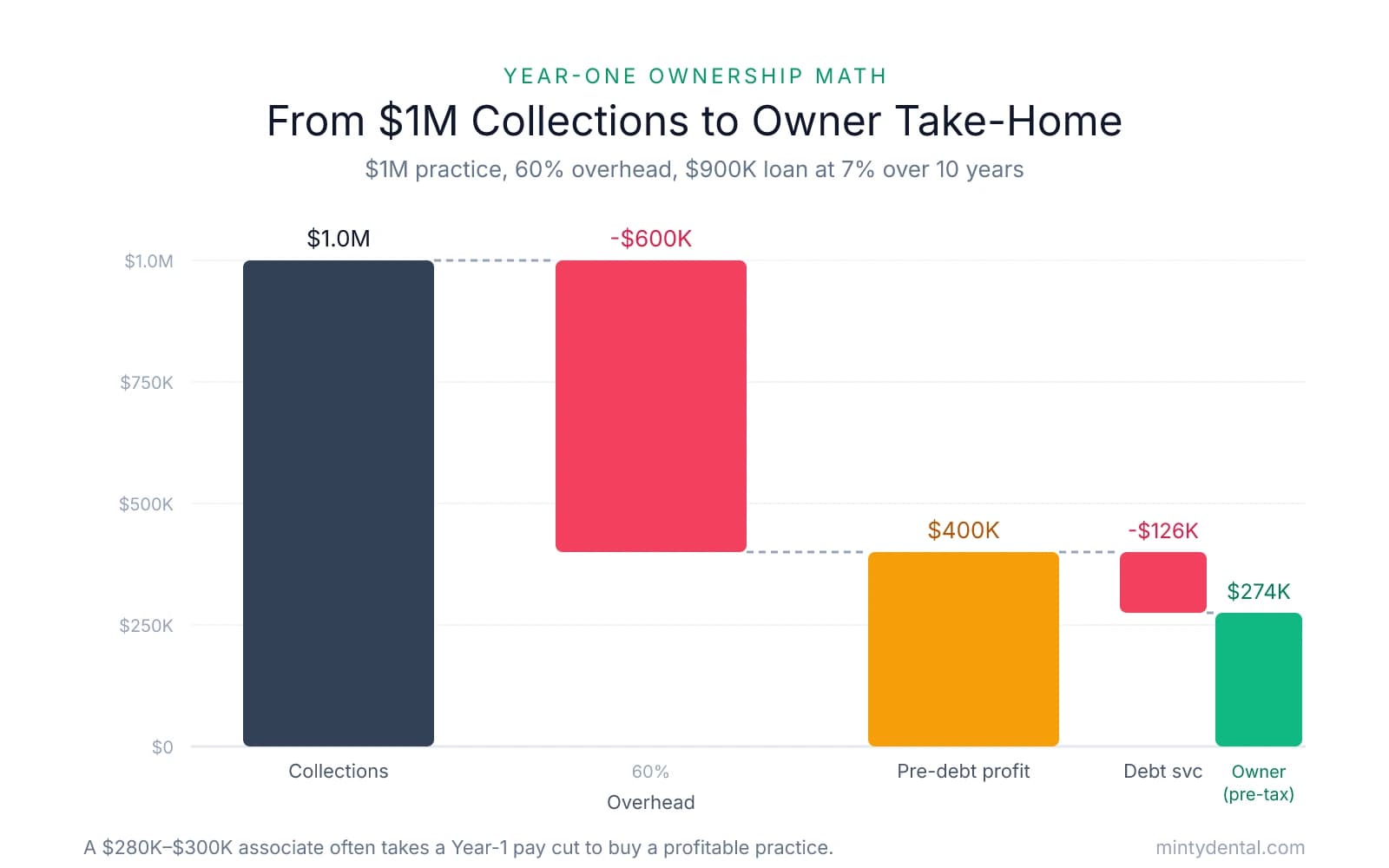
Work through a concrete example. A practice collecting $1M annually with 60% overhead leaves $400K before debt service. Finance the $900K purchase price over 10 years at 7%, and your monthly payment runs roughly $10,500, or about $126K per year. That leaves approximately $274K in owner income before taxes. If you were a high-producing associate earning $280K to $300K, you've just taken a pay cut to buy a profitable practice. That's not a sign the deal is wrong. It's the predictable arithmetic of acquisition debt.
The situation is tighter than that one number suggests for most buyers. Dentists in Panacea Financial's portfolio carry roughly $400K in student loan debt at the time of practice purchase, which means total debt at closing commonly reaches $1M or more when you add the practice loan. Dental-specific lenders do offer 100% financing on acquisitions, so you're typically not required to bring a large down payment to the table. That's genuinely useful for preserving working capital. But financing the full purchase price also means no equity cushion from day one and higher monthly debt service than a partially funded deal would carry. You can model different loan structures using Minty's dental practice loan calculator to see how term length and rate interact with your specific numbers.
The overhead variable deserves particular attention in year one. Overhead creeping above 65% is the most common reason new owners earn less than their projections. Staffing decisions, supply costs, and lab fees are harder to control when you're still learning the practice's rhythms, and a modest drift in any of those categories compresses the owner's take considerably. If you're evaluating a practice and the current overhead is running close to 60%, building a realistic year-one buffer into your projections is worth the effort rather than assuming you'll hold that line immediately.
True break-even takes longer than most buyers expect. The relevant measure isn't when the practice becomes profitable — it likely already is — but when your cumulative owner benefit, including compensation, equity accumulation, and tax advantages, exceeds your total invested capital and the associate income you gave up to buy it. By that standard, most acquisitions reach break-even somewhere between three and seven years, with the timeline compressing when cash flow is strong (lenders typically want to see a debt service coverage ratio above 1.25x before approving the loan, and practices above that threshold tend to build equity meaningfully faster) and extending when overhead runs high in the first two years.
The first-year income gap is the price of buying an asset that compounds. The associate paycheck stops the day you leave; the practice equity doesn't.
Two Financial Advantages Associates Can't Access: Tax Structure and Retirement Contributions
The income comparison measures gross earnings, not what actually accumulates as wealth. Two structural tools available only to owners can shift the effective financial outcome by $15K to $50K or more per year, without any increase in production.
S-corp income splitting. When a dentist operates as a sole proprietor, all net practice income flows through Schedule C and gets hit with self-employment tax: 15.3% on the first $184,500, then an uncapped 2.9% Medicare levy above that, plus 0.9% additional Medicare above $200K. On $600K of net income, that runs roughly $30K to $33K in SE tax annually. An S-corp election changes the structure. The owner pays themselves a W-2 salary, which is subject to FICA in the normal way, and takes the remaining profit as a K-1 distribution, which escapes the 15.3% SE tax entirely. A dentist netting $600K who structures a $200K W-2 salary and $400K K-1 distribution pays FICA only on the $200K portion, saving roughly $15K to $17K compared to sole proprietor treatment. That saving is annual and compounds. Associates on W-2 have no access to this structure; FICA applies to every dollar of their earned income.
Section 179 and bonus depreciation add another layer. Equipment purchases like cone-beam CT units, CAD/CAM systems, and chairs can often be deducted in full in the year of purchase rather than depreciated over several years, directly reducing the owner's taxable income. Timing a significant equipment purchase in a high-income year is a straightforward planning move.
Retirement contribution limits. The gap here is large and often underappreciated. A W-2 associate can defer up to $23,000 per year into a 401(k) in 2024 (plus a $7,500 catch-up if 50 or older). An owner using a Solo 401(k) or SEP-IRA can contribute up to $69,000 annually under the same IRS limits, combining both the employee deferral and an employer profit-sharing contribution. That's three times the associate's ceiling.
For owners in their 40s or 50s who want to shelter more income, a cash balance plan stacked on top of a 401(k) can push total annual pre-tax contributions to $150K or well beyond $300K depending on age and actuarial factors. The math on that, compounded over a decade, creates a retirement balance that no associate contribution structure can reach, regardless of income level.
None of this happens automatically. S-corp elections require filing, the W-2 salary needs to meet IRS reasonable compensation standards to survive scrutiny, and cash balance plans require actuarial setup and annual administration. These are standard tools for a dental-focused CPA, not exotic strategies, but they do require intentional implementation. An owner who never sets them up captures none of the benefit.
The Exit Value: What Associates Leave on the Table at Retirement
Every income comparison in this article has measured annual cash flows. This section measures something different: what's left at the end.
A dental practice is a saleable asset. When you retire as an owner, you don't just stop collecting a paycheck — you sell a business. Practices below $1.5M in collections typically sell doctor-to-doctor at 50–100% of collections, with EBITDA-based multiples of 5–8x common for single-location practices in private-buyer transactions. A practice collecting $1M annually with 60% overhead generates roughly $400K in adjusted EBITDA. At a 7x multiple, that's a $2.8M sale in a favorable transaction. Even at 50–70% of collections in a straightforward doctor-to-doctor deal, you're looking at $500K to $700K. An associate who earned the same clinical income over the same 25-year career retires with zero practice equity. Their retirement depends entirely on what accumulated in personal investment accounts.
That difference is the most significant financial gap between the two paths, and most income comparisons skip it entirely.
One valuation factor worth building toward deliberately: practices where the owner performs 90% or more of production face a 10–20% valuation reduction at sale because buyers are purchasing revenue that largely disappears when the seller walks out. Shifting production toward associate-led revenue over time is one of the highest-leverage things an owner can do to protect exit value, which is part of why adding an associate has both an operational and a valuation dimension. A practice where associates generate 30–40% of collections is a meaningfully different asset than one where the owner is the sole producer.
The ADA's own guidance on practice valuation includes a caution worth taking seriously: if you're assuming practice sale proceeds will fund the majority of your retirement, that's a concentration risk. The practice is illiquid, sale timing isn't always in your control, and market conditions or personal health can force a transaction before you're ready. The exit proceeds are real and often substantial, but they shouldn't substitute for consistent contributions to retirement accounts throughout your ownership years. The tax-advantaged retirement structures covered in the previous section compound specifically because they build independently of the practice's sale value.
The practical framing for an associate weighing this decision is. Ownership is financially worth it for most dentists who buy a well-run practice, manage overhead, and hold for 10 or more years. The tax advantages, the retirement contribution ceiling, the equity accumulation, and the eventual exit proceeds combine into a wealth-building vehicle an associate role can't replicate. But it's not automatic, and the first two to three years typically mean accepting lower take-home pay than your associate job offered while debt service runs high and overhead settles. The dentists who come out well financially are the ones who enter with realistic year-one expectations, build systems that reduce owner-dependence over time, and treat the practice as an asset to be developed rather than just a place to produce dentistry.
Sources & References
The data and claims in this article are drawn from the following sources. We prioritize government data, peer-reviewed research, and established industry publications to ensure accuracy.
- Dentist Salaries in 2025: Comparing DSO vs. Dentist-Owned Practices— www.whitecoatinvestor.comIndustry
- Dentist owner income increases by 9% - Becker's Dental Review— beckersdental.comNews
- Practice Owner vs Associate Dentist: Income Compared— dentistfinancialplanning.comIndustry
- Ask the Expert: How much debt is too much when buying a dental practice?— adanews.ada.orgIndustry
- Dentist S-Corp Tax Planning: Reasonable Comp, §179— reedcorp.taxIndustry
- Retirement plans for self-employed people | Internal Revenue Service— www.irs.govGovernment
- Dental Office Retirement Plans: The Complete Guide - Emparion— www.emparion.comIndustry
- Dental Practice Valuation & EBITDA Multiples (2026) - Ad Astra Equity— adastraequity.comIndustry
- [PDF] Trends in Dentists Income, Revenue and Hours Worked— ada.orgIndustry
Find Out If Practice Ownership Is Right for You
Weighing the financial leap from associate to owner is just the start. Minty guides dentists through every step of acquiring a practice, with no upfront fees.