Growing a Dental Practice When You Can't Find a Hygienist

Co-Founder, Minty Dental
In Summary
- Four in ten dental practices lack adequate hygiene staffing, and 91% of dentists actively recruiting a hygienist call the search very or extremely challenging.
- The Bureau of Labor Statistics projects 8% employment growth for dental hygienists through 2035, meaning demand will keep outpacing supply for the foreseeable future.
- Hygiene program enrollment rose 16% from 2020 to 2025 and produced a record number of graduates in 2025, yet total dental office staffing has been flat for over 18 months because retirements and exits are absorbing new graduates almost as fast as they enter the workforce.
- Real wages for dental office staff have declined relative to inflation and to medical office wages, so posting a higher hourly rate alone rarely solves the problem.
- The practical response is to treat hygiene capacity as a constraint to manage, not a vacancy to fill, using the schedule, the assisted hygiene model, and compensation structure as the levers.
When You Can't Hire Your Way Out of a Hygienist Shortage, You Need a Different Strategy
If you've posted the same hygiene position two or three times in the past year with little to show for it, you're not doing something wrong. You're experiencing a structural labor market problem that is playing out in practices everywhere.
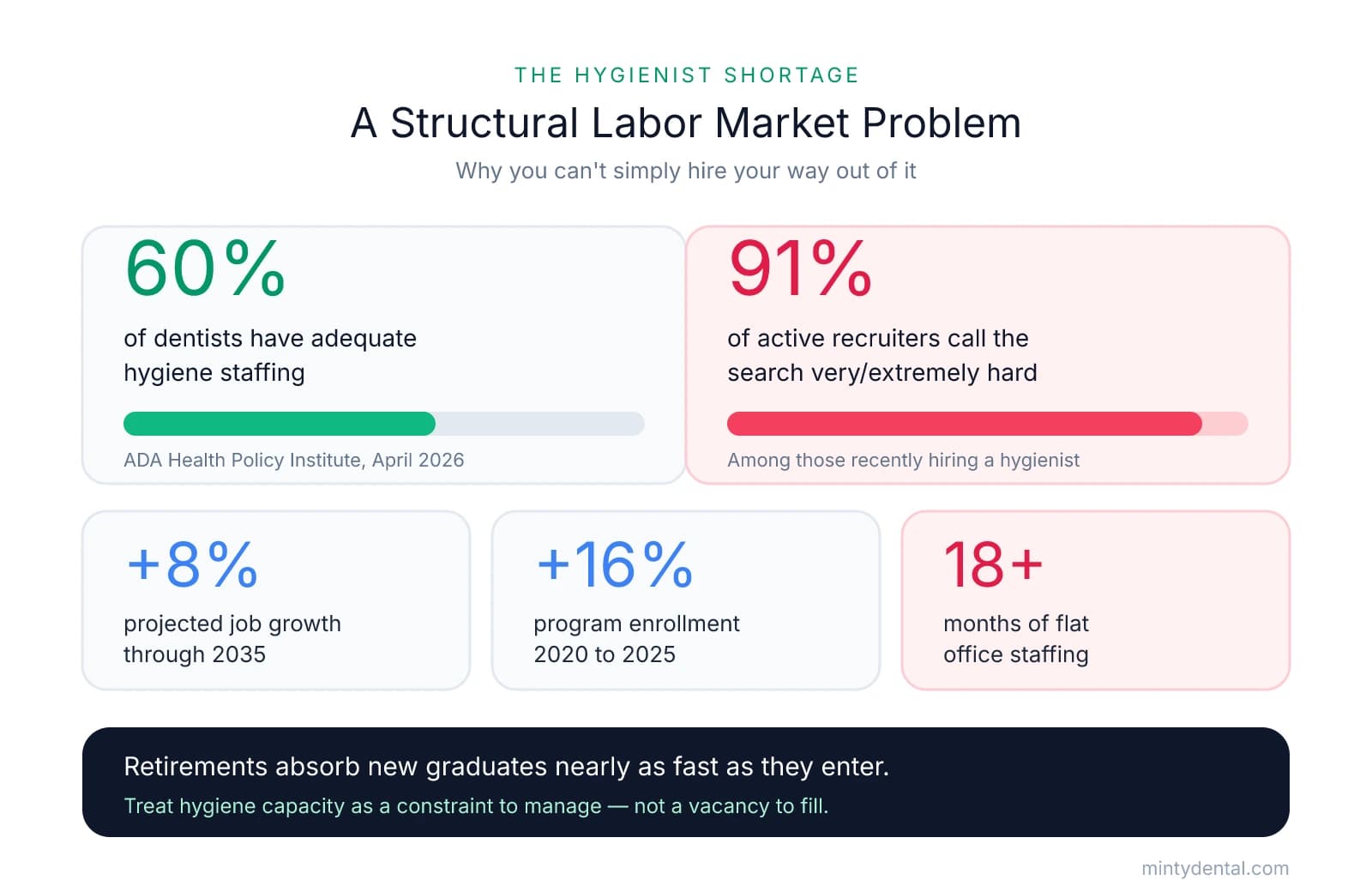
Only 60% of dentists report having adequate hygiene staffing, according to April 2026 data from the ADA Health Policy Institute. Among those who were actively recruiting or had recently tried to hire a hygienist, 91% described the search as very or extremely challenging. The comments dentists left in the HPI survey are telling: colleagues saying there are no unemployed hygienists in their area, that temps have no interest in permanent work, and that the wages candidates are asking for exceed what reimbursement rates can support. These aren't isolated complaints from one region. They're consistent across the country.
Employment for dental hygienists is projected to grow 8% through 2035, faster than the average for all occupations, which reflects sustained demand. But faster-than-average projected growth doesn't mean supply catches up; it means the gap between available positions and available candidates is expected to persist.
The training pipeline has responded. First-year enrollment in dental hygiene programs increased 16% from 2020 to 2025, and 2025 produced the highest number of hygiene program graduates on record. Yet total dental office staffing has been essentially flat for over 18 months. The reason is that retirements and voluntary exits are absorbing new graduates nearly as fast as they enter the workforce. The pipeline is growing, just not fast enough to produce a surplus.
Wages add another layer to the problem. Real compensation for dental office staff has declined relative to inflation over recent years and has fallen behind what medical offices are paying for comparable clinical roles. That gap matters because hygienists, especially experienced ones, have options. Posting a higher hourly rate helps at the margin, but it doesn't fix the underlying mismatch when the candidate pool itself is thin. Understanding whether your hygiene capacity is actually the binding constraint on practice growth is a useful first step before deciding how aggressively to compete on wages.
A hygiene vacancy is a problem you solve once, whereas a constrained hygiene labor market is a condition you operate within, possibly for years.
Getting More Production from the Hygiene Hours You Already Have
Before looking at the schedule itself, it's worth understanding what's actually available in the hours you're already paying for.
The assisted hygiene model
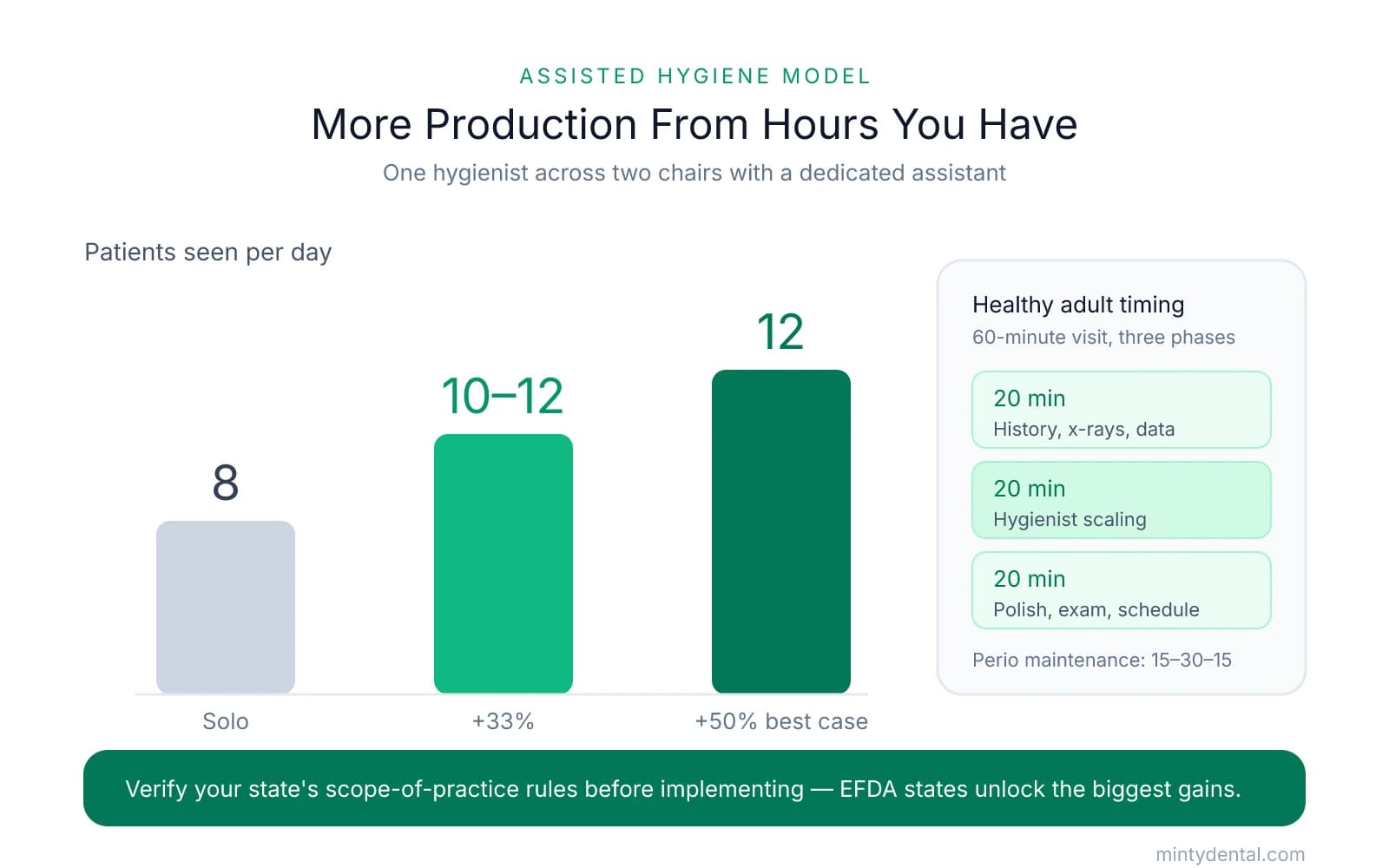
In assisted hygiene, one hygienist works across two operatories with a dedicated assistant running the supporting tasks: seating patients, reviewing health history, taking radiographs, charting, polishing, and disinfecting the room between appointments. The hygienist focuses exclusively on scaling, periodontal assessment, and patient communication. That division of labor eliminates the dead time a solo hygienist spends on tasks that don't require their license, and it keeps clinical production moving continuously across both chairs.
The productivity difference is real. Consultants familiar with the model report a 33% increase in patients seen as a straightforward outcome, with some practices hitting a 50% gain when scheduling is managed well. In concrete terms: a hygienist currently running eight patients solo in a day might see 10 to 12 under an assisted model. At your current hygiene production per visit, that gap is worth calculating before dismissing the setup cost of a dedicated assistant.
In one assisted hygiene timing framework for healthy adult patients, the first 20 minutes covers health history, radiographs, and data entry; the hygienist takes the middle 20 for scaling; the last 20 handles polishing, flossing, exam coordination, and scheduling. Perio maintenance patients run closer to a 15-30-15 split. The assistant and hygienist ideally work side-by-side operatories so each can read where the other is in the flow without constant communication.
One important constraint: state scope-of-practice rules govern which tasks a dental assistant can legally perform, and they vary significantly. Polishing, radiographs, and charting are permitted in many states, but you'll need to verify your state's specific allowances before implementing the model. In states that license expanded function dental assistants (EFDAs), the clinical range is broader and the productivity upside is greater.
Schedule discipline: utilization and recall
The assisted hygiene model only helps if the schedule itself is working. Two metrics from your practice management software tell you quickly whether it is.
The first is hygiene schedule utilization, the percentage of available appointment slots that are actually filled. A utilization rate below 92% means you're losing production to open time, not to a headcount shortage. Short-staffed practices often assume their hygiene problem is purely supply; frequently it's also a scheduling problem running in parallel.
The second is your reappointment rate, which measures how many patients leave a hygiene visit with their next appointment already booked. A healthy reappointment rate is 85% or better. Practices averaging 60 to 65% are losing a meaningful share of their active patient base between visits, and the effect compounds: those patients either drift to a longer recall cycle or leave the practice entirely. A schedule can look nearly full while still hiding this leak, because the open slots aren't clustered together in ways that make the problem obvious.
The most practical fixes are unglamorous but effective. Pre-appointing at checkout, rather than relying on outbound recall calls weeks later, has the highest conversion rate for keeping patients in cycle. ASAP lists allow the front desk to fill same-week cancellations without scrambling. Shadow scheduling, where a likely no-show is double-booked when a patient hasn't confirmed, keeps the column from going dark when the cancellation comes in the morning of.
Protecting Restorative Revenue When Hygiene Can't Feed the Chair
Hygiene is the diagnostic engine of a practice. Patients come in for a cleaning, get examined, and that exam is what surfaces decay, failing restorations, and periodontal disease that need treatment. When hygiene capacity shrinks, fewer exams happen, and the pipeline of diagnosed restorative work shrinks with it. The typical response is to wait for hygiene to recover before restorative production picks back up. That's the wrong posture, because you're leaving revenue on the table that's already been diagnosed.
Pull the unscheduled treatment report
Most practices have months of diagnosed but unscheduled treatment sitting in their practice management system. A patient came in, the doctor found a two-surface composite, they were told about it at checkout, and they said they'd call to schedule. They didn't call. That treatment is still in the record, and it's almost certainly not being worked actively.
Pulling the unscheduled treatment report weekly and having your front desk contact those patients is probably the highest-return administrative task in a constrained hygiene environment. There's no new clinical work required. The diagnosis is already done. The ask is converting a documented clinical finding into a scheduled appointment.
Use the morning huddle to find same-day starts
Patients on today's hygiene schedule who have outstanding treatment plans are the easiest same-day starts you'll find, because they're already in the building. A well-run morning huddle reviews each patient on the hygiene column for open treatment before the day begins, which gives the doctor's exam a specific goal and gives the front desk a heads-up to hold time in the afternoon schedule if the patient agrees to move forward.
Reserving 30 to 60 minutes in the doctor's afternoon for same-day procedures turns that morning identification into actual production. Without a protected block, same-day starts are aspirational: there's no time to seat the patient even if they say yes. Building that block into the schedule as a consistent habit is a discipline question more than a scheduling complexity.
What improved recall is worth in restorative terms
Practice benchmarks indicate that 20% of hygiene exams result in restorative treatment averaging $500 per patient. Keeping an additional 25 to 30 patients per month in active recall translates to roughly $2,000 to $3,000 in incremental restorative production monthly. These are hypothetical estimates based on practice-level averages, not guarantees, but the underlying logic is sound: more exams generate more diagnosed treatment, and more diagnosed treatment converts to scheduled production when the system is working the unscheduled report and running same-day starts.
A note on adding an associate
An associate is a reasonable growth path when restorative demand genuinely exceeds the owner's capacity, but the timing matters. An associate needs a steady stream of examined, diagnosed patients to produce from. If hygiene is constrained, that stream is thin, and the associate will underperform relative to their cost. The financial case for an associate gets much stronger once hygiene capacity is stabilized, because the associate has a full pipeline to work from. Bring an associate in before fixing hygiene, and you're paying for capacity you can't feed.
Building a Compensation Package That Actually Keeps Hygienists
The cheapest hygienist to recruit is the one already treating your patients. Turnover costs run well beyond the lost production during an open chair: recruiting fees, onboarding time, and the months it takes a new hire to build patient rapport are real expenses that rarely appear on a single line in the overhead report.
The average hygienist hourly wage reached $48.85 in 2025, up from $45.75 in 2023, representing three consecutive years of wage growth. That number also conceals enormous geographic spread: California, Washington, Oregon, Hawaii, and Alaska average roughly $60 per hour, while Alabama, Kentucky, Mississippi, and Tennessee average closer to $38. Benchmarking your offer against a national figure is nearly useless. What matters is what practices in your specific market are paying hygienists with comparable experience.
Even with wages rising, only 50% of hygienists report satisfaction with their total compensation. The dissatisfaction isn't primarily about the hourly rate. It's about what surrounds it. Dental practices have a well-documented reputation across the industry for thin or nonexistent benefits, and hygienists are aware of what comparable clinical roles in medical offices offer. Health insurance, a retirement contribution, and paid continuing education are the three benefits that move the needle most. None of them requires a large outlay relative to what an open chair costs.
Schedule predictability is a retention factor that costs even less to provide and is frequently overlooked. Hygienists regularly cite having hours cut when the schedule runs light as a serious dissatisfier. Offering a guaranteed minimum weekly hours commitment, even if the full schedule doesn't materialize some weeks, removes a source of financial anxiety that drives people to look elsewhere. It signals that you're treating the role as a real career position rather than a variable-cost staffing slot.
Culture matters more than most owners expect. 52% of hygienists who left jobs voluntarily said their manager could have done something to retain them. The things those managers could have done don't appear in the wage line: being treated as a clinical professional, having genuine autonomy over patient care decisions, and seeing a path for development within the practice. These are low-cost retention levers that are easy to underestimate precisely because they don't show up on a payroll report.
If you need to cover gaps while you stabilize staffing, app-based platforms like Cloud Dentistry, GoTu, and Kwikly can place a temp hygienist within 24 to 48 hours. Temp costs, including platform fees or agency markups on top of the hygienist's rate, need to be weighed against an empty hygiene chair that puts an estimated $1,200 to $1,600 per day in production at risk. For most practices, paying for a temp is justified as a bridge. Leaning on temps indefinitely, though, erodes culture and costs more than a well-structured permanent offer.
The practical starting point is a retention audit. Pull your current comp package and compare it line by line against local market rates, not national averages. Check whether you're offering health insurance and a retirement contribution. If you're not sure how to structure a hygienist pay package that's competitive without overloading your overhead, building that model before your next review conversation is worth the time. Then do something most owners never do: ask your hygienist directly what would make them stay. The answer will almost always be more useful than anything you'd learn from a job posting.
Sources & References
The data and claims in this article are drawn from the following sources. We prioritize government data, peer-reviewed research, and established industry publications to ensure accuracy.
- Dental Hygienist Shortage - American Dental Association— ada.orgIndustry
- Dental Hygienists : Occupational Outlook Handbook— www.bls.govGovernment
- Dental Hygienist Shortage - American Dental Association— ada.orgIndustry
- Is assisted hygiene right for you? | DANB— danb.orgIndustry
- Assisted Hygiene: Tips for Success - Burkhart Dental Supply— burkhartdental.comIndustry
- Improving Patient Recall Increases Dental Practice Profitability— practiceanalytics.comIndustry
- What Dental Hygienists Earned in 2025— dimensionsofdentalhygiene.comIndustry
- Why Employee Benefits are Key to Boosting Retention in the Workplace— dentalpost.netIndustry
- Dental Hygienist Shortage - American Dental Association— ada.orgIndustry
Plug Hygiene Gaps Before They Stall Your Practice
Minty Operations handles the business side of your practice so you can focus on the clinical fixes your hygiene department actually needs. If adding a location is part of your growth plan, we can help with that path too.