Dental Associate Pay: Percentage vs. Salary for Owners

Co-Founder, Minty Dental
In Summary
- Four compensation structures dominate associate pay: straight salary, percentage of production, percentage of collections, and hybrid (base plus percentage).
- The owner's margin on associate revenue depends on the sum of overhead plus compensation: the two figures must total less than 100% for the owner to keep anything.
- Median overhead runs about 64% for solo practitioners and about 68% for practices with associates, because adding a provider raises indirect costs.
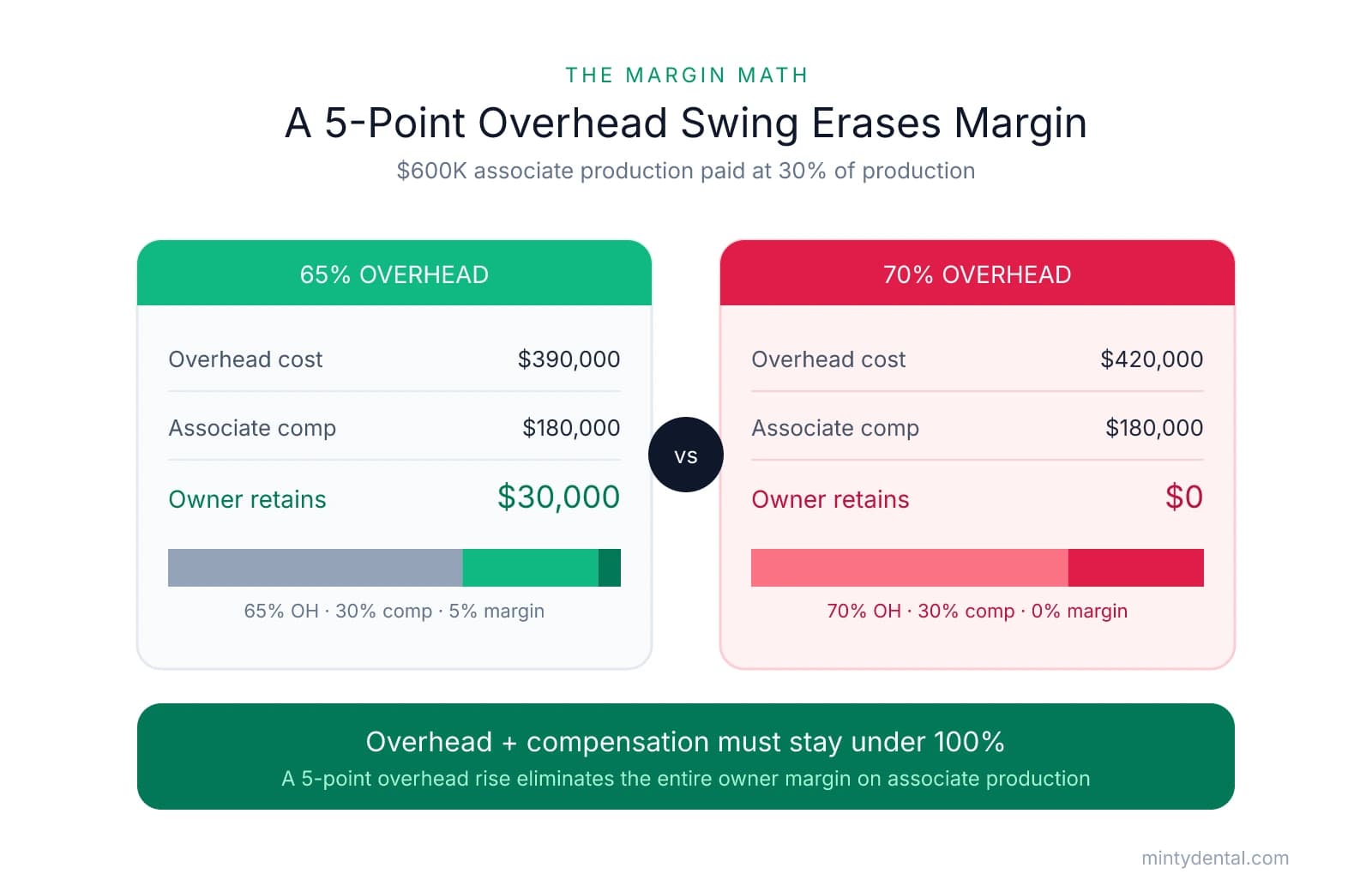
- At $600,000 in associate production paid at 30%, the owner retains roughly $30,000 at 65% overhead and nothing at 70% overhead.
- Production-based pay compensates on posted procedures regardless of collections, while collections-based pay shifts write-off and adjustment risk to the associate.
Your Overhead Rate Determines Which Compensation Model Works
The choice of compensation model is primarily a math question, and the answer depends on your practice's overhead rate.
Straight salary: The associate earns a fixed annual amount regardless of what they produce or the practice collects. The owner absorbs all production and collection risk.
Percentage of production: The associate earns a set percentage (commonly 25% to 35%) of the dollar value of procedures they perform, whether or not the practice collects the full amount.
Percentage of collections: The associate earns a percentage of cash actually received for their work, so write-offs, insurance adjustments, and patient non-payment reduce their pay.
Hybrid (base plus percentage): The associate receives a guaranteed daily or monthly base, with a percentage paid on production or collections above a breakeven threshold.
The distinction between production and collections matters because production-based pay compensates on posted procedures regardless of what the practice collects, while collections-based pay ties the associate's earnings to actual cash received. That difference moves write-off and adjustment risk from the owner to the associate.
Overhead plus compensation must add to less than 100% for the owner to retain any margin on associate revenue. If overhead consumes 70% of associate-generated revenue and compensation consumes 30%, nothing remains.
Median overhead sits near 64% for solo practitioners and near 68% for practices with associates, because adding a provider increases indirect costs such as staffing, supplies, and space. That gap determines how much room a given percentage leaves.
Consider an associate producing $600,000 annually at a 30% production split:
| Overhead rate | Overhead cost | Associate comp | Owner retains |
|---|---|---|---|
| 65% | $390,000 | $180,000 | $30,000 (5%) |
| 70% | $420,000 | $180,000 | $0 |
A five-point swing in overhead erases the entire margin. At 70% overhead and 30% comp, the owner retains close to zero on associate production. Running your own overhead number through a compensation calculator before setting a rate shows which model your practice can actually support.
How Each Model Shifts Financial Risk Between Owner and Associate
Each compensation model places financial risk in a different spot. Deciding which structure fits your practice depends on how predictable your associate's production is, how much you collect on what you bill, and how long you expect the associate to take to fill a schedule.
Straight salary: The owner absorbs all production risk. A slow month, a seasonal dip, or a stalled ramp-up does not change what the owner pays. This model works when the owner can predict the associate's production with confidence and has verified that expected production will cover the salary plus allocated overhead. If production falls short, the owner carries the gap. Salary is most defensible when an established patient base or a proven referral stream makes production reliable from the start.
Percentage of production: Pay scales with output, so a slow month costs the owner less. The owner still absorbs the risk of write-offs, PPO adjustments, and uncollected balances, because the associate is paid on what was billed rather than what was received. In a heavy PPO practice, this can mean paying the associate on $100 of production while the practice collects closer to $60. The wider the gap between your gross production and net collections, the more this model works against the owner.
Percentage of collections: The associate shares write-off and adjustment risk because pay is tied to cash the practice actually receives. Collections-based compensation forces the associate to share the risk of write-offs, adjustments, and patient non-payment. This is generally more owner-favorable in PPO-heavy environments, where a large share of billed production never converts to cash.
Hybrid (base plus percentage): A modest daily base covers recruiting appeal and ramp-up stability, while the percentage applies only above a breakeven threshold, giving the owner a built-in margin floor. A structure with a $500 to $800 per day base and a 28% to 32% collections percentage above breakeven can protect owner margin while giving the associate upside.
The ramp-up period changes the first-year calculus. New associates typically take 6 to 12 months to fill a schedule, so a straight percentage model may underpay them early, and a salary model may overpay relative to production. A hybrid bridges that window. If production stays low past the expected ramp, a diagnostic review of scheduling and case acceptance helps separate a slow start from a structural problem.
The Contract Definitions That Change the Dollar Outcome
Two practices can offer the same 30% percentage and arrive at very different associate pay, because the word "production" means different things depending on how the contract defines it. Gross production, adjusted production, and net collections are distinct bases, and the gap between them can run 20% to 40% in a PPO-heavy practice.
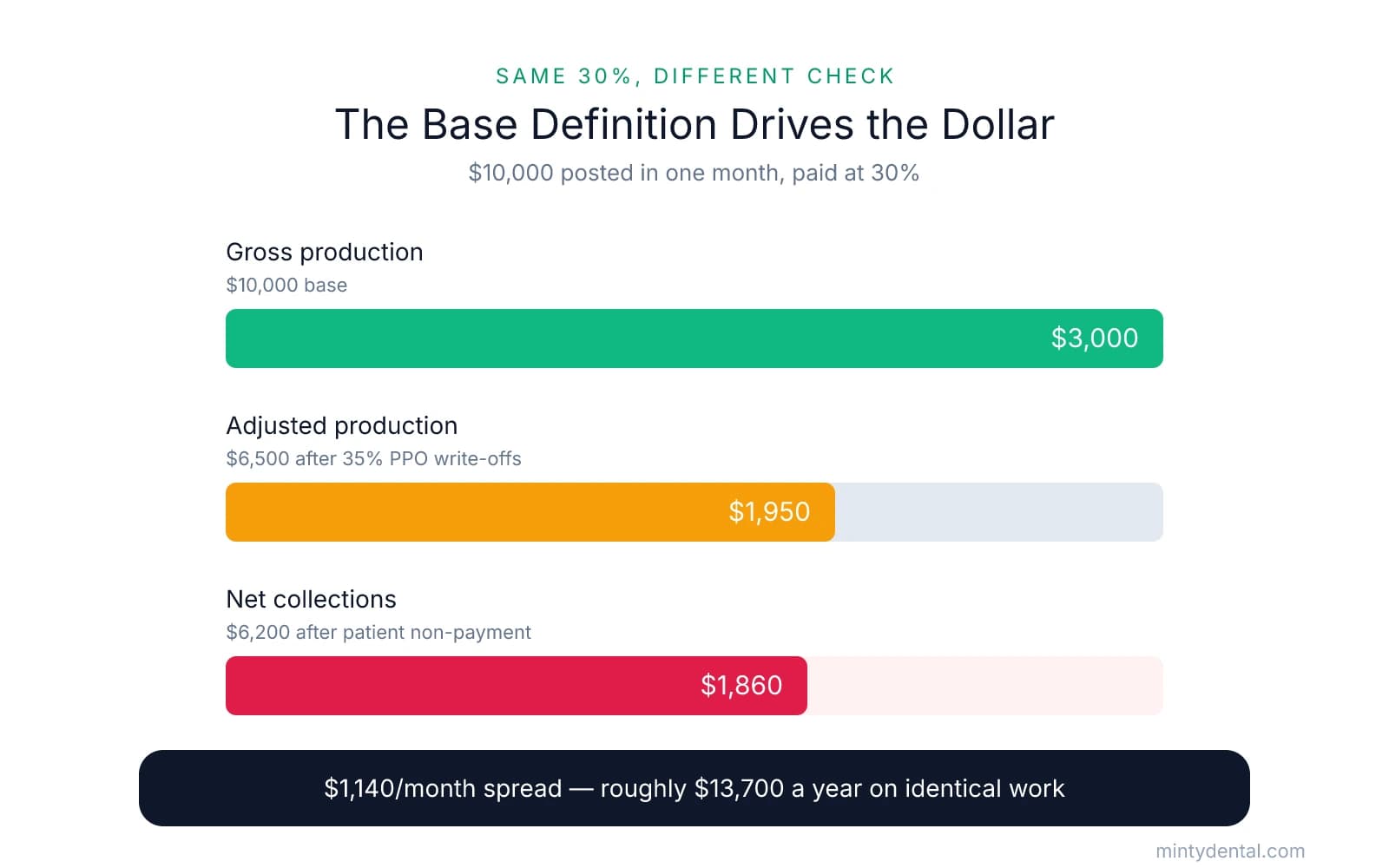
Consider an associate who posts $10,000 in a single month. Applying the same 30% percentage to each base produces a different check:
| Base definition | Amount after adjustments | Associate pay at 30% |
|---|---|---|
| Gross production | $10,000 | $3,000 |
| Adjusted production (after 35% PPO write-offs) | $6,500 | $1,950 |
| Net collections (after patient non-payment) | $6,200 | $1,860 |
The same clinical work yields a $1,140 monthly spread between the highest and lowest figure, or roughly $13,700 a year. Neither number is right or wrong, but both parties need to know which one the contract uses before signing.
Beyond the base itself, several items are commonly carved out of the production calculation. Each should be addressed in writing so the math is reproducible.
- Lab fee treatment. Many agreements deduct lab costs before applying the percentage, often split 50/50 or assigned entirely to the associate's crown and bridge production. If your lab fees run higher than the typical range, how they are allocated materially affects associate pay.
- Hygiene production. Some owners credit the associate for hygiene performed under their supervision, and others exclude it entirely. State which applies.
- Specialist referrals. Production sent out to a specialist, or work the associate refers internally, should be defined as included or excluded.
- Redone and warranty work. Clarify whether no-charge adjustments and remakes reduce the production base.
Compensation disputes most often arise not from the percentage itself but from fuzzy definitions and agreements that were never updated when fees, payer mix, or staffing changed. The percentage tends to get the attention during negotiation, while the base definition quietly determines the dollar outcome.
A practical safeguard is to attach a sample reconciliation to the contract: a worked example using your actual fee schedule and payer mix, showing a month of hypothetical production carried all the way to the associate's check. When both parties have reviewed the same math on paper, the structure is far less likely to produce conflict later.
Choosing the Right Model for Your Practice: A Decision Framework
There is no universal compensation model: the right structure depends on your practice's overhead rate, payer mix, the type of associate you want to attract, and your specific numbers.
Overhead below 60%: A straight percentage of collections at 28% to 32% is likely sustainable and straightforward to administer. With overhead this low, the gap between your revenue and the associate's percentage leaves a workable margin, and a single collections-based rate avoids the complexity of tracking a base against a threshold.
Overhead between 60% and 67%: A hybrid model with a modest daily base and a collections percentage above a breakeven threshold protects margin during ramp-up and slow periods. At this level, a straight percentage can still work once the schedule fills, but the base-plus-threshold structure prevents the owner from overpaying while production is building.
Overhead above 67%: Standard percentage-of-production models at 25% to 35% will likely leave near-zero or negative owner margin, as the margin math in the earlier table showed. Adjusting the compensation rate alone rarely solves this, because the overhead is consuming the room the percentage would otherwise occupy. The overhead structure needs attention alongside the compensation decision, and identifying which costs to reduce first is often the more productive starting point.
PPO write-offs above 30%: Collections-based pay is preferable to production-based pay because it prevents compensating the associate on revenue the practice never received. In a heavy PPO environment, paying on gross production can mean writing a check against dollars that were adjusted away before they reached your account. Contracts should clearly define how collections are calculated and reported, including any delays in collections that affect the associate's income.
A new associate with uncertain production: A hybrid model, or a salary with a defined review period such as a 90-day or six-month reset, reduces owner exposure during the ramp-up window. A scheduled review lets you recalibrate once actual production data exists rather than committing to a rate before you know what the associate will produce.
The model also shapes who applies. Salary offers tend to attract candidates who are earlier in their career or more risk-averse, while percentage-only offers tend to attract higher producers confident in their output. Owners weighing whether to add an associate or extend hours instead can consider whether their candidate pool and culture align with the model they intend to offer.
Revisit the structure whenever overhead shifts materially, because a model calibrated at 62% may not hold at 68%.
Sources & References
The data and claims in this article are drawn from the following sources. We prioritize government data, peer-reviewed research, and established industry publications to ensure accuracy.
- Dental Practice Research - American Dental Association— www.ada.orgIndustry
- Dental Associate Compensation: Models That Protect Margins— nstarfinance.comIndustry
- Associate Pay Isn't the Problem—Unclear Definitions Are— theprofitabledentist.comIndustry
- Which Compensation Structure is Right For You?— www.collieradvisors.com
Ready to optimize your associate compensation strategy?
Choosing the right pay structure for your dental associates directly impacts practice profitability and team retention. Minty's operations team helps independent practice owners implement compensation models that attract top talent while maintaining healthy margins.