Buying a Dental Practice Where the Seller Drives Referrals

Co-Founder, Minty Dental

In Summary
- Goodwill accounts for roughly 75% to 85% of a dental practice's purchase price, making it the primary asset in any acquisition rather than the equipment or buildout.
- Goodwill splits into enterprise goodwill (location, systems, staff, and recall engine, which transfers at closing) and personal goodwill (the seller's name, reputation, and personal referral relationships, which does not transfer automatically).
- When the seller is the dominant source of new patients, a disproportionate share of the goodwill is personal, and buyers who pay enterprise-goodwill prices for it may overpay for an asset that does not survive the seller's departure.
- Key-person discounts for owner dependency typically range from 5% to 25%, which on a $1.5M practice represents $75,000 to $375,000 in potential overpayment if the risk is not priced in.
- Quantifying referral concentration during diligence, then adjusting price and transition terms, is how buyers protect the value they are paying for.
Seller-Driven Referrals Are a Valuation Problem, Not Just a Transition Risk
Goodwill is the asset a buyer is actually purchasing. In a dental practice sale, the equipment and leasehold are minor line items. The ADA's valuation manual places the intangible value of patients, reputation, and referral flow at roughly 75% to 85% of the sale price. The question that determines whether that goodwill holds its value is how much of it belongs to the practice and how much belongs to the departing dentist.
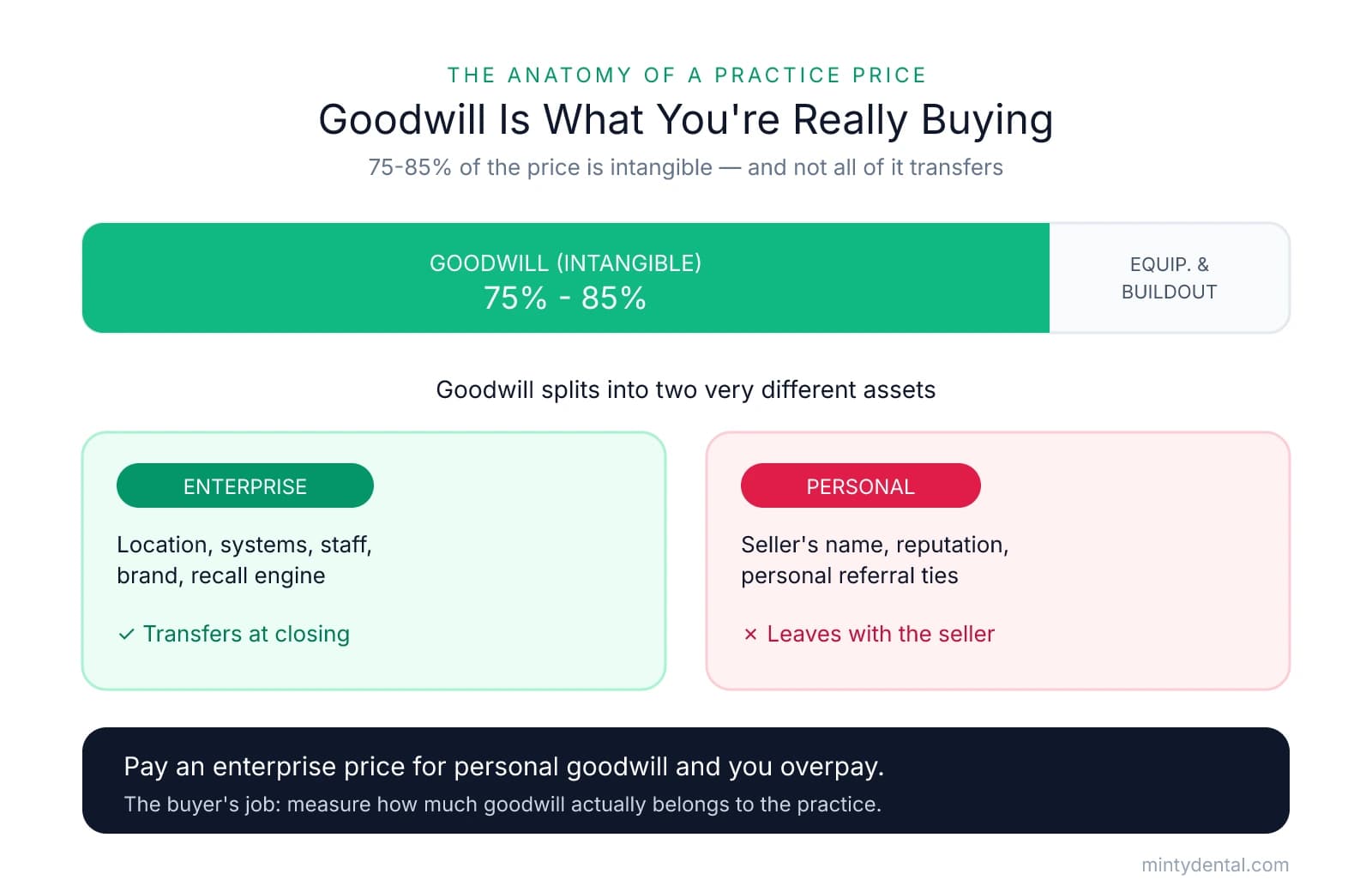
Goodwill divides into two categories that a buyer should value differently. Enterprise goodwill is the intangible value tied to the business itself: the location, the brand, the systems, the staff, and the recall engine that brings patients back on schedule. It transfers the day the keys change hands. Personal goodwill is the value tied to the individual dentist, including the seller's name, chairside reputation, and the referral relationships that exist because a specialist or a long-term patient trusts that specific person. It tends to leave when the seller does.
The distinction becomes a pricing issue when the seller is the main source of new patients. Patient referrals are the dominant acquisition channel in general dentistry, with 73% of patients choosing a dentist through recommendations from friends and family. That concentration is healthy when referrals flow because of the practice's systems and reputation. It becomes a concentration risk when those referrals arrive specifically because of the seller's personal relationships.
The valuation effect is measurable. The key-person discount literature, including IRS Rev. Rul. 59-60 and later valuation scholarship, places the reduction for owner dependency at 5% to 25%. On a $1.5M practice, that range represents $75,000 to $375,000 in potential overpayment if the dependency is not identified and priced during diligence. A buyer who pays a full enterprise-goodwill price for what is substantially personal goodwill is paying for an asset that may not remain after closing. The sections that follow give you a framework for measuring that dependency, adjusting price for it, and structuring the transition, including the seller's post-closing employment terms, to protect the value you are buying.
How to Measure Referral Dependency During Due Diligence
Most buyers know referral concentration matters but do not know what to request or how to read it. The data usually already exists inside the practice management software, so the task is asking for the right reports and interpreting them against clear thresholds.
Start with 24 months of new patient source reports. Dentrix, Eaglesoft, Curve, and similar platforms track referral source at intake, which means the practice can produce this history during diligence without building anything new. Twenty-four months smooths out seasonal swings and shows whether new patient flow is stable, growing, or declining before the sale.
Then trace the last 50 new patients back to their listed referral source. This audit technique turns a vague concern into a count you can act on. Tally how many list the seller's name, "friend of Dr. [Seller]," or a specific professional contact the seller knows personally, such as a referring physician or specialist. When a majority of recent new patients trace to the seller personally, the practice's acquisition engine is running on personal rather than enterprise relationships.
Sort each source into one of three categories, because they transfer at very different rates:
| Referral category | Example | Transferability |
|---|---|---|
| Existing patient word-of-mouth | A current patient recommends a friend | Generally transferable; tied to the practice experience |
| Professional or specialist referrals | A periodontist sends restorative cases | Partially transferable if the relationship is with the practice |
| Seller's personal network | A community contact or golf partner | Least transferable; depends on the seller's presence |
Asking the seller directly often reveals more than the reports alone. A useful question is: "If you were not here, which of your referral sources would still send patients to this practice?" The answer separates institutional flow from personal flow and gives you the seller's own read on which relationships are durable.
Look for corroborating signals that point the same direction. A high share of new patients listing the seller's name, a thin or absent Google review profile, minimal marketing spend, and no documented referral outreach program together suggest the new patient engine depends on the seller's relationships rather than the practice's systems. It also helps to confirm that the active patient count reflects genuinely engaged patients, since reported patient counts can be inflated in ways that overstate recurring demand.
Normal annual attrition runs 17% to 25% across thousands of dental offices, but in referral-dependent practices, post-sale losses can reach 20% to 30% within 18 months when the referral source does not transfer, a direct reduction in the revenue the purchase price was based on.
Pricing and Structuring the Deal When Referral Risk Is Real
Once diligence confirms meaningful referral dependency, buyers have three levers to bring the deal back into balance: adjust the price, restructure how it is paid, and extend the transition. These work best in combination, and none of them requires walking away from an otherwise sound practice.
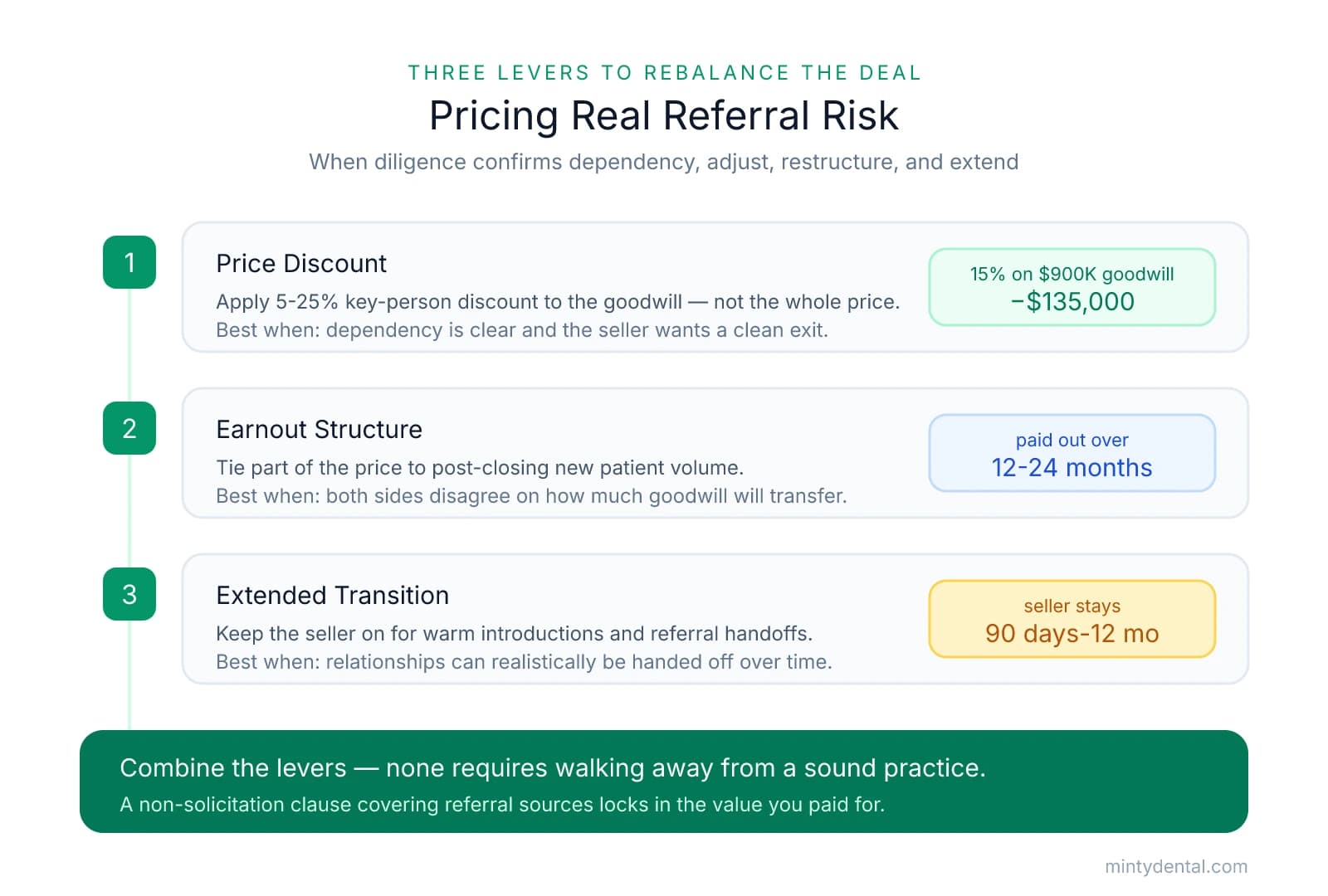
Price adjustment. Apply a key-person discount to the goodwill component rather than the whole purchase price, since the risk sits in the intangible value the seller personally carries. On a $1.2M practice where goodwill is $900,000, a 15% discount to the goodwill component reduces the offer by $135,000. The 5% to 25% range from valuation literature gives a defensible starting point, and the share of new patients that traced to the seller during diligence tells you where in that range to land.
Earnout structure. An earnout ties part of the purchase price to the practice's post-closing performance, typically paid out over 12 to 24 months if targets are met. This structure lets buyers and sellers disagree on value while still closing the deal, because the final price follows actual results. Tying the earnout to new patient volume shifts the personal-goodwill risk back to the seller, who is best positioned to influence whether those relationships transfer. If new patient flow holds at or above the historical average, the seller collects in full.
Extended seller transition. A longer seller presence, often 90 days to 12 months depending on the degree of dependency, gives time for personal introductions, co-treatment, and direct outreach to referral sources. The transition agreement should specify the seller's schedule, referral-transfer responsibilities, and an end date so both parties share the same expectations.
| Lever | Best when |
|---|---|
| Price discount | Dependency is clear and seller wants a clean exit |
| Earnout | Both sides disagree on how much goodwill will transfer |
| Extended transition | Relationships can realistically be handed off over time |
A non-solicitation clause creates the contractual restriction that prevents the seller from diverting relationships after closing. It should explicitly cover referral sources, not only patients and staff, so the seller cannot redirect professional relationships elsewhere. Courts generally enforce non-solicitation terms more reliably than non-competes, which makes the scope of that non-solicitation language worth negotiating carefully. It prevents redirection but does not replace active transfer, so pair it with transition responsibilities.
Finally, assess what marketing infrastructure exists to sustain new patient flow after the seller leaves. A practice with no Google presence, no recall system, and no referral outreach program will need investment to replace personal referrals with institutional ones.
Building a Referral Engine That Doesn't Depend on the Seller
Once the deal closes on fair terms, the work shifts from pricing the risk to replacing the personal referral flow with systems the practice owns. Some attrition of seller-tied relationships is normal and expected, so the goal is to minimize the losses and build a more durable engine that does not depend on any single person. The first 90 days set the trajectory.
Start with personal introductions while the seller is still present. In the first 30 days, have the seller introduce you to key referral sources in person, including referring physicians, specialists, and community contacts. These introductions carry more weight when the seller explicitly endorses you and frames the change as a continuation of the same care rather than a replacement. A warm handoff gives a referring specialist a reason to keep sending cases through the transition rather than redirecting them.
Send a co-signed transition letter. The ADA recommends a transition letter to active patients as a standard step, and a separate letter to professional referral sources matters at least as much in a referral-dependent practice. A letter co-signed by the seller carries more weight than one from you alone, because it borrows the trust the seller already holds with those contacts.
Audit the digital presence immediately. In practices where new patients arrived mostly through personal relationships, the online infrastructure is often underdeveloped. Check the Google Business Profile, review count, and website in the first week. A profile with fewer than 50 reviews and little recent activity is a gap you can close with a structured review request process at checkout, which builds a channel that captures patients searching independently of any referral.
Track referral sources from day one. Monthly new patient source reports from the practice management software show whether the seller's referral sources are transferring or whether attrition is accelerating. Building a referral tracking habit early gives you the visibility to intervene before a quarter of lost new patients becomes a trend.
Over the first 6 to 12 months, invest in the channels that work regardless of who owns the practice: patient experience systems that generate organic word-of-mouth, a structured recall program that keeps existing patients active and referring, and a Google presence that captures independent searches. Referrals are ultimately a result of the patient journey rather than any single program — practices that build a referable experience through consistent care and communication generate word-of-mouth that survives an ownership change. For specialist-heavy referral networks, cultivating trust with referring general dentists through continuing education events and open communication is one of the most durable ways to institutionalize those relationships after a transition. The practical starting point for institutionalizing those relationships is covered in more depth in a guide to building a referral network as a new owner.
Sources & References
The data and claims in this article are drawn from the following sources. We prioritize government data, peer-reviewed research, and established industry publications to ensure accuracy.
- Personal Goodwill: Why a Dental Buyer Can Withhold Your Cash— precisiondentalanalytics.comIndustry
- How to purchase with confidence | American Dental Association— ada.orgIndustry
- Earnouts in dental practice acquisitions: What you need to know— www.oralhealthgroup.comIndustry
- The Role of Restrictive Covenants in Dental Acquisitions— dentalcpas.comIndustry
- How to Build a Dental Referral Strategy That Actually Works— www.dentistrysupport.com
- 7 Strategies to Boost Patient Referrals for Dental Specialists— specializeddental.com
Ready to acquire a seller-dependent practice?
Purchasing a dental practice heavily reliant on the seller's referral network requires expert guidance to navigate personal goodwill risks and ensure sustainable patient flow. Minty's acquisition specialists help you evaluate referral dependencies and structure deals that protect your investment.