Getting a Mortgage After Buying a Dental Practice

Co-Founder, Minty Dental

In Summary
- The day you close on a dental practice, you shift from W-2 employee to self-employed business owner in the eyes of mortgage lenders — and that single change rewrites the rules for qualifying for a home loan
- Dental practice default rates are under 1%, meaning lenders still view dentists as strong borrowers; the challenge is documentation, not creditworthiness
- New practice owners typically carry around $1 million in combined debt (student loans plus practice loan) at closing — and still qualify for mortgages regularly
- Three specific obstacles make mortgage qualification harder after a practice purchase: the 2-year self-employment income history requirement, practice debt's effect on your personal debt-to-income ratio, and tax strategies that reduce your qualifying income on paper
- Physician mortgage loans exist precisely because conventional underwriting wasn't built for dentists — and they're one of the most effective tools for navigating this situation
Practice Ownership Changes How Mortgage Lenders See You
The moment you close on a dental practice, something changes that most new owners don't anticipate: in the eyes of every mortgage lender, you are no longer an employee. You're a self-employed business owner — and that single shift rewrites how your income is documented, how your debt is calculated, and which loan programs you can access.
This catches a lot of buyers off guard. The question many dentists ask is whether they can get a mortgage after buying a practice. The more useful question is how — because the answer is almost always yes, just through a different path than before.
Dental practice default rates sit below 1%, per the ADA. Lenders know this. They want to work with dentists. The friction isn't about whether you're creditworthy — it's about whether you can document your income in the way conventional underwriting requires.
That documentation gap is the root of most mortgage complications for new practice owners, and it shows up in three specific ways:
-
The 2-year history requirement. Most conventional lenders want to see two years of self-employment income before they'll count it toward qualification. If you closed on your practice six months ago, that income may not count yet — even if the practice is thriving.
-
Practice debt and your personal DTI. Your practice loan doesn't disappear from lenders' view just because it's a business obligation. How it's treated in your debt-to-income ratio depends heavily on loan structure and lender — and it can significantly affect what you qualify for.
-
Tax strategy working against you. Many practice owners, quite reasonably, work with their CPA to minimize taxable income. The problem is that mortgage lenders qualify you based on that same reduced number. Aggressive write-offs that make sense for tax purposes can shrink your qualifying income on paper.
None of these obstacles are insurmountable — but they do require a different approach than a W-2 borrower would take. It's also worth understanding the scale of debt many dentists are navigating: according to Panacea Financial via ADA News, the typical practice owner carries roughly $400,000 in student loans at closing, with total debt rising to around $1 million once the practice loan is added. Owners at that debt level still qualify for home mortgages regularly — a useful data point if the numbers feel daunting.
If you're still weighing the timing of these two major purchases, the sequencing question is worth thinking through before you're deep in either process. For those who've already closed on a practice, the rest of this article walks through each obstacle and the concrete strategies that address it.
The Two-Year Rule and How Practice Owners Work Around It
Of the three obstacles practice ownership creates, the two-year rule tends to catch new owners the most off guard — because it can make a thriving practice look like a liability on paper.
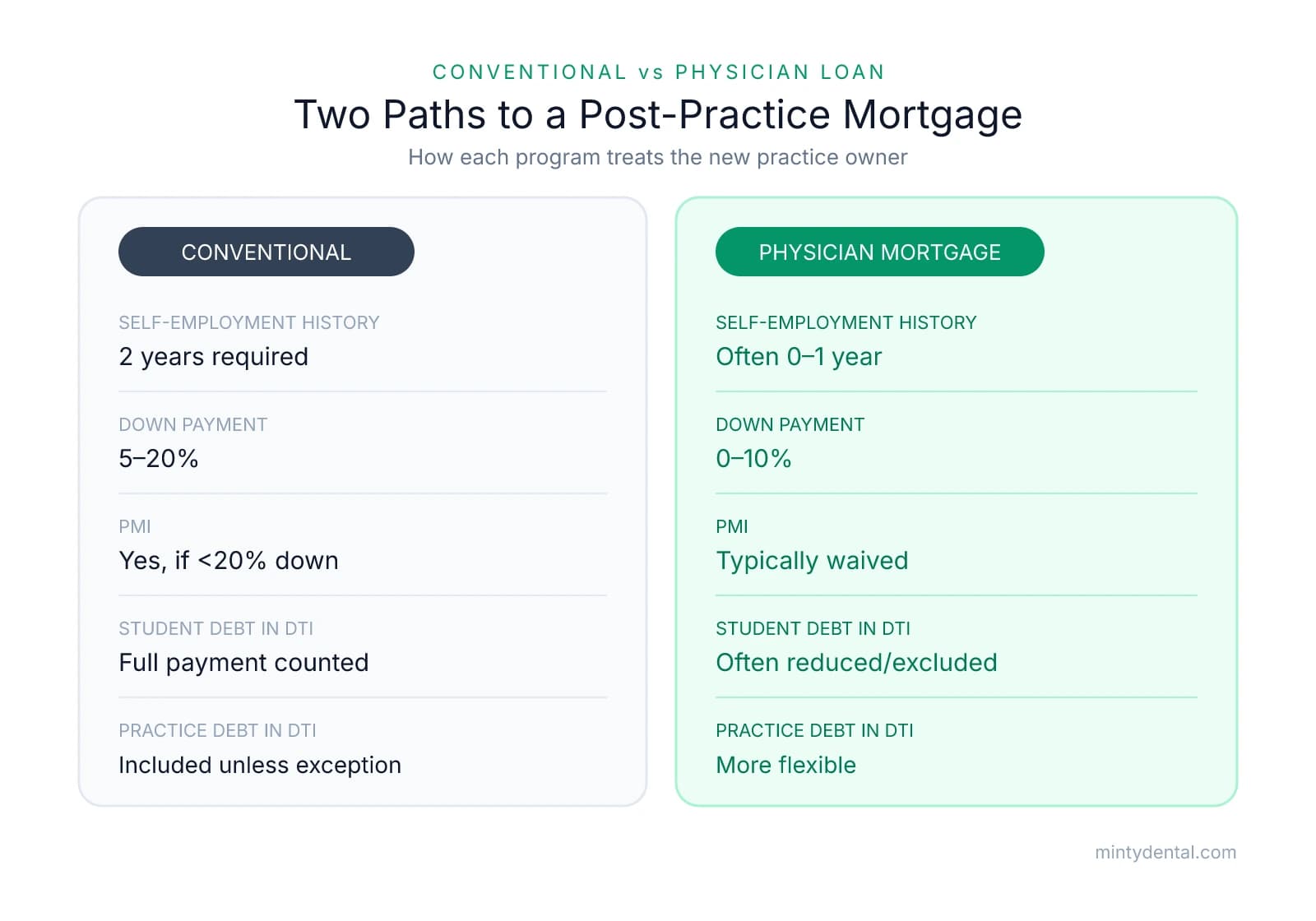
How the rule works: According to the Fannie Mae Selling Guide, conventional loans require at least two years of self-employment history before that income can be used to qualify a borrower. Lenders then average the two most recent years of Schedule C or K-1 income to arrive at a qualifying figure.
That averaging is where things get complicated. Year one of ownership almost always looks worse on paper than it actually is. Depreciation on equipment, amortization of purchased goodwill, and startup costs all reduce taxable income — sometimes dramatically. A practice generating strong cash flow can still show a net loss or minimal profit on a Schedule C after those deductions are applied. When a lender averages that low year-one figure with year two, the qualifying income drops well below what the practice is actually producing.
The Tax-Minimization Trap
A pattern worth paying attention to: the same tax strategies that make financial sense in year one can quietly undermine a mortgage application filed in year two or three. Working with a CPA to maximize deductions is smart — but those deductions reduce the income lenders are allowed to count. Some non-cash expenses like depreciation can be added back during underwriting, but not all write-offs receive that treatment.
If you're planning to buy a home within two to three years of closing on a practice, it's worth having an explicit conversation with your CPA before filing — not after. The documentation lenders expect from business tax returns includes net profit, depreciation addbacks, and amortization — knowing how those interact gives you the option to make a more informed tradeoff.
The Physician Loan Workaround
This is precisely the gap that physician and doctor mortgage loans were built to fill. Many lenders offering these programs to DDS and DMD holders don't require two years of self-employment history — some accept practice ownership income from day one, or treat the practice acquisition similarly to an employment contract for qualification purposes.
Here's how the two paths compare across the dimensions that matter most for new practice owners:
| Factor | Conventional Loan | Physician Mortgage Loan |
|---|---|---|
| Self-employment history required | 2 years | Often 0–1 year |
| Income documentation | 2-year average (Schedule C/K-1) | May use year-one income or P&L |
| Down payment | Typically 5–20% | Often 0–10% |
| PMI required | Yes, if <20% down | Typically waived |
| Student debt treatment | Included in DTI at full payment | Often excluded or reduced |
| Practice debt in DTI | Included unless exceptions apply | More flexible, lender-dependent |
Waiting It Out — When That's the Right Call
For buyers who prefer a conventional loan or don't qualify for a physician mortgage program, waiting 12–24 months after practice closing creates a meaningfully cleaner picture. By month 12, some lenders can begin using business income with supporting documentation. By year two, you have the full history conventional underwriting requires — and if the practice loan is structured correctly, the Fannie Mae 12-month business debt exception may allow it to be excluded from your personal DTI entirely.
The right path depends on your timeline, your tax filing strategy, and how your practice loan is structured — which is exactly what the next section covers.
How Your Practice Loan Affects Your Mortgage DTI
The practice loan's effect on your debt-to-income ratio is the obstacle most buyers don't see coming — because it feels like it shouldn't count. The practice generates the revenue that services the debt. Why would a lender hold it against you personally?
The answer is straightforward, if frustrating: most dental practice loans are personally guaranteed. That personal guarantee means the obligation appears in your name, and conventional underwriting counts it in your personal DTI regardless of where the cash flow originates.
How DTI Works — and Where the Math Breaks Down
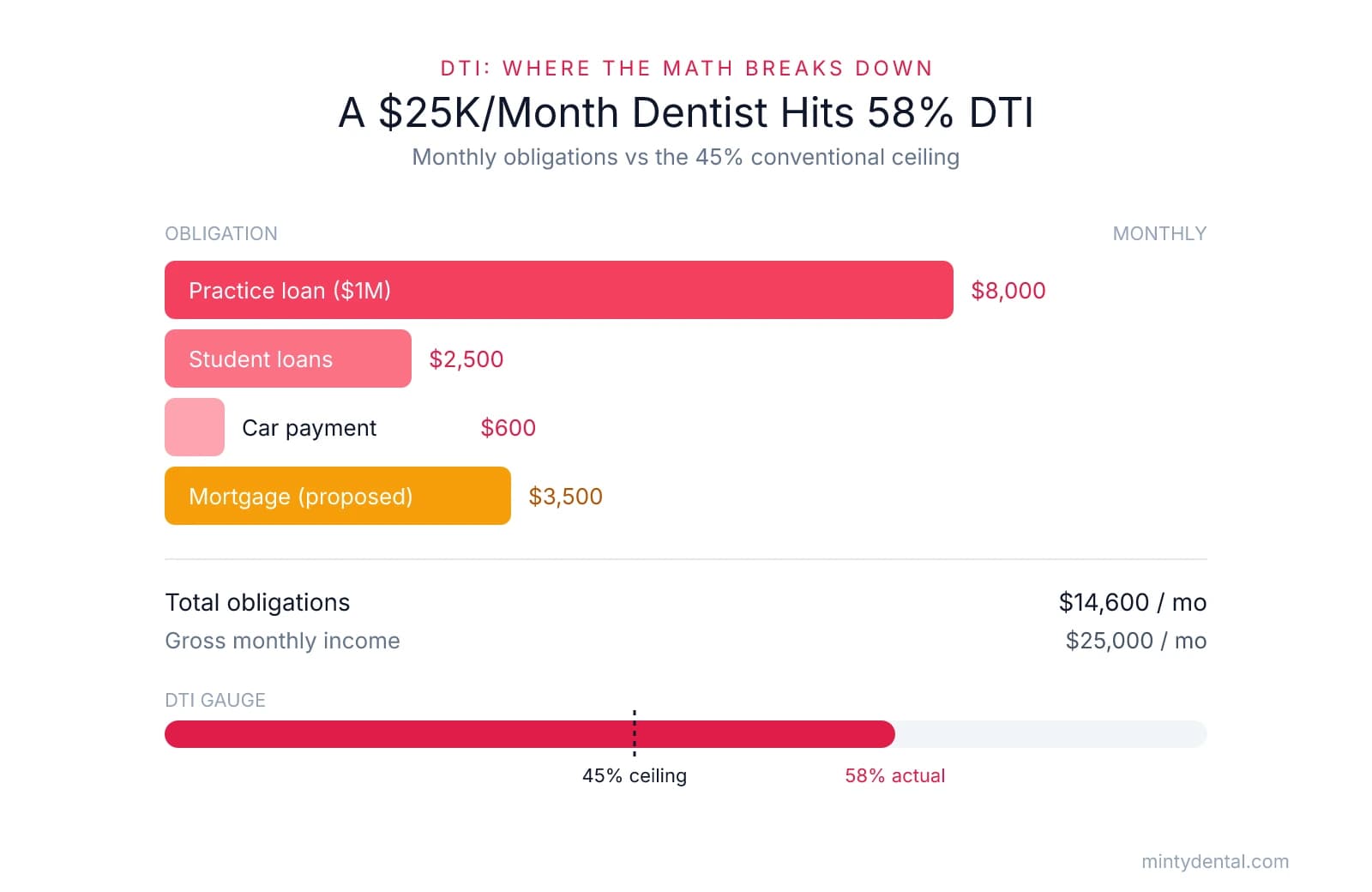
Back-end DTI is the ratio conventional lenders use to assess total debt load: all monthly debt payments divided by gross monthly income. According to the Fannie Mae Selling Guide, the standard ceiling sits at 45% for most conventionally underwritten loans, though some automated approvals allow up to 50% under specific conditions.
Here's where a realistic dentist scenario runs into trouble. Consider a practice owner with:
- $1M practice loan at roughly $8,000/month
- $400,000 in student loans at $2,500/month
- Car payment of $600/month
- Gross monthly income of $25,000
That's $11,100 in monthly obligations before a single dollar of mortgage payment — a baseline DTI of 44%. Add a $3,500 mortgage payment and DTI climbs to 58%, well above conventional thresholds. Even on a strong income, the math doesn't work without some form of relief.
The Fannie Mae 12-Month Business Payment Exception
One of the most valuable — and underused — provisions in conventional mortgage underwriting is the Fannie Mae business debt exclusion. If a business has made 12 consecutive months of payments on a personally guaranteed loan, documented through business bank statements, the lender can exclude that debt from the borrower's personal DTI calculation entirely.
For a practice owner with an $8,000/month practice loan, that exclusion recovers significant qualifying capacity — potentially the difference between approval and denial. The documentation requirement is specific: 12 months of cancelled checks or business bank statements showing the business account making each payment. Personal account payments don't qualify.
How Physician Mortgage Loans Handle Practice Debt
Physician mortgage programs — many of which are available to DDS and DMD holders — tend to apply more flexible DTI thresholds and often treat practice debt differently than conventional underwriting does. Some programs exclude practice loans from DTI by default; others apply higher DTI ceilings that accommodate the debt load common among new practice owners. The specifics vary by lender, which makes working with a mortgage professional who specializes in dental or physician borrowers genuinely worth the effort.
The Two-Year Offset
The other piece of the DTI puzzle is income. Once you have two years of tax returns showing practice income, lenders can use that revenue to offset the debt load — and the math often looks considerably better than it did in year one. The practice loan that pushed DTI above threshold in month six may be well within range by year three, once documented income is fully counted.
Before applying, it's worth running your own numbers: add up all monthly obligations, divide by gross monthly income, and compare that baseline to the 43–45% conventional ceiling. That calculation tells you immediately whether you're targeting a conventional loan, a physician mortgage, or whether the 12-month exception is the lever worth pulling first. Understanding how practice loan structure affects lender decisions can also shape which path makes the most sense.
A Practical Checklist for Getting Mortgage-Ready After Closing
The dentists who navigate this well aren't the ones who waited indefinitely — they're the ones who understood the sequence and planned around it deliberately. If you've already closed on a practice, here's a concrete framework for what to do next.
1. Time your application to the 12–24 month window. The period between one and two years after practice closing tends to be the sweet spot. At 12 months, you may qualify for the Fannie Mae business debt exclusion. At 24 months, you have the self-employment history conventional underwriting requires. If your timeline is shorter, a physician mortgage is likely the more realistic path.
2. Research physician mortgage lenders before assuming conventional is your only option. Many DDS and DMD holders don't realize they qualify for physician mortgage programs — products that often require 0–5% down, waive PMI, and apply more flexible income documentation standards. The White Coat Investor's physician loan database is a useful starting point for identifying lenders active in your state.
3. Talk to your CPA before filing the tax year you plan to apply. Once your return is filed, the qualifying income is locked in. A conversation with your accountant before filing — specifically about how planned deductions affect your Schedule C net income — gives you the option to make an informed tradeoff between tax savings and mortgage qualification.
4. Run all practice loan payments through your business account — consistently. If you're targeting the Fannie Mae 12-month business debt exclusion, the documentation requirement is specific: 12 consecutive months of business bank statements showing the practice account making each payment. Personal account payments don't qualify. Start this discipline at closing and don't interrupt it.
5. Check your credit and confirm your liquidity position. Practice acquisition typically involves multiple hard inquiries, which can create temporary credit score movement. Pull your reports and confirm nothing unexpected is lingering. Separately, mortgage lenders want to see reserves beyond the down payment — typically two to six months of housing payments in accessible accounts.
The path to homeownership after a practice purchase is real and well-traveled. It just requires knowing which rules apply to you now.
Sources & References
The data and claims in this article are drawn from the following sources. We prioritize government data, peer-reviewed research, and established industry publications to ensure accuracy.
- Talk to 3 Banks: The First Step in Buying a Dental Practice— ada.orgIndustry
- Ask the Expert: How much debt is too much when buying a dental ...— adanews.ada.orgIndustry
- Underwriting Factors and Documentation for a Self-Employed ...— selling-guide.fanniemae.com
- How Lenders View Business Tax Returns - Coast2Coast Mortgage— coast2coastmortgage.com
- Monthly Debt Obligations - Fannie Mae Selling Guide— selling-guide.fanniemae.com
- Doctor Mortgage Loan [Complete Guide]— www.whitecoatinvestor.com
Ready to Own Your Practice and Home?
Buying a dental practice is a major financial decision that impacts your mortgage eligibility. Minty's acquisition experts guide you through the entire process—from finding the right practice to closing—so you can make informed decisions about your financial future.