OSHA and Infection Control When Buying a Dental Practice

Co-Founder, Minty Dental

In Summary
- OSHA enforces dental office compliance through general industry standards — primarily the Bloodborne Pathogens Standard (29 CFR 1910.1030) — not dental-specific rules, meaning many buyers underestimate their exposure
- State dental boards layer additional infection control requirements on top of federal OSHA standards, and enforcement has tightened significantly in recent years
- Sellers approaching retirement often make a deliberate choice to defer sterilization and compliance upgrades — transferring those costs to the buyer at closing
- OSHA penalty exposure reaches up to $16,550 per serious violation and up to $165,514 per willful or repeated violation under the 2026 penalty schedule
- Sterilization area renovations alone can exceed $100,000 in significantly non-compliant practices — a cost that rarely appears in the purchase price unless a buyer surfaces it during due diligence
Compliance Gaps Are a Financial Risk, Not Just a Paperwork Problem
It's completely understandable that buyers spend most of their due diligence energy on revenue trends, patient counts, and collections ratios. Those numbers tell the story of what you're buying. What they don't tell you is what you're inheriting — and OSHA and infection control compliance is one of the categories where the gap between those two things can be expensive.
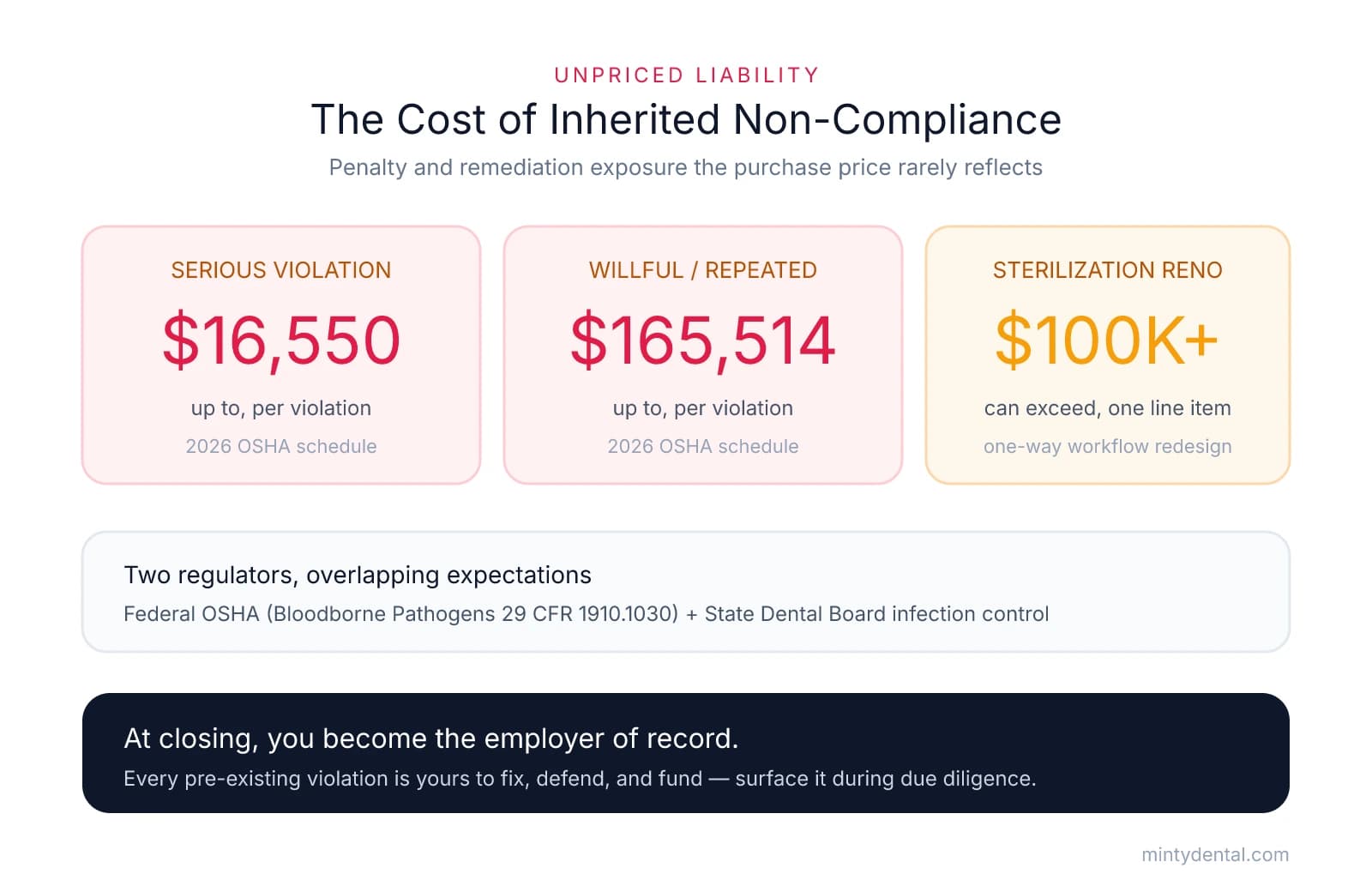
The moment you close, you become the employer of record. Any pre-existing violations discovered after that date are yours to fix, yours to defend, and yours to fund. There's no carve-out for "the previous owner let this slide."
Why this category gets skipped: Most sellers approaching retirement make a rational economic decision — they defer sterilization upgrades and infection control investments that won't pay back within their remaining ownership window. As the Oral Health Group notes, most sterilization areas are out of date in both design and equipment, and dentists near the end of their careers often consciously choose to forgo the investment. That's a reasonable call for them. For the buyer, it's an unpriced liability sitting inside the purchase.
The regulatory framework: OSHA has no dental-specific standard. Instead, dental offices fall under general industry rules — with the Bloodborne Pathogens Standard (29 CFR 1910.1030) serving as the primary enforcement vehicle. State dental boards enforce their own infection control requirements independently, and many states have tightened those standards in recent years. That dual-layer structure means compliance isn't a single checkbox — it's two separate regulatory bodies with overlapping but distinct expectations.
The penalty exposure is real: According to OSHA's 2026 penalty schedule, serious violations carry fines of up to $16,550 per violation, while willful or repeated violations can reach $165,514 per violation. A practice with systemic sterilization deficiencies — improper instrument processing, missing exposure control plans, inadequate staff training records — could face multiple citations from a single inspection.
The remediation cost: When a practice is significantly out of compliance, the fix isn't a weekend project. Sterilization area renovations to meet current standards, including dedicated one-way workflow design and updated equipment, can exceed $100,000 — before accounting for staff training, downtime, or consulting fees. That's a material number relative to most acquisition prices, and it belongs in the negotiation, not the first-year operating budget.
Reviewing a practice's malpractice and complaint history is already standard buyer practice. Compliance infrastructure deserves the same scrutiny — because the financial exposure, in the wrong situation, is comparable.
What to Actually Look for During the Site Visit
Most first-time buyers walk a practice and focus on equipment condition, operatory count, and whether the space feels functional. Experienced buyers treat the site visit as a compliance audit, not a tour. Here's what that looks like in practice.
The OSHA Layer: Employer-Facing Documentation
Start by requesting documents before you walk in the door. The four things worth asking for upfront:
-
The written Exposure Control Plan — required under 29 CFR 1910.1030 and must be updated annually. Ask for the current version and check the revision date. An undated binder or a plan that hasn't been touched in three years is a flag worth noting.
-
Bloodborne pathogens training records for all current staff — not a policy binder, not a sign-in sheet from five years ago. Ask for 12–24 months of individual training documentation showing each employee completed annual training in a live, interactive format with a qualified trainer. Per the Colorado Dental Association's inspection data, improper training has been cited in every single OSHA and dental board inspection reviewed by their contract inspectors — making this the single most reliable red flag in any compliance review.
-
Hepatitis B vaccination records or signed declination forms for every at-risk employee. These are individually required under the Bloodborne Pathogens Standard — a single missing form is a citable violation.
-
Safety Data Sheets (SDS) for all chemicals in use, and a sharps injury log. Both are standard OSHA requirements that are frequently incomplete in practices that haven't had a formal compliance review.
The Infection Control Layer: What to Observe in Person
Documentation tells you what the practice claims. The sterilization area tells you what's actually happening.
When you walk the sterilization room, pay attention to the physical layout first. A compliant workflow moves instruments in one direction — contaminated instruments enter on one side, packaged sterile instruments exit on the other. Bidirectional flow, shared surfaces, or a cramped layout that forces staff to cross clean and dirty zones is a structural problem, not a training problem, and it typically requires renovation to fix.
Then look at the logs. Request 12–24 months of spore testing records for every sterilizer in the practice. According to the CDC's Infection Prevention Checklist for Dental Settings, weekly biological monitoring of every sterilizer is a basic expectation for safe care — and gaps in that log are, per the Colorado Dental Association, the number one reason dental boards summarily suspend dental offices. A recent passing result means very little without the history behind it.
Also observe:
- Surface barriers on clinical contact surfaces — light handles, chair controls, bracket tables. Missing barriers, or evidence that staff are disinfecting instead of barrier-protecting high-touch surfaces, is a cited violation.
- Disinfectant contact times — products need to remain wet for their full tuberculocidal kill time. Ask what disinfectant the practice uses and whether staff are trained on contact time compliance.
- Instrument packaging technique and sterilizer loading — overloading and improper packaging are among the most commonly cited sterilization violations.
The CDC's Infection Prevention Checklist for Dental Settings is worth printing and bringing to the site visit. It's structured as a direct observation guide — exactly the format you need when walking an unfamiliar practice.
One pattern worth paying attention to: compliance gaps in these areas rarely exist in isolation. A practice missing training records often has spore testing gaps too. When you find one, look harder for the others — and factor the full remediation picture into your negotiation. First-year ownership carries enough unexpected expenses without inheriting a compliance backlog that should have been priced into the deal.
How to Price Compliance Gaps and Protect Yourself in the Purchase Agreement
Once you've walked the practice and identified compliance deficiencies, the question shifts from discovery to strategy. In most cases, the answer isn't to walk away — it's to price the risk accurately and build protection into the deal structure before you sign anything.
Start with a Remediation Estimate
A compliance gap without a dollar figure attached is just a concern. With a dollar figure, it becomes a negotiating lever.
Work with a dental-specific OSHA consultant or infection control specialist to estimate the cost of bringing the practice into compliance. The line items typically include:
- Sterilization area renovation — workflow redesign and construction, potentially $30,000–$100,000+ depending on the severity of the layout problem
- Equipment replacement — autoclaves, ultrasonic cleaners, and packaging systems past serviceable life
- Training program setup — initial staff training, documentation systems, and annual compliance tracking infrastructure
- Consulting and inspection fees — a post-closing compliance audit to confirm the work is complete
Once you have that estimate, it belongs in your offer — either as a direct price reduction or as a credit at closing.
Asset Purchase vs. Stock Purchase: The Liability Exposure Gap
Deal structure matters significantly here. In an asset sale — the most common structure in dental transitions — you're buying the practice's tangible and intangible assets, not the legal entity itself. Pre-existing regulatory liabilities generally stay with the seller's entity. In a stock sale, you step into the seller's shoes entirely, inheriting the entity and everything attached to it, including any unresolved compliance exposure.
| Asset Purchase | Stock Purchase | |
|---|---|---|
| Pre-closing OSHA violations | Generally remain with seller | Transfer to buyer with entity |
| Regulatory liability exposure | Lower | Higher |
| Buyer's ability to negotiate clean start | Stronger | Limited |
Where possible, structuring the deal as an asset purchase gives meaningful protection against inherited pre-closing liabilities — a point worth raising with your transaction attorney early.
What to Negotiate in the Purchase Agreement
Deal structure only goes so far. The purchase agreement is where you lock in contractual protection for what you can't fully verify during due diligence.
A few provisions worth pushing for:
- Representations and warranties covering OSHA and infection control compliance — not just financial statements and patient records. The seller should explicitly represent that the practice is in material compliance with applicable OSHA standards and state infection control regulations as of closing. As Blackburn Lawyers notes, compliance with laws and IPAC requirements are standard areas for seller representations in dental practice agreements.
- Indemnification language for pre-closing violations discovered post-closing — if a state board inspection six months after closing surfaces a violation that predates your ownership, you want the seller on the hook for remediation costs, not you.
- Survival periods of at least 12–24 months for compliance reps — many buyers accept shorter survival periods on regulatory warranties than on financial reps, which is worth reconsidering. Compliance violations often surface during post-closing inspections, not immediately.
- A compliance escrow holdback — in deals with identified gaps, it's reasonable to ask that a portion of the purchase price be held in escrow and released only after a post-closing inspection confirms the practice meets compliance standards.
Compliance deficiencies don't have to kill a deal. A practice needing a $40,000 sterilization upgrade is still potentially a strong acquisition — as long as the price reflects it. The goal is to make sure you're not absorbing a cost the seller should have priced in years ago.
Your First 90 Days: Building a Compliant Practice from Day One
The due diligence checklist, remediation estimates, and purchase agreement protections are all preparation. Once you close, the work becomes operational. If you've done the pre-closing work well, you already know exactly what needs to happen — here's how to sequence it.
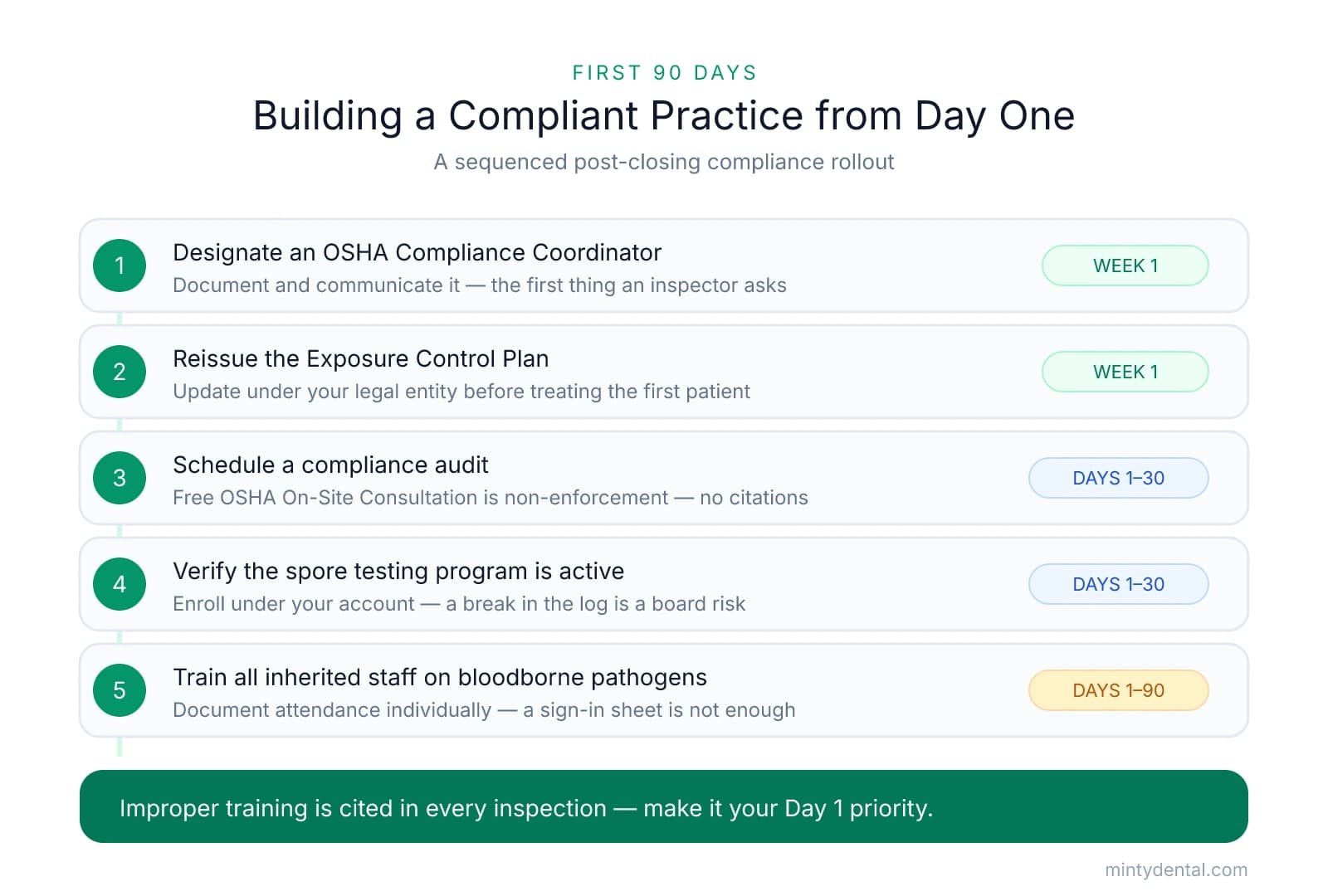
Week one priorities:
-
Designate an OSHA Compliance Coordinator on day one. OSHA requires one person to hold formal responsibility for compliance oversight — and it's typically the first question an inspector asks when they walk in. That person can be you, an office manager, or a senior clinical staff member, but the designation needs to be documented and communicated to staff immediately.
-
Update the Exposure Control Plan under your name and entity. The plan the seller had on file is no longer valid — it names a different employer. Reissue it under your legal entity before you treat the first patient.
Within the first 30 days:
-
Schedule a compliance audit. A dental-specific OSHA consultant can walk the practice and produce a prioritized remediation list. If cost is a concern, OSHA's free On-Site Consultation Program is available to small businesses — it's a non-enforcement visit, meaning the consultant identifies gaps without triggering citations or penalties. Many dental supply companies, including Patterson, Schein, and Benco, also offer compliance audit services as part of their customer relationships.
-
Verify the spore testing program is active. Confirm the lab service is enrolled under your account, not the seller's, and that weekly testing will continue without a gap. A break in the log — even a short one — is an immediate dental board risk.
Within the first 90 days:
- Conduct bloodborne pathogens training for all inherited staff. Annual training is required under the Bloodborne Pathogens Standard, and a new ownership transition is a natural, defensible reset point. Document attendance individually — a sign-in sheet isn't sufficient. This is also a meaningful moment for the team: it signals that you take the clinical environment seriously, which matters for staff retention during an inherently uncertain transition.
Sources & References
The data and claims in this article are drawn from the following sources. We prioritize government data, peer-reviewed research, and established industry publications to ensure accuracy.
- Due Diligence When Purchasing a Dental Practice - Oral Health Group— www.oralhealthgroup.comIndustry
- Dentistry - Enforcement | Occupational Safety and Health ...— osha.govGovernment
- Dentistry - Enforcement | Occupational Safety and Health ...— osha.govGovernment
- Top 5 Most Common OSHA & CDC Infection Control ...— cdaonline.orgIndustry
- Summary of Infection Prevention Practices in Dental Settings— cdc.govGovernment
- Asset vs. Stock Sale in Dental Transitions - NDP— ndptransitions.comIndustry
- Dental Practice Purchase: What Should be in the Purchase and Sale ...— blackburnlawyers.caIndustry
- Dentistry - Enforcement | Occupational Safety and Health ...— osha.govGovernment
Ready to acquire a compliant dental practice?
Navigating OSHA and infection control standards is crucial when acquiring a dental practice. Minty's acquisition experts guide you through comprehensive due diligence to ensure you're inheriting a fully compliant operation.