Seller Owes Back Payroll Taxes: What Dental Buyers Must Know

Co-Founder, Minty Dental

In Summary
- Most dental practice acquisitions are structured as asset purchases, but payroll taxes are a well-documented exception to the assumption that asset deals provide a clean slate from the seller's liabilities.
- Payroll taxes include FICA, federal income tax withholding, FUTA, and state unemployment insurance — the employee-withheld portion (called "trust fund taxes") is treated as government property from the moment of withholding, not when it's due.
- The IRS Trust Fund Recovery Penalty equals 100% of unpaid trust fund taxes and can be assessed personally against anyone who takes control of payroll — including a new owner.
- An IRS lien can exist before any public Notice of Federal Tax Lien is filed, meaning a clean title search or public records search does not guarantee the practice is lien-free.
- This risk is manageable with the right due diligence and contract language — the goal of this article is to show you exactly what to look for and how to protect yourself.
An Asset Purchase Doesn't Automatically Protect You from the Seller's Payroll Taxes
Most buyers enter a dental practice acquisition with a reasonable assumption: if you buy assets rather than equity, you're buying equipment, goodwill, and patient records — not the seller's legal problems. For many categories of liability, that holds. Payroll taxes are a specific, well-documented exception — and one that catches buyers off guard more often than it should.
What makes payroll taxes different: When a dental practice withholds Social Security, Medicare, and federal income taxes from an employee's paycheck, the IRS treats that money as government property from the moment it's withheld — not when it's due, not when it's deposited. These are called trust fund taxes, and they sit in a different legal category than ordinary business debts. The full picture of payroll tax obligations includes FICA, federal income tax withholding, FUTA, and state unemployment insurance — but trust fund taxes represent the most acute risk because of what the IRS can do to collect them.
That collection tool is the Trust Fund Recovery Penalty (TFRP), which equals 100% of unpaid trust fund taxes and can be assessed personally against any "responsible person" — anyone with authority and control over the business's financial affairs. This category isn't limited to the seller. A buyer who takes over payroll operations and becomes aware of outstanding trust fund taxes can, under certain circumstances, be pulled into TFRP exposure. The IRS doesn't require bad intent — willful indifference to a known obligation is enough.
The second layer of risk operates at the state level. As Plante Moran's state and local tax due diligence guidance notes, almost every state has successor liability statutes that can hold a buyer responsible for certain pre-acquisition taxes even in an asset deal. These statutes vary by state, but many are triggered by bulk sales — exactly the kind of transaction a dental practice acquisition represents.
What makes dental acquisitions particularly exposed is operational continuity. Courts and tax agencies typically assess successor liability by asking whether the buyer continued the same business: same location, same employees, same operations. In a dental practice sale, the answer is almost always yes. Retaining the seller's staff and keeping the doors open at the same address — the very things that protect patient retention — are the same factors that can establish successor liability.
One protection worth understanding early: an IRS lien can exist before any public Notice of Federal Tax Lien is filed. This "silent lien" period means a clean public records search doesn't confirm the practice is lien-free. Similar gaps exist with UCC liens on practice equipment, where public filings don't always capture the full picture of encumbered assets.
None of this is a reason to walk away from an otherwise strong acquisition — it's a reason to look carefully. The sections that follow show you exactly where to look.
How to Find Payroll Tax Problems Before You Close
The documents that reveal payroll tax exposure aren't the ones sellers typically volunteer in a deal package. You'll need to request them specifically, and in some cases go around the seller entirely to verify what you're seeing.
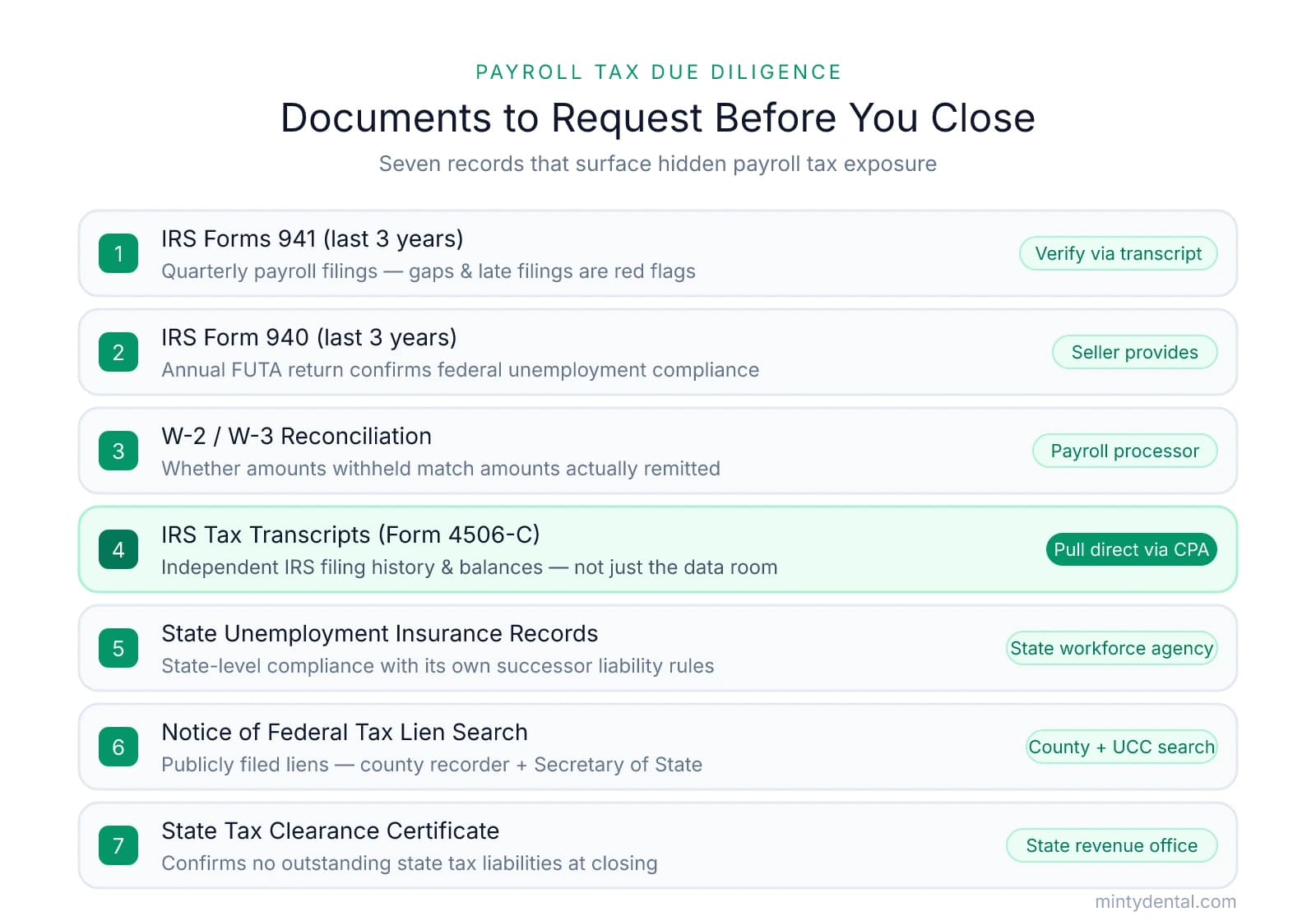
The Core Document Request List
Start by asking for these items as part of your formal due diligence request:
| Document | What It Reveals | Where to Get It |
|---|---|---|
| IRS Forms 941 (last 3 years) | Quarterly payroll tax filings — gaps, late filings, or amended returns are red flags | Seller provides; verify via transcript |
| IRS Form 940 (last 3 years) | Annual FUTA return — confirms federal unemployment tax compliance | Seller provides |
| W-2/W-3 reconciliation | Whether amounts withheld from employees match amounts actually remitted | Seller's payroll records or payroll processor |
| IRS tax transcripts (Form 4506-C) | Complete IRS filing history and outstanding balances — independent of what the seller gives you | Seller authorizes your CPA to pull directly from IRS |
| State unemployment insurance records | State-level payroll tax compliance, which has its own successor liability rules | State workforce agency |
| Notice of Federal Tax Lien search | Publicly filed liens against the seller's assets | County recorder's office and Secretary of State (UCC search) |
| State tax clearance certificate | Confirms no outstanding state tax liabilities at closing | State revenue or comptroller's office |
The Silent Lien Problem
A clean lien search is not a clean bill of health. According to the IRS, a federal tax lien arises automatically the moment taxes are assessed and the seller fails to pay — before any public Notice of Federal Tax Lien is filed. That gap between assessment and public filing is where buyers get caught.
This is why the Form 4506-C transcript request matters so much. When the seller authorizes your CPA to pull transcripts directly from the IRS, you get an independent view of filing history and account balances — not just the documents the seller chose to include in the data room.
State Tax Clearance Certificates: Build in the Lead Time
Many states require a tax clearance certificate before a business sale can close without successor liability exposure. The Texas Comptroller makes this explicit: if you close without one and the seller owes back taxes, you become liable up to the purchase price. Texas, Pennsylvania, New York, and Illinois all have specific procedures, and many carry lead times of 45 days or more. These need to be built into your timeline from the moment you go under letter of intent, not requested the week before closing.
State unemployment insurance records deserve a separate review. State agencies operate independently from the IRS and have their own successor liability frameworks, so federal compliance doesn't automatically mean state compliance.
Who Should Be Reviewing This
A dental CPA with M&A experience should be reviewing the 941s — not just the practice's P&L. Financial statements won't surface unfiled or underpaid quarterly returns. A pattern worth paying attention to: practices under cash flow pressure often stay current on vendor payments and let payroll tax deposits slip, precisely because the IRS consequence isn't immediate. That's exactly the kind of problem that shows up in 941s and nowhere else.
The same logic applies to your legal team. As discussed in choosing the right attorney for a dental acquisition, independent counsel — not shared with the seller — is what gives you the standing to push for transcript access and tax clearance before closing.
How to Structure the Deal When Payroll Tax Problems Surface
Finding payroll tax exposure in due diligence doesn't mean the deal is dead. Many acquisitions with tax issues close cleanly — the difference is usually how the resolution gets structured before closing. Here are the four main paths buyers navigate.
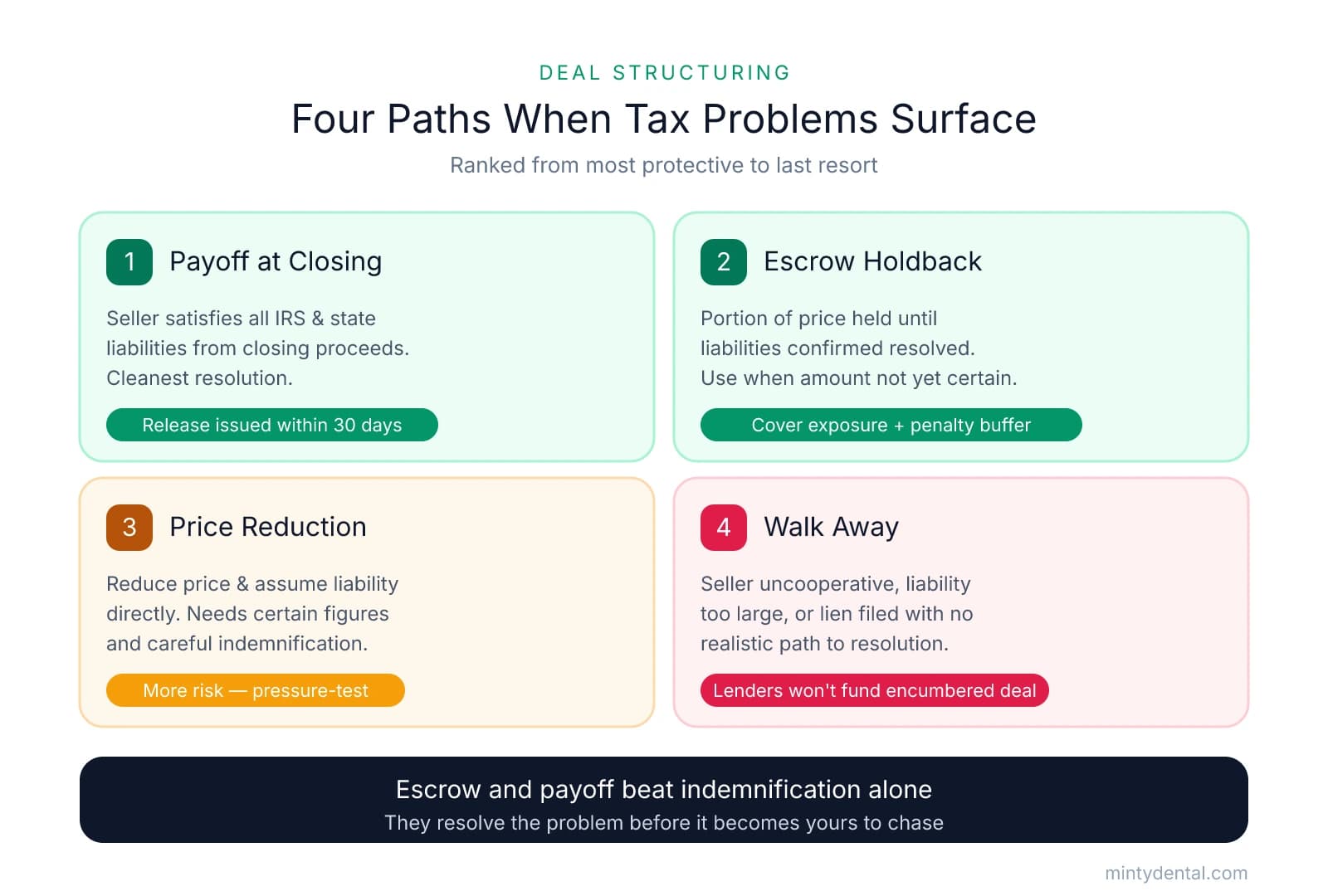
1. Require Payoff at Closing
The cleanest resolution is requiring the seller to satisfy all outstanding IRS and state payroll tax liabilities directly from closing proceeds — the same way a mortgage lien gets paid off in a real estate transaction. The seller's attorney requests a payoff letter from the IRS; the amount gets remitted at closing; and the IRS issues a Certificate of Release within 30 days of full payment. This approach works when the seller has enough equity in the deal to cover the liability. When the numbers are tight, the conversation gets more complicated.
2. Escrow Holdback
When the full liability amount isn't confirmed at closing — because a state clearance certificate is still pending, or because the IRS transcript showed a balance not yet formally assessed — an escrow holdback is often the right structure. A defined portion of the purchase price stays in escrow until you receive written confirmation that all payroll tax liabilities are resolved. The holdback amount should cover the known exposure plus a reasonable buffer for accrued penalties and interest. This is structurally stronger than relying on the seller's promise to pay post-closing.
3. Price Reduction with Direct Assumption
If the liability is quantified and the seller can't pay it from proceeds, some buyers negotiate a reduced purchase price and assume the liability directly. This can work when the discount is real and the liability amount is certain, but it requires careful indemnification language and, in most cases, a direct payment arrangement with the IRS. This path carries more risk than the first two — pressure-test the liability figure carefully before agreeing to it.
4. Walk Away
Sometimes the right answer is to not close. Situations that tend to warrant serious reconsideration: the seller is uncooperative about providing 941 transcripts or authorizing IRS access; the liability is large relative to the purchase price; or a Notice of Federal Tax Lien has been filed with no realistic path to satisfying it. As Wipfli's transaction advisory guidance notes, asset purchase protections have real limits — and most lenders won't fund a deal where their collateral is encumbered by a prior IRS lien.
The Contract Language That Actually Matters
Whichever path you take, three provisions in the purchase agreement deserve close attention:
- Seller representations and warranties: These should specifically cover payroll tax filings and remittances — not just general "compliance with law" language, which is often too vague to be enforceable when a specific payroll tax issue surfaces post-closing.
- Indemnification provisions: The seller should indemnify you for all pre-closing tax liabilities, with clear triggering conditions and a defined process for handling IRS or state claims.
- Survival periods: IRS assessments can surface months or years after closing — a survival period of three years or more is common in deals with known tax exposure.
One important caveat: indemnification is only as strong as the seller's post-closing financial position. A seller who walks away from closing with little left may not be able to make you whole if a liability surfaces later. Escrow holdbacks and lien payoffs at closing are structurally more reliable than indemnification alone — they resolve the problem before it becomes yours to chase.
What to Do If Payroll Tax Problems Surface After Closing
Discovering payroll tax problems after closing is stressful — but it's a navigable situation, and the steps you take in the first few weeks matter most.
Start with the purchase agreement. If the seller made representations about tax compliance and the agreement includes an indemnification clause, you have a contractual claim. Enforce it promptly — survival periods typically run two to three years from closing. Document everything: when you discovered the issue, what the IRS or state agency has communicated, and what the liability appears to be.
Contact a tax attorney with IRS controversy experience immediately. The IRS collection process runs on strict timelines. If the IRS issues Letter 1153 proposing a Trust Fund Recovery Penalty assessment, you have 60 days to appeal. Miss that window and the assessment becomes final. A general business attorney or dental CPA won't necessarily know these deadlines.
Assess whether you're actually exposed to the TFRP. Many buyers assume the worst unnecessarily. The Trust Fund Recovery Penalty applies to individuals who were responsible for payroll decisions and willfully failed to remit trust fund taxes. A new owner who inherited the situation, discovered it promptly, and moved to address it is in a meaningfully different position than someone who continued non-payment with knowledge of the outstanding obligation.
Understand the IRS's timeline. The IRS generally has three years from the filing date to assess the TFRP and 10 years from assessment to collect. Knowing where a liability falls within those windows helps you and your attorney assess the actual risk — some older liabilities may be outside the assessment window entirely.
Explore resolution programs. The IRS offers installment agreements and offers in compromise that can resolve payroll tax liabilities over time. A tax attorney with IRS experience can often achieve better terms than a business owner navigating the process directly.
The best post-closing protection is always the due diligence and contract work done before closing. But when something slips through, the outcome is largely determined by how quickly you act and whether you have the right counsel in your corner.
Sources & References
The data and claims in this article are drawn from the following sources. We prioritize government data, peer-reviewed research, and established industry publications to ensure accuracy.
- Employment taxes and the Trust Fund Recovery Penalty (TFRP)— www.irs.govGovernment
- State and local tax due diligence: Navigating the maze of obligations ...— www.plantemoran.comIndustry
- Understanding a federal tax lien— www.irs.govGovernment
- Buying an Existing Business - Texas Comptroller— comptroller.texas.govGovernment
- Resolving Federal Tax Liens for Cleanup Record— www.haynestaxlaw.comIndustry
- Does an asset purchase protect you from successor liability?— www.wipfli.comIndustry
Navigate Tax Liabilities Before Buying Your Practice
Payroll tax issues can derail a dental practice acquisition if not properly evaluated during due diligence. Minty's acquisition experts guide you through every step of the buying process, ensuring you understand potential liabilities before closing.