Dental Associate Buy-In Offer: How to Evaluate Price and Terms

Co-Founder, Minty Dental

In Summary
- A dental associate buy-in is the purchase of an ownership interest, typically 10 to 50 percent, in the practice where you already work, usually as a step toward full or shared ownership.
- Every buy-in offer contains two separate things to evaluate: the price for the equity stake and the partnership or operating agreement that defines what that stake actually entitles you to.
- Familiarity with the practice can make an offer feel fair before the numbers have been verified, which is a common reason associates underweight the terms.
- Private practice ownership has declined from 84.7 percent in 2005 to 72.5 percent in 2023, making buy-in arrangements an increasingly common path to ownership.
- A structured two-part evaluation lets you assess price and terms independently before responding to any offer.
A Buy-In Offer Has Two Parts, and Most Associates Only Evaluate One
Dental associate buy-in defined: A buy-in is the purchase of an ownership interest, typically between 10 and 50 percent, in the practice where you already work. It usually functions as a step toward shared or full ownership rather than a standalone transaction, which is part of why it gets evaluated differently from buying a practice outright.
Any buy-in offer is really two documents in one. The first is a price for the equity stake, derived from a practice valuation. The second is the partnership or operating agreement that defines what owning that stake means day to day: your compensation formula, your decision-making rights, your share of profits, and the terms under which you can exit. These two components need independent evaluation, because a fair price attached to unfavorable terms can leave you worse off than a higher price with clear, balanced governance.
Most associates concentrate almost entirely on the price. That focus is understandable, because the number is concrete and the agreement language is not. What tends to get underweighted is the agreement that governs the stake, and this is where familiarity works against careful review. Years of working in the practice and trusting the seller can create a sense that the offer must be fair, when fairness has not actually been verified against the numbers or the terms.
This path has grown more common as ownership has shifted. Private practice ownership declined from 84.7 percent in 2005 to 72.5 percent in 2023, with buy-in arrangements filling part of the gap for associates seeking a foothold in ownership. That trend deserves the same scrutiny applied to a full acquisition, particularly around the structural realities of holding a minority position.
How to Evaluate Whether the Buy-In Price Is Reasonable
The price in a buy-in offer comes from a practice valuation, and understanding how that number was built is the first step in judging whether it holds up. Three valuation methods appear most often in dental transitions, and each measures something different.
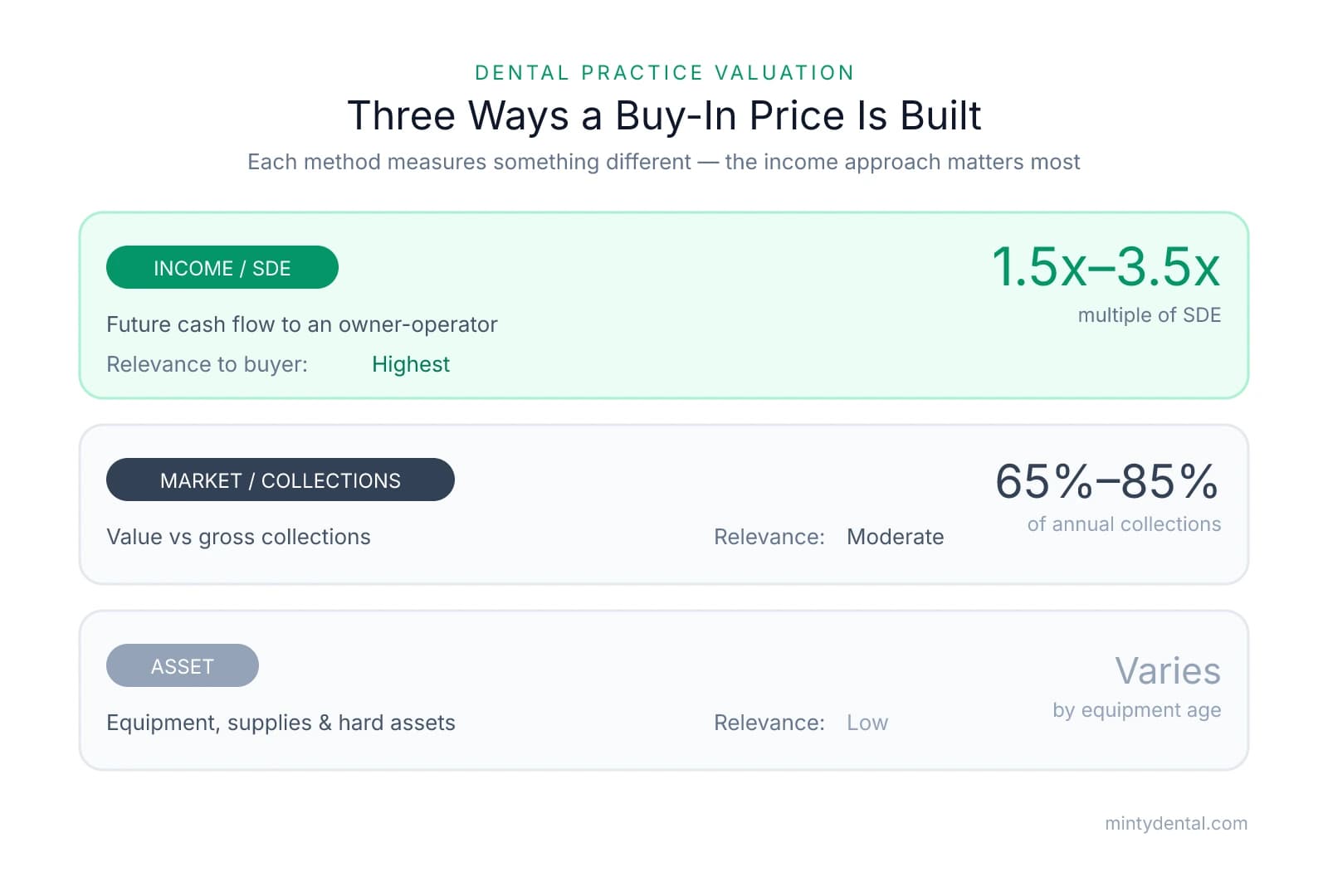
| Method | What it measures | Typical range | Relevance to a buyer |
|---|---|---|---|
| Income / SDE | Future cash flow available to an owner-operator | 1.5x to 3.5x SDE | Highest, because it reflects what you will actually earn |
| Market / collections | Value relative to gross collections | 65% to 85% of annual collections | Moderate, useful as a cross-check |
| Asset | Value of equipment, supplies, and hard assets | Varies by equipment age | Low for a going concern, higher for distressed sales |
For an associate evaluating future earnings, the income approach is the most relevant, because it ties the price to the cash the practice actually generates rather than to top-line volume alone. A practice can collect strongly and still leave little for an owner after expenses, which is why collections percentage works better as a check on the income figure than as the primary basis.
Where a deal lands within these ranges depends on transferable earnings, patient retention, provider concentration, and how much of the production depends on the departing owner. Practices with durable hygiene revenue and low dependence on a single doctor tend to sit toward the high end, while owner-dependent practices may be discussed toward the lower bands.
The multiple matters less than the earnings base beneath it. SDE (seller's discretionary earnings) adds back the owner's total compensation and personal expenses to show what a single owner-operator earns. EBITDA measures earnings before interest, taxes, depreciation, and amortization, but assumes a market-rate salary for the dentist's clinical work. A multiple applied to SDE and the same multiple applied to EBITDA produce very different numbers, so the earnings base is only as reliable as the normalization behind it.
Two questions help you test that base. First, has the seller's compensation been adjusted to a market rate for the clinical hours worked. Second, have one-time revenues or expenses been excluded so the earnings reflect ongoing operations. Reviewing which add-backs a lender will actually accept gives you a practical benchmark for whether the adjustments are defensible.
The seller's appraiser works for the seller, so the valuation is a starting position rather than a neutral fact. An accurate valuation is the foundation for any sale or partnership formation, and commissioning your own review through a dental-specific CPA or transition consultant lets you confirm which method was used and why before you treat the price as settled.
The Financial Terms Test: Does Ownership Actually Pay More?
A fair price does not guarantee a good outcome, because the return on a buy-in depends on how the financial terms convert your ownership into income. The clearest way to test that is the income neutrality question: after paying the annual debt service on your buy-in loan, does your total compensation as a partner (clinical pay plus ownership distributions) exceed what you earned as a pure associate? If the answer is no, the deal reduces your near-term income and requires a compelling non-financial rationale, such as equity appreciation or a defined path to full ownership, to justify the gap.
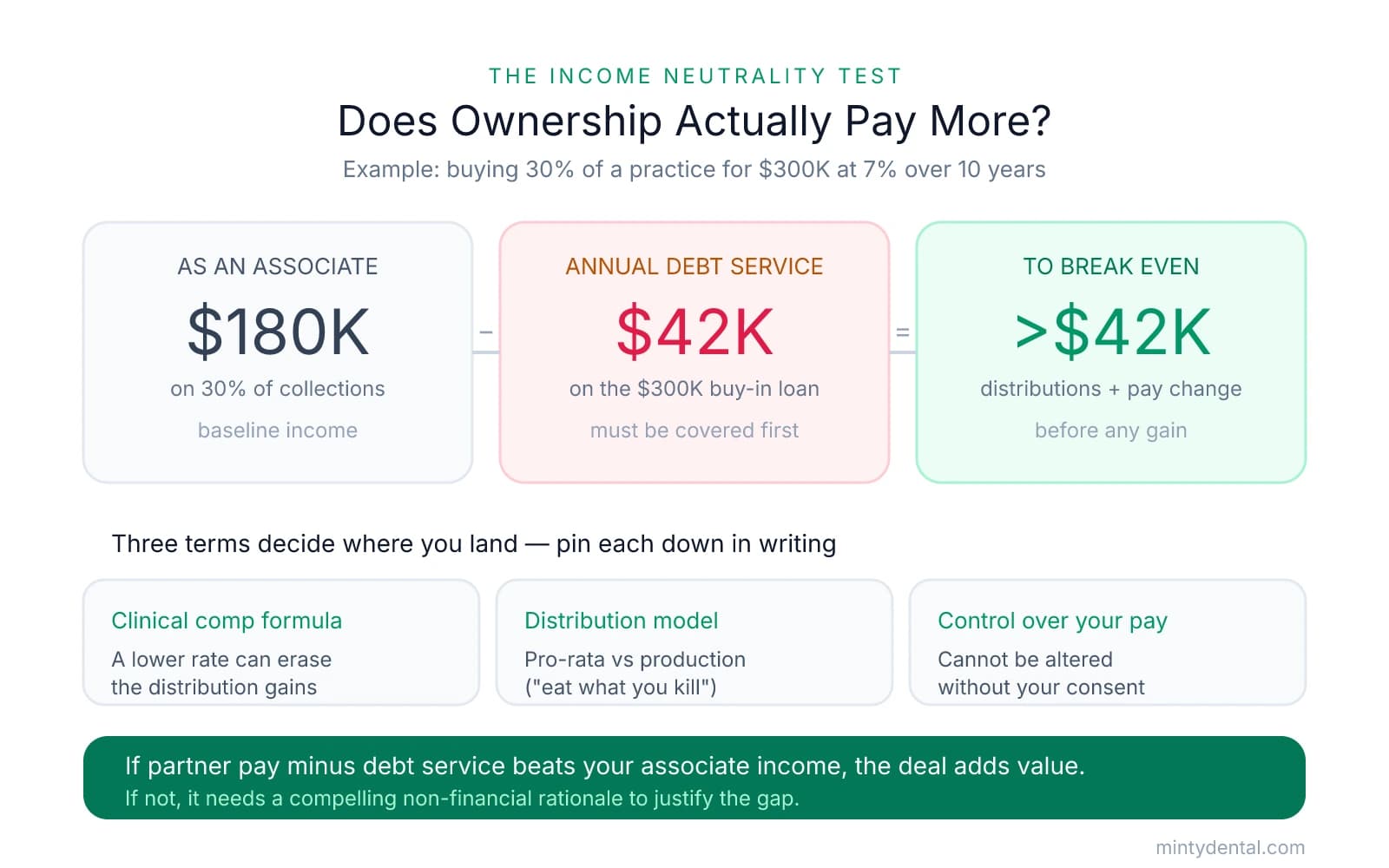
Run the numbers before you respond. Consider an associate earning $180,000 on 30 percent of collections who buys 30 percent of the practice for $300,000, financed at 7 percent over 10 years. The loan carries roughly $42,000 in annual debt service. For the buy-in to be income-neutral, distributions plus any change in clinical pay must cover that $42,000 before you see a dollar of gain. Modeling several scenarios, including a flat production year, shows how much cushion the deal actually has.
Three terms determine where you land, and each needs to be defined explicitly in the partnership agreement.
- Clinical compensation formula. As an employee you likely earn a production percentage. After a buy-in, many practices shift to a guaranteed payment or an adjusted production formula for the clinical work. The new formula should be written out, because a lower clinical rate combined with debt service can erase the income the distributions are meant to add.
- Profit distribution model. Two structures dominate. Pro-rata allocation pays distributions by ownership percentage, so a 30 percent owner receives 30 percent of profit regardless of what they produce. Production-based allocation ("eat what you kill") ties distributions to each owner's output. An associate who produces more than their ownership share generally fares better under a production-based model.
- Ability to change your pay. The agreement should specify that your compensation structure cannot be altered without your consent. Transition guidance states that a corporate practice cannot revise the terms of a minority partner's interest under any circumstances, which protects the income assumptions your model depends on.
Associates earning 25 to 35 percent of collections as employees benefit from modeling take-home pay across each structure, including the shift from W2 employee to partner status. A W2-versus-1099 calculator helps quantify how the tax treatment changes when your income moves from wages to distributions.
The Non-Price Terms That Determine Whether the Deal Is Actually Fair
The partnership agreement tells you what the stake actually controls, and this is where minority ownership either carries real weight or becomes a passive investment with a doctor's workload attached. Four provisions determine the difference, and each can be reduced to a question you answer before signing.
Governance and decision rights. The agreement should specify which decisions require unanimous consent and which pass by majority vote. As a minority partner, majority-vote governance means the controlling owner can act without you on most matters. The provisions worth pinning down are whether the fee schedule can be changed without your input, whether you can veto the hiring of an additional dentist who would compete for your production, and whether major equipment purchases or a practice relocation require your agreement. A comprehensive partnership agreement should detail how decision-making authority is allocated, so the absence of that detail is itself informative.
Path to full ownership. A defined path includes a timeline for acquiring additional equity tranches and a pre-agreed valuation formula for those future purchases. Without a formula, each tranche gets renegotiated from scratch, and the seller holds the leverage every time. A path described as "we'll figure it out later" leaves your route to majority ownership at the seller's discretion.
Buy-sell agreement. This provision governs what happens if the partnership dissolves, a partner dies or becomes disabled, or you want to exit. Three elements protect a minority partner:
- A valuation mechanism rather than a fixed price. Fixed-price agreements are seldom updated and go stale, leaving the price disconnected from actual value at the moment it matters.
- A mandatory buyout provision at no less than the price you paid, so you can exit without depending on the majority owner's willingness to purchase.
- A defined timeline for completing the buyout, so a triggering event does not leave your capital locked up indefinitely.
Non-compete scope. The geographic radius and duration should be proportionate to the stake you bought. A restriction sized for a full owner may be unreasonable for a 20 percent partner, particularly if you leave before reaching full ownership. Understanding how the non-solicitation terms limit contact with patients and staff matters as much as the mileage radius.
These protections are what make a minority discount inappropriate in a private partnership, but only when they are explicitly written into the agreement rather than assumed.
Accept a buy-in only when those price, income, governance, and exit questions all pass. If you cannot get clarity, treat that as a signal about the arrangement itself and compare the path against a full acquisition outside the practice.
Sources & References
The data and claims in this article are drawn from the following sources. We prioritize government data, peer-reviewed research, and established industry publications to ensure accuracy.
- Buying or Selling a Dental Practice, Start with an Accurate Valuation— ada.orgIndustry
- Dental Practice Valuation Multiples: 2026 Guide - Auxo Capital Advisors— auxocapitaladvisors.comIndustry
- Buying or Selling a Dental Practice, Start with an Accurate Valuation— ada.orgIndustry
- Transitions Roundtable: Minority interest discount - Dental Economics— www.dentaleconomics.comIndustry
- What Should a Dental Partnership Agreement Include?— www.dentalattorneys.comIndustry
- Buy-Sell Agreements for Dentists Preventing Disputes Over Value— www.marinerwealthadvisors.comIndustry
Ready to evaluate your buy-in opportunity?
Whether you're assessing a buy-in offer or planning to acquire a practice, understanding fair valuation and terms is crucial. Minty's acquisition experts guide you through every step of the process, from initial evaluation to closing.