Should You Buy Your Parent's Dental Practice? A Decision Framework

Co-Founder, Minty Dental

In Summary
- Family succession eliminates adversarial negotiations but introduces emotional complexity—parent's identity tied to the practice, child's sense of obligation, and unspoken expectations around valuation and timing
- Patient retention in family transitions runs under 5%—nearly identical to any ownership change—driven by continuity of location and staff, not the shared last name
- Pay fair market value even if offered a discount—discounted pricing creates gift tax complications, sibling resentment, and estate planning issues that outlast the transaction
- Geography and quality of life should drive the decision, not convenience or family pressure—you're making a 20-year life choice, not just accepting a job
- Emotional readiness matters on both sides—require proof your parent has run retirement numbers with a financial professional before committing
Family Succession Isn't Simpler—It's Just Different
Family succession in dental practice refers to the transfer of practice ownership from a parent dentist to their child, typically structured as a sale rather than a gift to preserve fair market value and avoid tax complications. While it eliminates adversarial dynamics, it introduces emotional complexities that arm's-length deals don't face.
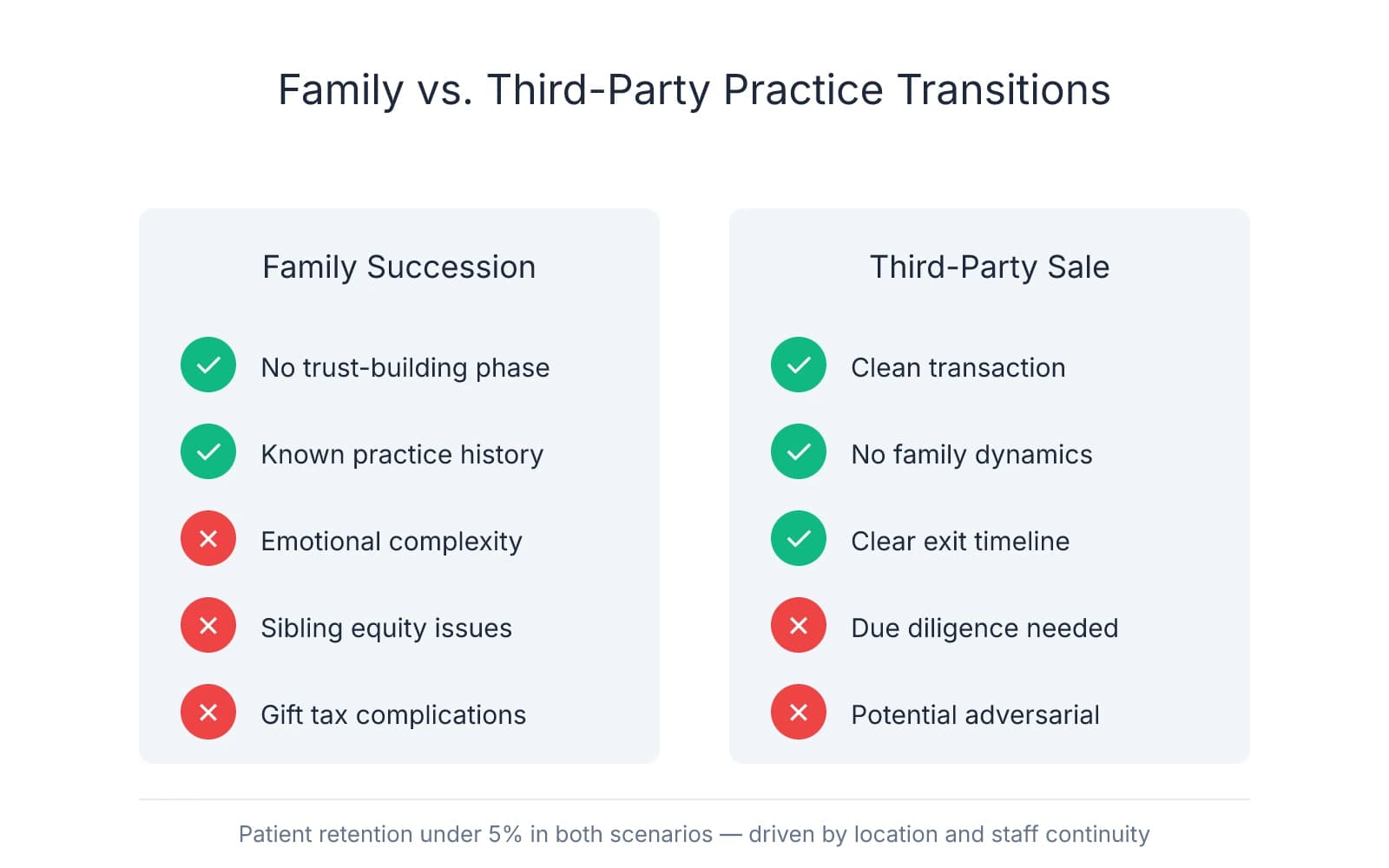
The appeal is obvious: no trust-building phase, no wondering whether the seller is hiding problems, no adversarial posturing over price. One protection many buyers overlook is the emotional landmine beneath that convenience—when a parent's identity is tied to the practice, letting go becomes psychologically difficult, even when they claim they're ready. The child often feels obligation masquerading as interest, with unspoken expectations that saying yes is the only acceptable answer.
Where this dynamic goes sideways is when neither party acknowledges the pressure. The parent assumes the child wants the practice because they haven't said otherwise. The child assumes declining would feel like rejection. Both avoid the harder conversation—whether this is genuinely the right fit—because the emotional stakes feel too high.
What the Shared Last Name Actually Buys You
Many families assume the shared last name will retain patients in ways a stranger's name won't. Patient attrition in family transitions typically runs under 5%—nearly identical to any other ownership change. The retention advantage comes from continuity of location, staff, and systems, not the family connection.
If the family name were the deciding factor, attrition would be measurably lower. It's not. What keeps patients is a smooth transition, retained staff, and a positive first visit—none of which require shared DNA.
Geography Should Drive the Decision, Not Guilt
One pattern worth paying attention to: residents finishing school often lean toward the option that clears student debt fastest, which makes family succession feel like the obvious choice. In candid financial planning conversations, quality of life plateaus around $300k in annual revenue for most specialists. Beyond that threshold, the difference between options is lifestyle, not income.
If the practice sits in a geography you'd choose independently—where you want to raise kids, where your partner can build a career, where you'd be happy in 15 years—then the family connection is a bonus. If you're choosing the location because the practice is already there, you're making a 20-year life decision based on convenience. That's the kind of tradeoff that feels reasonable at 28 and suffocating at 45. Knowing when to walk away from buying a dental practice matters as much in family succession as it does with strangers—maybe more, because the emotional cost of walking away feels higher.
Pay Fair Market Value—Even If Your Parent Offers a Discount
The instinct to offer a discount feels generous. What it actually does is create tax complications, sibling resentment, and a transaction structure that neither the IRS nor the family will view as clean.
Independent valuation is the foundation of a defensible family succession. Expect to pay around $5,000 for a qualified appraiser—this cost can be split if both parties trust the valuator. The valuation establishes fair market value, which protects both sides. For the parent, it documents that the sale price reflects what an unrelated buyer would pay, which matters for estate planning and gift tax reporting. For the child, it confirms they're not overpaying out of obligation or underpaying in ways that create future liability.
Where buyers often get burned is treating the valuation as optional because "we trust each other." Trust doesn't eliminate the IRS's interest in the transaction. A discounted sale below fair market value triggers gift tax consequences for the parent—the difference between the appraised value and the actual sale price is treated as a gift, subject to the annual exclusion of $18,000 per recipient (2024) or the lifetime exemption of $13.61 million. That lifetime exemption drops to roughly $7 million in 2026, meaning discounted sales executed after that date will consume exemption capacity faster than most families expect.
Two Primary Structures: Sale vs. Partial Gifting
Most family transitions follow one of two paths. The first is an outright sale at fair market value, where the child finances the purchase through conventional or SBA loans and the parent receives full market price. This structure is clean—no gift tax reporting, no sibling equity complications, and financing options for buying a dental practice treat family purchases the same as arm's-length deals.
The second structure involves partial gifting with estate planning considerations. The parent sells a portion of the practice at fair market value and gifts the remainder, using the annual exclusion or lifetime exemption to minimize tax impact. This approach works when the parent has sufficient exemption capacity and wants to reduce the child's financing burden without triggering immediate tax liability. Minority interest gifting can reduce valuation through lack-of-control discounts, but this requires sophisticated estate planning and may not be appropriate for families with multiple heirs who expect equitable treatment.
Why Discounted Sales Create Sibling Equity Issues
A pattern across family transitions: the child buying the practice assumes the discount is a private matter between them and the parent. The siblings assume the discount represents a disproportionate inheritance that should be offset elsewhere in the estate. Neither assumption gets voiced until the parent's estate is being settled, at which point the resentment is entrenched.
If the parent intends the discounted sale as an advance on the child's inheritance, that needs to be documented and communicated to all heirs. If the parent intends it as a separate gift that doesn't affect inheritance distribution, that also needs to be explicit. The worst outcome is ambiguity—where the buying child believes they earned the discount through sweat equity and the non-buying siblings believe they're owed compensation for the financial advantage their sibling received.
Financing Family Succession: No Special Treatment
One protection many buyers overlook is that lenders don't care about the family relationship. Conventional loans and SBA loans evaluate family purchases using the same underwriting criteria as third-party acquisitions. The practice needs to generate sufficient cash flow to service the debt. The buyer needs acceptable credit and enough liquidity to meet down payment and working capital requirements.
Where this becomes a problem is when families assume informal arrangements will suffice. A handshake agreement to "pay it back over time" creates tax reporting ambiguity, no legal protection if the relationship deteriorates, and no clarity on what happens if the practice underperforms. Treating the transaction as a business deal—with formal loan documents, recorded security interests, and clear default provisions—protects both parties and ensures the IRS views the arrangement as a bona fide sale rather than a disguised gift.
The Sibling Equity Question: How to Be Fair When Only One Child Wants the Practice
The most emotionally charged conversations in family succession often happen after the deal closes—when siblings who weren't involved in the practice start questioning whether the distribution was fair. A pattern worth paying attention to: parents who avoid this conversation early assume silence means agreement. What it usually means is that siblings haven't yet processed what the succession plan implies for their own inheritance.
Fair doesn't mean equal. One child may inherit the practice while others receive equivalent value through real estate, investment accounts, or life insurance proceeds. The challenge is determining what "equivalent" means when the practice represents 60-80% of the parent's estate value and the other assets don't cleanly divide. Many families wrestle with how to equitably distribute assets when one child receives an income-generating business and the others receive passive holdings that may or may not appreciate at the same rate.
Where this goes sideways is when parents assume the child buying the practice is "getting a job" rather than receiving an asset. The siblings see a $1.2 million practice transfer and assume their sibling just received a $1.2 million head start. The buying child sees $800,000 in debt, 60-hour weeks, and the pressure of keeping the business viable. Both perspectives are valid, and neither gets resolved without transparent communication before the transaction closes.
Professional Valuation Enables Equitable Distribution
Independent appraisal does more than establish fair market value for the sale—it gives parents a clear number to work with when planning equitable distribution among all heirs. If the practice appraises at $1.1 million and the parent has two other children, the estate plan needs to account for how those children receive roughly $1.1 million in value through other means.
Unspoken expectations about who "deserves" the practice are common triggers for family conflict. The buying child may believe they earned the opportunity through years of working in the practice. The non-buying siblings may believe birth order or financial need should factor into the distribution. None of these assumptions get tested until someone voices them—and by then, positions are entrenched.
Life Insurance as an Equalization Tool
When the practice represents the majority of the parent's estate value, life insurance becomes one of the most practical tools for equalizing inheritance. The parent purchases a policy with a death benefit large enough to provide the non-buying children with assets equivalent to the practice value. The buying child inherits the practice. The other children receive the insurance proceeds.
This structure works cleanly when implemented early—ideally 5-10 years before the anticipated transition, while the parent is still insurable at reasonable rates. Where it breaks down is when parents delay the conversation until their 60s, at which point premiums are prohibitively expensive or health issues make coverage unavailable.
Early Communication Prevents Resentment
One step many families overlook is involving all siblings in the succession conversation before the plan is finalized. That doesn't mean giving non-buying children veto power—it means explaining the structure, the rationale, and how the estate plan accounts for equitable treatment.
A framework that tends to reduce conflict: frame the conversation around what each child needs to build financial security, not what they deserve based on effort or proximity to the parent. When the conversation shifts from fairness-as-equality to fairness-as-meeting-individual-needs, the emotional charge often decreases.
Unresolved sibling equity issues don't just strain relationships—they can destroy the practice's value if the buying child feels unsupported by the family or if estate disputes force a premature sale.
Questions to Answer Before You Commit
Before you sign anything—before you engage an attorney, before you start loan conversations—work through these questions honestly. Not the answers you think you should give. The answers that reflect what you actually want.
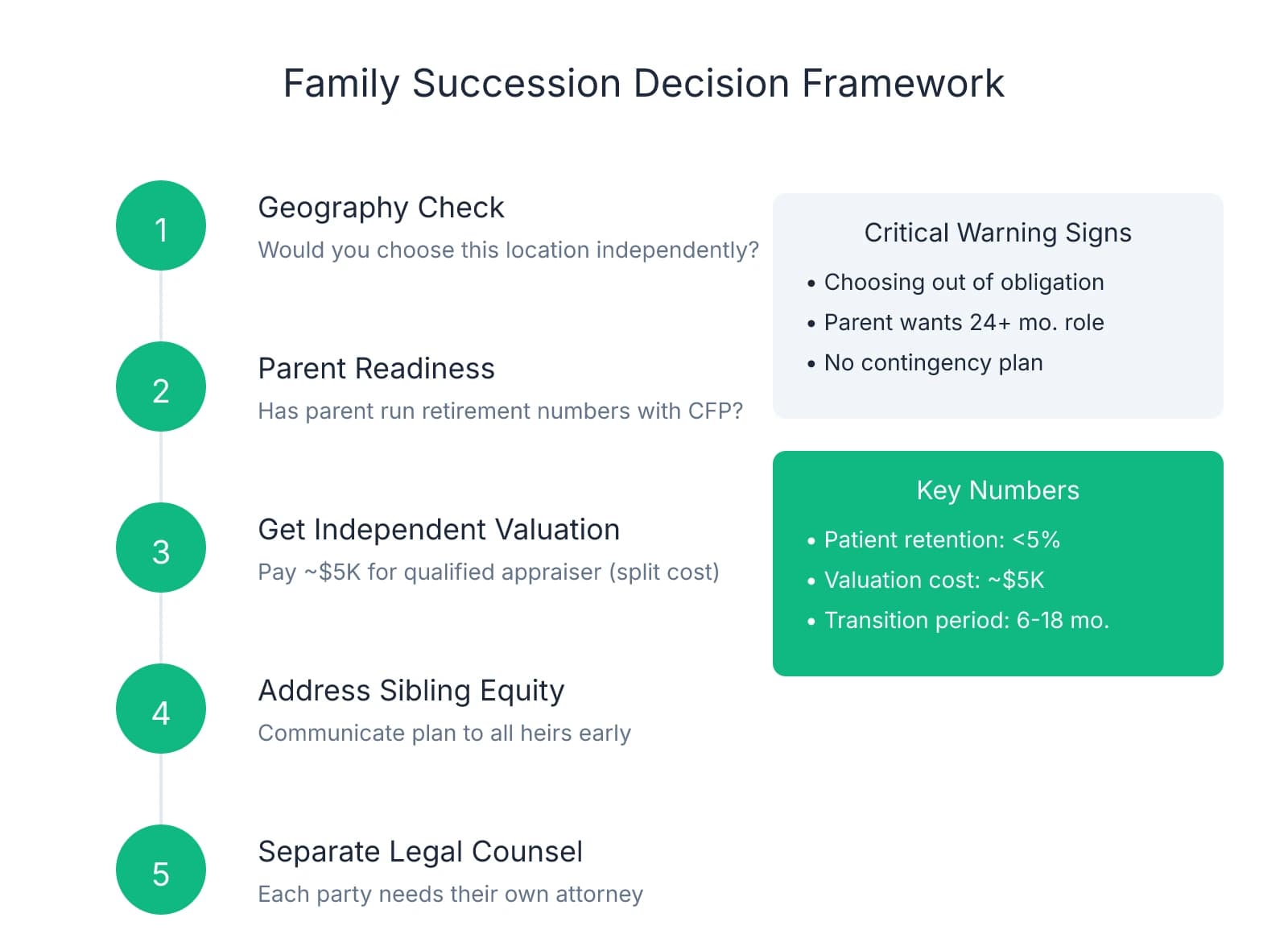
Will you be happy living and working in this location for the next 15-20 years? Not "can you tolerate it"—will you actively want to be there when you're 45, when your kids are in school, when your partner is building their career? If the practice were in a different city, would you choose this geography independently? Practices don't transplant. If you're choosing the location because the practice is already there, you're making a 20-year life decision based on your parent's preferences, not yours. Location matters for visibility, patient demographics, and competitive landscape—factors that will shape your daily work life for decades.
Has your parent consulted a CPA or CFP about their ability to retire? Not "do they want to retire"—have they run the numbers with a financial professional who confirmed they can maintain their lifestyle without practice income? A parent who hasn't done this work isn't ready to sell, even if they believe they are. The transition timeline will stretch, their involvement will linger, and you'll spend years managing someone else's unresolved exit anxiety.
Are you buying this practice because it's the right opportunity, or because you feel obligated? Obligation is a terrible foundation for a 20-year business decision. If your honest answer is "I'd rather explore other options, but I don't want to disappoint my parent," that's information worth acting on. Looking at other practices, talking to other sellers, and comparing what's available in markets you'd actually want to live in gives you the data to make a confident decision. If your parent's practice is genuinely the best fit, exploring alternatives will confirm that.
What's your contingency plan if you decide not to buy? Many buyers avoid this question because it feels like planning for failure. What it actually does is remove the pressure that clouds judgment. If you know you have other viable paths—other practices you're considering, other markets you'd be happy in—you can evaluate your parent's practice on its merits rather than out of fear that saying no means starting from zero.
Have you agreed on the transition timeline and your parent's ongoing role? For practices collecting over $1.2 million, 6-18 months of structured parent involvement is typical and valuable. What's not typical—and what signals unresolved readiness issues—is a parent who insists on 24+ months of involvement or who can't articulate what their role will be after the transition period ends. Having the seller introduce you to as many active patients as possible during the transition builds patient trust and smooths the handoff.
Do you each have separate legal representation? This is non-negotiable. Each party needs their own attorney, even in family deals—especially in family deals. Your parent's attorney represents their interests. Your attorney represents yours. Those interests overlap in some areas and conflict in others, and trying to save money by sharing counsel is how families end up with agreements that protect one party and expose the other. What to negotiate in a dental practice agreement applies just as much to family succession as it does to third-party sales.
If any of these questions produce answers that make you uncomfortable, that discomfort is worth listening to. Family succession works when both parties are genuinely ready—financially, emotionally, and logistically. When one side isn't, the transaction becomes a slow-motion problem that strains both the business and the relationship.
Sources & References
The data and claims in this article are drawn from the following sources. We prioritize government data, peer-reviewed research, and established industry publications to ensure accuracy.
- Navigating a Parent/Child Dental Practice Sale— www.dentalbuyeradvocates.com
- Patient Retention Following a Dental Practice Sale— dentaltransitions.comIndustry
- Tax Implications for Family Business Succession Planning in 2024 ...— familyenterpriseusa.comIndustry
- Succession Planning for the Family Dental Practice - CBIZ— www.cbiz.com
- Emotional Pitfalls in Family Business Succession Planning— seekingsuccession.comIndustry
- [PDF] 9 Questions You Should Ask Before Buying a Practice— www.agd.orgIndustry
Frequently Asked Questions
Ready to take over the family practice?
Buying your parent's dental practice is a significant decision that requires expert guidance. Minty Plus provides hands-on acquisition support and post-close management to ensure a smooth family succession transition.