Using Your Spouse's Income to Qualify for a Dental Practice Loan

Co-Founder, Minty Dental

In Summary
- Dental practice loans are primarily underwritten on the practice's cash flow, not the buyer's personal income — this is fundamentally different from how mortgage lenders evaluate borrowers
- The key qualification metric is debt service coverage ratio (DSCR): most dental lenders require 1.25x or better, meaning the practice generates $1.25 for every $1.00 of annual debt service
- Because dental goodwill typically represents 60–80% of the purchase price and can't be pledged as hard collateral, lenders rely on the SBA 7(a) government guarantee and the practice's cash flow history instead
- A practice with strong, documented cash flow can qualify a buyer for 100% financing regardless of their personal income level
- Spouse income is a secondary factor in dental practice lending — it enters the picture through global cash flow analysis, not as a primary qualification metric
Dental Practice Loans Are Underwritten on Practice Cash Flow — Not Your Income
If you've ever bought a home, the way dental practice lending works will feel counterintuitive at first — and that confusion is completely reasonable. Mortgage lenders center everything on your personal income: your W-2s, your debt-to-income ratio, your employment history. So it's natural to assume that a spouse's income could give your application a meaningful boost the same way a co-borrower's salary might on a home purchase.
That assumption is understandable, but it misses how dental practice lending actually works.
Whether you're pursuing an SBA 7(a) loan or a conventional dental-specialty product, the primary underwriting question isn't what do you earn? — it's what does the practice earn? Lenders evaluate whether the business itself generates enough cash flow to service the debt, measured by the debt service coverage ratio, or DSCR.
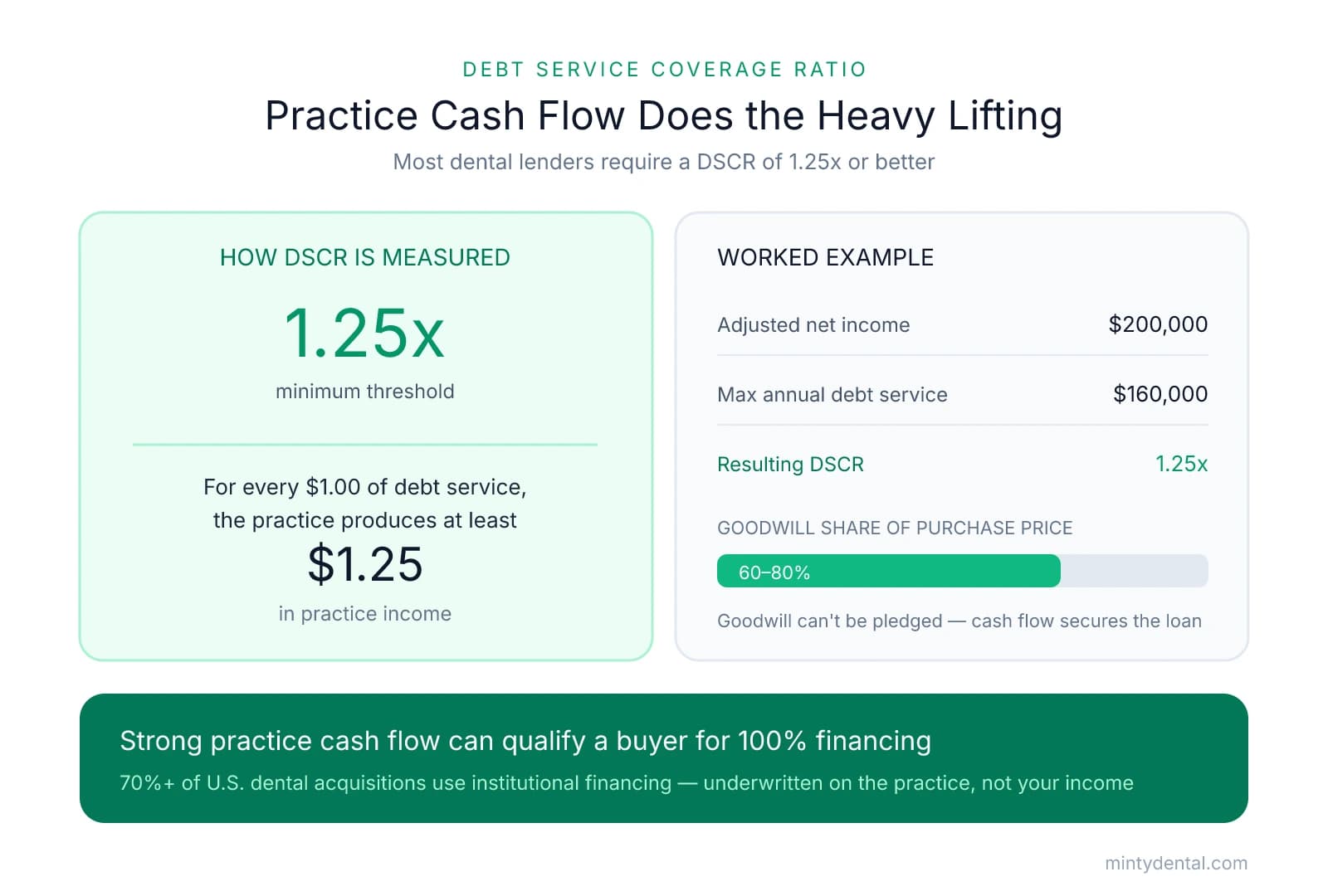
Debt Service Coverage Ratio (DSCR): The practice's annual net income divided by its total annual loan payments. Most dental lenders require a DSCR of 1.25x or better — meaning for every $1.00 of debt service, the practice produces at least $1.25 in income. A practice generating $200,000 in adjusted net income, for example, could comfortably support up to $160,000 in annual debt payments at that threshold.
This structure exists for a specific reason. In most dental acquisitions, goodwill — the value of the patient base, reputation, and systems — represents 60–80% of the purchase price. That's not equipment you can repossess or real estate you can foreclose on. Because lenders can't secure the loan against hard collateral in the traditional sense, they rely on the SBA 7(a) government guarantee and the practice's documented cash flow track record to manage their risk instead.
The practical implication is significant: a practice with strong, consistent collections and clean financials can often qualify a buyer for full financing regardless of personal income level. This is why 100% financing is genuinely available in dental acquisitions — a reality that surprises many first-time buyers who assumed they'd need a large down payment or a high-earning spouse to get approved.
According to the American Dental Association, more than 70% of dental practice acquisitions in the United States involve institutional financing — and in nearly all of those deals, the practice's financial history is the foundation of the underwriting, not the buyer's personal earnings.
Your spouse's income isn't irrelevant — but it works alongside the practice's cash flow, not in place of it. The next sections explain exactly how that plays out.
Where Spouse Income Actually Enters the Picture: Global Cash Flow
Once a lender has evaluated the practice's DSCR, they build a second layer of analysis called a global cash flow review: a household-level financial picture that combines the practice's business income with the borrower's personal financial position. This is where your spouse's income enters the underwriting conversation.
The mechanism is SBA Form 413, the personal financial statement required from all loan guarantors. Form 413 captures household income, personal assets, and outstanding liabilities — student loans, mortgages, car payments, credit card balances. If your spouse is a guarantor on the loan, their income and financial obligations appear on this form and become part of the lender's complete picture of repayment capacity.
The Three Scenarios Where Spouse Income Moves the Needle
Spouse income isn't equally valuable in every deal. Where it tends to matter most is in three specific situations:
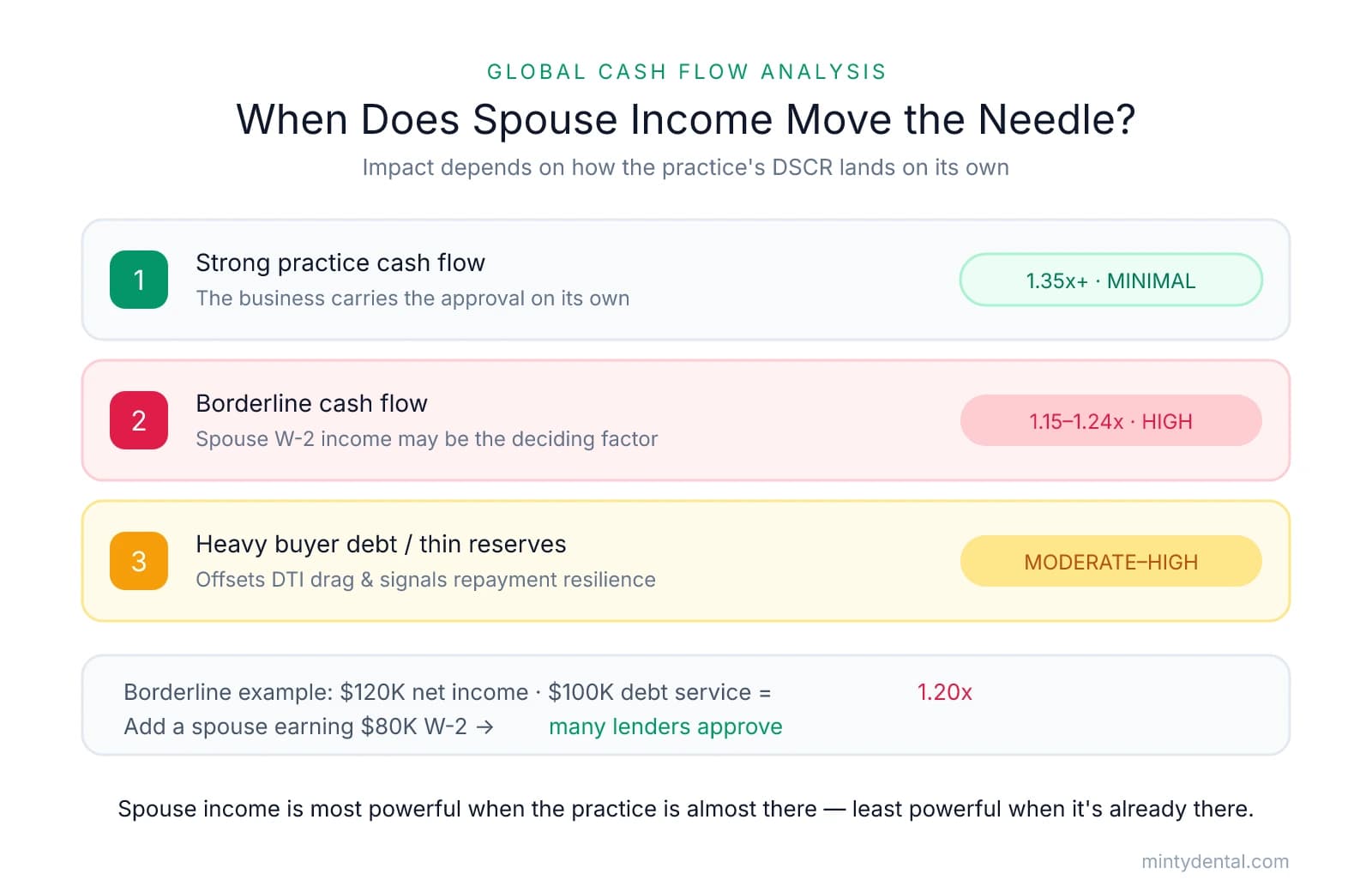
1. Borderline DSCR. When a practice's cash flow lands close to — but not comfortably above — the 1.25x threshold, a spouse generating stable W-2 income can serve as a documented compensating factor. As AdvisorLoans notes, for borderline approvals, a spouse who generates income can be added as a guarantor specifically to push the loan over the approval line.
Consider a concrete example: a practice generating $120,000 in annual net income with $100,000 in annual debt service produces a DSCR of 1.20x — slightly below the standard threshold. On its own, that deal may not clear underwriting. But a spouse earning $80,000 in stable W-2 income changes the household's global cash flow picture meaningfully, and many lenders will treat that as sufficient support to approve.
2. Heavy personal debt load. Dental graduates often carry $250,000–$300,000 or more in student loan debt. Those obligations factor into the lender's global debt-to-income calculation. A spouse's income can offset that drag — not by eliminating the debt, but by demonstrating that the household has enough income to service both the practice loan and existing personal obligations simultaneously.
3. Liquidity and reserves. A working spouse signals something lenders value beyond raw numbers: household resilience. If collections dip during a post-acquisition transition, a second income reduces the risk of a missed loan payment. Lenders often treat this as a qualitative positive even when the DSCR is already adequate.
When Spouse Income Adds Less Value
When a practice already produces a DSCR of 1.35x or higher, the business cash flow is doing the heavy lifting — and adding a spouse's income rarely changes the approval outcome or loan terms.
| Scenario | Practice DSCR | Spouse Income Impact |
|---|---|---|
| Strong practice cash flow | 1.35x+ | Minimal — practice carries the approval |
| Borderline cash flow | 1.15x–1.24x | High — may be the deciding compensating factor |
| Heavy buyer debt load | Any | Moderate to high — offsets personal DTI drag |
| Thin household reserves | Any | Moderate — signals repayment resilience |
The pattern worth internalizing: spouse income is most powerful when the practice is almost there but not quite — and least powerful when the practice financials are already doing the work on their own.
What Lenders Require in Return: Guaranty Rules, Credit Exposure, and Community Property
Bringing a spouse's income into the global cash flow picture isn't free — it comes with obligations worth understanding before you structure the application. None of these requirements are unusual in the context of a stable marriage, but knowing them in advance helps you make deliberate choices rather than discovering them mid-underwriting.
The Three Triggers for a Spousal Guaranty
Under current SBA rules, a spouse must personally guarantee the loan in any of three situations:
-
Combined ownership reaches 20% or more. If the borrower owns 19% of the practice entity and the spouse owns even 1%, their combined stake crosses the threshold — and both must guarantee. Per SBA lending guidelines, any individual owning 20% or more of a borrowing entity is required to provide an unlimited personal guaranty on 7(a) loans.
-
Community property or jointly-held assets are pledged as collateral. If the lender takes a security interest in assets that are legally co-owned — a home purchased during marriage, for example — the spouse's signature is required to encumber that asset.
-
The spouse exerts significant operational influence. Managing the practice's finances, signing vendor contracts, or making major business decisions can make a spouse a de facto owner in the SBA's view, triggering a guaranty requirement even without a formal ownership stake.
In non-community-property states, a spouse who holds no ownership interest and isn't pledging personal assets may not need to guarantee at all — worth confirming with your lender early, before the application is structured.
Community Property States: Where Geography Changes the Rules
In the nine community property states — Arizona, California, Idaho, Louisiana, Nevada, New Mexico, Texas, Washington, and Wisconsin — assets and debts acquired during marriage are legally owned equally by both spouses. Lenders in these states may require spousal involvement regardless of the spouse's formal role in the practice. If you're buying in one of these states, assume spousal participation in the application is likely and plan for it early.
Credit Exposure and the Guarantor vs. Co-Borrower Distinction
When a spouse is added to the application in any capacity, their credit history is evaluated. A score below 680 can introduce friction or require additional compensating factors — so the net benefit of adding spouse income needs to be weighed against the credit profile they bring with them.
The role the spouse plays also matters structurally:
| Guarantor | Co-Borrower | |
|---|---|---|
| Liability begins | Only upon default | From day one |
| Debts counted in DTI | Generally no | Yes |
| Credit pulled | Yes | Yes |
| Income counted | As compensating factor | Directly in qualification |
A guarantor's existing debts generally don't flow into the buyer's DTI calculation the way a co-borrower's would. That distinction matters if your spouse carries significant debt of their own — adding a high-earning spouse as a co-borrower can boost the income picture while simultaneously adding debt obligations that partially offset the gain. This connects directly to the broader question of how major financial decisions interact when you're buying a practice.
How to Decide Whether to Include Your Spouse — and How to Prepare
With the mechanics clear — how global cash flow works, where spouse income moves the needle, and what guaranty requirements follow — what most buyers need is a simple decision sequence to work through before sitting down with a lender.
Step 1: Start with the practice, not the household. Pull the target practice's adjusted net income and calculate the DSCR against your projected debt service. If the practice clears 1.35x or higher on its own, the loan likely qualifies without your spouse's income — and adding them may introduce credit exposure and guaranty obligations without meaningfully improving your terms.
Step 2: If the DSCR is borderline (1.10x–1.25x), run the net household calculation. Don't just add your spouse's income — subtract their debt obligations too. A spouse earning $90,000 but carrying $1,800 in monthly debt payments contributes less to global cash flow than the gross number suggests. The question is whether the household picture is stronger with them included than without. If the answer is yes, include them. If the math is roughly neutral, weigh the credit and guaranty exposure carefully before deciding.
Step 3: Check your state. Buyers in Arizona, California, Idaho, Louisiana, Nevada, New Mexico, Texas, Washington, or Wisconsin should assume spousal involvement will be required regardless of preference. Plan for it early so it doesn't slow down underwriting later.
Step 4: Prepare the spouse's financial picture in advance. If your spouse will be involved in any capacity, gather two years of tax returns, a current credit report, and a complete list of monthly debt obligations before approaching a lender. Having this organized at the start tends to compress the underwriting timeline noticeably — especially when the household is already managing significant existing debt, where existing loan obligations can complicate how lenders read the combined picture.
Step 5: Work with a dental-specific lender. Generalist SBA lenders may not have deep experience structuring household-level global cash flow analyses for dental acquisitions. A dental-specialty lender will know how to present the combined picture — practice income, spouse income, and personal debt obligations — in a way that reflects the deal accurately. That experience can matter when the application is borderline.
The clearest action you can take before submitting any application: build a one-page household cash flow summary — practice net income plus spouse income, minus all personal debt obligations — and bring it to your first lender conversation. Buyers who present this analysis proactively tend to move through underwriting faster. Understanding how to read the practice's P&L is the natural starting point for building that picture accurately.
Sources & References
The data and claims in this article are drawn from the following sources. We prioritize government data, peer-reviewed research, and established industry publications to ensure accuracy.
- Dental Practice Loans 2026: SBA 7(a), 504 & Bank Rates— dentalpracticeinsider.orgIndustry
- Demystifying the Practice Loan Process— ada.orgIndustry
- Debt Service Coverage Ratio: What It Is & How to Calculate— nerdwallet.comIndustry
- Spousal Guaranty Requirements for SBA Loans— advisorloans.comIndustry
- Demystifying the Practice Loan Process— ada.orgIndustry
- Best Practices: Requirements for SBA Guarantees— starfieldsmith.comIndustry
- Are Student Loans Community Property? 10 States Where ...— www.studentloanplanner.comIndustry
- Dating a dentist with 450k private loan… : r/whitecoatinvestor— www.reddit.com
Ready to acquire your dental practice?
Whether you're leveraging combined household income or exploring financing options, acquiring a dental practice requires expert guidance. Minty's acquisition specialists work with you from initial search through closing to find the right practice and financing strategy.