Buying a Dental Practice with an Active Insurance Audit

Co-Founder, Minty Dental

In Summary
- A dental insurance audit doesn't automatically disqualify a practice from sale — the type of audit matters far more than its existence
- Audits fall on a spectrum from routine utilization review (low risk) to fraud investigation or dental board referral (potentially disqualifying)
- Most audits are triggered by statistical outliers in claims data or random selection — not fraud suspicion
- Government and private payor dental audits rose sharply in 2024 and continued increasing through 2025, with further growth expected in 2026 — buyers will encounter this situation more frequently
- The right response isn't to walk away or ignore it — it's to triage the audit type, run targeted due diligence, and structure the contract to shift pre-closing liability back to the seller
An Active Audit Isn't a Deal-Killer — But It Changes Everything About Due Diligence
Dental insurance audit (acquisition context): A formal review initiated by a government program or private payor to examine a practice's billing records, coding accuracy, and clinical documentation — verifying that claims submitted were properly supported and correctly paid. In an acquisition, any open or unresolved audit travels with the practice unless the deal is structured to prevent it.
That last sentence is where many buyers get into trouble. The instinct when an audit surfaces in due diligence tends to be binary: panic and walk, or rationalize and proceed. Neither response is particularly useful. What actually determines whether a deal is viable — and on what terms — is understanding which kind of audit you're looking at.
As the Michigan Dental Association notes, dentists selected for audit shouldn't assume fraud is the issue: "The question in most audits is whether the payor has paid the dentist the correct amount, not whether fraud has been committed." That distinction shapes everything about how a buyer should respond.
The Audit Severity Spectrum
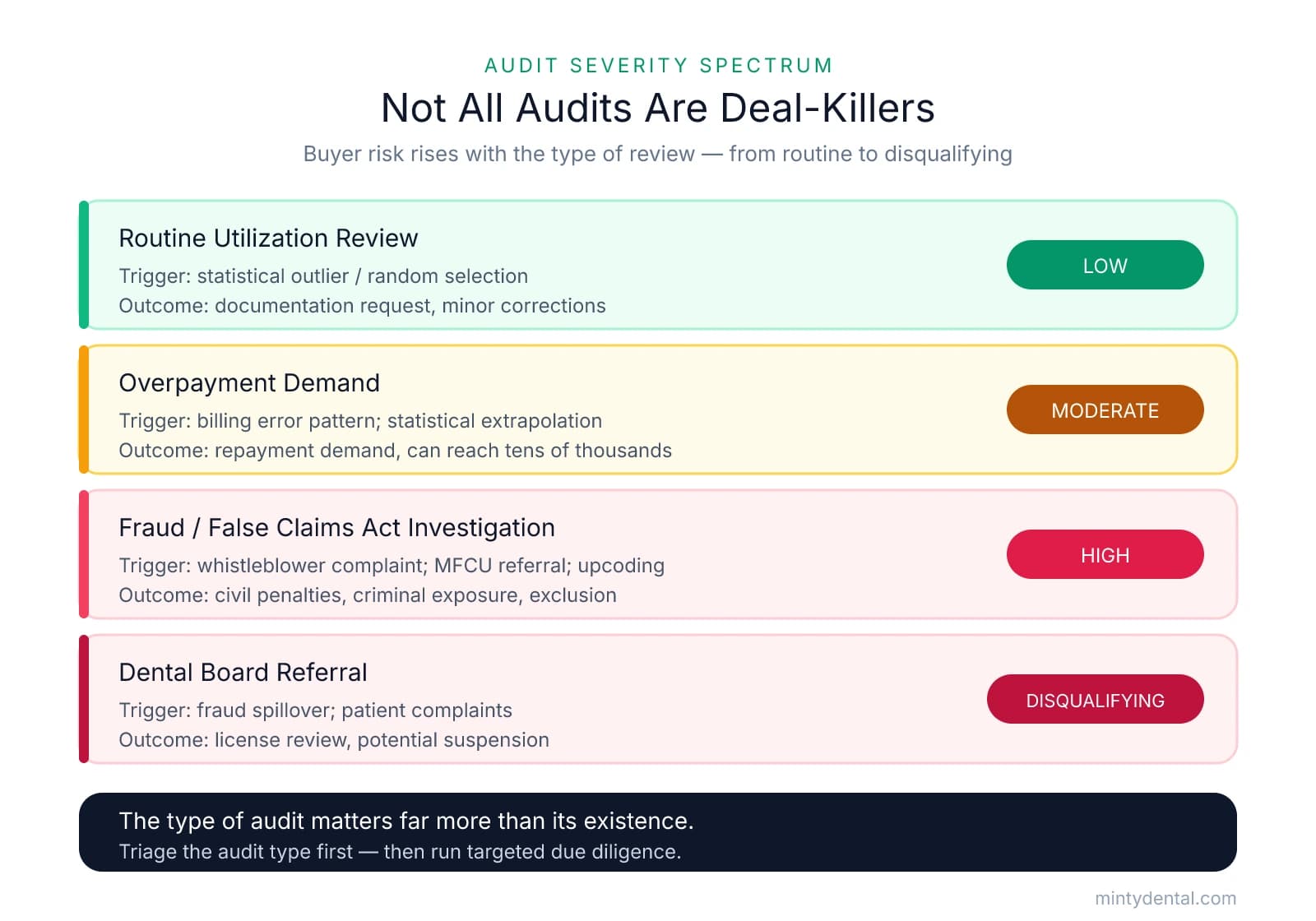
Audits aren't monolithic. They range from administrative nuisances to practice-ending investigations, and the gap between those extremes is enormous.
| Audit Type | Common Trigger | Typical Outcome | Buyer Risk Level |
|---|---|---|---|
| Routine utilization review | Statistical outlier in claims data; random selection | Documentation request; minor coding corrections | Low — usually resolvable before or at closing |
| Overpayment demand | Pattern of billing errors; statistical extrapolation applied | Repayment demand, potentially extrapolated across all claims in audit period | Moderate — liability can reach tens of thousands; needs contractual protection |
| Fraud / False Claims Act investigation | Whistleblower complaint; MFCU referral; pattern of upcoding | Civil penalties, criminal exposure, payor exclusion | High to disqualifying — requires independent legal assessment |
| Dental board referral | Fraud investigation spillover; patient complaints | License review, potential suspension | Potentially disqualifying — affects the seller's ability to transfer a viable practice |
A pattern worth paying attention to: overpayment demands become significantly more dangerous when payors apply statistical extrapolation — auditing a sample of claims and projecting that error rate across the entire billing period. A modest overpayment on reviewed claims can escalate into a six-figure repayment demand. This is the mechanism that turns a "minor audit" into a material liability.
Why Buyers Will See This More Often
This isn't a niche scenario. According to Liles Parker, government and private payor audits of dental claims rose sharply in 2024 and continued increasing through 2025, with further growth expected in 2026. Medicaid Fraud Control Units, Medicare Administrative Contractors, TRICARE auditors, and private payor Special Investigation Units are all actively expanding dental claim review activity.
For buyers, this means an active audit at closing is becoming a more routine discovery — not a rare exception. Practices most frequently targeted include those with high volumes of pediatric pulpotomies, surgical extractions, or procedures that statistically deviate from regional peers. If the practice you're evaluating serves a significant Medicaid population, understanding its payer mix and billing history becomes even more critical before you proceed.
The audit itself isn't the story. What it reveals about the seller's billing culture — and whether the deal can be structured to protect you from pre-closing exposure — is where the real analysis begins.
How to Assess the Real Exposure Before You Make a Decision
With that framing in place, the next step isn't deciding whether to proceed — it's building a clear picture of what you're actually dealing with. Buyers who ask the right questions at this stage consistently end up in a stronger negotiating position, whether that means restructuring the deal, adjusting price, or walking away with confidence rather than regret.
Start with these core questions, directed to the seller and their attorney:
1. Who initiated the audit? Private payors — commercial insurers running utilization reviews — operate very differently from government agencies. If the audit involves a Medicaid Fraud Control Unit (MFCU), a Unified Program Integrity Contractor (UPIC), or a RAC contractor, the stakes are categorically higher. Government-initiated audits carry potential criminal exposure and can trigger False Claims Act liability, which no indemnification clause fully neutralizes.
2. What triggered it? Random selection and data mining are the most common triggers — and generally the least alarming. A whistleblower complaint from a former employee, or a referral from another agency, signals something more serious may be underneath. As EisnerAmper notes, insurance companies can report findings to the National Practitioner Data Bank, which often sets off a chain reaction of reviews by other payor networks and federal agencies — a risk that compounds quickly once a whistleblower is involved.
3. What is the scope, and is statistical extrapolation being applied? Ask for the audit period length and the number of claims under review. Then ask specifically whether the payor is using statistical extrapolation. Per the Michigan Dental Association, "a relatively nominal overpayment on the manually audited claims can escalate to a repayment demand exceeding tens of thousands of dollars over the entire audit period." A documentation problem that looks manageable in isolation can become a six-figure liability once extrapolation is applied.
4. Has a recoupment demand been issued? If so, how much? Has the seller responded, appealed, or entered into a repayment agreement? An uncontested demand with no response is a different situation from one where the seller has engaged legal counsel and filed a formal appeal.
5. Has the audit been referred to a dental board or law enforcement? This is a categorically different situation from a billing dispute. According to Mahan Dental Law, payer audit findings can be referred to licensing authorities when conduct raises concerns beyond reimbursement — and once a board investigation opens, it can affect the seller's ability to transfer a viable, operating practice.
6. What does the billing record actually show? Don't rely solely on the seller's characterization of the audit. Request complete billing records and have a dental-specific healthcare attorney or compliance consultant review them independently. What you're looking for isn't just the flagged claims — it's whether the underlying billing patterns suggest a systemic problem or an isolated documentation gap.
The network termination risk deserves particular attention here. An audit finding can result in the practice being dropped from payor networks entirely — not just a repayment demand. Given that over 72% of adults and nearly 90% of children carry dental insurance coverage, losing a major payor relationship directly threatens the revenue base you're acquiring. This is worth stress-testing against the practice's payer mix before proceeding.
Buyers who work through these questions systematically aren't just protecting themselves — they're building the factual foundation for every contract negotiation that follows.
How Asset Purchase Structure and Contract Protections Shift the Risk
Once you understand what the audit actually involves, the practical question becomes: how do you structure the deal so that pre-closing liability stays with the seller where it belongs?
The starting point is the asset purchase structure. In dental acquisitions, the general rule is that a buyer of assets does not inherit the seller's liabilities simply by virtue of owning the assets. That baseline protection is meaningful — but it's not a wall. Courts have carved out well-established exceptions: de facto merger, continuity of enterprise, and implied assumption of liabilities. If you retain the same staff, same location, same payor contracts, and same trade name, a court could find enough continuity to hold you responsible for pre-closing conduct. Asset purchase structure is a foundation, not a substitute for explicit contractual protection.
The Contract Provisions That Actually Protect You
When an active audit is disclosed, the purchase agreement needs to address it directly. A dental-specific healthcare attorney — not a general business attorney — should draft these provisions. The nuances of payor contracts, Medicaid recoupment rights, and healthcare compliance law require specialized expertise that general transactional counsel often lacks. For more on why that distinction matters, the difference between generic and healthcare-specific drafting can determine whether a clause holds when it's actually tested.
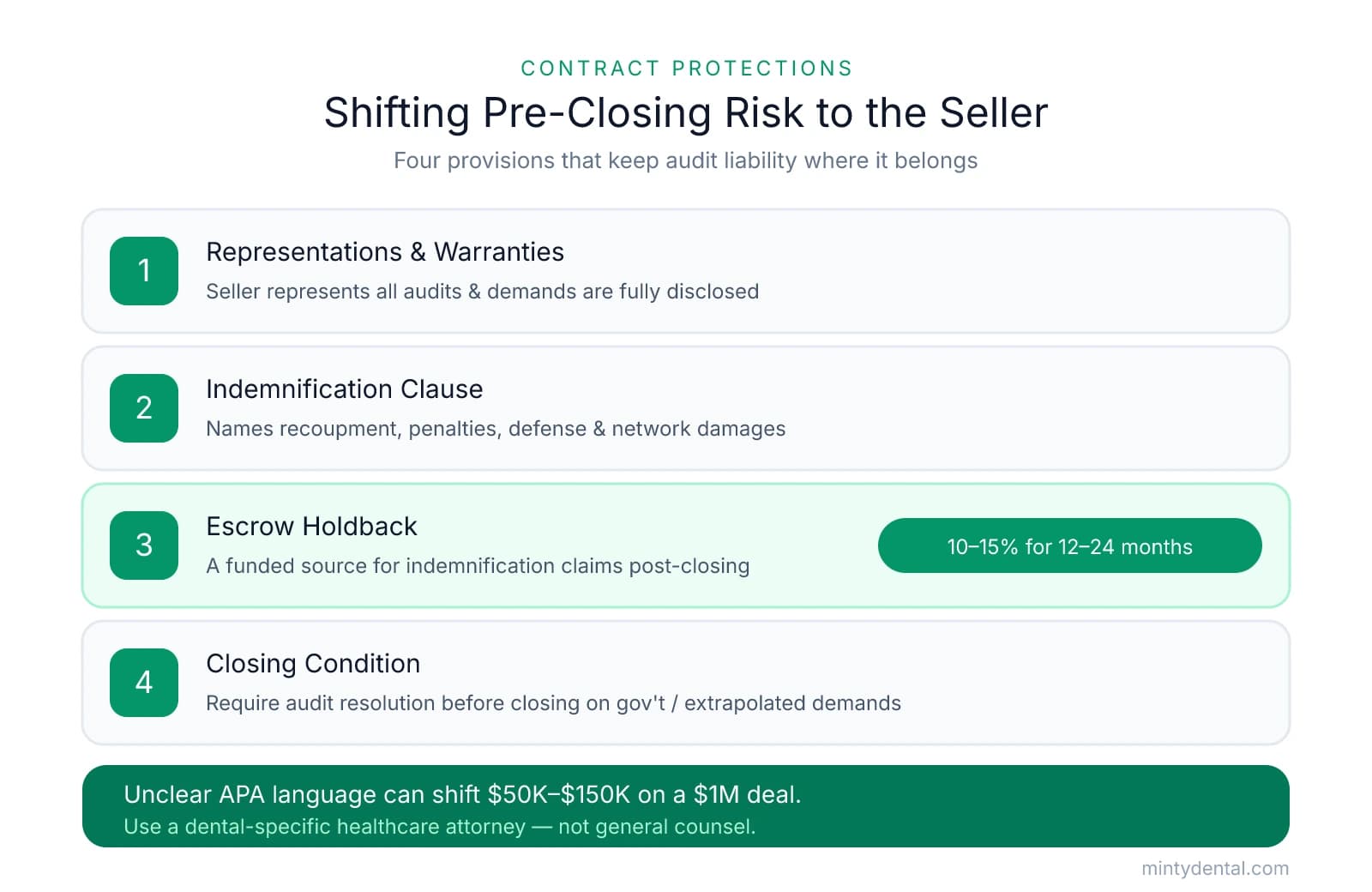
Representations and warranties: The seller should represent, explicitly, that all pending audits, investigations, recoupment demands, and payor correspondence have been fully disclosed. This creates a contractual basis for indemnification if something surfaces post-closing that wasn't disclosed — and puts the seller on notice that omissions have consequences.
Indemnification clause: This is the core protection. The clause should explicitly cover pre-closing audit liabilities — recoupment demands, civil penalties, legal defense costs, and any payor network termination damages that arise after closing but relate to pre-closing billing conduct. Vague indemnification language that doesn't name audit-specific liabilities tends to generate disputes when claims actually arise.
Escrow holdback: A portion of the purchase price — typically 10–15% — held in escrow for 12–24 months provides a funded source for indemnification claims if the audit resolves unfavorably. Without a funded mechanism, an indemnification clause is only as good as the seller's post-closing financial position, which may deteriorate quickly if a large recoupment demand lands.
Closing condition: For government audits or those involving extrapolated demands, consider requiring audit resolution — or a defined outcome threshold — before closing can proceed. Sellers may resist this, but it's a reasonable ask when the potential liability is open-ended.
The Price Adjustment Angle
A disclosed audit is also a legitimate basis for negotiating a lower purchase price or building in a price adjustment mechanism tied to the final audit outcome. Per Dental Practice Insider, unclear language in key APA provisions can shift $50,000–$150,000 in risk or price on a $1M deal — and an unresolved audit is precisely the kind of contingency that justifies a structured adjustment rather than a fixed price.
The goal isn't to penalize the seller for a disclosed audit — it's to make sure the deal economics reflect the actual risk you're absorbing.
When to Walk Away — and When the Deal Is Still Worth Doing
Everything covered so far comes down to one decision: proceed, restructure, or walk. Here's a practical framework for making that call.
Scenarios Where Walking Away Is the Right Answer
Some audit situations carry risk that no contract structure can adequately contain:
- Active fraud investigation or False Claims Act exposure — Government-initiated investigations involving MFCUs, UPICs, or DOJ referrals can carry criminal liability and civil penalties that indemnification clauses cannot fully neutralize. No escrow holdback is sized for that outcome.
- Dental board referral or license suspension risk — As Mahan Dental Law notes, payer audit findings can be referred to licensing authorities when conduct raises concerns beyond reimbursement. An active board investigation affects the seller's ability to transfer a viable, operating practice.
- Unquantified government program liability — Medicaid or Medicare audits where statistical extrapolation has been applied but the final demand hasn't been calculated represent open-ended exposure. Proceeding before that number is known means pricing a deal without knowing a material variable.
- Seller unwilling to disclose or indemnify — A seller's transparency about the audit — and their willingness to back that transparency with escrow and indemnification — is itself meaningful information. Resistance to disclosure isn't just a negotiating posture; it signals what they believe the audit will ultimately reveal.
Scenarios Where the Deal Can Still Work
Not every audit warrants walking away. Many deals close successfully when the right protections are in place:
- The audit is a routine private payor utilization review with no extrapolation applied and no government agency involvement
- A recoupment demand has been issued, quantified, and is modest relative to the purchase price — and the seller agrees to escrow funds to cover it
- The seller provides full indemnification with explicit coverage for audit-related liabilities, including legal defense costs and payor network termination damages
- The underlying billing issues appear to be documentation errors rather than intentional misconduct — a pattern that a compliance review of the actual billing records can help confirm
A seller who cooperates fully through due diligence, agrees to a structured post-closing transition period, and backs their representations with escrow is a fundamentally different counterparty than one who minimizes the audit and resists contractual accountability.
The Practical Next Step
Discovering an active audit mid-due-diligence is a reason to pause — not panic. Bring in a dental healthcare attorney before deciding whether to proceed. Review the billing records independently. Ask every question outlined in this article and get the answers in writing.
The audit is information. What you do with it determines whether you end up with a protected deal or an expensive mistake.
Sources & References
The data and claims in this article are drawn from the following sources. We prioritize government data, peer-reviewed research, and established industry publications to ensure accuracy.
- Insurance Audits: What to Do— www.michigandental.orgIndustry
- Dental claim audits and investigations will increase in 2026— www.lilesparker.com
- Dental Insurance Claims Audits Are on the Rise— www.eisneramper.com
- How Payer Audits Can Lead to License Discipline— mahandentallaw.comIndustry
- The Art of the (Bad) Deal: Successor Liability in M&A ...— ballardspahr.com
- Dental Practice Purchase Agreement: 2026 Term Guide For ...— dentalpracticeinsider.orgIndustry
Navigate Practice Acquisition with Confidence
Buying a dental practice with audit complications requires expert guidance. Minty's acquisition specialists help you evaluate risk, structure deals, and close successfully—even in complex situations.