Negotiating a Dental Practice Price Down After Due Diligence

Co-Founder, Minty Dental

In Summary
- Most buyers know they should push back after finding problems in due diligence — few know how to arrive at a number the seller can't dismiss
- Financial discrepancies like collections gaps adjust the valuation multiple, meaning a $120K shortfall at a 3x multiple is a $360K valuation problem, not a $120K one
- Capital and liability items — deferred equipment, undisclosed liabilities, compliance gaps — are dollar-for-dollar subtractions that stack on top of any multiple-based adjustment
- A healthy practice should have an A/R ratio of 1.0 (total receivables equal to one month of production); ratios above 1.5 signal collection problems that reduce working capital value directly
- Nearly half of all broken small business deals collapse because due diligence revealed material problems not visible from initial offering materials — which means sellers generally expect some renegotiation after diligence
Translating Due Diligence Findings Into a Specific Dollar Number Is the Whole Game
The conversation most buyers dread — telling a seller the price needs to come down — goes sideways not because sellers are unreasonable, but because buyers arrive with a vague sense that "some things came up" rather than a documented adjustment figure. The goal of post-diligence renegotiation isn't to negotiate in the abstract. It's to build a number the seller can follow, verify, and respond to.
That starts with understanding that not all findings hit the price the same way.
Two Categories, Two Different Math Problems
Financial discrepancies — gaps between represented and actual collections, inflated add-backs, overstated production — don't reduce the price dollar-for-dollar. They reduce the earnings base the multiple is applied to, which compounds the impact significantly.
Capital and liability items — deferred equipment replacement, undisclosed liens, compliance remediation costs — are subtracted directly from the agreed price, dollar-for-dollar, regardless of the multiple.
Keeping these two categories separate is what turns a vague complaint into a defensible memo.
A Worked Example
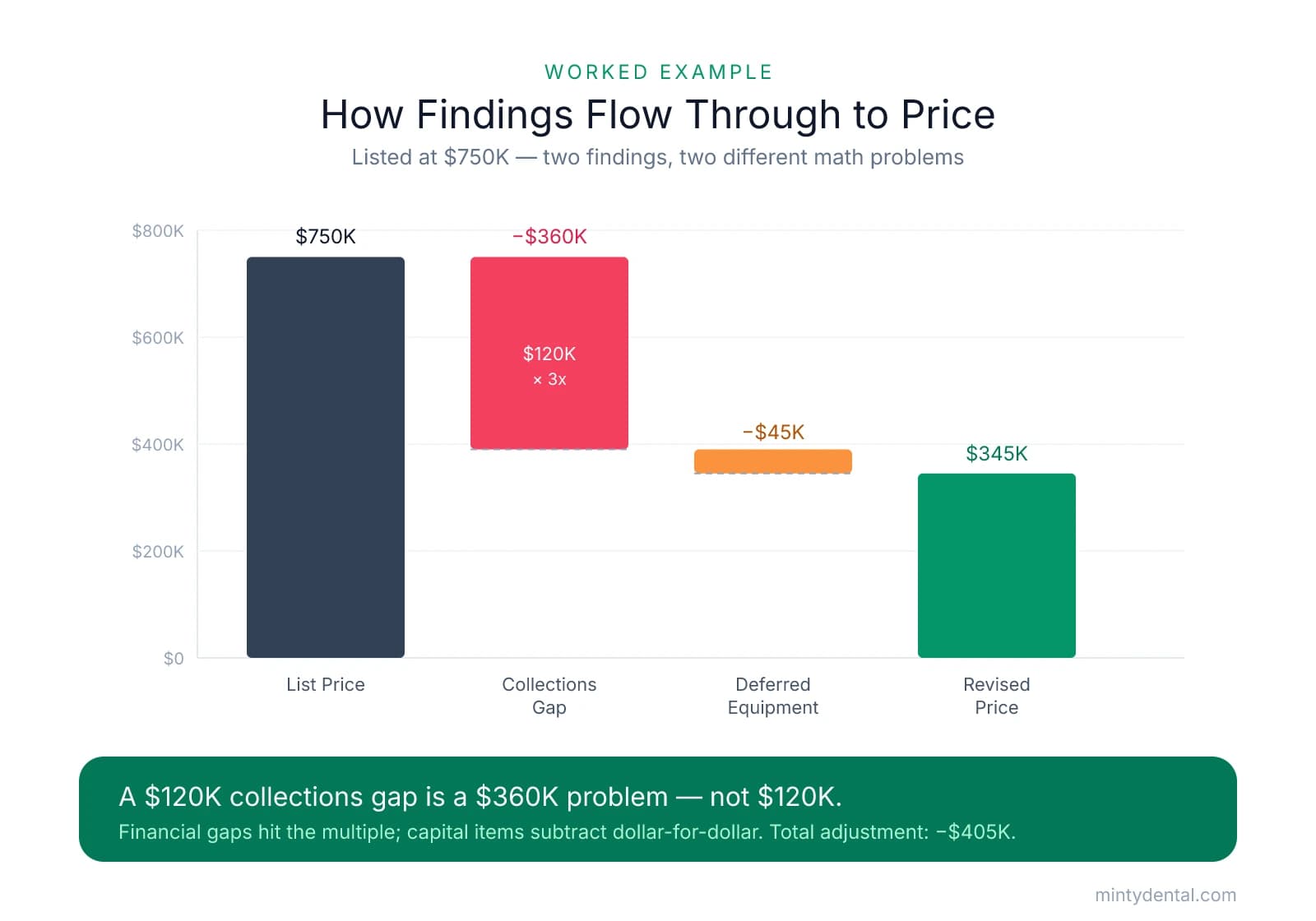
Consider a practice listed at $750,000, priced on represented collections of $800,000 at roughly a 0.94x collections multiple — consistent with a 3x EBITDA multiple after typical overhead. Due diligence surfaces two findings:
- Actual trailing collections: $680,000 — a $120,000 gap from what was represented
- Deferred equipment replacement: $45,000 — aging compressor, sterilization unit, and operatory chair documented in a third-party equipment assessment
Here's how each flows through to a revised price:
| Finding | Calculation Method | Dollar Impact |
|---|---|---|
| $120K collections gap | $120K × 3x EBITDA multiple | −$360,000 |
| $45K deferred equipment | Dollar-for-dollar subtraction | −$45,000 |
| Total adjustment | −$405,000 |
The revised defensible price lands around $345,000 — not $705,000 after a token $45K haircut. This is the math most buyers miss, and it's why budgeting for equipment upgrades before finalizing a price matters as much as the financial review itself.
The A/R Problem Is Its Own Line Item
Accounts receivable deserves separate treatment. A healthy dental practice carries an A/R ratio of 1.0 — total receivables equal to one month of average production. A practice producing $80,000 monthly with $140,000 in outstanding A/R carries a ratio of 1.75, signaling systemic collection problems. The portion of that A/R that's realistically uncollectible — typically anything aged beyond 90 days without a payment plan — is a direct working capital reduction, not a multiple-based adjustment.
Why Sellers Expect This Conversation
According to Axial's 2025 Dead Deal Report, nearly half of all broken small business LOIs fail because formal due diligence revealed material problems not visible from initial offering materials. Experienced sellers and their brokers know this. A well-documented adjustment memo isn't an attack on the deal — it's a normal part of the process, and framing it that way tends to keep the conversation productive.
The sections that follow cover how to choose the right adjustment tool for each finding type, and how to present the full memo without putting the seller on the defensive.
Price Cut Isn't Always the Right Tool — Know Your Adjustment Options
Once you've built a defensible adjustment figure, the next decision is how to deliver it — and a straight price reduction isn't always the right vehicle. Most buyers default to asking for a lower number on the purchase agreement, which works well for some findings but creates friction or lender complications for others.
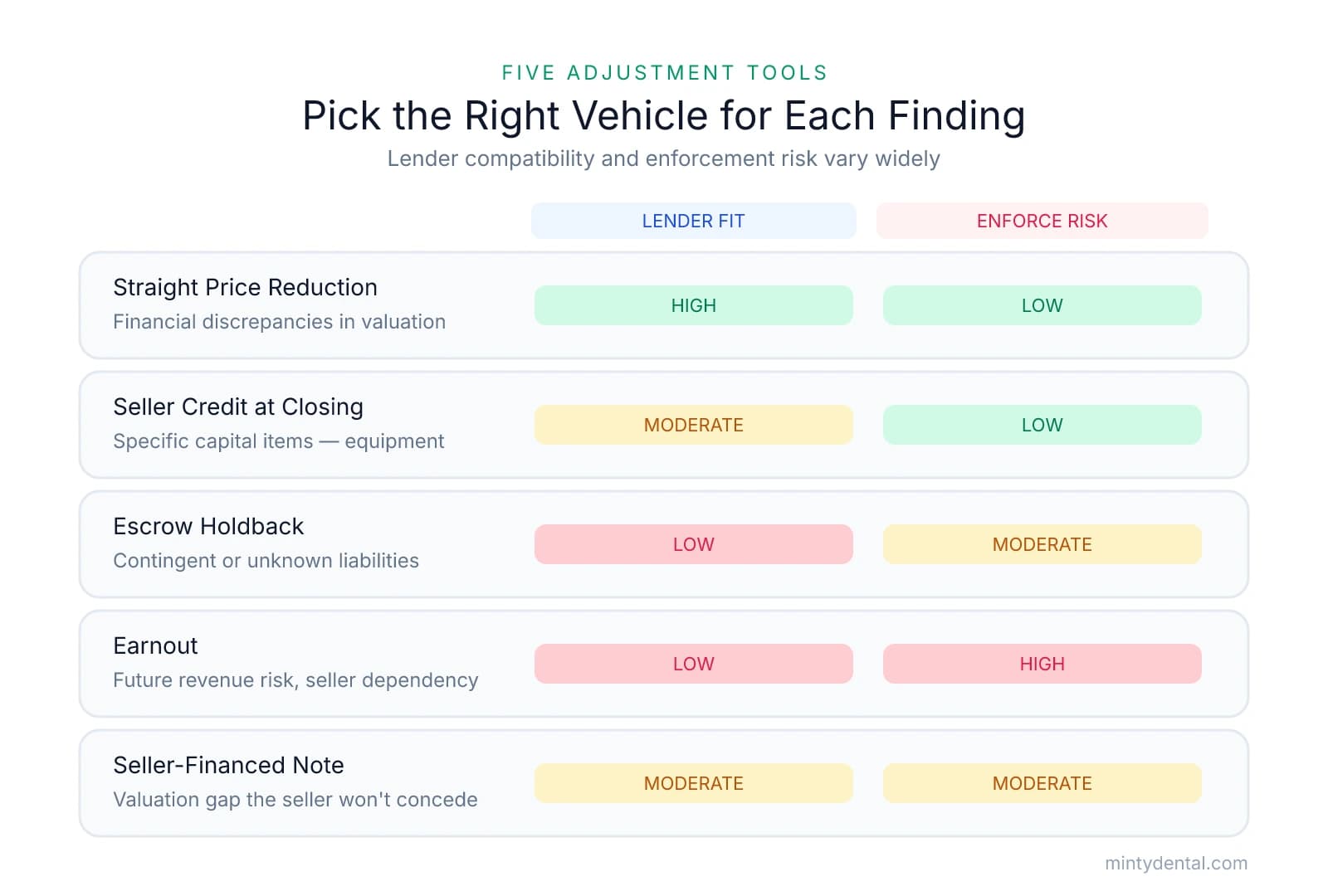
Here's how the five main adjustment tools work, and when each one fits.
| Tool | Best For | Lender Compatibility | Enforcement Risk |
|---|---|---|---|
| Straight price reduction | Financial discrepancies affecting the valuation model | High — simplest for lenders | Low |
| Seller credit at closing | Specific capital items (equipment, build-out) | Moderate — lender must approve | Low |
| Escrow holdback | Contingent or unknown liabilities | Low — many lenders restrict | Moderate |
| Earnout | Future revenue risk, seller dependency, retention uncertainty | Low — complex to underwrite | High |
| Seller-financed note | Valuation gap seller won't concede | Moderate — lender must approve | Moderate |
Straight price reduction is the cleanest tool when the finding directly affects the earnings base — collections gaps, inflated add-backs, overstated production. Lenders understand it, title companies process it without friction, and there's nothing to enforce after closing.
Seller credit at closing works well when the issue is a specific capital item — say, a $45,000 equipment replacement — and both parties want to preserve the headline price. Some lenders underwrite to a loan-to-value ratio tied to the purchase price, and a credit keeps that number intact while still compensating the buyer. The lender needs to approve the credit structure, but most will accommodate it for documented capital needs. Pairing this with a pre-closing equipment assessment (see evaluating dental practice technology) gives you the documentation to support the credit amount.
Escrow holdback fits when the liability is real but the final cost isn't known at closing — pending litigation, unresolved compliance issues, or back payroll taxes where the IRS hasn't issued a final assessment. A portion of the purchase price sits in escrow until the matter resolves, protecting the buyer without requiring the seller to accept a permanent price cut on a contingent risk. Many SBA and conventional dental lenders restrict or prohibit large holdbacks, so this structure needs lender sign-off before it goes into the LOI amendment. If back payroll taxes are the issue, the specifics of how that liability transfers should be resolved before structuring the holdback amount.
Earnouts address a different problem — not a known deficiency, but a disagreement about future value. As Oral Health Group notes, an earnout lets buyers and sellers disagree on valuation while still closing: the buyer pays a base price, with additional payments contingent on post-closing performance targets. This structure fits situations where seller dependency or patient retention uncertainty is the core concern. A well-structured earnout on patient retention risk can bridge that gap without either side conceding the point — though earnouts require clear metric definitions, audit rights, and dispute resolution language to be worth anything.
Seller-financed notes can bridge a valuation gap when the seller won't accept a price cut but will accept deferred payment. A portion of the purchase price becomes a promissory note, sometimes tied to performance, which shifts some risk back to the seller without requiring a formal price reduction.
One pattern worth paying attention to: lenders have strong opinions about non-standard structures. Loop your lender in before presenting any holdback, earnout, or seller note to the seller — finding out the structure is unfinanceable after the seller has agreed to it creates a different problem entirely.
How to Present Your Findings Without Blowing Up the Deal
The math from the previous two sections only works if the seller actually engages with it. The single biggest reason renegotiation conversations collapse isn't the size of the adjustment — it's how the conversation opens. A seller who feels accused shuts down. A seller who feels like they're solving a problem with you stays at the table.
Start With a Written Findings Memo, Not a Phone Call
Before any verbal conversation, put your findings in writing. A one-to-two page memo that documents each issue, the methodology used to quantify it, and the resulting dollar impact gives the seller something concrete to review — and signals that this is a financial analysis, not a grievance. As the ADA notes, starting with an accurate valuation is the foundation for effective negotiations — and your memo is essentially a revised valuation with the supporting work shown.
Structure the memo in three parts:
- What due diligence confirmed — lead with the positives. Patient retention looks strong, staff tenure is solid, the location holds up. This signals good faith and shows you're not looking for a reason to walk.
- What the findings show — each issue, documented with source (tax returns, equipment assessment, A/R aging report), with the dollar impact calculated and the methodology explained.
- Proposed adjustments — two or three options, not one demand.
Frame It as a Valuation Problem, Not an Accusation
The language you use matters more than most buyers expect. "The practice can't support the original price at these collection levels" is a financial observation. "You misrepresented the collections" is an accusation that triggers defensiveness and, sometimes, lawyers. The former invites the seller to solve a problem with you. The latter ends conversations.
Give the Seller a Menu, Not an Ultimatum
Rather than presenting a single demand, offer two or three adjustment structures — a price reduction, a seller credit at closing, or a holdback — and let the seller choose. Dental Buyer Advocates makes the point well: understanding what matters most to the seller — whether that's holding onto accounts receivable, a shorter transition period, or a clean headline price — is what makes a workable structure possible. A seller who cares about the headline number might prefer a credit over a price cut. One who's anxious about timeline might trade a larger adjustment for a faster close. Agency reduces resistance.
Understand the Broker's Role Before You Deliver the Memo
If a broker is involved, their commission depends on the deal closing — which aligns them with keeping things together — but their fiduciary relationship is with the seller. Going through the broker is usually the right move, since they can soften the delivery and manage the seller's initial reaction. Where it gets complicated is if the broker is actively minimizing your findings to protect the commission. Having your own attorney review the memo before it goes out ensures the language is precise and your interests are represented regardless of how the broker frames it.
Set a Response Window
Close the memo with a clear timeline — five to seven business days for the seller to respond. Deals that drift into open-ended "let us think about it" territory tend to stall, and stalled deals rarely close on favorable terms for either side.
After the Seller Agrees: Locking the Adjustment Into the Purchase Agreement
A verbal agreement to reduce the price — even one confirmed by email — is not enforceable. What matters is what ends up in the Asset Purchase Agreement. Until the adjustment is reflected in a signed APA amendment, the deal still reflects the original terms.
Every Adjustment Needs to Live in the APA
Each finding you negotiated — whether it produced a price reduction, a seller credit, a holdback, or an earnout — needs to be explicitly documented in the APA:
- Price reductions reflected in the updated purchase price and recitals
- Seller credits specified as a line item in the closing statement, with lender approval confirmed
- Representations and warranties updated to reflect verified figures — if the seller represented collections at $800K and diligence confirmed $680K, the APA should state $680K
That last point is easy to overlook. Sellers sometimes agree to a price adjustment while leaving the original representations intact, which creates ambiguity about what was actually warranted.
Escrow Holdbacks Require Precise Language
A holdback that's vaguely defined is almost impossible to enforce. If escrow is part of your structure, the APA needs to specify four things:
- The exact dollar amount held
- The trigger conditions for release
- The timeline — when does the holdback period end regardless of outcome
- Who holds the funds — a neutral third party, not the seller's attorney
Earnout Language Is Where Post-Closing Disputes Are Born
As Oral Health Group notes, earnouts require precise metric definitions — vague language about "practice performance" creates exactly the kind of disagreement that ends up in arbitration. The APA must define the specific performance metric, the measurement period, how the metric is calculated and verified, and the payment schedule. Audit rights are equally important and often omitted.
Your Attorney Reviews the Amendment Before You Sign
The findings memo is a negotiating document, not a legal instrument. Before signing any amendment to the LOI or APA, have your attorney confirm that the language actually delivers what you negotiated.
Getting the adjustment right at closing is what determines whether you start ownership on solid financial footing. The purchase price allocation calculator helps you think through how the adjusted price flows through to asset allocation — with real tax implications from day one. And if you're still working through what findings actually warrant renegotiation, the full renegotiation framework covers that ground in detail.
The buyers who come out of this process well aren't the ones who negotiated the hardest — they're the ones who made sure what they negotiated actually held.
Sources & References
The data and claims in this article are drawn from the following sources. We prioritize government data, peer-reviewed research, and established industry publications to ensure accuracy.
- Financial Due Diligence for Dental Practices— duckettladd.comIndustry
- Axial's 2025 Dead Deal Report— axial.net
- Earnouts in dental practice acquisitions: What you need to ...— www.oralhealthgroup.comIndustry
- Buying or Selling a Dental Practice, Start with an Accurate Valuation— ada.orgIndustry
- Dental Practice Negotiations— www.dentalbuyeradvocates.comIndustry
Ready to negotiate your practice acquisition confidently?
Due diligence findings give you leverage in price negotiations, but navigating the process requires expertise. Minty's acquisition specialists guide you through every negotiation step, from identifying issues to closing at the right price.