Buying a Dental Practice to Escape a Toxic Associateship

Co-Founder, Minty Dental

In Summary
- Nearly 46% of associate dentists report experiencing burnout, with toxic office culture and lack of growth opportunities among the top drivers — this is a systemic problem, not a personal one
- Practice owners and partners consistently report higher job satisfaction and lower burnout rates than associates, even after accounting for the added responsibilities of ownership
- The income gap between owners and associates often exceeds $50,000 annually for general dentists, meaning the financial case for buying frequently supports the emotional one
- Urgency is a useful signal that something needs to change — but it's a poor decision-maker on its own; the goal is to channel it, not be driven by it
- The most important question to answer before you start searching: "Am I buying to build something, or just to escape?" Both can lead to ownership — but only one leads to a good outcome
A Toxic Associateship Is a Valid Reason to Buy — But Not the Only One You Need
If you're reading this while dreading tomorrow's shift, fielding production pressure that feels more like a quota than a care standard, or working for an owner who treats autonomy as a threat — that experience is real, and it's far more common than the profession tends to admit.
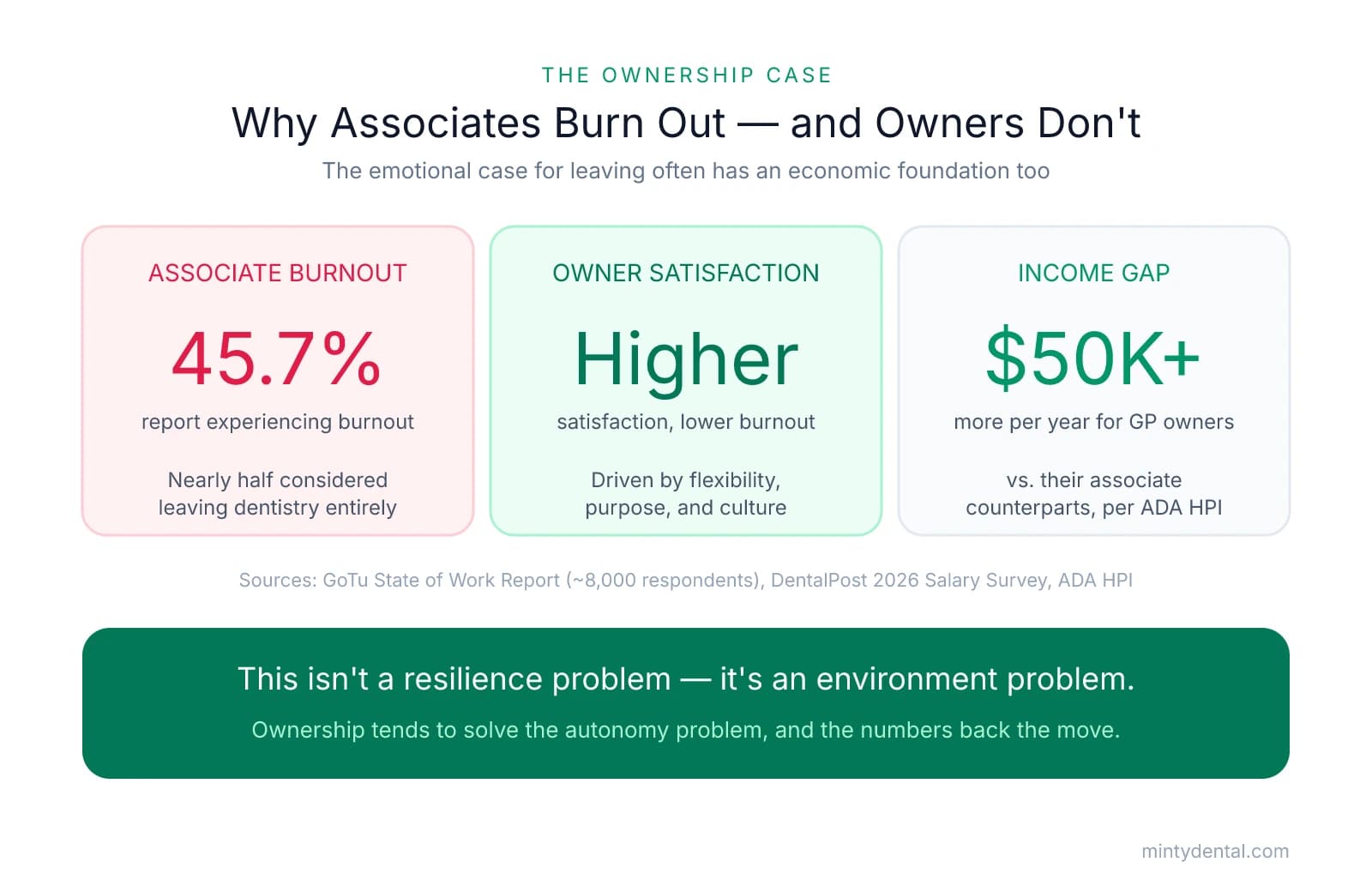
According to the GoTu State of Work Report, developed in partnership with the American Dental Hygienists' Association across nearly 8,000 respondents, 45.7% of associate dentists report experiencing burnout. The top drivers aren't personal shortcomings — they're structural: toxic office culture, excessive workload, low pay, and limited growth opportunities. Nearly half of burned-out respondents have considered leaving dentistry entirely. Many have already changed offices or reduced their hours just to cope.
This isn't a resilience problem. It's an environment problem.
Practice owners report significantly higher job satisfaction and lower burnout rates than associates — a pattern that holds even after accounting for the added responsibilities of ownership. The DentalPost 2026 Dental Salary Survey found that partners and owners outpaced associates and corporate employees on both satisfaction and burnout measures, with an increasing share attributing their wellbeing to flexibility, purpose, and culture — not just compensation.
The financial picture tends to reinforce this. General practitioner owners earn meaningfully more than their associate counterparts — often $50,000 or more annually, per ADA Health Policy Institute data — which means the case for ownership frequently has both an emotional and an economic foundation.
So the emotional case for leaving is legitimate. Ownership genuinely does tend to solve the autonomy problem, even as it introduces new ones.
But urgency is a useful accelerant and a dangerous decision-maker. The desire to escape a toxic situation creates real momentum — it gets you to pick up the phone, start the search, talk to lenders. That momentum has value. What it can't do is substitute for the underlying rationale that makes a specific practice worth buying.
The question worth sitting with before you start searching isn't "should I own?" — it's "am I buying to build something, or just to get out?" Both answers can lead to the same transaction. But the mindset behind the answer shapes how you evaluate practices, how you handle setbacks during due diligence, and whether you're making a strategic move or a reactive one.
The rest of this article is built around helping you tell the difference — and act accordingly.
Your Non-Compete Shapes Where You Can Buy — Read It Before You Search
Before you open a single listing, pull out your employment agreement and find the non-compete clause. What's in there — or isn't — will define your geographic search area more than any other factor, and many associates are either more constrained or more free than they assume.
How associate non-competes are typically structured: Most restrict you from practicing at a competing dental office within a defined geographic radius — commonly 5 to 10 miles from the practice location (not your home) — for a duration of one to two years following separation. Some agreements also include patient non-solicitation clauses, which operate separately and are worth reviewing on their own.
The distinction that matters most for buyers: most non-competes restrict practicing at a competing location, not owning a practice outside the restricted zone. If a practice you're considering sits 12 miles from your current employer, buying it while still employed may be entirely permissible under your agreement — as long as you're not yet practicing there. The non-compete clock typically starts at separation, not at the moment you sign a purchase agreement or close a deal.
That's a meaningful window. Many associates search, negotiate, and close on a practice while still employed — then manage the transition out of their associateship once ownership is secured.
What Your Non-Compete Does and Doesn't Prevent
| Term | What It Typically Restricts | What It Typically Doesn't Restrict |
|---|---|---|
| Geographic radius (5–10 mi) | Practicing at a competing office within that zone | Owning a practice outside that radius |
| Duration (1–2 years) | Competing employment after separation | Searching, negotiating, or closing before separation |
| Patient non-solicitation | Actively recruiting your current patients | Patients who independently follow you |
| Restricted activities | Clinical practice at a competing location | Business ownership, investing, or administrative roles |
State law adds another layer of complexity. California, North Dakota, and Oklahoma have long rendered most employee non-competes largely unenforceable — meaning associates in those states often have far more geographic flexibility than their contracts suggest. Several other states have moved in a similar direction with recent legislation.
The FTC attempted to resolve this nationally with a 2024 rule banning non-compete clauses for most workers — but federal courts blocked the rule before it took effect, leaving state law as the governing framework for most dentists. As dental contract attorneys at Chelle Law note, the same non-compete language can be fully enforceable in one state and void in another — which is why jurisdiction matters as much as the contract language itself.
The practical step: before you start searching, have a dental employment attorney review your non-compete clause. This is typically a flat-fee engagement and takes a few days. What you get back is a clear picture of your geographic options — which practices are safely outside your restricted zone, which are borderline, and whether your state's laws give you more flexibility than the contract implies.
Think of the non-compete not as a wall, but as a boundary that defines where your search begins. In many cases, that boundary is narrower than associates fear — and understanding it precisely is what lets you search with confidence rather than anxiety.
How to Evaluate a Practice Without Letting Urgency Cloud Your Judgment
With your geographic boundaries established, the next challenge is evaluating what's actually inside them — without letting the desire to escape distort what you see.
There's a specific cognitive trap that affects buyers fleeing difficult situations: any practice starts to look good when you're comparing it to where you are now. A thin cash flow feels acceptable because "at least I'm the boss." A problematic lease gets rationalized because "I just need to get out." Due diligence steps get skipped because "the seller seems trustworthy." This is the urgency discount — and it's one of the more reliable ways a motivated buyer ends up in a practice that trades one set of problems for another.
The antidote isn't to slow down indefinitely. It's to evaluate each practice on its own merits, independent of how miserable your current situation feels. The framework below is designed as a self-check — questions to run through before you let momentum carry you past something worth pausing on.
The Practice Evaluation Self-Check
1. Does year-one cash flow cover debt service AND a livable income — not just one or the other? Run the numbers with your accountant before signing an LOI. A practice that cash flows after debt service but leaves you earning less than your current associateship isn't an upgrade — it's a lateral move with more risk. If you want a starting point for what "livable" looks like relative to your current compensation, the associate pay calculator can help you build a comparison baseline.
2. Is patient retention stable or declining over the last three years? Declining retention in a practice you're buying to escape to is a different kind of trap. Ask for patient visit data across the last 36 months. A shrinking active patient base means you're buying a practice that's already contracting — and you'll need to reverse that trend before you can grow.
3. Is the seller's stated reason for selling consistent with what the financials show? Mismatches here are worth investigating before you go further. A seller citing retirement while revenue has dropped 20% over two years deserves a direct conversation. It doesn't mean the deal is dead — but it does mean you need a clearer explanation before the LOI is signed. Understanding what drives practice growth before you buy can help you distinguish a temporary dip from a structural decline.
4. Does the lease have sufficient runway? Ideally, you want five or more years remaining — or renewal options that give you equivalent security. A lease assignment with two years left puts you in a renegotiation position almost immediately after closing, often from a weak position. Landlords know you're invested.
Don't Quit Before You Close
Most acquisitions take three to six months from search to close. During that entire window, you're still employed — and that income is something lenders actively want to see through underwriting. Quitting before closing removes the income stability that supports your loan approval and signals financial instability at exactly the wrong moment.
Stay employed. Stay focused. The exit becomes real at closing, not before.
The Right Goal
The practice you're looking for solves two problems simultaneously: it gives you the autonomy your current situation denies, and it sets you up financially to sustain that autonomy long-term. A practice that only solves the first problem — that gets you out but leaves you cash-strapped, lease-exposed, or inheriting a shrinking patient base — hasn't actually solved the problem. It's just moved it.
Sequencing the Exit: How to Search, Close, and Resign Without Blowing Up Your Income
The evaluation framework above tells you what to look for. This section covers how to execute the move without creating a financial gap between your last associate paycheck and your first day as an owner.
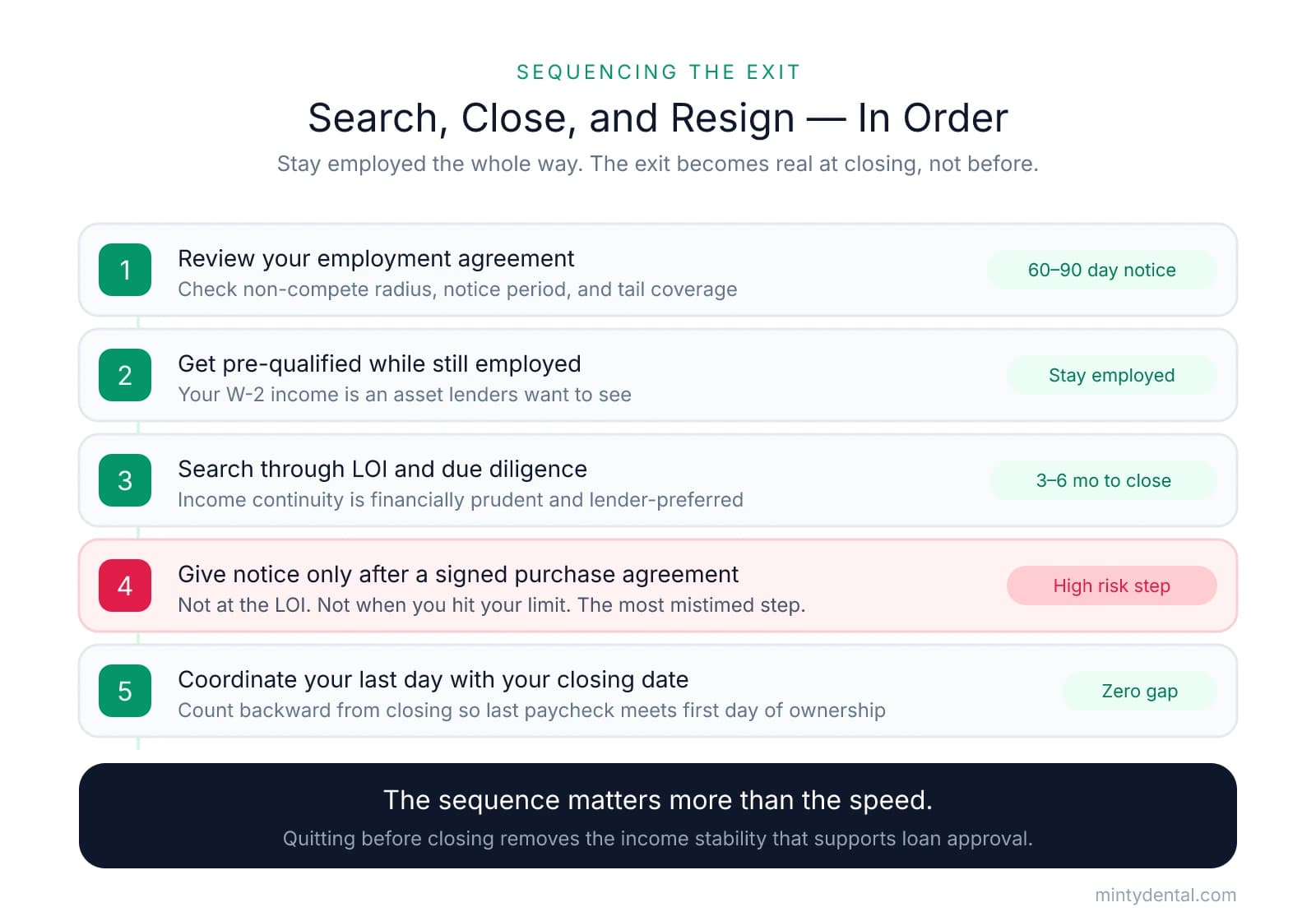
The sequence matters more than the speed. Here's how most successful transitions unfold:
Step 1: Review your employment agreement before you do anything else. Specifically, look at the non-compete radius, the notice requirement, and any tail coverage obligations. Many associate contracts require 60–90 days notice — a detail that becomes critical later in this sequence. Have a dental attorney review it if you haven't already; this step shapes everything that follows.
Step 2: Get pre-qualified with a dental-specific lender while still employed. Your W-2 income is an asset at this stage. Lenders want to see stable employment through underwriting, and getting pre-qualified now — before you've found a practice — tells you your actual budget and signals to sellers that you're a serious buyer. Understanding what lenders look for in a dental acquisition loan before your first conversation puts you in a stronger position from the start.
Step 3: Search while still employed — all the way through LOI and due diligence. As noted earlier, most acquisitions take three to six months from search to close. That window is finite and survivable. Many buyers have navigated it while working in genuinely difficult environments. The income continuity isn't just financially prudent — it's lender-preferred.
Step 4: Give notice only after you have a signed purchase agreement and a clear closing timeline. Not when you emotionally hit your limit. Not after the LOI. After the purchase agreement is signed and closing is scheduled. This is the most commonly mistimed step in the process — and the one with the most financial consequence. A detailed breakdown of how to handle the resignation conversation itself is worth reading before you get to this point.
Step 5: Coordinate your last day with your closing date. The goal is zero gap. If your contract requires 60 days notice, count backward from your expected closing date and give notice accordingly. Your last associate paycheck and your first day of ownership should be as close together as possible.
If the Situation Becomes Untenable Before You Close
Sometimes the environment deteriorates faster than the timeline allows. If leaving early becomes necessary, communicate with your lender immediately — don't wait until the next scheduled call. A change in employment status mid-process is manageable when disclosed early; it becomes a problem when the lender discovers it during final underwriting. Most dental lenders have seen this scenario before and can work with it given enough lead time.
The 3–6 month window between starting your search and closing is genuinely hard when you're working somewhere that's wearing you down. But it's also finite. The exit becomes real at closing — and the sequence above is what gets you there without blowing up the deal on the way out.
Sources & References
The data and claims in this article are drawn from the following sources. We prioritize government data, peer-reviewed research, and established industry publications to ensure accuracy.
- GoTu State of Work Report— gotu.com
- DentalPost 2026 Dental Salary Survey— email.amplify360.com
- [PDF] Dental workforce shortages: Data to Navigate Today's Labor Market— ada.orgIndustry
- FTC issues ban on noncompete clauses - ADA News— adanews.ada.orgIndustry
- Dentist Non-Compete Rules And Risks | Robert Chelle— reviewdentalcontracts.comIndustry
- How Long Does it Take to Buy a Dental Practice?— pmagroup.netIndustry
Ready to Own Your Dental Future?
Leaving a toxic associateship is the first step—finding the right practice to own is the next. Minty guides dentists through the entire acquisition process, from identifying opportunities that match your vision to closing the deal, with expert support every step of the way.