Co-Buyer Backs Out of a Dental Practice Deal: What to Do

Co-Founder, Minty Dental
In Summary
- A co-buyer backing out mid-deal creates three distinct problems: potential legal exposure to the seller, a financing gap, and deal momentum loss — each requiring a separate response
- The stage of the deal when the exit happens determines how serious each problem is — pre-LOI exits carry almost no risk, while post-APA exits can put your earnest money deposit in jeopardy
- The earnest money deposit (typically 5–10% of the purchase price) is the primary financial asset at risk, and whether it's protected depends on whether a financing contingency is still active
- Most LOIs are non-binding except for exclusivity and confidentiality clauses — a co-buyer exit before the Asset Purchase Agreement is signed rarely creates legal liability if your contingencies are properly written
- Your first call should be to your attorney, not the seller — understanding your legal position before disclosing anything is the move that protects you most
A Co-Buyer Exit Creates Three Separate Problems — Each Needs a Different Response
When a co-buyer backs out, the instinct for many buyers is to treat it as a single crisis — the deal is falling apart, and something must be done. That framing makes it harder to respond well. What's actually happening is three separate problems arriving at once, and conflating them leads to reactive decisions that can make each one worse.
The three problems are: a potential legal exposure to the seller, a financing gap that may no longer support the acquisition on your own, and a deal momentum problem with a clock running. Each one has a different solution, a different set of advisors, and a different timeline. Getting clear on which problem you're actually solving in a given moment is what keeps the deal — and your deposit — intact.
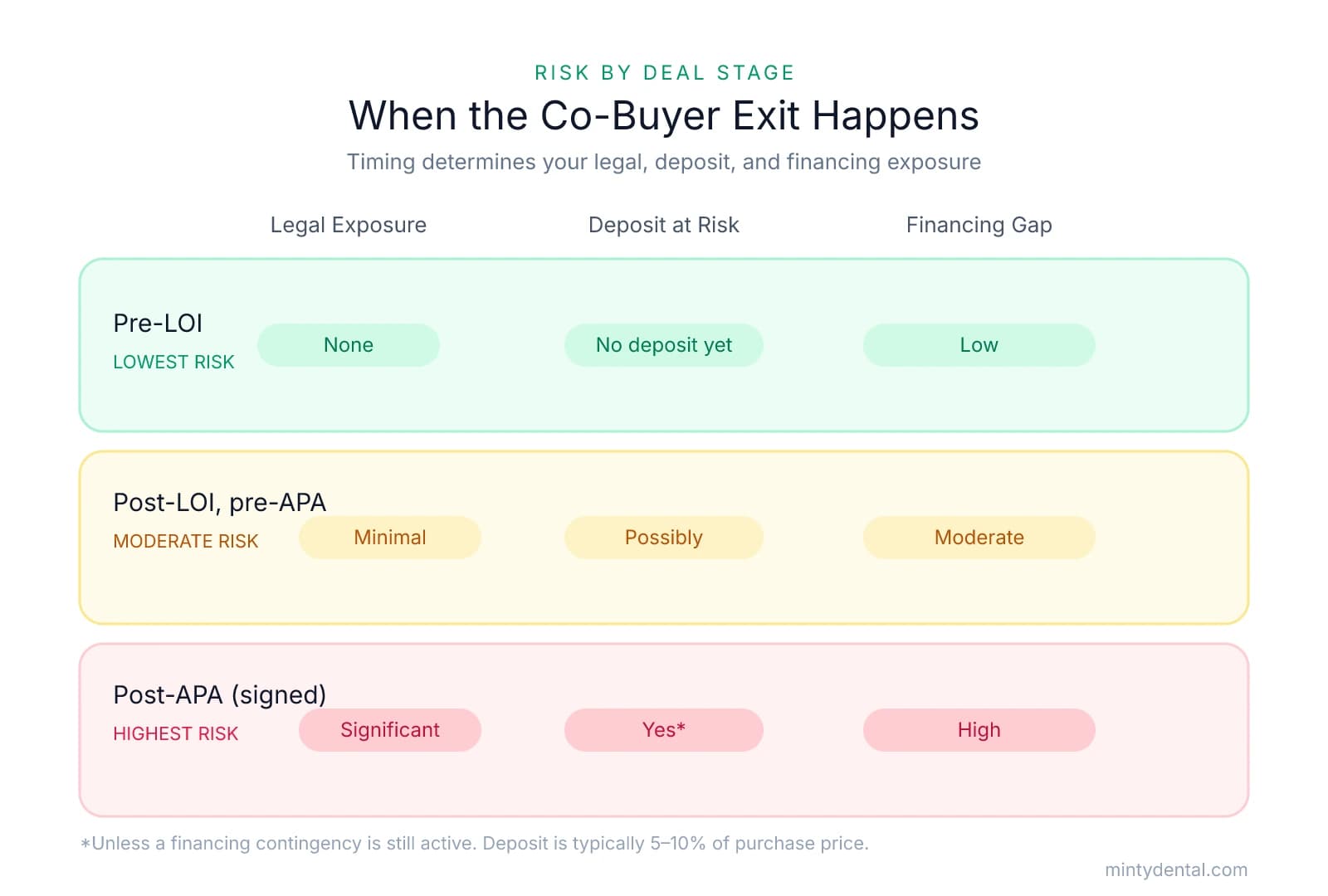
How serious each problem is depends almost entirely on where you are in the deal timeline. Here's a quick orientation:
| Deal Stage | Legal Exposure | Deposit at Risk | Financing Gap |
|---|---|---|---|
| Pre-LOI | None | No deposit yet | Low — no commitments made |
| Post-LOI, pre-APA | Minimal (LOI is largely non-binding) | Possibly — if deposited | Moderate — lender pre-approval may need revision |
| Post-APA (signed) | Significant — contract obligations exist | Yes, unless contingency is active | High — lender underwriting tied to original structure |
As dental practice LOI guidance from Polished Legal notes, most LOI provisions are non-binding — but exclusivity and confidentiality clauses typically are. That distinction matters here: a co-buyer exit post-LOI doesn't automatically expose you to seller claims, but it does mean you're still bound by exclusivity while you figure out your next move.
The earnest money deposit — typically 5–10% of the purchase price — is the financial asset most immediately at risk. Whether it's protected comes down to one question: is a financing contingency still active? If it is, and your lender can no longer approve the loan under the new solo-buyer structure, you likely have a clean exit path. If contingencies have already been removed, the calculus changes significantly. Understanding how purchase contingencies work before you make any disclosures is worth the hour it takes.
The one move that tends to protect buyers most at this stage: call your attorney first, then your lender — not the seller. Your legal position and your financing options need to be understood before you disclose anything, because what you say to the seller, and when, shapes every negotiation that follows.
The deal isn't necessarily dead. But the next 48–72 hours matter more than most buyers realize.
Read Your Documents Before You Do Anything Else
Before you call the seller, the broker, or even your lender, pull out every document you've signed and work through a specific set of questions. The answers will tell you what your actual exposure is — and what leverage, if any, you still have.
Here's a checklist of questions to answer before you contact anyone:
-
Does the LOI name both buyers, or a single entity? If the LOI lists two individuals as co-buyers, your co-buyer's exit may technically implicate the good-faith or exclusivity provisions — but as dental transition attorneys at AGS Law note, LOIs are largely non-binding outside of confidentiality and exclusivity clauses. In practice, this is rarely enforced. What matters more is whether the LOI names a business entity (an LLC or PLLC) rather than two individuals — if so, the entity's obligations survive the co-buyer's exit, and you may have more flexibility than you think.
-
Has the Asset Purchase Agreement been signed? This is the document that changes everything. Once the APA is executed, the buyer entity named in it is legally obligated to close. Removing a co-buyer from that structure isn't as simple as notifying the seller — it requires a formal written amendment, negotiated and signed by both parties. If you're post-APA, this is the first thing your attorney needs to address.
-
Is a financing contingency still active? This is arguably the most important protection in your entire document stack. A properly written financing contingency allows you to terminate the deal and recover your earnest money deposit if your loan structure changes materially — which a co-buyer exit almost certainly triggers. If that contingency is still live, you have options. If it's been waived or has expired, your deposit exposure increases significantly.
-
Was your co-buyer a named co-borrower on the loan application? If so, your lender needs to know immediately. The original loan approval was underwritten based on two borrowers' financials, credit profiles, and income. That approval may be void the moment one borrower exits, and a new underwriting process will likely begin from scratch.
One pattern worth paying attention to: many buyers in this situation instinctively want to call the seller and explain what's happening — either out of transparency or anxiety. Resist that impulse. Disclosing the co-buyer exit before you understand your legal position can signal deal instability and weaken every negotiation that follows.
Your first call should be to a dental-specific transaction attorney. General business attorneys can handle contracts, but dental practice acquisitions involve nuances — lender credentialing requirements, state dental board entity rules, HIPAA-related asset transfers — that a generalist may not flag. An attorney who works in dental transitions regularly will recognize these dynamics immediately and help you assess your position before you say anything to anyone else.
Once you know where you stand legally, you'll be in a much better position to decide whether to restructure, renegotiate, or walk away cleanly.
Can You Qualify for Solo Financing — and Does the Deal Still Work?
With your legal position clarified, the financing question becomes the most consequential decision point in the deal. The good news: dental-specific lenders routinely offer 100% financing to solo buyers, even first-time owners carrying student debt. According to the ADA, dental practices carry a default rate of less than 1% — which is why lenders are willing to finance the full purchase price without requiring a co-borrower. A partner exit doesn't automatically close the financing door.
What it does do is trigger a full re-underwriting. Your lender's original approval was built around two borrowers — two credit profiles, two income streams, two debt-to-income ratios. Remove one, and the loan essentially starts over. The variables lenders will re-evaluate include:
- Credit score — the solo buyer's score now carries the full weight of the approval
- Debt-to-income ratio — student loans and any existing obligations are measured against a single income
- Clinical production history — lenders want to see that you can personally generate enough to service the debt
- Liquidity — cash reserves become more important when there's no second income to absorb early shortfalls
One lender's "no" isn't the industry's answer. Underwriting criteria vary meaningfully across dental-specific lenders, and what disqualifies you at one institution may be workable at another. Talking to at least two or three lenders — as the ADA recommends — before concluding solo financing is off the table is worth the time. A deeper look at what banks evaluate during dental practice loan underwriting can help you anticipate where your application may need strengthening.
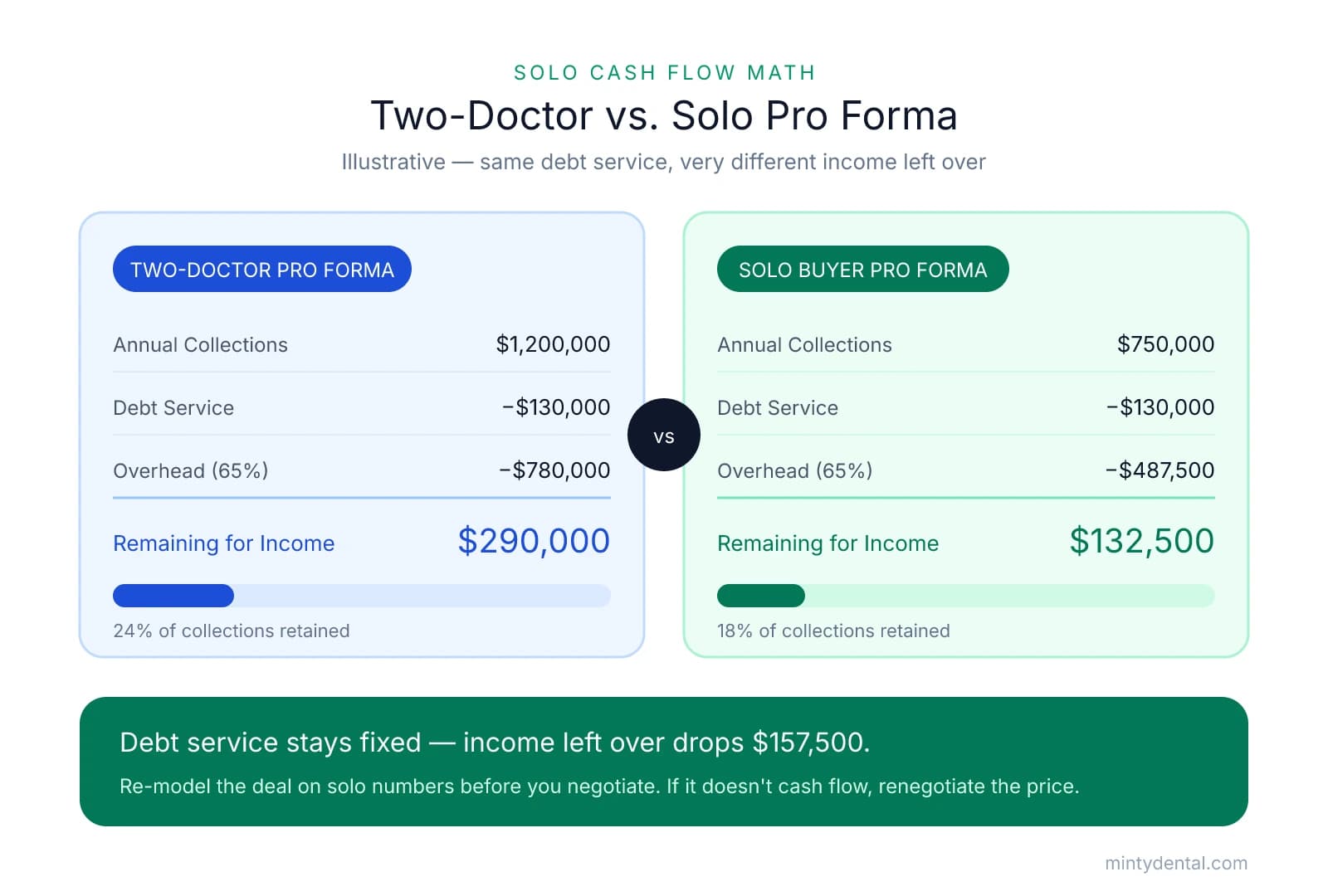
The cash flow math changes materially when you go solo. A practice that penciled out for two doctors needs to be re-modeled for one. The core question: can this practice generate enough revenue — on a single-doctor production schedule — to cover full debt service, overhead, and your personal income?
A rough comparison worth running:
| Scenario | Annual Collections | Debt Service | Overhead (65%) | Remaining for Income |
|---|---|---|---|---|
| Two-doctor pro forma | $1,200,000 | $130,000 | $780,000 | $290,000 |
| Solo buyer pro forma | $750,000 | $130,000 | $487,500 | $132,500 |
The numbers above are illustrative, but the pattern is real. If the practice was sized for two providers — large operatory count, high fixed overhead, or production that genuinely required two full-time schedules — the economics may not work at the original price. That's not a reason to panic; it's a reason to renegotiate. Modeling your solo income against debt service is exactly what the Minty associate pay calculator is built for, and running those numbers before you approach the seller gives you a grounded position to negotiate from.
Which brings up something many buyers in this situation miss: a co-buyer exit can actually create negotiating leverage. The seller now knows the deal is fragile, and a motivated seller may be willing to adjust the purchase price, extend the closing timeline, or offer seller financing to keep things moving. Whether to pursue SBA or conventional financing for a restructured deal is also worth revisiting, since the right loan structure may shift when you're borrowing solo.
The deal may still work — but it needs to work on your numbers, not the ones you built with a partner.
Proceed Solo, Renegotiate, or Walk Away: Making the Call
With your legal position clarified and your solo financing picture in focus, the decision comes down to three paths. The right one depends on what the numbers actually show.
Path 1 — Proceed solo makes sense when you can qualify for financing independently, the practice cash flows on a single-doctor production schedule at the current price, and the deal terms don't require material changes to work. If your re-underwriting comes back clean and the solo pro forma holds up, the co-buyer exit was disruptive but not disqualifying.
Path 2 — Renegotiate is worth pursuing when the practice is slightly oversized for solo ownership but you still want it. A co-buyer exit is a legitimate reason to go back to the seller — not as an apology, but as a changed circumstance that affects the deal's economics. Price reductions, an extended closing timeline, or a seller carry note are all reasonable asks. Solo doctor acquisitions commonly involve seller financing covering 10–25% of the purchase price, which means a motivated seller already has a familiar playbook for structuring flexibility. If the bank appraisal also came in below asking price, that's additional leverage worth understanding before you approach the renegotiation conversation.
Path 3 — Walk away is the right call when the financing contingency is still active, the solo economics don't work at the current price, and the seller won't move. This isn't failure — it's the contingency doing exactly what it was designed to do. Using it cleanly is better than closing on a deal that doesn't cash flow.
The Sunk Cost Trap
One pattern worth naming directly: many buyers feel pressure to push through because of what's already been spent — attorney fees, due diligence time, months of momentum. Those costs are already gone regardless of what you decide. The only question that matters now is whether this deal works going forward, on your numbers, as a solo buyer. Letting sunk costs drive a six- or seven-figure decision is where many first-time buyers get into trouble — and 100% solo financing is more accessible than most assume, which means walking away doesn't have to mean starting over from scratch.
Your First 48 Hours
- Call your attorney — confirm your legal exposure, review contingency status, and understand what disclosing the co-buyer exit to the seller triggers
- Call your lender — initiate solo re-underwriting and get a clear read on whether you qualify independently
- Re-run the cash flow model — rebuild the pro forma as a single-doctor practice at the current price, then at a negotiated price
- Decide — proceed, renegotiate, or exit cleanly under your contingency
The deal may still be worth doing. But it needs to work on your terms — not the ones you built with a partner who's no longer in it.
Sources & References
The data and claims in this article are drawn from the following sources. We prioritize government data, peer-reviewed research, and established industry publications to ensure accuracy.
- Dental Practice Letter of Intent (LOI) Key Terms— polishedlegal.comIndustry
- Dental Transition FAQs— www.agslawfirm.com
- Talk to 3 Banks: The First Step in Buying a Dental Practice— ada.orgIndustry
- How to Sell a Dental Practice: DSO & Solo Buyers (2026)— ctacquisitions.com
Navigate Your Dental Practice Purchase Solo
Losing a co-buyer mid-deal is stressful, but you don't have to figure out next steps alone. Minty's acquisition experts guide you through every scenario—whether you're restructuring financing, finding new partners, or moving forward independently.