Buying a Dental Practice When the Seller Is Divorcing

Co-Founder, Minty Dental

In Summary
- About one in four dentists will experience a divorce, and the dental practice is almost always the largest marital asset at stake — making it the focal point of any settlement.
- In community property states (California, Texas, Arizona, Washington, and five others), the non-dentist spouse may hold a legal claim to half the practice — meaning the seller alone may not have authority to transfer it.
- In the remaining 41 equitable distribution states, courts divide assets "fairly" based on factors like marriage duration and financial contributions — the outcome is less predictable, but the risk to a buyer is similar.
- Courts can issue temporary restraining orders (TROs) that freeze asset transfers during divorce proceedings — a sale completed in violation of one can be voided after closing.
- Verifying the seller's legal authority to sell is the first thing to confirm in a divorce-involved deal, not a detail to sort out later.
A Seller's Divorce Doesn't Kill the Deal — But It Changes Everything You Need to Verify
A dental practice sale involving a divorcing seller isn't automatically a deal to walk away from. But it is a different category of transaction — one where the standard due diligence checklist leaves meaningful gaps. The legal and financial complexity introduced by an active divorce touches the seller's authority to sell, the reliability of the valuation, and the stability of the timeline in ways that most buyers don't anticipate until they're already deep in the process.
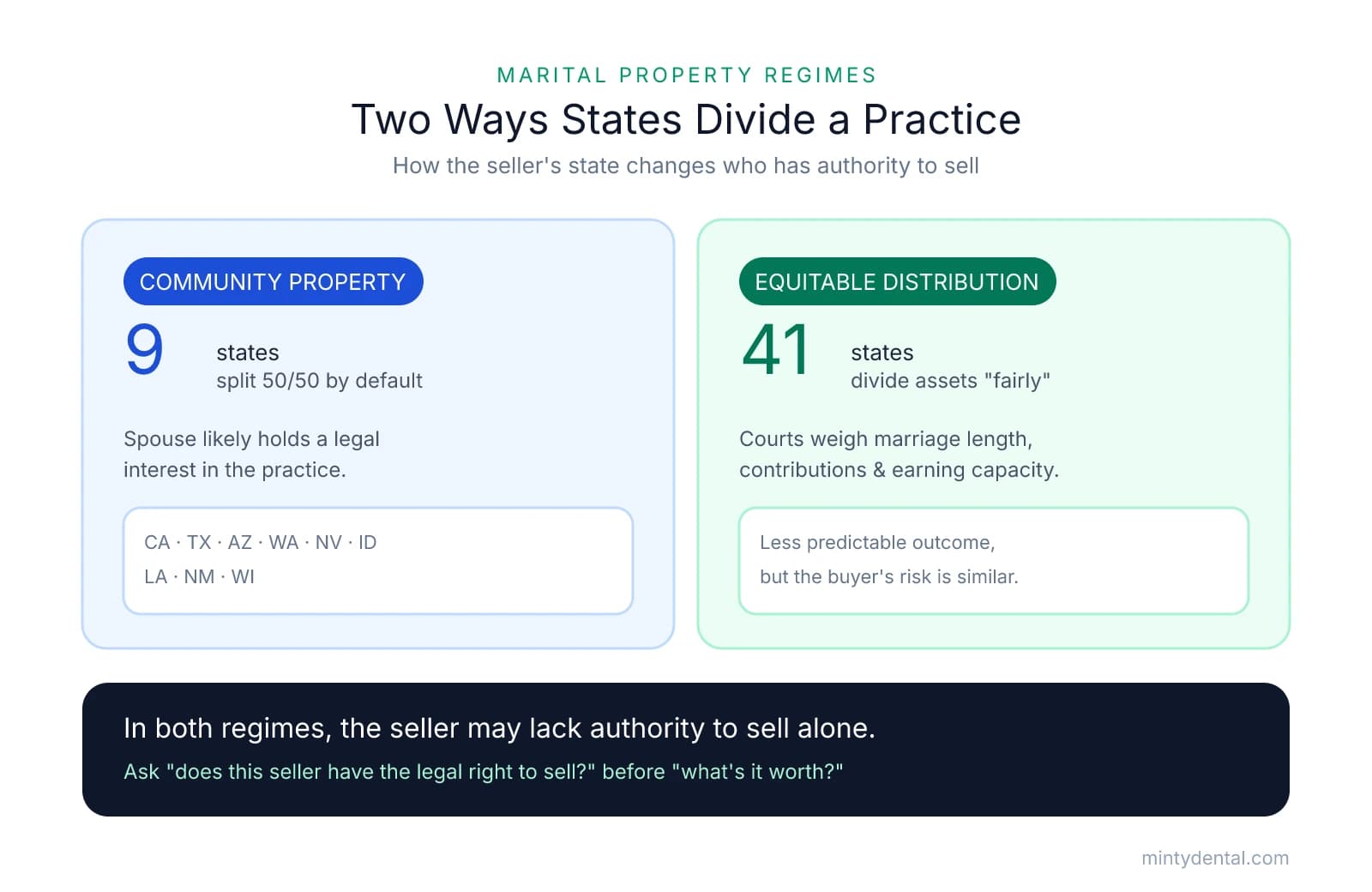
The scale of the issue is worth understanding upfront. According to Dental Economics, about one in four dentists has been or will be divorced — and in those cases, the practice is typically the largest single asset at issue. That combination — high frequency, high stakes — means buyers will encounter this situation. Knowing how to read it clearly is a practical skill, not an edge case.
The two property regimes every buyer should understand:
Community property states — California, Texas, Arizona, Washington, Nevada, Idaho, Louisiana, New Mexico, and Wisconsin — treat most assets acquired during the marriage as jointly owned, split 50/50 by default. If the seller built the practice while married, the non-dentist spouse likely holds a legal interest in it, regardless of whose name is on the LLC or the bank account.
Equitable distribution states — the remaining 41 states — divide marital assets "fairly" rather than equally. Courts weigh factors like the length of the marriage, each spouse's financial contributions, and earning capacity. The outcome is less predictable than a 50/50 split, but the core risk for a buyer is the same: the seller may not have unilateral authority to transfer the practice.
In either regime, a practice built during the marriage is almost certainly a marital asset. That's the starting assumption — and it shifts the first question a buyer should ask from "what's the practice worth?" to "does this seller have the legal right to sell?"
That question matters because courts can issue temporary restraining orders (TROs) or automatic injunctions that prohibit either spouse from transferring, encumbering, or disposing of marital assets while proceedings are pending. A sale completed in violation of an undisclosed TRO isn't just legally complicated — it can be voided entirely, leaving a buyer without the practice and in the middle of litigation they didn't sign up for.
The good news is that each of these risks is identifiable and manageable with the right legal support. Having your own attorney — one who isn't shared with the seller or the broker — is where that process starts. The sections that follow break down exactly what to verify, what contract language to require, and how to assess whether a divorce-involved deal is worth pursuing.
The Valuation Problem: Why Divorce Appraisals and Market Appraisals Diverge
Once you've confirmed the seller has legal authority to sell, the next question is whether the number they're asking reflects what the practice is actually worth — or what the divorce settlement needed it to be worth.
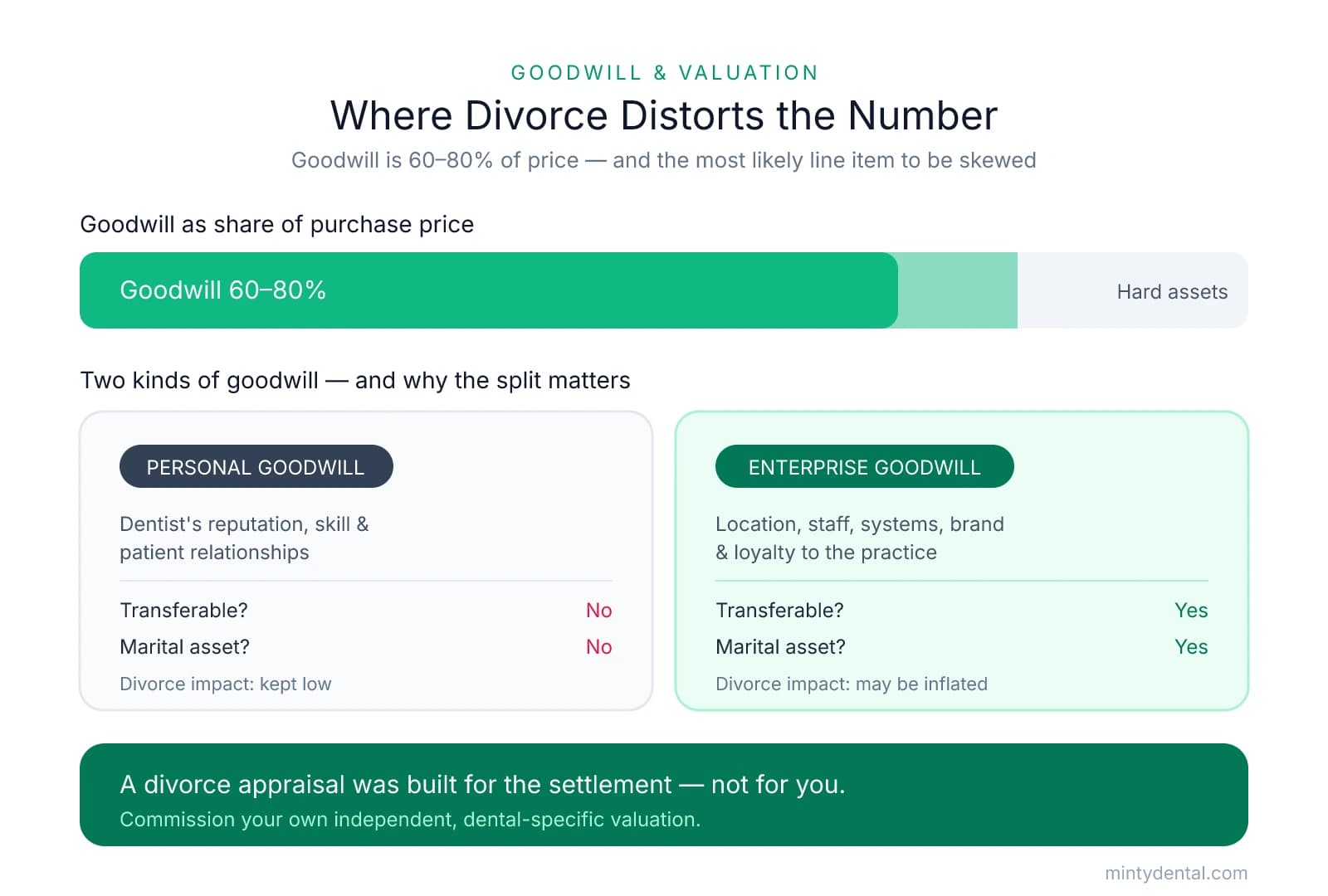
These are often different figures, and understanding why starts with goodwill.
According to US Dental Practices, goodwill typically represents 60–80% of a dental practice's total purchase price — making it the single highest-stakes line item in any acquisition, and in a divorce-involved sale, the most likely to be distorted.
Why the goodwill split matters to you as a buyer:
Not all goodwill is the same, and the distinction becomes critical in divorce proceedings:
| Personal Goodwill | Enterprise Goodwill | |
|---|---|---|
| What it represents | The dentist's individual reputation, clinical skill, and patient relationships | Location, staff, systems, brand, and patient loyalty to the practice itself |
| Transferable to a buyer? | No | Yes |
| Marital asset? | No — excluded in most equitable distribution states | Yes — divisible in divorce proceedings |
| Divorce valuation impact | Kept low to reduce the dentist's exposure | May be inflated to maximize the non-dentist spouse's payout |
As Dental Products Report explains, in equitable distribution states, personal goodwill is not considered a marital asset — it belongs to the dentist. Enterprise goodwill, however, is marital property and subject to division. That creates a financial incentive in divorce proceedings to characterize as much value as possible as enterprise goodwill, since that's the pool the non-dentist spouse can claim from.
The result: a divorce appraisal may assign an inflated enterprise goodwill figure that serves the settlement — and that number can quietly anchor the asking price a buyer sees. The reverse also happens: sellers under significant financial pressure sometimes accept below-market prices just to close quickly and access liquidity. Both distortions are real, and neither reflects fair market value.
The practical implication is straightforward: any valuation that emerged from divorce proceedings was built for a different purpose, using a different methodology and often a different valuation date than a market sale requires. Commissioning your own independent appraisal — from a dental-specific valuator with no connection to the divorce — is the clearest way to establish what the practice is actually worth to you. Given that goodwill allocation also carries significant tax implications, understanding the tax treatment of goodwill in your purchase agreement is worth working through in parallel with the valuation itself.
Due Diligence Questions to Ask When the Seller Is Divorcing
With the valuation risks in focus, the next step is building a due diligence checklist that accounts for the specific variables a seller's divorce introduces. These aren't accusations — they're the same questions any careful buyer would ask once they understand how divorce changes the transaction. Work through them systematically with your attorney before moving past the LOI.
1. Confirm the seller's legal authority to sell
Ask the seller's attorney to provide written confirmation that no TRO, automatic injunction, or court order restricts the transfer of the practice. This is a threshold requirement, not a courtesy request. Your own attorney should independently verify this through a court records search rather than relying solely on the seller's representation. In community property states, also confirm whether the non-dentist spouse is required to co-sign the purchase agreement or provide written consent for the sale to be legally valid.
2. Determine where the divorce actually stands
The risk profile of a divorce-involved deal shifts significantly depending on the proceedings' current status:
- Finalized divorce: Lowest risk. Division of the practice has been settled, and the seller's authority to transfer is typically clear.
- Mediation or negotiated settlement: Moderate risk. A deal is taking shape, but terms can still shift — and a sale may need to be structured around the settlement timeline.
- Active litigation: Highest risk. Court timelines are unpredictable, contested proceedings can stall or void a sale, and a judge can intervene in ways neither party anticipated.
Get a straight answer on this early. "We're working through it" is not a status — it's a flag.
3. Understand the non-dentist spouse's position
Does the spouse know the practice is being sold? Do they consent to it? In community property states, their legal interest may make that consent a requirement, not a formality. Even in equitable distribution states, a spouse who objects can create complications that delay or derail closing. Sellers who are vague about their spouse's awareness rarely resolve that vagueness in the buyer's favor.
4. Request and independently review any divorce-related appraisals
If the practice was appraised as part of the divorce proceedings, request a copy — then commission your own appraisal from a dental-specific valuator with no connection to the divorce. As the previous section covered, divorce valuations serve a different purpose than market valuations and shouldn't be used as a proxy for what you should pay.
5. Assess whether financial stress is affecting practice operations
A seller navigating divorce proceedings may be distracted, financially pressured, or both. Between LOI and closing, watch for declining collections trends, staff turnover, deferred equipment maintenance, or reduced clinical hours. Request updated financials at closing — not just the statements from the due diligence package — to confirm the practice hasn't materially changed.
6. Build timeline buffers into your LOI and financing structure
The Benjamin Ross Group explicitly identifies a seller's divorce as one of the top factors that extend timelines and cause deals to collapse. Build realistic contingency windows into your LOI, and have a candid conversation with your lender about what happens if closing slips by 30–60 days.
One protection many buyers overlook in these deals is structuring the seller's post-closing transition obligations in writing — with defined responsibilities and timelines. A seller managing a personal crisis may be less available than expected after closing, and a well-drafted seller employment agreement is often what keeps patient retention on track when circumstances make the seller less present than planned.
Protecting Yourself in the Purchase Agreement — and Deciding Whether to Proceed
The due diligence work covered in the previous section tells you what you're dealing with. The purchase agreement is where you translate that knowledge into legal protection. In a divorce-adjacent sale, a few provisions matter more than they would in a standard transaction.
Seller representations and warranties should explicitly state that the seller has full legal authority to sell the practice, that no court order restricts the transfer, and that the practice is not subject to any pending legal proceedings that would affect the sale. These representations should survive closing and be backed by indemnification — meaning if a hidden TRO or undisclosed spousal claim surfaces after closing, the seller bears the financial consequence, not you. As Blackburn Lawyers notes, negotiating the scope of representations and warranties is one of the most important — and most overlooked — aspects of any dental practice purchase.
Spousal consent language varies by state, but the principle is consistent: the non-dentist spouse's legal interest in the practice needs to be formally resolved before closing. In community property states, the clearest protection is requiring the spouse to co-sign the purchase agreement or provide a written consent and release. In equitable distribution states, your attorney should review the divorce decree or settlement agreement to confirm it explicitly authorizes the sale — not just that a settlement exists, but that the practice transfer is addressed within it.
A closing condition tied to family law clearance is worth adding in most divorce-involved deals. Structuring the agreement so that closing cannot occur until the seller provides written confirmation from their family law attorney that the transaction is legally permitted gives you a documented checkpoint — and a clean exit if that confirmation never arrives.
Termination rights and earnest money protections deserve careful attention here. Divorce-adjacent deals carry meaningfully elevated fall-through risk, and buyers who discover title or authority problems at closing without pre-negotiated exit rights can find themselves in a difficult position. Tying earnest money refund provisions explicitly to the seller's inability to deliver clean title or legal authority to sell is a reasonable ask — and one that a seller with a clean situation shouldn't resist.
Having your own attorney who understands both dental practice transactions and the family law overlay is what makes these provisions enforceable rather than aspirational.
When to proceed — and when to walk:
| Proceed with confidence when... | Exercise caution or walk away when... |
|---|---|
| Divorce is finalized or settlement is near-final | Active contested litigation is ongoing |
| Seller has independent counsel coordinating with family law attorney | Seller is evasive about divorce status or spouse's awareness |
| Non-dentist spouse is cooperative and documented | No spousal consent in a community property state |
| Practice financials are clean and stable | Collections or operations show recent deterioration |
A motivated seller in a divorce situation can represent a genuine opportunity — sometimes the most favorable pricing and terms come from sellers who need to move quickly and cleanly. The buyers who capture that opportunity are the ones who've done the legal and financial verification work before signing, not after.
Sources & References
The data and claims in this article are drawn from the following sources. We prioritize government data, peer-reviewed research, and established industry publications to ensure accuracy.
- When dentists divorce: Navigating the complexities of ...— www.dentaleconomics.comIndustry
- Dental Practice Goodwill: How It's Valued and Why It Matters— usdentalpractices.comIndustry
- Understanding Equitable Distribution, Community Property, and Goodwill ...— dentalproductsreport.comIndustry
- How Time Can Kill a Deal When Trying to Sell Your Business— benjaminrossgroup.comIndustry
- Dental Practice Purchase: What Should be in the Purchase and Sale ...— blackburnlawyers.caIndustry
Ready to navigate a complex dental practice acquisition?
Buying a practice during a seller's divorce involves unique legal and financial considerations. Minty's acquisition experts guide you through every step of the process, from initial evaluation to closing, ensuring you understand all complications and protect your investment.