Goodwill Allocation in a Dental Practice Purchase: Tax Impact

Co-Founder, Minty Dental

In Summary
- Purchase price allocation (PPA) is an IRS-required process that divides a practice's total purchase price across distinct asset classes — and it directly determines how much you can deduct, and how fast
- Goodwill typically represents 75–90% of a dental practice's purchase price, making it the dominant line item in most allocations
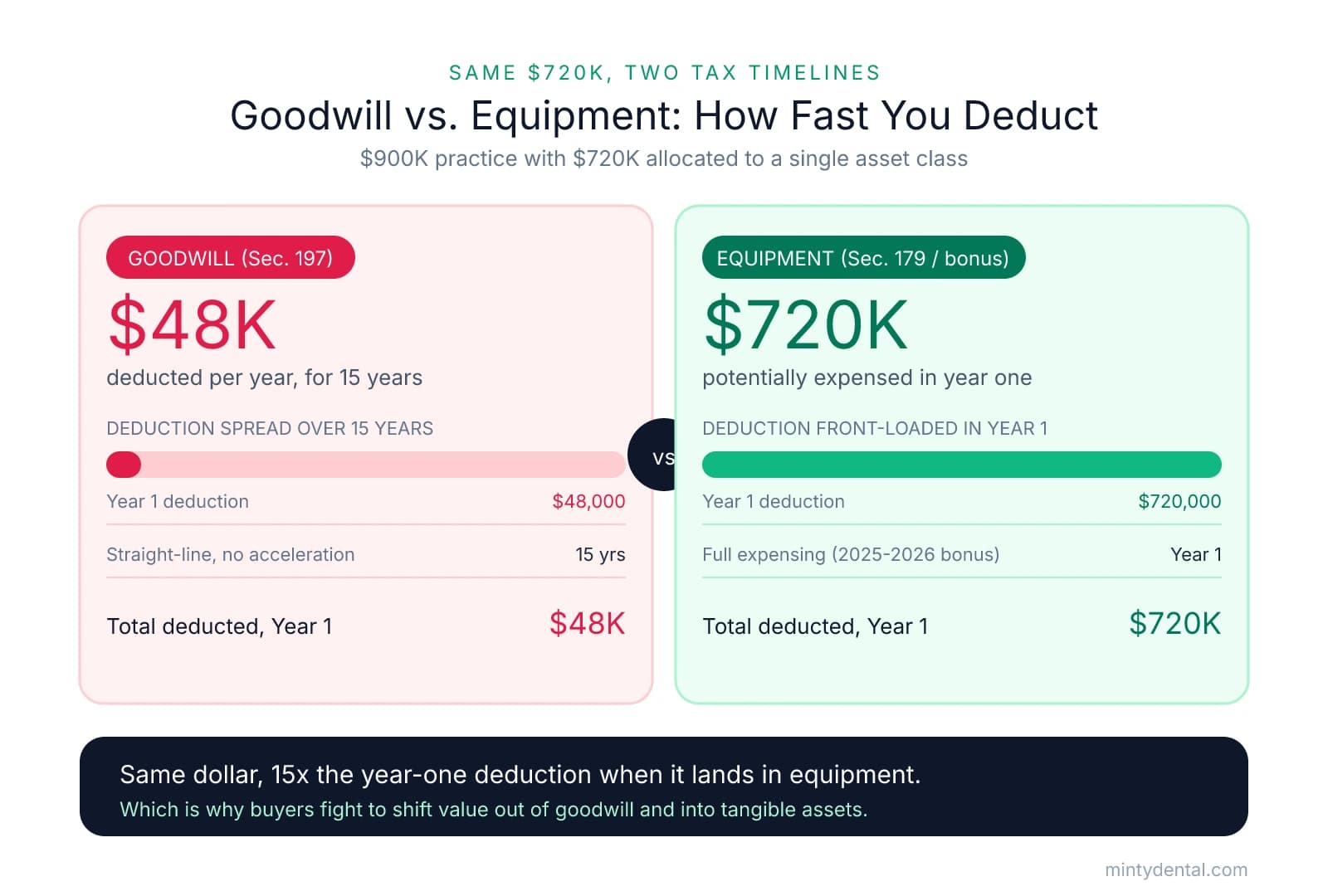
- Under IRC Section 197, goodwill must be amortized straight-line over 15 years — on a $900,000 practice with $720,000 allocated to goodwill, that's $48,000/year in deductions, not a lump sum
- Equipment and supplies can often be fully expensed in year one through Section 179 or bonus depreciation — making their allocation far more valuable to a buyer in the short term
- Both buyer and seller must file IRS Form 8594 reporting the same allocation — making this a negotiated agreement, not a number either party sets unilaterally
The Allocation Behind the Price Tag Shapes Your Tax Bill for 15 Years
Purchase price allocation (PPA) is the IRS-required process of dividing a practice's total purchase price across distinct asset classes — equipment, supplies, patient records, non-compete agreements, and goodwill — each of which is deducted on its own schedule. It isn't optional, and neither party can set the numbers arbitrarily. Both buyer and seller must file IRS Form 8594 reporting a matching allocation with their federal tax returns.
Most dental practice transactions close as asset sales rather than stock sales. That structure gives buyers a stepped-up basis in each asset class — meaning you can begin depreciating or amortizing the assets at their full purchase price, not the seller's original cost. That's a meaningful advantage, but only if the allocation is structured to maximize it.
Here's where the tension lives: goodwill is almost always the largest line item. According to Wickens Law / Dental Economics, goodwill represents 75% to 90% of the purchase price in a typical dental practice asset sale. CBIZ's healthcare advisory team puts the range at 60–80%. Either way, goodwill dominates the allocation — and it's the slowest asset class to deduct.
Under IRC Section 197, goodwill acquired after August 10, 1993 must be amortized straight-line over 15 years. There's no accelerating it, no front-loading it. On a $900,000 practice where $720,000 is allocated to goodwill, the annual amortization deduction is $48,000 — every year, for 15 years.
The same $720,000 in equipment tells a very different story.
| Asset Class | Typical Deduction Method | Deduction Timeline |
|---|---|---|
| Goodwill | IRC Section 197 amortization | Straight-line over 15 years |
| Patient records / intangibles | IRC Section 197 amortization | Straight-line over 15 years |
| Non-compete agreements | IRC Section 197 amortization | Straight-line over 15 years |
| Equipment & fixtures | MACRS depreciation | 5–7 years (standard) |
| Equipment & fixtures | Section 179 / bonus depreciation | Potentially year one |
| Supplies & inventory | Ordinary business expense | Year one |
Equipment and supplies sit in faster-depreciating classes. Section 179 and bonus depreciation — when available — can allow full expensing in the year of purchase, turning that allocation into an immediate tax offset against practice income. A buyer who negotiates more of the purchase price into equipment rather than goodwill can potentially deduct hundreds of thousands of dollars in year one instead of spreading it across a decade and a half.
That asymmetry is why the allocation deserves the same attention as the purchase price itself. If you want to model how different allocation splits affect your actual after-tax deductions year by year, the PPA calculator can walk through the numbers before you get to the negotiating table.
The allocation isn't paperwork that follows the deal — in many ways, it is the deal.
Why Buyers and Sellers Want Opposite Allocations — and What the IRS Allows
That tension has a structural explanation. Buyer and seller tax interests point in genuinely opposite directions, and understanding why helps you negotiate from a position of clarity rather than frustration.
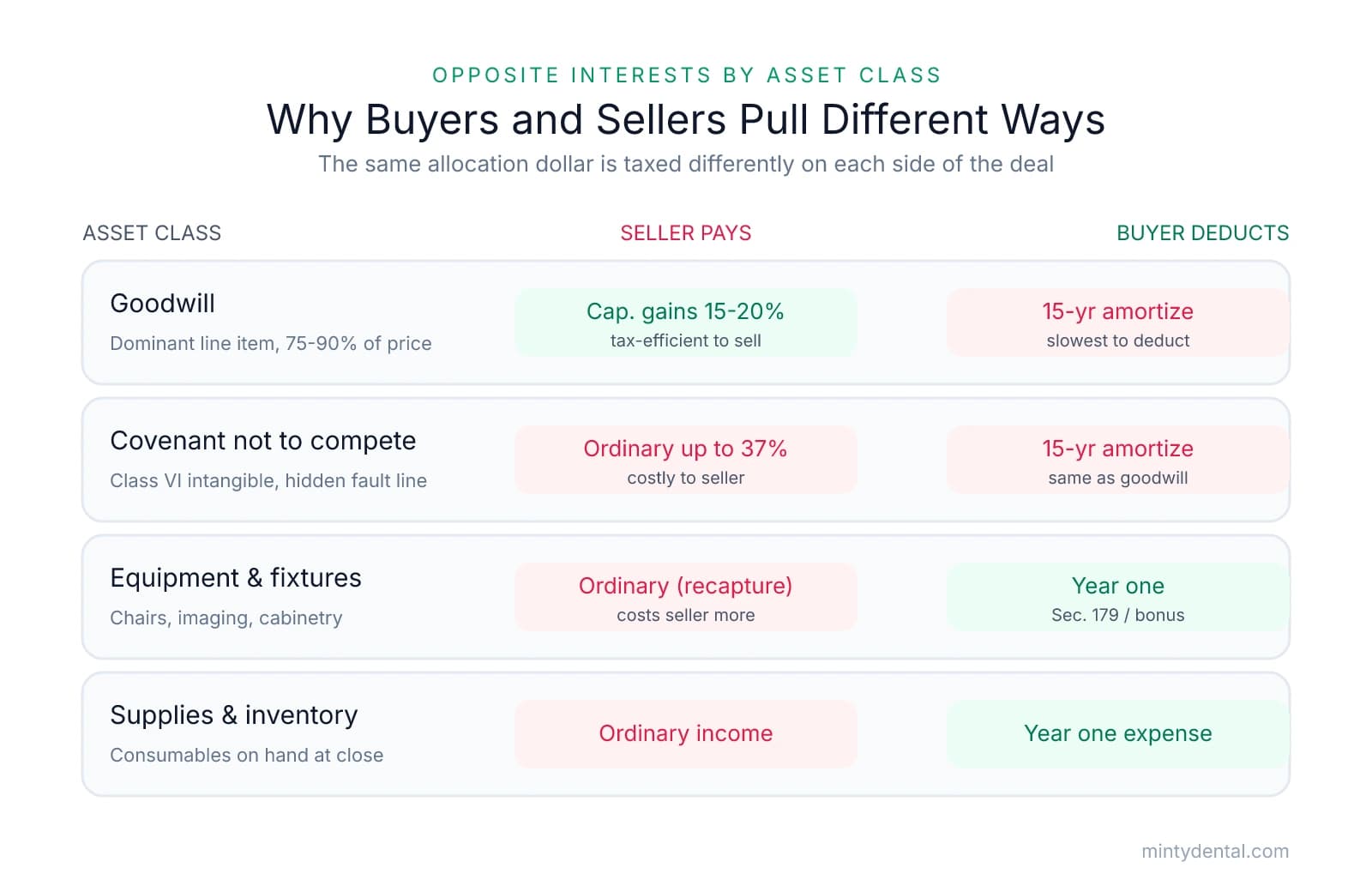
For sellers, goodwill is the most tax-efficient asset class to sell. Gains on goodwill are taxed at long-term capital gains rates — typically 15–20% — rather than ordinary income rates that can reach 37%. On a $700,000 goodwill allocation, the difference can represent $100,000 or more in additional tax. Naturally, sellers want as much of the purchase price as possible characterized as goodwill.
For buyers, goodwill is the least efficient asset class to own. As covered above, it amortizes straight-line over 15 years with no acceleration. Equipment and supplies, by contrast, can often be fully expensed in year one — turning the same dollar of purchase price into an immediate deduction rather than a trickle over a decade and a half.
The table below captures how the same asset class lands differently depending on which side of the transaction you're on:
| Asset Class | Seller's Tax Treatment | Buyer's Deduction Timeline |
|---|---|---|
| Goodwill | Long-term capital gains (15–20%) | 15-year amortization (Section 197) |
| Covenant not to compete | Ordinary income (up to 37%) | 15-year amortization (Section 197) |
| Equipment & fixtures | Ordinary income (depreciation recapture) | Year one via Section 179 / bonus depreciation |
| Supplies & inventory | Ordinary income | Year one expense |
The Covenant Not to Compete: A Hidden Fault Line
One pattern worth paying attention to is how covenants not to compete get characterized. Under Section 197, non-compete agreements are Class VI intangibles — amortized over 15 years, the same schedule as goodwill. But the tax treatment for the seller is very different: proceeds allocated to a non-compete are taxed as ordinary income, not capital gains.
That asymmetry creates a predictable dynamic. Sellers generally prefer to characterize value as goodwill rather than a non-compete, because the tax cost is meaningfully lower. Buyers are often indifferent between the two — both amortize on the same 15-year schedule. Understanding this gives buyers a potential concession to offer in exchange for movement elsewhere in the allocation.
The seller employment or transition agreement is a related consideration — how the post-closing seller role is structured can affect how compensation versus goodwill is characterized, which has its own tax implications worth reviewing with your CPA.
What the IRS Actually Allows: The Residual Method
Neither party can assign values arbitrarily. Under Section 1060 of the Internal Revenue Code, the IRS requires both buyer and seller to use the residual method: tangible assets are valued first at fair market value, moving through a prescribed Class I through Class VII hierarchy, with goodwill landing last as whatever remains after all other classes are accounted for.
As the Michigan Dental Association notes, the allocation should be negotiated in the purchase agreement — not the letter of intent. Including allocation terms in the LOI is premature and potentially binding before either party has done the tax analysis.
Critically, both parties must file matching Form 8594 allocations with their federal tax returns. Mismatched filings are a known audit trigger — and the IRS will scrutinize both returns when the numbers don't align. That mutual exposure is actually useful leverage: it creates a shared incentive to agree on an allocation both parties can defend.
How to Approach the Allocation Negotiation as a Buyer
The allocation is often presented by the seller's broker or CPA as a settled matter — a reasonable-looking breakdown that arrives with the purchase agreement, formatted as if it were standard. Many buyers accept it without question. That's understandable: by the time the purchase agreement lands, most buyers are focused on financing, staffing, and the transition itself. But accepting the seller's proposed allocation without pushback is one of the more costly oversights in a dental practice acquisition.
A practical framework for approaching it differently:
Step 1: Treat the allocation as a negotiating item from the start
Raise allocation in your initial conversations with the seller's team — not after the purchase agreement is drafted. The allocation belongs in the purchase agreement, not the LOI, but that doesn't mean waiting until the agreement arrives to think about it. Coming to the table with a position signals that you've done the analysis and aren't simply accepting whatever's proposed.
Step 2: Commission an independent equipment appraisal
An independent appraisal establishes fair market value for tangible assets — dental chairs, imaging equipment, instruments, cabinetry — based on age, condition, and replacement cost. Because the IRS residual method requires goodwill to be valued last, a higher defensible equipment value directly reduces the goodwill residual. As Dental CPAs notes, goodwill is simply "the difference" after all other assets are valued — which means the equipment number anchors everything above it.
Step 3: Model the year-one impact of shifting value into equipment
With bonus depreciation restored to 100% for 2025 and 2026 under the One Big Beautiful Bill, equipment allocated in a purchase can potentially be fully expensed in year one, per IRS Publication 946. Even a $50,000 shift from goodwill to equipment — at a 37% marginal rate — produces roughly $18,500 in additional first-year tax savings compared to the same amount amortized over 15 years. The PPA calculator can help you model these scenarios before you negotiate.
Step 4: Understand the seller's constraint — and what you can offer
Sellers pay ordinary income tax on equipment gains but capital gains rates on goodwill. Shifting value to equipment costs the seller real money. That's a reason to structure a trade, not abandon the negotiation. A slightly higher total price, favorable payment terms, or flexibility on another deal point may be enough to make the shift worthwhile for both sides.
Step 5: Account for depreciation recapture before going aggressive
If you later sell the practice, any depreciation taken on equipment is recaptured at ordinary income rates under IRS recapture rules. An aggressive equipment allocation that saves taxes today can create a meaningful liability at exit. Whether that tradeoff makes sense depends on your expected hold period and exit structure — which is exactly why a dental-specific CPA should model both scenarios before you sign, not after closing when the numbers are locked.
What to Do Before You Sign: A Pre-Closing Allocation Checklist
The allocation negotiation is one of the few places in a dental practice acquisition where you can meaningfully improve your financial position without changing the headline price — which makes it worth starting earlier than most buyers do.
1. Confirm the deal is structured as an asset sale. Stock sales give buyers no stepped-up basis and no depreciation or amortization deductions on acquired assets. In a stock sale, you're inheriting the seller's tax basis — which may be near zero after years of depreciation. Most dental practice transactions close as asset sales, but confirm this explicitly before any other allocation work begins.
2. Request the seller's proposed allocation early — not at closing. By the time the purchase agreement lands, your leverage is largely gone. Raise allocation in early purchase agreement negotiations, when you still have room to push back. As the Michigan Dental Association's legal counsel notes, allocation belongs in the purchase agreement itself — not the LOI, and not as a post-closing afterthought.
3. Commission an independent equipment appraisal. This is the most IRS-defensible way to support a higher tangible asset allocation. Because goodwill is valued last under the residual method, a well-documented equipment appraisal directly reduces the goodwill residual — and gives you a position you can defend if the IRS ever scrutinizes the filing.
4. Have a dental-specific CPA model two or three allocation scenarios before you sign. The after-tax difference between scenarios can be substantial in years one through five. A CPA who works primarily with dental buyers will know how to stress-test equipment values, model Section 179 and bonus depreciation impact, and flag recapture exposure at exit.
5. Understand the covenant not to compete as a separate line item. Its value amortizes over 15 years — the same schedule as goodwill — but the seller pays ordinary income tax on it rather than capital gains. That asymmetry gives buyers a potential concession to offer elsewhere in the negotiation.
6. Confirm both parties will file matching Form 8594. Mismatched filings are an audit trigger. Make sure the allocation is explicitly stated in the purchase agreement — not left to be determined after closing.
One timing consideration worth modeling: buyers who plan to hold the practice long-term benefit most from goodwill's 15-year amortization, since the deductions compound steadily over time. Those who might sell within five to seven years should think carefully about depreciation recapture on equipment before pushing hard for a tangible-heavy allocation — the tax savings today can become a liability at exit.
The allocation won't change what you pay. But it will shape what that payment actually costs you, year by year, for the life of your ownership.
Sources & References
The data and claims in this article are drawn from the following sources. We prioritize government data, peer-reviewed research, and established industry publications to ensure accuracy.
- Intangibles | Internal Revenue Service— www.irs.govGovernment
- [PDF] The current status of personal goodwill— wickenslaw.comIndustry
- Understanding the Allocation of Purchase Price in a Dental Practice ...— www.cbiz.comIndustry
- Instructions for Form 8594 (11/2021) | Internal Revenue Service— www.irs.govGovernment
- Purchase Price Allocation When Selling Your Practice— www.michigandental.orgIndustry
- About Form 8594, Asset Acquisition Statement Under Section 1060— www.irs.govGovernment
- What Purchase Price Percentage Should Be Allocated To Goodwill?— dentalcpas.comIndustry
- How the OBBB Changed Depreciation Rules for Healthcare Practices— adamsbrowncpa.comIndustry
- Publication 946 (2025), How To Depreciate Property - IRS— www.irs.govGovernment
- [PDF] Purchase Price Allocation When Selling Your Practice— commons.ada.orgIndustry
Ready to navigate your dental practice acquisition?
Understanding goodwill allocation is crucial when buying a dental practice, but the process involves complex tax considerations. Minty's acquisition experts guide you through every step of the purchase, ensuring proper asset allocation and tax optimization from search to closing.