Buying a Dental Practice When the Seller Owns the Building

Co-Founder, Minty Dental

In Summary
- When a seller owns the office building, buyers face two simultaneous decisions: the practice purchase and the real estate — and how you handle one directly affects the other
- Three paths are available: buy the practice and building together, lease from the seller-turned-landlord, or lease with a negotiated option to purchase later
- Many dentists retain their building as a retirement income stream — but that preference doesn't eliminate your leverage as a buyer
- The right path depends on your cash position, the practice's cash flow, and local real estate market conditions — there's no universal answer
- Lease terms, rent escalation clauses, and any future purchase rights are all negotiable — getting these right matters as much as the practice price itself
The Building Question Changes the Entire Deal Structure
Most dental acquisitions come down to one core question: is this practice worth buying at this price? But when the seller owns the building, a second question lands on the table at the same time — and the two are financially entangled in ways that catch many buyers off guard.
It's a common scenario. Many dentists purchase their office building early in their career and hold it for decades, treating it as a retirement asset that generates income long after they stop practicing. When it comes time to sell the practice, retaining the building as a landlord is often their preferred outcome — not because it's the only option, but because it's the one that serves their financial plan. That preference is understandable. It doesn't have to define your deal.
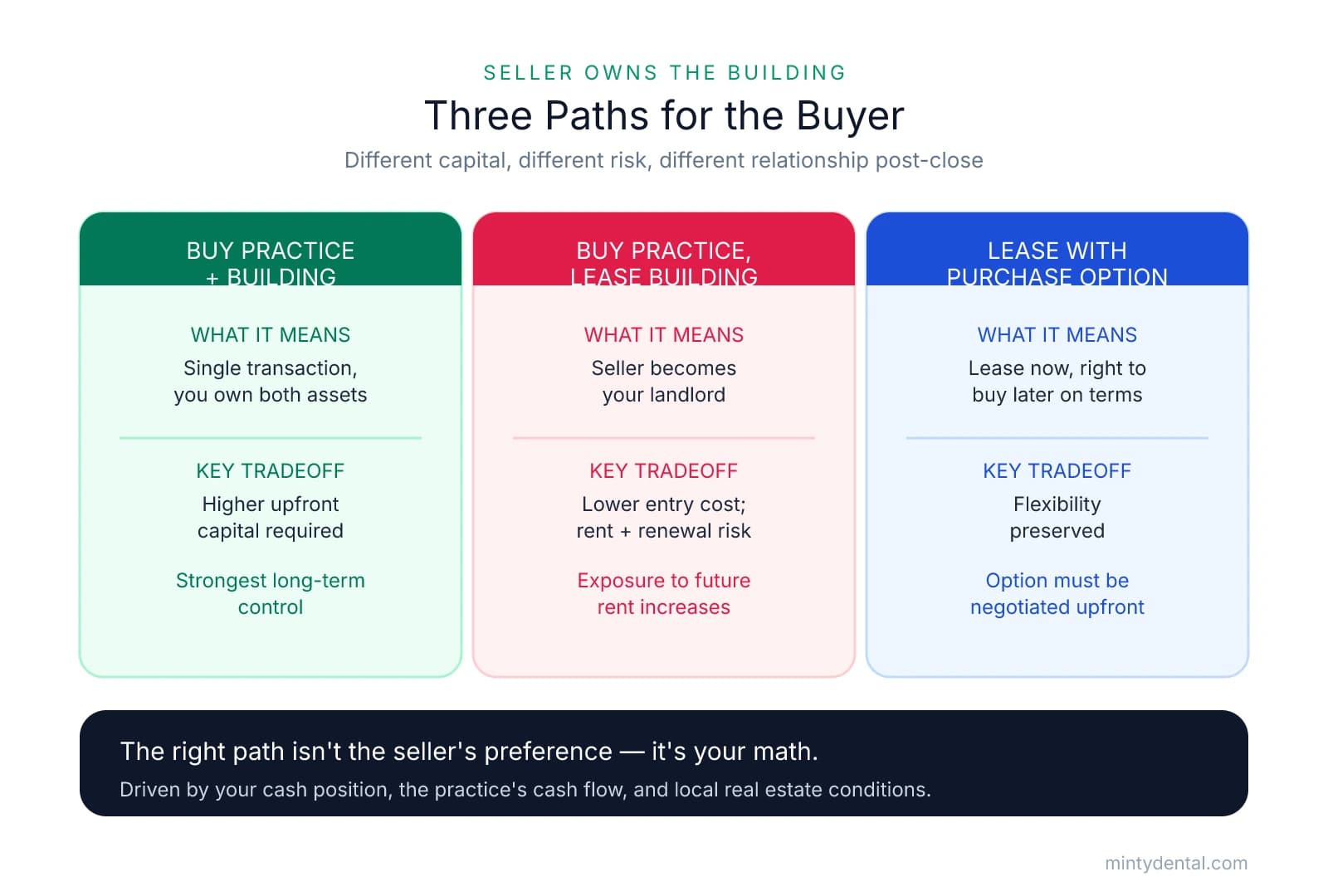
As a buyer, you're navigating three distinct paths:
| Path | What It Means | Key Tradeoff |
|---|---|---|
| Buy practice + building | Single transaction, you own both assets | Higher upfront capital required; stronger long-term control |
| Buy practice, lease building | Seller becomes your landlord | Lower entry cost; exposure to rent increases and lease renewal risk |
| Buy practice, lease with purchase option | Lease now, right to buy later at defined terms | Flexibility preserved; option must be negotiated carefully upfront |
Each path has a different capital requirement, a different risk profile, and a different relationship with the seller post-close. What tends to determine the right choice isn't the seller's preference — it's the intersection of your available cash, the practice's ability to service debt, and what the local commercial real estate market looks like.
A pattern worth paying attention to: buyers who treat the real estate question as secondary often find themselves locked into lease terms that constrain the practice's value down the road. Rent escalation clauses, short initial terms, and missing renewal options are the kinds of details that look minor at signing and become significant at year five. Understanding how lease assignments and terms transfer in a dental acquisition is worth doing before you're deep into negotiations.
The sections that follow break down each path — what it costs, what it protects, and what to negotiate regardless of which direction you go.
Buying the Building: When It Makes Sense and What It Costs
Owning the building alongside the practice is the highest-control outcome available in this scenario. Every mortgage payment builds equity in an asset you'll eventually own outright — rather than funding a landlord's retirement. You also eliminate rent escalation risk, gain full control over renovations, and create a second wealth-building vehicle that operates independently of the practice's goodwill value.
But the upside comes with a real constraint: buying the real estate adds a second layer of debt, and lenders will evaluate whether the practice's cash flow can support both.
The Financing Decision: Two Main Paths
Most buyers financing a combined practice-plus-real-estate deal will encounter two options:
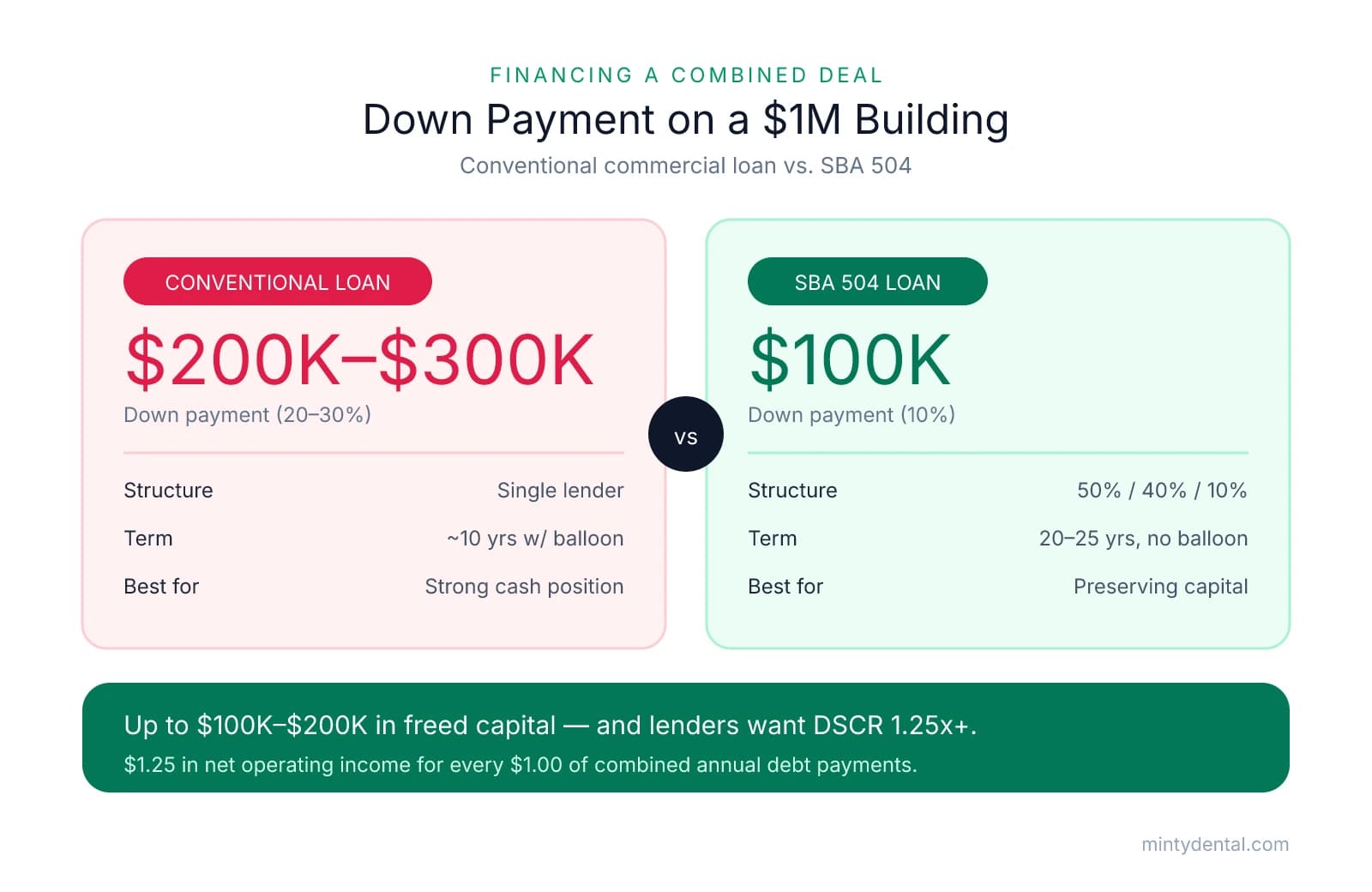
| Conventional Commercial Loan | SBA 504 Loan | |
|---|---|---|
| Down payment | 20–30% of real estate value | 10% for established practices |
| Loan structure | Single lender | 50% conventional / 40% CDC-SBA / 10% borrower |
| Rate type | Fixed or variable | Fixed rate on SBA portion |
| Term | Often 10 years with balloon | 20 or 25 years, no balloon |
| Best for | Strong cash position, simpler closing | Preserving working capital |
On a $1M building, that down payment difference — $100,000 versus $200,000–$300,000 — is meaningful capital that could otherwise fund working capital, equipment, or early-year cash flow cushion.
SBA 504 structure: The SBA 504 program is a two-loan arrangement: a conventional lender covers 50% in first position, a Certified Development Company (CDC) provides 40% at a fixed rate with 20- or 25-year terms, and you contribute 10% as the borrower. There are no balloon payments on the SBA portion, which makes long-term cash flow planning more predictable. A deeper comparison of how these structures play out for dental buyers is worth reviewing in the SBA vs. conventional loan breakdown before you commit to a path.
Entity Structure and Tax Efficiency
Most CPAs recommend holding the real estate in a separate LLC that leases the space back to your dental practice entity. This structure — sometimes called an operating company / real estate company (OpCo/PropCo) split — creates liability separation between the clinical business and the property, allows for cleaner tax treatment on each entity, and gives you exit flexibility: you can sell the practice later without being forced to sell the building.
One tax advantage worth modeling early: a cost segregation study on dental-specific improvements — operatory plumbing, X-ray shielding, HVAC systems — can accelerate depreciation on those components and meaningfully reduce your tax burden in the first few years of ownership.
The Cash Flow Test You Need to Run First
Adding real estate debt increases your total debt service, and lenders typically want to see a debt service coverage ratio (DSCR) of 1.25x or better across the combined practice and real estate loans — meaning for every $1.00 in annual debt payments, the practice needs to generate at least $1.25 in net operating income.
Before committing to the combined purchase, model this out explicitly: does the practice's verified cash flow — after owner compensation, staff costs, and overhead — support both loans with enough cushion for working capital and unexpected expenses? If the numbers are tight, the SBA 504's lower down payment and longer term can improve the ratio. If they don't work at all, the lease path may be the more realistic starting point.
Leasing from the Seller: What to Negotiate Before You Sign
For many buyers, leasing from the seller is simply how the deal works out — not because it's the preferred outcome, but because the seller isn't willing to part with the building. Retaining the property as a retirement income stream is a common goal for selling dentists, and a reasonable one. What matters is that the lease you sign protects your investment in the practice with the same rigor you applied to the purchase price.
A poorly structured lease can quietly undermine everything you paid for. Here's what to negotiate before you sign.
Term Length and Renewal Options
Most dental lenders will require at least five years remaining on the lease — plus renewal options covering the majority of the loan term — before approving practice financing. As Hemmen & Associates notes, the standard structure is a 5-year initial term with multiple 5-year renewal options. A short lease with no renewal rights isn't just a business risk — it can kill your financing before the deal closes.
When reviewing renewal terms, pay attention to who controls them. Options that require landlord approval to exercise aren't true options. The renewal right should be yours to invoke unilaterally.
Rent at Market Rate
Above-market rent inflates your overhead and reduces the practice's true cash flow — which affects both day-to-day profitability and resale value. Pull comparable commercial lease rates for dental space in the area before accepting the seller's proposed figure. If the rent is materially above market, that gap is a negotiating point, not a fixed cost.
Understanding NNN Leases
Triple net leases are common in dental real estate. Under an NNN structure, you pay a base rent plus a prorated share of property taxes, building insurance, and maintenance costs. As Helsell Fetterman's dental lease guide explains, comparing base rent figures without accounting for lease type can be misleading — the all-in cost is what matters for overhead analysis. Get an estimate of the NNN components, not just the base rate.
Assignment Rights
If you ever sell the practice, the lease must transfer to your buyer. Without a clear assignment clause, a future sale can stall — or fall apart entirely — because the seller-turned-landlord has leverage to block or renegotiate. Understanding how lease assignments work in dental acquisitions is worth doing before you're in the middle of a transaction where this becomes a problem.
Right of First Refusal
A right of first refusal (ROFR) is arguably the most valuable protection available when leasing from a seller. It gives you the right to purchase the building — at a defined price or by matching any third-party offer — before the seller can sell to someone else.
Without a ROFR, the seller could sell the building to a third-party investor who raises rent, declines to renew, or redevelops the space entirely. That scenario puts your entire goodwill investment at risk: the patients, the staff, the location equity — all of it tied to a building you no longer have any claim to. When structured well, a ROFR protects both sides: you get security, and the seller retains full flexibility to sell on their timeline.
Get Independent Legal Review
The attorney reviewing your practice purchase agreement may not flag real estate-specific risks in the lease. A dental-specific attorney reviewing the lease independently — before you sign — is a separate engagement worth making. The case for hiring your own attorney applies here with particular force: the lease will govern your occupancy for a decade or more, and the terms you accept at signing are largely the terms you'll live with.
Making the Call: A Framework for the Real Estate Decision
The practice price, the lease terms, the financing structure — by this point, you've absorbed a lot of variables. What tends to help buyers move from information to decision is working through three questions in sequence, before making an offer that includes (or excludes) the real estate.
Question 1: Can the practice's cash flow support both loans?
Start with the math. Take the practice's adjusted net income — seller's discretionary earnings, verified through three years of tax returns and P&L statements — and subtract the estimated annual practice loan payment. What remains is what you have available to service real estate debt, cover working capital, and absorb the unexpected first-year expenses that most new owners underestimate.
If that remainder comfortably covers a real estate loan payment and leaves meaningful cushion, buying may be viable. If it's tight, leasing preserves cash flow flexibility during the period when you need it most — credentialing transitions, staff adjustments, and the general unpredictability of a new ownership year. Lenders will run this same analysis; running it yourself first puts you in a stronger position.
Question 2: What does the local real estate market actually look like?
A building in a high-demand suburban corridor with rising commercial rents is a meaningfully different investment than a strip-mall space in a flat or declining market. Before deciding, get a commercial real estate appraisal and understand local cap rates. If rents in the area are trending up, locking in ownership now protects you from escalating occupancy costs. If the market is soft, the lease path becomes more attractive on its own terms. It's also worth scrutinizing the physical space itself: as most lease-versus-buy analyses show, the financial outcomes often come out close — meaning location quality, visibility, and layout can tip the decision as much as the numbers do.
Question 3: Will the seller consider a lease-with-option structure?
This question is worth asking directly, and earlier than most buyers think to ask it. Some sellers will agree to lease now at market rate with a pre-agreed purchase price — or a right of first refusal — exercisable within three to five years. That structure gives you lower upfront capital requirements while preserving a defined path to ownership, and it's often the best outcome available when cash flow is tight but the building is worth owning long-term.
If you do decide to buy, engage a dental CPA before closing — not after. Modeling the entity structure, depreciation schedule, and cost segregation opportunity early can meaningfully affect your tax position in the first few years, as outlined in the previous section.
And if you decide to lease: that's not a consolation prize. For first-year owners navigating the full weight of a new acquisition, preserving cash flow is often the smarter move. The ADA's practice purchase guidance reinforces that understanding your budget constraints before closing is foundational — and the real estate decision is no exception. Owning the practice successfully first, then buying the building, is a sequence that tends to work: the real estate will still be there, and the practice's stabilized cash flow is what makes the purchase viable on your terms, not the seller's.
Sources & References
The data and claims in this article are drawn from the following sources. We prioritize government data, peer-reviewed research, and established industry publications to ensure accuracy.
- Can I Sell My Dental Practice Without Real Estate? What ...— ameriprac.comIndustry
- SBA 504 Loan for Medical and Dental Office: A Broker's ...— janover.proIndustry
- Owning the Building Behind Your Dental Practice— sassetti.comIndustry
- The Crucial Role of Office Lease Negotiations in Dental Practice Sales— hemmenassoc.comIndustry
- What Should Dentists Consider When Negotiating and Reviewing a Lease— helsell.comIndustry
- Should You Buy the Building As Well As the Practice?— www.dentalbuyeradvocates.com
- How to purchase with confidence— www.ada.orgIndustry
Ready to navigate your practice acquisition?
Buying a dental practice with real estate involves complex decisions about ownership structure and financing. Minty's acquisition experts guide you through every step—from evaluating property deals to closing—with no upfront fees.