Buying a Minority Stake in a Dental Practice: Key Risks

Co-Founder, Minty Dental

In Summary
- A dental practice minority buy-in means purchasing an undivided interest in the practice entity — not specific assets like equipment, goodwill, or patient relationships
- According to the ADA Health Policy Institute, practice ownership has declined from 84.7% in 2005 to 72.5% in 2023, pushing more dentists toward buy-in arrangements as an alternative path
- Minority ownership is structurally different from full ownership — holding less than a controlling interest affects your decision-making power, the value of your stake, your ability to exit, and your options if the partnership breaks down
- Four risk categories deserve careful evaluation before signing: control limitations, valuation discounts, illiquidity, and exit terms
- The appeal of a buy-in is real, but lower upfront capital and a familiar practice don't eliminate the structural risks that come with a minority position
A Minority Stake Isn't a Smaller Version of Ownership — It's a Different Thing Entirely
Dental practice minority buy-in defined: A minority buy-in means purchasing an undivided interest in the practice entity — not specific equipment, not the goodwill, not the patient relationships. Like a share of stock, your interest represents ownership in the whole, but entitles you to none of its individual parts.
That distinction matters more than most buyers realize at the time of signing.
The path to a buy-in has become increasingly common. According to the ADA Health Policy Institute, practice ownership has dropped from 84.7% in 2005 to 72.5% in 2023, with younger dentists attaining ownership at a notably lower rate than prior generations. As full acquisitions have become harder to access — whether due to rising valuations, student debt loads, or limited inventory — buy-in arrangements have filled the gap for many associates looking for a foothold in ownership.
The appeal is genuine. A buy-in typically requires less upfront capital than a full acquisition, comes with a patient base you already know, a team already in place, and a seller who's often willing to stay through the transition. For an associate who's spent years building relationships in a practice, it can feel like the natural next step. That instinct isn't wrong — but the buy-in path and the full acquisition path are not the same decision with different price tags.
What tends to get lost in the excitement of a specific deal is that minority ownership is structurally different from full ownership in ways that don't show up in the headline purchase price. Holding less than a controlling interest changes what you can decide unilaterally, how your stake is valued, how easily you can exit if things go sideways, and what leverage you have if the relationship with your partner deteriorates. Four risk categories sit at the center of any honest evaluation:
- Control limitations — what decisions you can and can't make without your partner's agreement
- Valuation discounts — why a minority interest is worth less per percentage point than a majority stake
- Illiquidity — how difficult it is to sell a minority interest in a closely held practice
- Exit terms — what happens when the partnership ends, and whether your agreement actually protects you
The Control Problem: What You Can't Do as a Minority Owner
Of the four risk categories, control is the one most buyers underestimate — because the limitations aren't visible in the purchase price or the ownership percentage. They live in the operating agreement.

As a minority owner, you typically cannot act unilaterally on any decision that materially affects the practice:
- Setting your own compensation (or your partner's)
- Hiring or terminating staff
- Approving major equipment purchases or capital expenditures
- Changing clinical protocols or service mix
- Accepting or rejecting a DSO acquisition offer
- Opening a second location — or closing the existing one
These aren't edge cases. They're the decisions that define how a practice runs and what it's worth.
The voting math makes this concrete. As Bruce Bryen, CPA, CVA explains on DrBicuspid.com, under an operating agreement requiring a 76% vote to approve major decisions, a 25% owner's stake carries only approximately 18% effective decision-making power on those issues. The headline ownership percentage overstates actual influence — sometimes by a significant margin.
The 50/50 problem is its own category. An equal split can feel balanced and fair, but in practice it creates two minority owners — neither of whom controls anything. Consequential disagreements over DSO affiliation, a second location, or a PPO exit don't resolve themselves through goodwill. According to dental partnership attorneys at DDS Lawyers, deadlocks among equal owners on fundamental business decisions often end in judicial dissolution or litigation rather than compromise.
When partnerships sour, majority owners have real tools available. Squeeze-out tactics — withholding distributions, capping the minority owner's compensation, excluding them from management systems, or invoking buyout provisions at below-market valuations — are documented patterns in closely held business disputes. State law protections vary dramatically: some states provide statutory oppression remedies for minority shareholders, while Delaware LLCs can contractually eliminate fiduciary duties almost entirely, leaving the minority owner with little recourse outside of what the agreement itself provides.
That last point is the frame worth carrying into any buy-in negotiation: the operating agreement is the purchase agreement. Reading it with the same scrutiny you'd apply to an asset purchase agreement — ideally with your own attorney reviewing it independently — isn't overcaution. It's the minimum.
Before signing, work through these governance questions:
- What vote threshold is required for major decisions — and how does your stake measure against it?
- Can the majority owner change your compensation or distributions without your consent?
- What happens if the majority owner receives a DSO offer you don't want to accept?
- Does the agreement include anti-dilution protections if new ownership interests are issued?
- What buyout mechanism applies if the partnership dissolves — and who determines the valuation?
- Are fiduciary duties preserved, or have they been waived or limited in the agreement?
If any of these questions don't have clear answers in the operating agreement, that's the negotiation — before you sign, not after.
The Valuation and Illiquidity Trap: What Your Stake Is Actually Worth
The control risks above are largely structural — they show up in how the practice runs day to day. The financial risks are quieter. They don't surface until you try to exit, and by then the leverage has already shifted.
Your Stake Isn't Worth What the Math Suggests
The most common miscalculation in minority buy-ins: a buyer looks at the practice's appraised value, multiplies by their ownership percentage, and treats the result as what they're buying. A 30% stake in a $1M practice must be worth $300K, right?
In practice, it isn't — and the gap can be substantial.
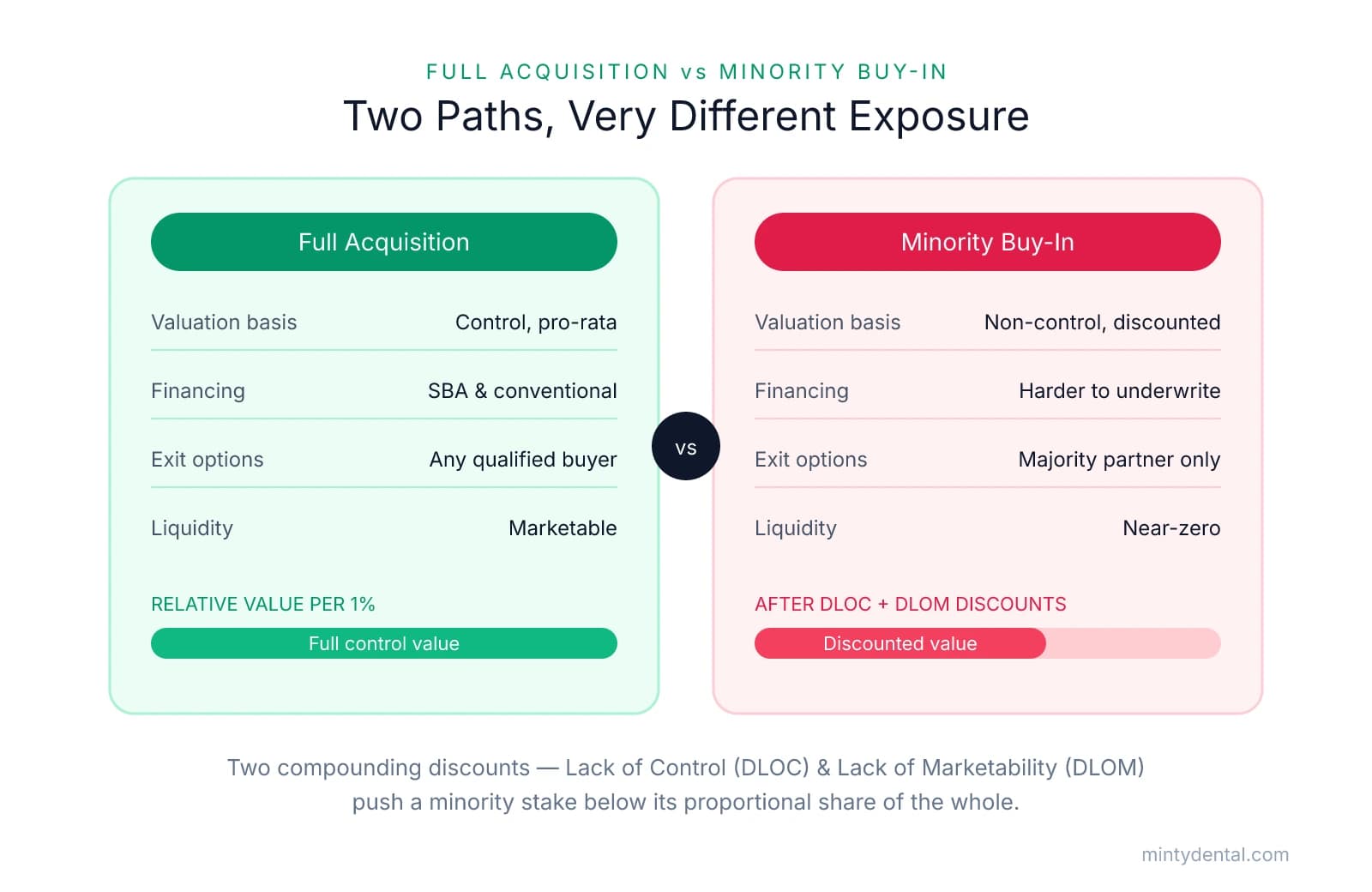
Minority interest valuation: A minority stake in a closely held dental practice is subject to two compounding discounts that reduce its standalone value below its proportional share of the whole:
- Discount for Lack of Control (DLOC) — reflects that a minority owner cannot direct the practice's operations, distributions, or strategic decisions
- Discount for Lack of Marketability (DLOM) — reflects that the interest cannot be freely sold to a third party
As Business Valuation Resources notes, most dentists entering buy-in agreements believe their interest is worth a pro-rata share of the practice's control value — and most attorneys drafting those agreements don't fully understand what "fair market value" means when applied to a noncontrolling interest. The result is that buyers often pay a control-level price for a non-control-level asset.
The Illiquidity Problem Has No Easy Workaround
A dental practice minority interest is a Closely Held Minority Interest — it cannot be freely sold to a third party, and in most cases cannot be sold at all outside the partnership. As Menlo Transitions observes, this type of interest is "not freely marketable or readily sold, if it can be sold at all."
That single fact reshapes the entire exit calculus. When you're ready to leave — whether by choice or necessity — there is effectively one buyer: your majority partner. And they know it.
| Dimension | Full Acquisition | Minority Buy-In |
|---|---|---|
| Valuation basis | Control-level, pro-rata | Non-control, discounted |
| Financing access | SBA 7(a) and conventional lenders well-suited | Harder to underwrite; proportional income stream is smaller |
| Exit options | Sell to any qualified buyer | Effectively limited to majority partner |
| Liquidity | Marketable to third parties | Near-zero outside the partnership |
Financing Is Harder Than Most Buyers Expect
Most dental practice lenders — including SBA 7(a) programs — are built around full-practice cash flow models. A minority stake produces a proportional income stream that's harder to underwrite, and lenders are often more cautious about deal structures where the borrower doesn't control the asset securing the loan.
The Buy-Sell Agreement Is Where Value Is Won or Lost
The valuation method specified in the buy-sell agreement is the most consequential clause a minority buyer will encounter — and often the least scrutinized. If the agreement specifies "fair market value" without defining the level of value — control or non-control, with or without a marketability discount — a departing minority owner may receive significantly less than they invested.
Two provisions worth negotiating before closing:
- Explicit valuation level — specify whether the buyout price is calculated at pro-rata control value, or whether DLOC and DLOM apply
- Mandatory buyout provision — without a contractual obligation for the majority partner to purchase your interest, you may have no exit at all
Without mandatory buyout language, a minority owner who wants to leave holds an illiquid, unmarketable interest with no guaranteed path to recovery.
Before You Sign: A Framework for Evaluating a Minority Buy-In Deal
The risks covered here — control limitations, valuation discounts, illiquidity, exit uncertainty — aren't reasons to walk away from every minority buy-in. They're reasons to evaluate the specific deal in front of you with the same rigor you'd apply to a full acquisition. In some ways, more rigor, because the protections that come built into a full acquisition have to be negotiated into a minority buy-in one clause at a time.
1. Governance: What does the operating agreement actually say?
Map every major decision category to the vote threshold required — and check whether your stake gives you any blocking rights on decisions that directly affect your income:
- Compensation and distribution changes — can the majority owner adjust your pay without your consent?
- Hiring and termination — do you have a voice, or just an opinion?
- Capital expenditures — is there a dollar threshold above which your approval is required?
- DSO affiliation or practice sale — can the majority owner accept an acquisition offer you oppose?
If the agreement is silent on any of these, that silence favors the majority owner.
2. Valuation and exit: What does the buy-sell agreement actually guarantee?
A buy-sell agreement that doesn't specify a valuation method isn't a protection — it's a future dispute waiting to happen. Before signing, confirm:
- The valuation method is explicitly named (income approach, market approach, or a defined formula)
- The level of value is stated — pro-rata control value, or non-control with DLOC and DLOM applied
- A mandatory buyout provision obligates the majority partner to purchase your interest if you exit
- The agreement addresses what happens if the majority owner receives a DSO acquisition offer
That last point deserves particular attention. As dental partnership attorneys note, DSO affiliation decisions are among the most common triggers for partnership disputes — and most buy-sell agreements were drafted before DSO consolidation made this a routine scenario.
3. Non-compete exposure: What are you agreeing to if this goes wrong?
Minority owners almost always sign non-compete agreements as a condition of the buy-in — and these agreements typically survive departure, regardless of why the relationship ended. Before signing, understand the geographic radius, duration, and enforceability under your state's law. A soured partnership could leave you unable to practice within a meaningful radius of your existing patient base for years, a pattern well-documented in dental partnership disputes.
The alternative worth pricing out
Many buyers assume a minority buy-in is the only realistic path to ownership — an assumption worth testing. Full practice acquisitions are often more financeable than buyers expect: lenders are structured for it, the cash flow model is cleaner, and the buyer controls the practice from day one. If you haven't seriously evaluated buying outside versus buying in, do that analysis before committing to a minority structure.
A minority buy-in can make sense when the operating agreement includes genuine blocking rights on income-affecting decisions, the buy-sell specifies valuation at the control level, a mandatory buyout provision is in place, and the majority partner has a credible path to full ownership transfer. When those conditions are met, a buy-in can be a legitimate entry into ownership.
When they're not, you're not buying a smaller version of ownership. You're buying exposure.
Sources & References
The data and claims in this article are drawn from the following sources. We prioritize government data, peer-reviewed research, and established industry publications to ensure accuracy.
- Demystifying the Practice Loan Process— ada.orgIndustry
- Discounting a practice's value for a minority interest sale or ...— drbicuspid.comNews
- Unlocking a Deadlock: How to Resolve Dental Partnership Disputes— ddslawyers.comIndustry
- Minority Oppression - The Business Divorce Law Report— thebusinessdivorcelawyer.comIndustry
- 7 Tips for Valuing—and Designing—Buy-In and Buyout ...— bvresources.comIndustry
- Should I Enter Into a Dental Practice Partnership? -— menlotransitions.comIndustry
- Resolving Ownership Disputes in Dental Partnerships— www.dentalattorneys.comIndustry
Ready to acquire a dental practice?
Minority stakes come with unique challenges, but acquiring a controlling interest in a dental practice offers clearer ownership and operational control. Minty guides you through the entire acquisition process, from identifying the right practice to closing the deal.