Why Your PMS Fee Schedule Doesn't Match What Insurance Pays

Co-Founder, Minty Dental

In Summary
- The fee schedule in your PMS is a static list someone entered manually — it has no live connection to the carrier and does not update when the carrier changes its rates.
- Three numbers should always be in sync: the contracted allowance in your signed PPO agreement, the fee loaded in your PMS, and the allowed amount on the EOB.
- When those numbers drift apart, the practice can write off more than the contract requires — giving away real revenue on every claim.
- Carriers may post fee schedule amendments on their portals or bury them in newsletters without directly notifying the practice.
- The ADA recommends reviewing contracted fee schedules annually and confirming that any agreed changes appear on subsequent EOBs.
The PMS Fee Schedule Is a Copy of Your Contract — and Copies Go Stale
Three numbers drive every PPO claim in your practice. The first is the contracted allowance: the fee your signed PPO agreement says the carrier will recognize for a given CDT code. The second is the PMS fee: whatever amount someone entered into Dentrix, Eaglesoft, or Open Dental when the plan was set up. The third is the EOB allowed amount: what the carrier actually applied when it processed the claim. When all three match, the write-off math is clean and your patient estimates are accurate. When they diverge, the practice is either over-writing-off, under-collecting, or producing estimates that don't reflect what patients actually owe at checkout.
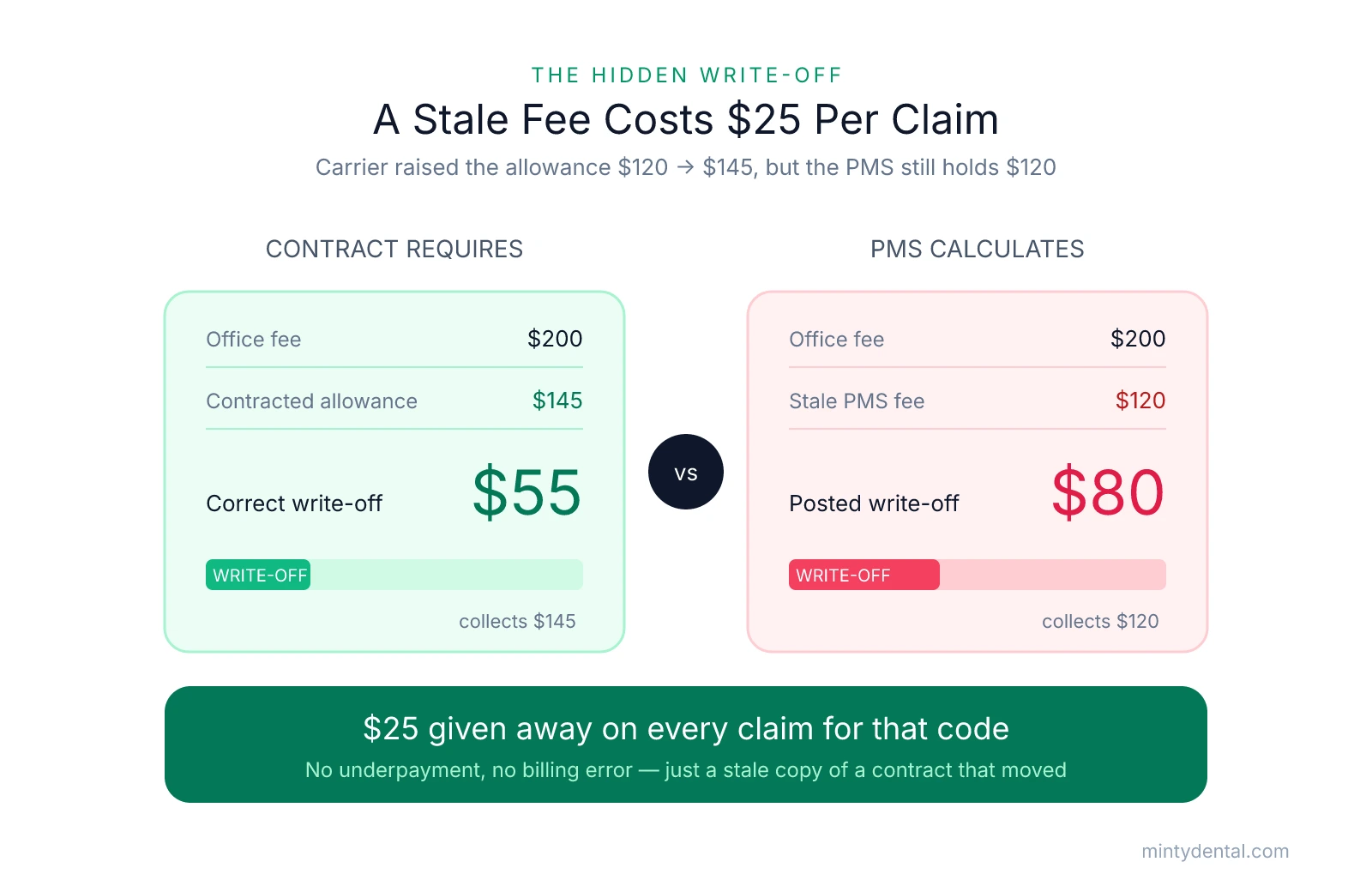
The PMS fee schedule is only as accurate as the last time someone updated it. It is not a live feed from the carrier. It's a static list, and once it's entered, it sits there until someone changes it manually. The contract it was copied from, however, does not stand still. PPO fee schedules can and do change mid-contract, and when carriers update their allowances, they may post amendments to their provider portals or include notices in newsletters rather than contacting the practice directly. If nobody on your team catches the update and loads the new fees, your software keeps calculating write-offs and patient portions from an outdated number.
Here's what that looks like in practice. Say your office fee for a procedure is $200 (hypothetical). The contracted allowance was $120 when the plan was set up, but the carrier increased it to $145 at the last amendment. Your PMS still holds $120. When your team posts the claim, they write off $80 against the PMS fee instead of the $55 the contract actually requires. That's $25 given away on every single claim for that code, with no underpayment and no billing error — just a stale copy of a contract that moved.
The ADA recommends reviewing contracted fee schedules annually and checking subsequent EOBs to confirm the carrier applied any agreed changes. That second step matters: even when you have a written amendment, the carrier's payment system doesn't always reflect it immediately, and an EOB comparison is the only way to verify the change actually went through.
A couple of warning signs are worth watching for in your own reports. If write-offs for a specific carrier are creeping up while your production with that plan stays flat, the PMS fees and the contracted allowances have likely drifted apart. The same signal appears at the code level: if the allowed amount on EOBs consistently differs from the PMS fee for the same CDT code, the copy in your software no longer matches the contract. Either direction matters. A PMS fee that's too high means your team is writing off more than the contract requires. A PMS fee that's lower than the current contracted allowance means your patient estimates and payment reviews are understating what the carrier should allow, which can obscure genuine underpayments. How often PPO fee schedules actually update varies by carrier and contract, but the gap between update cycles is exactly when stale PMS fees cause the most quiet damage.
Four Reasons the Numbers Don't Match — and How to Tell Them Apart
A PMS-vs-EOB gap isn't one problem with one fix. There are four distinct causes, and they point to different records, different corrections, and different levels of financial exposure. It's worth separating them before assuming the carrier made an error.
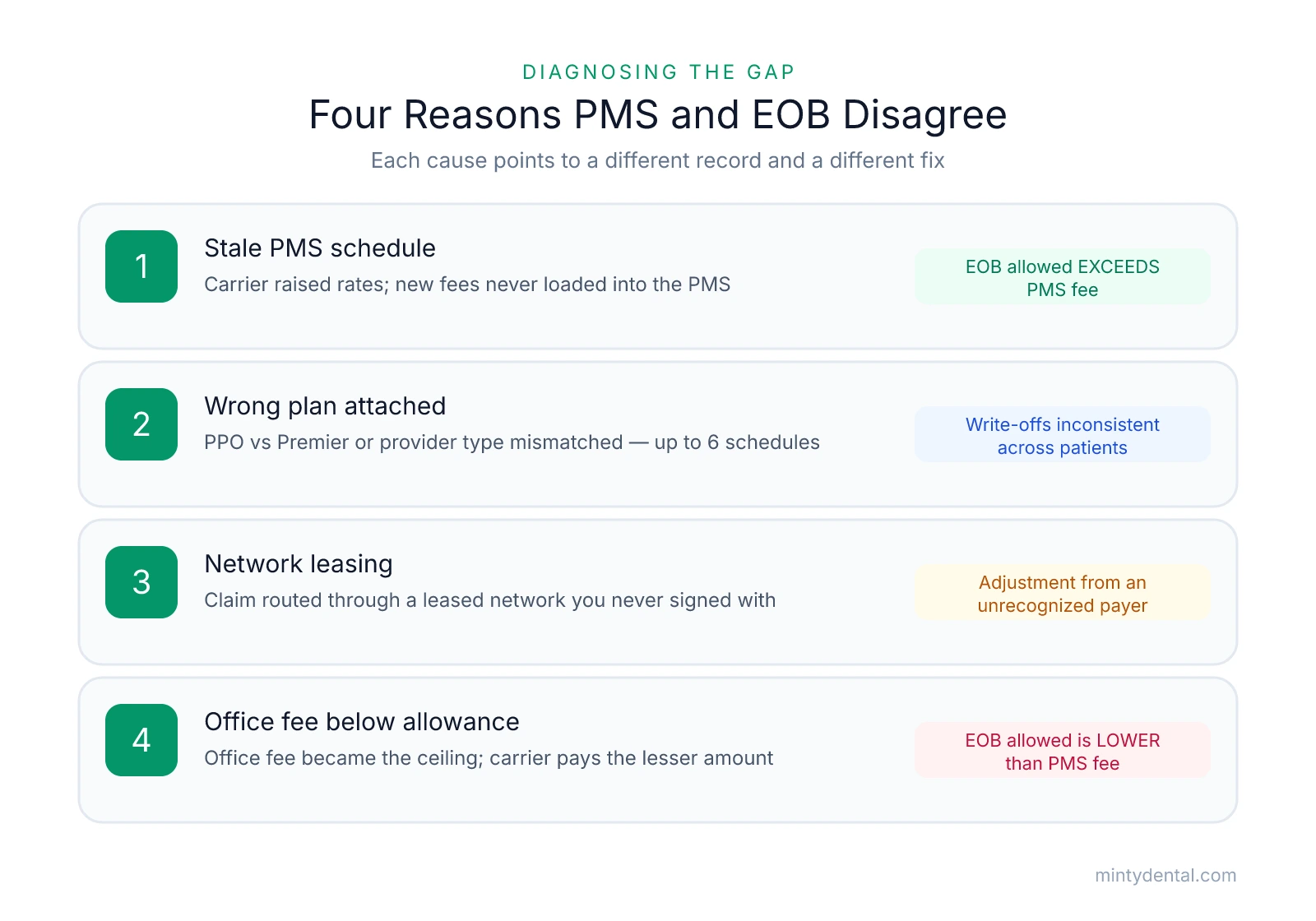
Cause 1: Stale PMS schedule. This is the most common version of the problem. The carrier updated its contracted allowances, but nobody loaded the new fees into the PMS. The result is that the EOB allowed amount comes in higher than what the PMS shows. Your team writes off to the PMS number, posts the claim as reconciled, and the practice quietly absorbs the difference. Because the EOB amount is higher than what the PMS expected, this one is easy to overlook as a problem. It looks like the carrier is being generous, not that your software is out of date. Reviewing your contracted fees against incoming EOBs at least annually — and especially after any carrier-issued amendment notice — is the check that catches this.
Cause 2: Wrong plan attached in the PMS. Carriers like Delta Dental operate multiple networks under a single participating provider agreement, each with its own fee schedule. One Delta company publishes up to six separate fee schedules to a single contracted office, reflecting combinations of network tier (PPO vs. Premier) and provider type (general dentist, hygienist, specialist). If the wrong schedule is attached to a patient's plan in the PMS, the write-off math is wrong from the start. A Delta Premier patient whose account is priced at the PPO schedule will appear to generate a higher write-off than the contract requires. The reverse is also true. The record to check is the plan setup in the PMS: confirm that the network tier and provider type attached to the patient's plan actually match what the carrier is applying on the EOB.
Cause 3: Network leasing. A claim arrives from a payer the practice never directly signed with, but the EOB applies a contracted adjustment anyway. This happens when an original network is leased to another payer, and that payer processes the claim under a different fee schedule than the one in the PMS. The contracting architecture behind a claim can extend well beyond the list of direct agreements in your credentialing folder, and the allowed amount that comes back may be lower than what your PMS shows for the original network. When you see a contracted adjustment from an unrecognized payer name, the first step is tracing which network the payer accessed and whether your original contract permits that kind of access. More background on how leased networks create rates the practice never agreed to can help frame what you're looking at on those EOBs.
Cause 4: Office fee below the contracted allowance. PPO contracts pay the lesser of the submitted fee or the contracted allowance. If your office fee for a procedure is lower than what the carrier would otherwise allow, the carrier pays the office fee and stops there. The practice never collects up to its own contracted rate. Unlike the other three causes, the EOB allowed amount here is lower than the PMS contracted fee, because the office fee itself became the ceiling. This is one of the more common sources of quiet revenue loss in practice billing systems, and it's entirely avoidable by keeping office fees at or above each carrier's contracted allowance.
Not every EOB that pays less than your fee indicates a mismatch. Deductibles, coinsurance, annual maximums, frequency limitations, and coordination of benefits (COB) all produce lower payments without any fee schedule problem. If a patient hasn't met their deductible, the carrier pays less, and that's working as designed. These are legitimate benefit reductions, not discrepancies. The four causes above only apply when the allowed amount itself differs from what your contract and PMS reflect.
| Cause | Symptom on EOB | Record that reveals it | Fix |
|---|---|---|---|
| Stale PMS schedule | EOB allowed amount exceeds PMS fee | PMS fee vs. current carrier fee schedule or amendment | Pull current contracted fees; update the PMS |
| Wrong plan attached | Write-offs inconsistent for same carrier across patients | PMS plan setup vs. EOB network tier and provider type | Verify plan setup matches the correct network and provider-type schedule |
| Network leasing | Contracted adjustment from an unrecognized payer name | Signed agreements vs. EOB payer name and network identifier | Identify which network was accessed; review original contract for leasing permissions |
| Office fee below allowance | EOB allowed amount is lower than PMS contracted fee | Office fee schedule vs. contracted allowance per CDT code | Raise office fees to meet or exceed contracted allowances |
How a Stale Fee Schedule Corrupts Write-Offs, Estimates, and AR
A stale PMS fee schedule pushes errors into three separate areas of your practice finances, and each one compounds the others.
First, write-offs go wrong in both directions. When your PMS holds a contracted fee that's lower than what the current contract actually allows, your team writes off more than the contract requires. That excess write-off is real revenue the practice is forfeiting, with no corresponding benefit — the carrier isn't requiring it, and no contract language justifies it. The reverse is equally problematic: if the PMS fee has drifted higher than the current contracted allowance (perhaps a carrier reduced rates and nobody updated the schedule), the team posts an insufficient write-off, leaving a patient balance that the contract doesn't support collecting. That balance sits on the account as an obligation to the patient, not to the carrier, and it will either generate a complaint at checkout or require a corrective write-off later. Industry consultants estimate that outdated fee schedules result in a 5 to 12 percent loss in gross revenue through these kinds of uncollected PPO adjustments. That's an industry estimate rather than a verified benchmark, but the direction is consistent with what a stale schedule does across hundreds of claims.
Treatment plan estimates are also only as accurate as the fee schedule behind them. When your treatment coordinator builds a patient estimate, the PMS pulls from the same stored fee schedule your team uses for write-offs. A stale fee produces a stale estimate. If the PMS fee overstates the contracted allowance, the patient's projected out-of-pocket share comes out too low, and the difference shows up as a surprise balance after the claim processes. If the PMS fee understates the allowance, the estimate overstates the patient's share, and the practice ends up issuing a refund or credit. Neither outcome is good for trust, and both create administrative work that a correct fee schedule would have avoided. Old or missing fee schedules can repeatedly deliver lower payments than the plan allows, and the same stale data that affects payment posting affects every estimate built before the claim is even submitted.
Finally, AR absorbs the error and distorts the picture. Excess write-offs make AR look cleaner than it actually is — balances that should remain on the account get adjusted away, so the aging report understates what's genuinely owed. Insufficient write-offs do the opposite: phantom balances inflate AR with amounts that will never be collected, which makes your AR days look worse than your actual collections warrant and complicates any analysis of payer performance.
One variation worth separating out: some teams write off the entire unpaid balance after a carrier pays, rather than the specific contractual adjustment amount. This produces similar symptoms to a stale schedule but has a different cause. The stale schedule is a data maintenance problem — the wrong number is loaded. The write-off-to-zero habit is a workflow problem — the team is using an incorrect posting method. Both need fixing, but updating the fee schedule won't correct a posting workflow, and retraining the team won't fix a fee that's been wrong for two years.
The last consequence of a stale schedule is the one that makes everything else harder to diagnose: you lose the baseline you need to catch genuine carrier underpayments. If the PMS fee doesn't match the contract, you have no reliable number to compare against the EOB allowed amount. An underpayment looks like a normal post, and a correct payment looks like a discrepancy. Without an accurate PMS fee, you're checking the EOB against a number that doesn't reflect reality — which means real carrier errors pass through undetected.
Auditing Your Fee Schedules: Where to Start and What to Fix
You don't need to audit every payer or every code. Start with your top five payers by production volume and your top ten to fifteen CDT codes. That's where small per-claim differences compound fastest — a $20 discrepancy on a code you bill two hundred times a year is a different problem than the same gap on a rarely performed procedure.
For each payer-code combination, compare the three numbers: the contracted allowance from your signed agreement or the carrier's current provider portal, the fee loaded in your PMS, and the allowed amount on recent EOBs. Then classify what you find. If the PMS fee is below the current contracted allowance, you're writing off more than the contract requires. If the PMS fee is above what EOBs consistently allow, there's a possible carrier underpayment or a network leasing issue passing through undetected. If the EOB allowed amount is below your office fee, your office fee has become the ceiling — and you can raise it. Each gap type points to a different record and a different correction; they're not all the same fix.
One practical obstacle: EOBs almost never tell you which fee schedule priced the claim. A 2026 review of 70 EOBs across 33 carriers found zero non-boilerplate fee-schedule labels, and of 45 carriers' claim-status portals, only two stated a fee-schedule identifier. The EOB gives you the allowed amount; it does not tell you where that number came from. So if the allowed amount doesn't match what you expected, the carrier's provider portal or a direct call to provider relations is usually the only way to confirm which schedule is active on your account.
Once you confirm which schedule is active, you can resolve the specific mismatch: request the current fee schedule through the carrier's provider portal or provider relations contact to verify and load updated rates for stale schedules, or cross-check the network name and provider type in your PMS plan setup against both the patient's insurance card and the EOB network identifier to fix wrong plan attachments. If the EOB payer and network names don't match your signed contracts, investigate whether the claim was routed through a leased network under a fee schedule you never directly negotiated before assuming the payment is correct.
Treat an annual review of your top payers and codes as the floor, not the goal. Any carrier notification of a fee schedule change should trigger an immediate spot check to verify what changed, update the PMS, and confirm on recent EOBs that the carrier's payment system is applying the new rate.
The reason this matters beyond daily operations is that your fee schedule data is also the foundation for evaluating PPO participation. If you're trying to decide whether a plan is worth keeping or how a given payer stacks up against the rest of your payer mix, those analyses depend entirely on knowing what the plan is actually paying. Stale or misloaded fees distort both the write-off math and the revenue picture — which means any participation decision made from that data is built on the wrong inputs.
Sources & References
The data and claims in this article are drawn from the following sources. We prioritize government data, peer-reviewed research, and established industry publications to ensure accuracy.
- Dental PPO Fee Schedule Management: Stop Underpayments— orcm.usIndustry
- How to read your Explanation of Benefits (EOB) Statement— ada.orgIndustry
- Delta Dental PPO vs Premier: what's the difference?— www.kaylie.ai
- Dental PPO Network Leasing: Who Is Really Paying You?— www.solutions101.com
- Dental Practice Fee Schedule Review for Optimal Billing— nxlevelconsultants.comIndustry
- 3 ways that old or missing fee schedules derail your dental ...— www.dentalclaimsupport.com
- How do I tell which fee schedule paid a dental claim?— kaylie.ai
See Where Your Crown Fee Actually Stands
If your EOBs are surfacing numbers your PMS does not recognize, the starting point is knowing what your contracted rate should be for your area. A Rate Check shows where your PPO crown fee sits locally and whether a group fee schedule could close the gap.