Which Procedure Codes to Target First in a PPO Negotiation

Co-Founder, Minty Dental

In Summary
- A code-level negotiation asks a carrier to raise the allowed amount on specific CDT codes, not to grant an across-the-board percentage increase — and carriers respond more favorably to focused, data-backed requests.
- The metric that reveals your real negotiation targets is weighted write-off: the gap between your office fee and the carrier's allowed amount, multiplied by how many times you bill that code each year.
- High-frequency codes like adult prophy (D1110) often produce far larger annual write-offs than low-volume restorative codes, even when the per-unit fee gap is much smaller.
- A blended reimbursement percentage hides this problem because it weights a code you bill 4 times the same as one you bill 900 times.
- The ADA advises dentists to evaluate their top 20 procedures and their write-offs by payer before starting a negotiation — not their overall contract rate.
Volume Times Gap — Not Fee Size — Determines Which Codes to Negotiate First
A code-level negotiation is a targeted request to a carrier asking it to raise the allowed amount on specific CDT codes. It is different in kind from a generic rate letter asking for "an increase in reimbursement." Instead of saying "pay us more across the board," you are presenting the carrier with a short list of procedure codes, your current contracted rate for each, and a case for why that rate should move. That specificity matters because carriers negotiate fee schedules code by code internally. A request framed the same way gives them something to actually process.
The problem most owners run into is deciding which codes belong on that list. The instinct is to look at the crown fee. If D2740 feels low, that is what goes in the letter. It is a reasonable instinct — crown fees are visible, they sting on individual cases, and they are easy to compare across payers. But the crown fee is often not where the money is.
Here is why. A single blended reimbursement percentage, say a contract averaging 65% of your office fees, treats every code the same when calculating that number. A procedure you bill four times a year gets the same weight as one you bill nine hundred times. The result is a number that can look acceptable while a handful of high-frequency lines quietly drain revenue every week. If your most common codes happen to be the most underpaid ones, the average obscures it entirely. If you want a fuller picture of where your overall write-off rate is coming from, the write-off percentage by payer is a good starting point, but it still will not show you which specific codes are driving it.
The correct metric is the weighted write-off, calculated at the code level and by payer: take your office fee, subtract the carrier's contracted allowed amount to get the per-unit gap, then multiply that gap by how many times you billed the code over the past twelve months. That gives you the annual revenue opportunity for that code at that carrier.
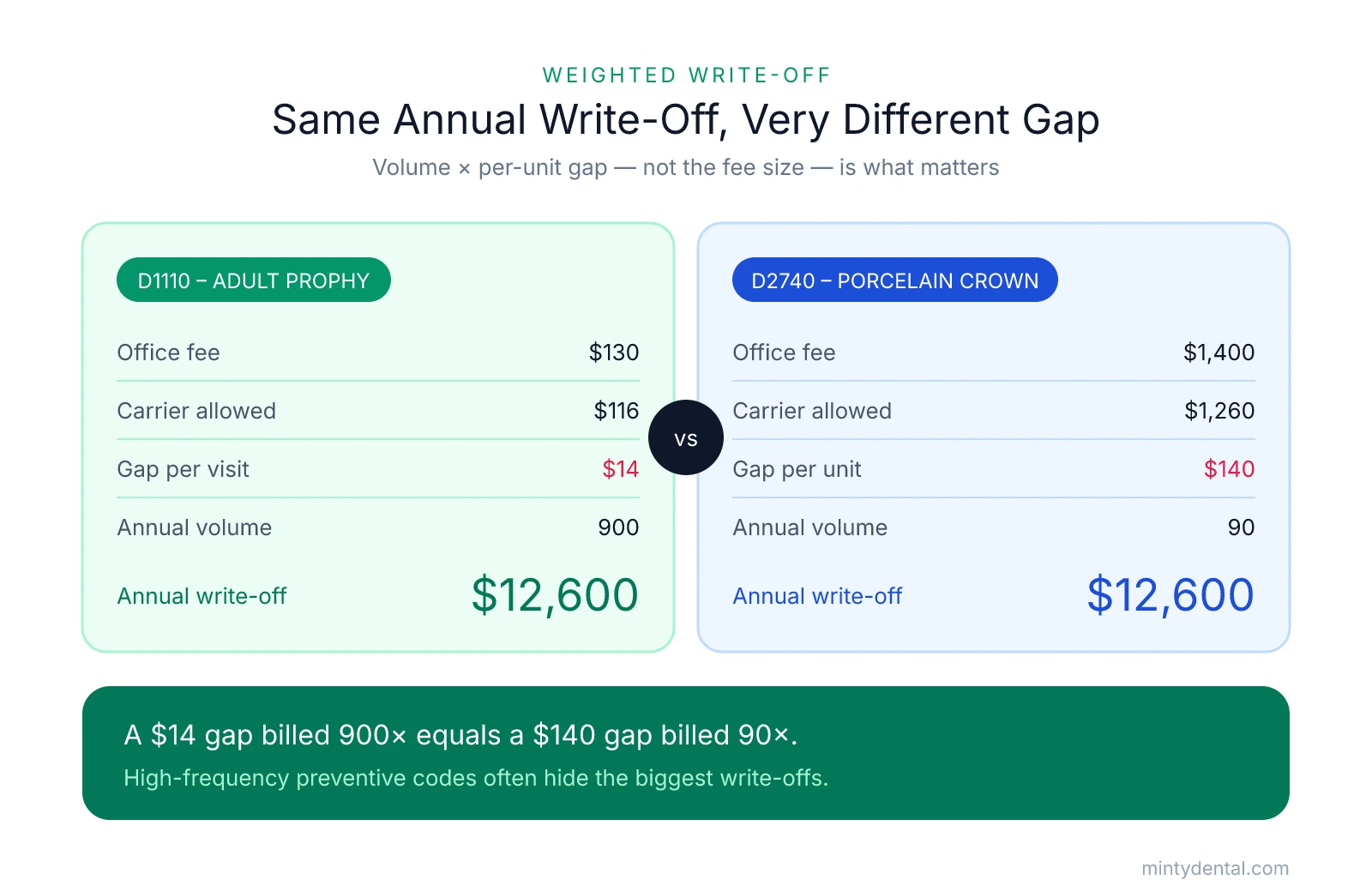
Consider a straightforward hypothetical. Your office fee for D1110 (adult prophy) is $130. One carrier allows $116, leaving a $14 gap per visit. You bill D1110 for that payer 900 times a year. That is $12,600 in annual write-offs from a single code at a single payer. Now look at D2740 (porcelain crown). Your office fee is $1,400 and that same payer allows $1,260, a $140 gap per unit. You place 90 crowns a year with this payer. That comes to $12,600 as well, but the prophy gets you there with a $14 gap. The crown feels more significant case by case; the math is identical at the annual level, and that is before you consider that your other payers may reimburse crowns reasonably while prophy fees have drifted across the board.
This is not a hypothetical problem. Q4 2025 ADA Health Policy Institute data shows reimbursement rates are not keeping pace with overall inflation and practice expenses — which means the gap between what procedures cost you to deliver and what carriers pay has been widening. High-volume codes feel that compression most, because a small per-unit shortfall compounds quickly across the volume that fills your schedule.
The ADA's own guidance reflects this. Before starting a negotiation, the recommendation is to evaluate your top 20 procedures and what you write off on each of them, by payer, and then to begin with one carrier rather than spreading a negotiation across all of them at once. That sequence only works if you have already done the volume-times-gap math — otherwise you are still negotiating on instinct rather than on the lines that actually drive your write-off.
How to Pull Your Top-Code List from Your Practice Management Software
The report you need already exists in your practice management software. In Dentrix, it's usually listed as "Procedure Code Summary" or found within the production reports module. Eaglesoft calls it "Procedures by Code" and places it under Reports > Practice > Production. Open Dental has a "Procedure Code Report" in the Reports menu under the Production section. The names differ slightly, but every major PMS can generate the same thing: a list of every CDT code billed over a chosen period, with the number of times it was billed and the total production dollars it generated.
Set the date range to the last 12 months and run it for all providers. When the report comes out, sort by total production dollars, not by frequency. Frequency tells you what you do most often; production dollars tell you what's driving your revenue. Those two things don't always match, and for this exercise, dollars are what you care about.
What you'll find, in almost every general practice, is that roughly 30 codes account for about 90% of billable production. That concentration is what makes code-level negotiation manageable. You don't need to analyze your entire CDT code list. You need to work through a list that's short enough to build a focused request around.
Once you have that ranked list, the next step is to layer in what a specific carrier actually pays for each code. If your PMS has the carrier's contracted fee schedule loaded and kept current, you can pull the allowed amounts directly from there. If the schedule on file is outdated or you're not sure it's current, pull three to six recent EOBs from that payer and use the allowed amounts shown there. The EOB-based approach is more accurate than relying on a schedule that may not have been updated when the carrier last adjusted its rates. (If you've ever noticed that what a payer actually sends doesn't match what your software shows, there are a few specific reasons that discrepancy happens.)
With both columns in hand, build a simple worksheet. Each row is one CDT code, and the columns run across like this:
| Code | Description | Annual Volume | Office Fee | Carrier Allowed | Gap Per Procedure | Annual Gap |
|---|---|---|---|---|---|---|
| D1110 | Adult prophy | 900 | $130 | $116 | $14 | $12,600 |
| D2740 | Porcelain crown | 90 | $1,400 | $1,260 | $140 | $12,600 |
| D0274 | 4 bitewing x-rays | 700 | $75 | $60 | $15 | $10,500 |
Sort by Annual Gap descending. The codes at the top of that sorted list are your negotiation targets. The codes near the bottom may still have a meaningful per-unit gap, but they don't move the needle at your billing volume.
Two things to watch for as you build this worksheet. First, run it per payer. A code that one carrier pays well may be significantly underpaid by another, so the target list is not universal. Your payer mix shapes which carriers deserve the most urgent attention, but each carrier's negotiation request should come from that carrier's own numbers. Second, flag any code where the carrier's allowed amount meets or exceeds your office fee. Those codes don't belong on the negotiation list, but they're worth noticing: if a payer is already covering your full fee on a given procedure, it may be a sign your UCR for that code is set lower than it should be for your area.
The Code Categories That Produce the Largest Write-Offs in Most General Practices
Once you sort your worksheet by annual gap, the same four code categories tend to cluster at the top in general practices. Understanding why each category lands there helps you make a credible case to the carrier, not just a data dump.
Preventive and diagnostic codes (D1110, D0120, D0274, D1120)
These are the most commonly overlooked negotiation targets, and the volume math is why. Adult prophy, periodic exam, four bitewings, and child prophy are billed hundreds of times per year at most practices. Carriers set those rates low partly because practices rarely push back on them. The per-procedure gap might be $10 to $20, which feels trivial, but small fee gaps compound quickly when they affect hundreds of claims. When you run the annual gap calculation on even two or three of these codes at a single payer, you often find more opportunity here than anywhere else in the fee schedule.
Restorative codes (D2740, D2750, D2392, D2393)
Crowns and posterior composites get the most attention at contract signing, which creates a specific problem: by the time you're renegotiating, those codes may already be at or near the carrier's ceiling for your area. Check the gap before including them. If D2740 and D2750 have a modest per-unit gap at a payer that's otherwise flexible, they may not move much, and including them without data support weakens the request. If the gap is real and the volume is there, they belong on the list. Just don't lead with them on instinct.
Periodontal codes (D4341, D4910)
Scaling and root planing and perio maintenance both carry significant chair time and clinical complexity relative to what many carriers allow. D4910, perio maintenance, is particularly worth examining in practices with active perio programs: if a meaningful portion of your hygiene schedule is recall-converted-to-maintenance, the volume on D4910 can rival D1110. If your team isn't consistently coding and completing perio treatment according to clinical findings, that's a separate revenue issue, but if the perio protocol is in place and the volume is real, D4910 is a strong negotiation candidate.
Core buildup, D2950
This code requires a separate check before you negotiate it. Carriers frequently bundle D2950 with the crown, paying a combined amount that's less than the two codes billed separately, or they apply a processing policy that reduces effective reimbursement. Before including D2950 in a negotiation request, verify both what the carrier allows and how they process it. If bundling is reducing your actual payment, the problem may be the policy rather than the allowed amount, and those require different responses.
Putting it together: a hypothetical short list
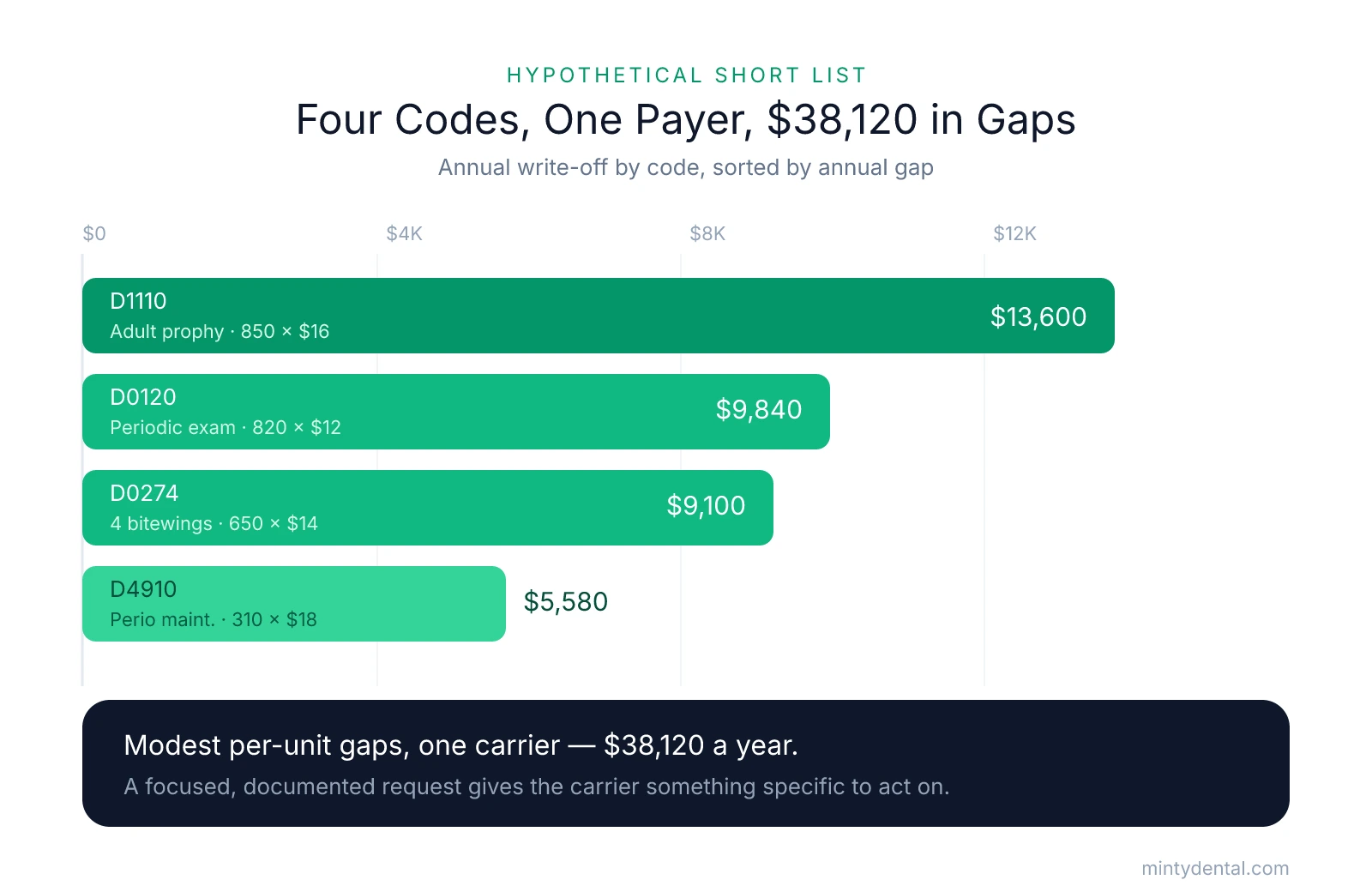
To illustrate what this looks like in practice, consider a hypothetical general practice with one mid-sized PPO. Four codes, D1110, D0120, D0274, and D4910, generate the following (hypothetical) annual gaps at that payer:
| Code | Description | Annual Volume | Per-Unit Gap | Annual Gap |
|---|---|---|---|---|
| D1110 | Adult prophy | 850 | $16 | $13,600 |
| D0120 | Periodic exam | 820 | $12 | $9,840 |
| D0274 | 4 bitewings | 650 | $14 | $9,100 |
| D4910 | Perio maintenance | 310 | $18 | $5,580 |
| Total | $38,120 |
Four codes, modest per-procedure gaps, one payer: a hypothetical $38,000 in annual write-offs. That's the kind of focused, documented request that gives a carrier something specific to respond to.
A note on specialty-heavy practices
If your practice has a strong endo focus, D3310, D3320, and D3330 will almost certainly surface at the top of your gap analysis and deserve priority. A perio-active practice should work through D4341, D4342, and D4910 as a group. The framework is the same; the codes that fill the top of the sorted list will just be different.
Turning Your Code List Into a Negotiation Request the Carrier Will Take Seriously
Once your worksheet is sorted by annual gap, you have the core of your negotiation request. What you do with that list determines whether the carrier's provider relations rep can actually move it forward internally, or files it with every other vague rate complaint they receive.
Keep the list to 10 to 15 codes per payer. A request covering 50 or 100 codes signals that you haven't done the analysis and gives the rep no clear place to start. A short list focused on your highest annual-gap items signals exactly the opposite.
For each code on that list, include four things: your current contracted allowed amount, your proposed amount, your annual volume at that payer, and the annual revenue difference. That last column is what matters most to the person reviewing your request. It translates your per-unit gap into a dollar figure they can present internally as a business case. Without volume and annual impact, you're asking the carrier to do analysis you should have already done.
Your proposed amounts need to be anchored to something beyond your own preference. Carriers respond better to market-referenced asks than to round numbers that look like guesses. The ADA Survey of Dental Fees gives you zip-code-level UCR data organized by percentile, which is exactly the format a provider relations rep can use to justify moving a code. State dental association fee surveys and zip-code-level tools like Sikka.ai serve the same function. If your proposed fee sits at the 80th percentile for your area, say so. That's a defensible reference point; an arbitrary number is not.
Before you submit anything, check your contract's amendment window. Most PPO contracts run 18 to 24 months with specific notice requirements baked in. Submitting a request outside that window may delay action by a full contract cycle, so the timing of your request matters as much as the content.
On outcomes: practices that bring focused, code-level cases to carriers see typical averages on direct contracts landing in the 8 to 12 percent range on highly utilized codes, with individual results varying widely by market, carrier, and contract type. That's an industry reference, not a prediction for your specific situation.
One caveat that's easy to miss after a successful negotiation: a rate increase on your direct contract may not apply to every claim you think it does. If your patients' employers access your network through a leased or secondary network arrangement, those claims may still be priced at the lower leased rate rather than your newly negotiated one. Before and after any negotiation, verify how your claims are actually being routed, because a rate increase that gets bypassed by network leasing doesn't improve your collections.
Sources & References
The data and claims in this article are drawn from the following sources. We prioritize government data, peer-reviewed research, and established industry publications to ensure accuracy.
- Dear ADA: Reimbursement rates | American Dental Association— adanews.ada.orgIndustry
- PPO Re-Negotiating Steps— burkhartdental.com
- PPO Fee Schedules 2026: 3 Negotiation Tactics That ...— virtualdentalbilling.comIndustry
- Fee Schedule Negotiation Guide— ada.orgIndustry
- What Dentists Should Know About PPO Re-Negotiation— pponegotiationsolutions.comIndustry
- Can Dentists Negotiate PPO Fee Schedules?— apexreimbursement.comIndustry
See Where Your Crown Fee Stands Before Negotiating
You have identified the codes driving your largest write-offs. Run a quick check to see how your current PPO fee for those procedures compares to what group schedules pay in your area.