Budgeting for Equipment Upgrades After Buying a Dental Practice

Co-Founder, Minty Dental
In Summary
- Equipment condition is a due diligence issue, not a post-closing surprise — what you discover before signing shapes both your offer price and your year-one budget
- Request a room-by-room equipment list with age, maintenance history, repair frequency, and active service contracts as part of every practice evaluation
- Two categories of equipment risk to identify early: functional-but-aging (needs a replacement timeline) and already-failing (needs immediate budget allocation)
- Healthy practices spend 3–5% of collections on equipment and technology — practices running below this benchmark may be hiding deferred maintenance costs that will land on you after closing
- Documented equipment deficiencies are a legitimate negotiation lever — they can support a price reduction or seller credit before you sign
Equipment Planning Starts Before You Close, Not After
Budgeting for equipment upgrades after buying a dental practice means knowing what you're inheriting before you sign — not discovering it after closing.
Walking into a practice for the first time and feeling overwhelmed by aging chairs, outdated imaging, or a compressor that sounds like it's on its last legs is completely normal. What separates buyers who manage that reality well from those who get caught off guard isn't experience — it's timing. The buyers who fare best treat equipment as a due diligence question, not a post-closing project.
That shift in timing matters more than most buyers expect. Equipment condition affects three things simultaneously: your offer price, your financing structure, and your cash flow in the first 12 months. Miss it during due diligence, and you're absorbing costs you didn't budget for — often right when practice revenue is still stabilizing. Those surprises are among the most common financial shocks new owners face in year one.
Two Categories of Equipment Risk
When reviewing a practice's equipment, it helps to sort everything into two buckets:
- Functional-but-aging: Equipment that's working but approaching end of useful life. These items don't require immediate capital, but they need a replacement timeline built into your 2–3 year budget.
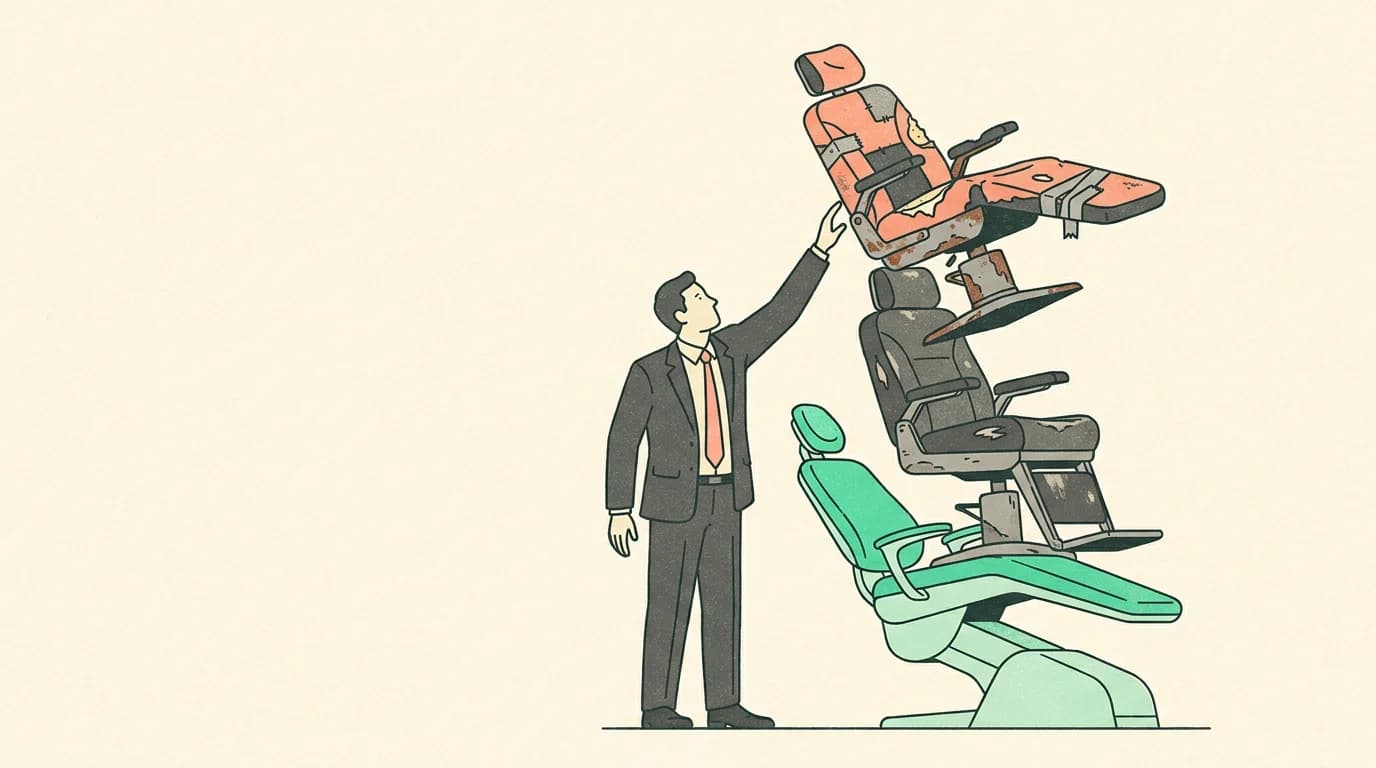
- Already-failing: Equipment with active repair issues, chronic service calls, or no remaining useful life. These require immediate budget allocation — ideally negotiated into the deal before closing.
Four Questions to Ask During Equipment Due Diligence
As part of your evaluation, request a room-by-room equipment list and work through these questions for each major item:
- How old is it? Age alone isn't disqualifying, but it establishes a replacement horizon.
- What does the maintenance history look like? Consistent preventive maintenance is a green flag; gaps suggest deferred care.
- How often has it needed repairs in the last two years? Repair frequency often predicts imminent failure better than age does.
- Is there an active service contract? Contracts transfer differently — some are assignable, others terminate at sale.
Using the 3–5% Benchmark as a Red Flag Detector
According to DentiMax's 2026 overhead report, equipment and technology should account for 3–5% of collections in a healthy practice. When a practice is running significantly below that threshold, it's worth asking why — in many cases, the answer is deferred maintenance that never showed up as a line item but will show up as a capital expense on your watch.
That benchmark also gives you a concrete negotiation anchor. Documented upgrade needs — backed by an equipment inspection — can support a price reduction or seller credit at closing, turning what feels like a liability into a structured conversation. Equipment condition, in other words, isn't just a risk to manage. It's a lever.
How to Build Your Equipment Upgrade Priority List
Once you've catalogued what you're inheriting, the next challenge is sequencing. Not every upgrade needs to happen at once — trying to tackle everything in year one is one of the faster ways to strain cash flow before revenue has stabilized. A tiered framework helps you separate what can't wait from what can, and what belongs in a future budget entirely.
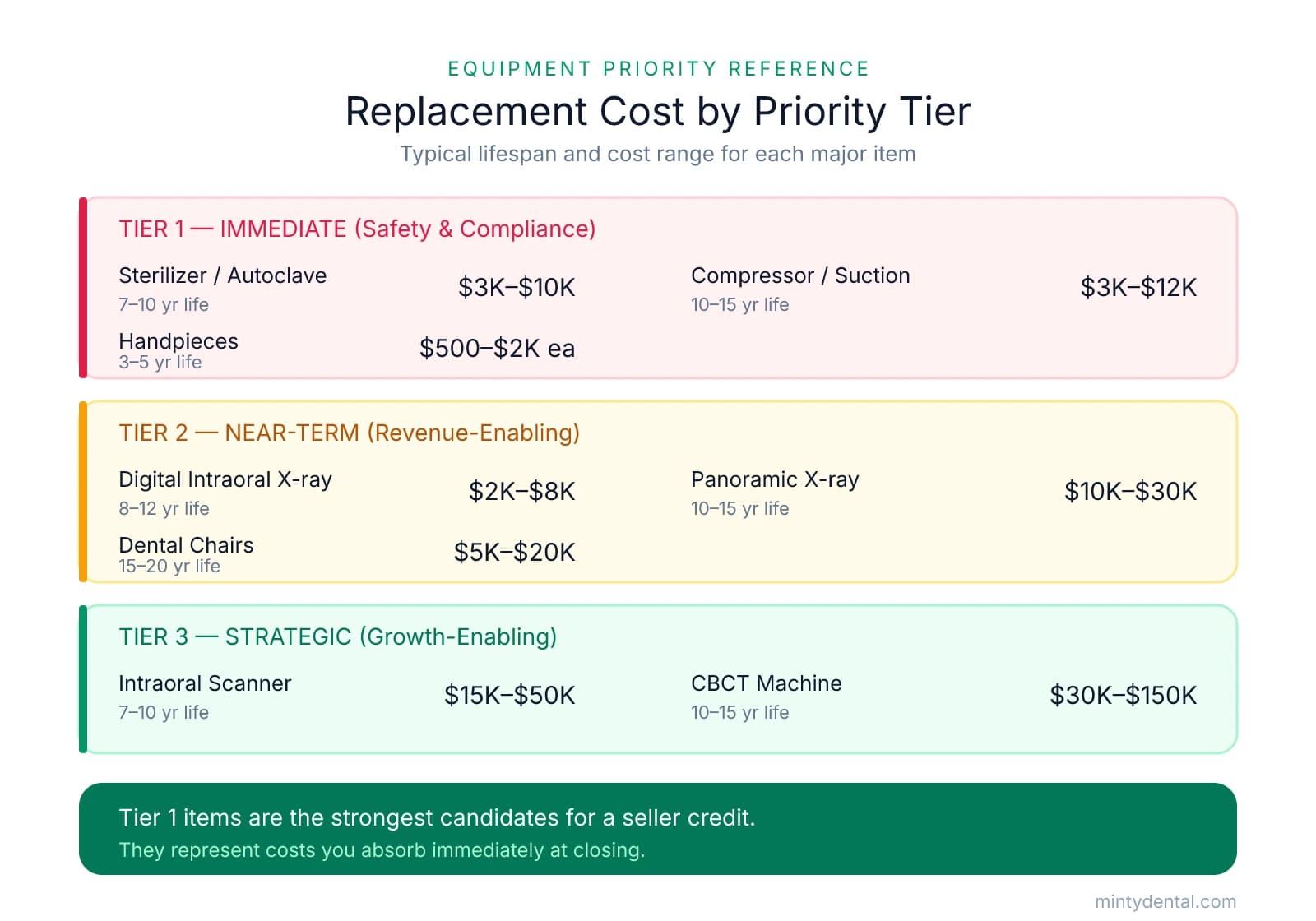
The Three-Tier System
Tier 1 — Immediate (Safety and Compliance)
Start here. Sterilizers, autoclaves, suction systems, and air compressors aren't optional upgrades — they're the infrastructure your clinical operation runs on, and failures in any of them can create OSHA compliance exposure or patient safety issues that land on you as the new owner. If you're evaluating a practice's infection control posture during due diligence, the OSHA and infection control compliance checklist is worth working through before you close.
Useful life benchmarks help assess urgency: sterilizers typically last 7–10 years, compressors and suction systems 10–15 years, and handpieces just 3–5 years, per Hager Dent's 2025 equipment replacement guide. A practical rule of thumb: when annual repair costs exceed 15–20% of replacement cost, replacement is usually more economical than continued patching.
Tier 2 — Near-Term (Revenue-Enabling)
Once safety equipment is addressed, attention shifts to anything actively limiting production capacity or patient experience. Aging digital X-ray systems, missing intraoral cameras, and worn operatory chairs fall into this category. These aren't emergencies, but they have a direct line to daily revenue.
Cost benchmarks to build into your planning:
- Digital intraoral X-ray units: $2,000–$8,000
- Panoramic X-ray systems: $10,000–$30,000
- Dental chairs: 15–20 year lifespan, but worn upholstery or hydraulic issues often justify earlier replacement
Tier 3 — Strategic (Growth-Enabling)
CBCT machines, intraoral scanners, and CAD/CAM systems belong here — high-value technology that expands service lines but requires stable cash flow before the investment makes sense. In most cases, these are year 2–3 decisions. Refurbished equipment can meaningfully reduce the entry cost: a refurbished CBCT runs $30,000–$60,000 versus $40,000–$150,000 new, and intraoral scanners range from $15,000–$50,000 depending on system and features.
Equipment Priority Reference Table
| Equipment Type | Typical Lifespan | Replacement Cost Range | Priority Tier |
|---|---|---|---|
| Sterilizer / Autoclave | 7–10 years | $3,000–$10,000 | Tier 1 — Immediate |
| Air Compressor / Suction | 10–15 years | $3,000–$12,000 | Tier 1 — Immediate |
| Handpieces | 3–5 years | $500–$2,000 each | Tier 1 — Immediate |
| Digital Intraoral X-ray | 8–12 years | $2,000–$8,000 | Tier 2 — Near-Term |
| Panoramic X-ray | 10–15 years | $10,000–$30,000 | Tier 2 — Near-Term |
| Dental Chairs | 15–20 years | $5,000–$20,000 | Tier 2 — Near-Term |
| Intraoral Scanner | 7–10 years | $15,000–$50,000 | Tier 3 — Strategic |
| CBCT Machine | 10–15 years | $30,000–$150,000 | Tier 3 — Strategic |
The value of this framework isn't just internal planning — it's a negotiation tool. Tier 1 items identified during due diligence are the strongest candidates for a seller credit or price adjustment at closing, since they represent costs you'll absorb immediately. Tier 2 and 3 items inform your financing structure and capital reserve planning in ways that are easier to address before you sign than after.
Financing Upgrades Without Wrecking Your First-Year Cash Flow
With upgrade priorities tiered and negotiation leverage identified, the next question is practical: how do you fund this when you've just taken on $800K–$1M in acquisition debt?
The instinct many buyers have is to pay cash for anything they can — it feels cleaner, and more debt feels like the last thing you need. In year one, though, that instinct can work against you. Preserving working capital matters more than minimizing financing costs when revenue is still stabilizing and unexpected expenses are most likely to surface. The tax math tends to reinforce that decision too.
Three Financing Paths Worth Knowing
Equipment term loans are the most straightforward option for large, one-time purchases. Dental-specific lenders — separate from your acquisition lender — often offer competitive rates with predictable monthly payments, making them easier to model into a year-one budget. If you're still weighing acquisition financing structures, the tradeoffs between SBA and conventional loans affect how much flexibility you'll have for layering in equipment debt afterward.
Vendor and manufacturer financing is worth exploring before assuming you need a third-party lender. Many equipment vendors offer promotional rates — sometimes 0% for 12–24 months — particularly on larger purchases. These terms often require strong credit and may have deferred interest structures, so reading the fine print before committing matters.
Equipment leasing trades ownership for lower monthly payments, which can be the right call for technology that evolves quickly. Intraoral scanners and imaging software, for example, can become functionally obsolete within a product cycle or two — leasing keeps you from being locked into depreciating hardware. For core infrastructure like chairs, compressors, and suction systems, financing to own tends to make more long-term sense.
The Tax Angle Changes the Math
Here's the part many first-time buyers miss: Section 179 applies to financed equipment — you don't need to pay cash to claim the deduction, only place the equipment in service by December 31.
According to ADA News, the equipment doesn't have to be paid for to qualify — it just has to be in service. The 2025 deduction limit sits at $2.5 million, per Henry Schein Financial. On top of that, the One Big Beautiful Bill Act of 2025 restored 100% bonus depreciation, meaning qualifying purchases can be fully deducted in the year placed in service. In practical terms, the tax benefit of a financed equipment purchase can exceed the financing cost — making the loan effectively cheaper than it appears on paper.
How equipment gets categorized at closing also affects your depreciation strategy from day one — the Purchase Price Allocation calculator is useful context for understanding how that works.
Build the Reserve In, Don't React to It
Rather than treating upgrades as expenses you'll figure out when they arise, build a dedicated equipment reserve into your year-one budget from the start. A common benchmark is 3–5% of projected collections — consistent with the healthy practice spending range covered earlier. Treating that line item as fixed, rather than discretionary, is what separates buyers who feel in control of their first year from those who feel like they're constantly reacting to it.
Turning Your Equipment Plan Into a 3-Year Roadmap
Everything covered here — the due diligence audit, the tiered priority framework, the financing and tax tools — is most valuable when it feeds into a concrete timeline built before closing, not after.
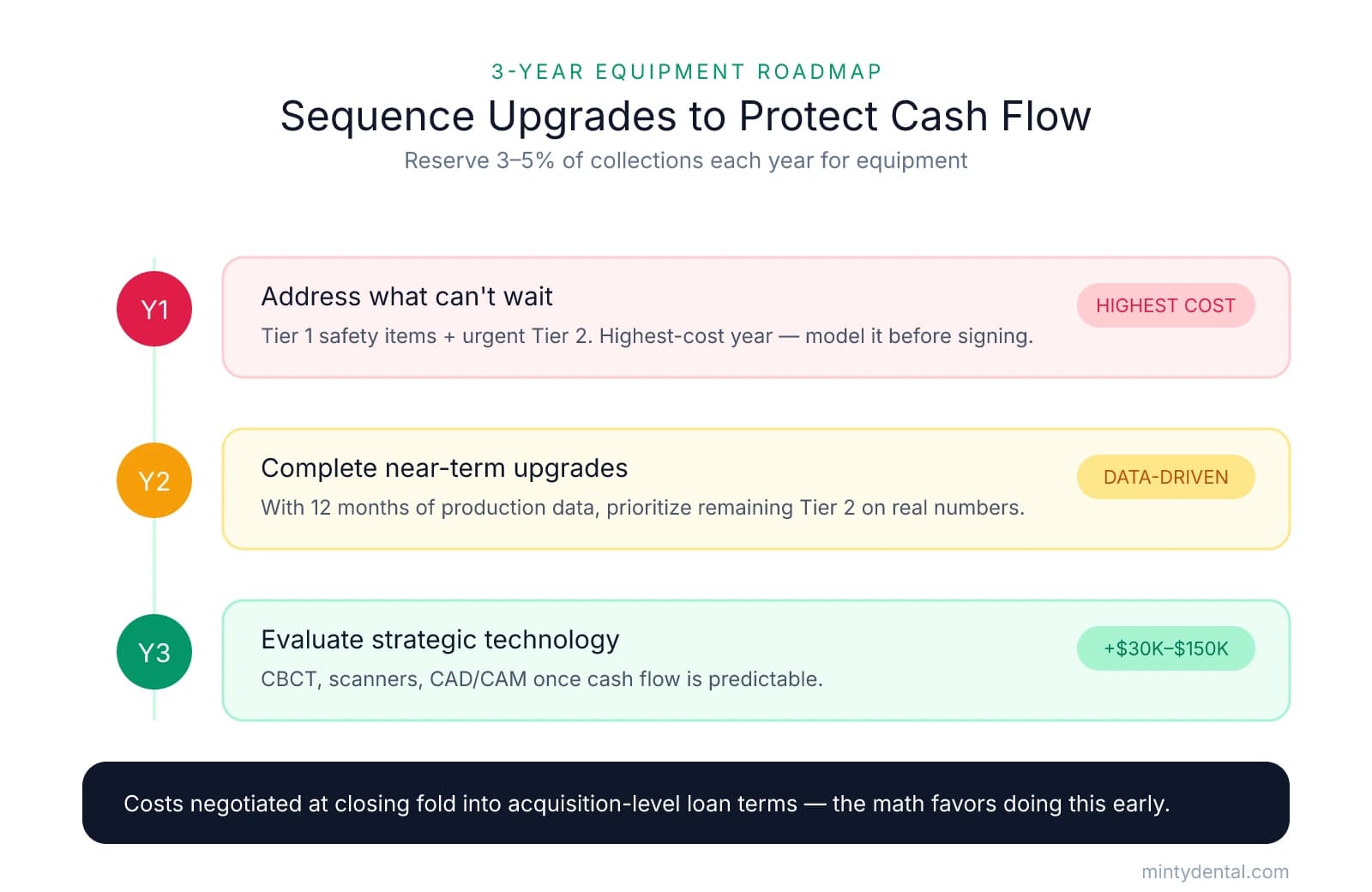
Here's how that roadmap tends to look in practice:
Year 1 — Address what can't wait. Tier 1 safety and compliance items (sterilizers, compressors, suction systems) get handled immediately, along with any Tier 2 equipment actively limiting production capacity. This is your highest-cost year for equipment, which is exactly why it needs to be modeled into your cash flow before you sign.
Year 2 — Complete near-term upgrades as revenue stabilizes. Once you have 12 months of production data, you'll have a much clearer picture of which remaining Tier 2 items are worth prioritizing. Decisions made with real numbers are almost always better than decisions made on projections.
Year 3 and beyond — Evaluate strategic technology investments. CBCT machines, intraoral scanners, CAD/CAM systems — these belong here, when cash flow is predictable and you understand patient demand well enough to model the return. These investments can add $30,000–$150,000 to your equipment budget, which is precisely why deferring them until your financials are stable is the right call.
The Pre-Closing Checklist That Makes This Possible
The roadmap only works if the due diligence audit is thorough. Before closing, work through these six steps:
- Request a room-by-room equipment list with ages, model numbers, and current condition notes
- Pull maintenance and repair history for the last two to three years — frequency of service calls often predicts failure better than age alone
- Bring in a dental equipment technician or rep for a physical inspection — what looks functional can hide chronic issues that don't show up on paper
- Document upgrade needs and get rough cost estimates for anything in Tier 1 or Tier 2
- Use that documentation to negotiate — a price credit or seller concession at closing is almost always cheaper than financing the same work separately post-closing
- Build the upgrade timeline into your first-year cash flow model before you finalize your offer or financing structure
That last point is worth emphasizing. Equipment costs negotiated at closing get absorbed into your acquisition loan at acquisition-level terms. The same costs financed separately six months later come with different rates, different structures, and less leverage. The math favors doing this work early.
What You're Actually Buying
No practice comes with perfect equipment. What separates buyers who thrive in year one from those who feel constantly behind isn't finding a flawless operation — it's knowing exactly what they're walking into and having a plan that accounts for it.
Buyers who complete this process before closing have converted equipment uncertainty into a documented, budgeted, sequenced plan. That's not just good financial management — it's the foundation of a confident first year of ownership. A financial checklist for expanding your dental practice reinforces this point: the practices best positioned for growth are those that plan capital expenditures before they become urgent.
Sources & References
The data and claims in this article are drawn from the following sources. We prioritize government data, peer-reviewed research, and established industry publications to ensure accuracy.
- How to Buy a Dental Practice: The Due Diligence Process ...— dentaltransitions.comIndustry
- Dental Office Overhead Percentages: 2026 Report— dentimax.comIndustry
- Dental Equipment Replacement Timeline 2025— hagerdent.com
- $2,000–$8,000— istardentalequipment.com
- How Much Does a Dental CBCT Machine Cost in 2025?— duraprohealth.comIndustry
- $15,000–$50,000— voxeldental.co.uk
- What to know about section 179 deduction when filing your ...— adanews.ada.orgIndustry
- Section 179 Tax Deduction for Dental Practices— dentalfinancial.henryschein.comIndustry
- Deductions: Section 179 and Bonus Depreciation— www.usbank.com
- Dental Startup Equipment Costs and Budget Planning— idealpractices.com
- Financial Checklist for Expanding Your Dental Practice— hrforhealth.comIndustry
Ready to optimize your practice operations?
Managing equipment upgrades and operational costs is crucial after acquiring a practice. Minty's Operations team handles the business side of independent practices, including technology infrastructure and capital planning, so you can focus on patient care.