Buying a Dental Practice That Isn't for Sale

Co-Founder, Minty Dental
In Summary
- About one-third of dentist owners plan to retire within six years, but most haven't started a formal sale process — creating a large pool of off-market opportunities
- The average dentist retires at 68.7 years old, meaning owners in their late 50s and early 60s are in a pre-decision window: open to the right conversation, not yet committed to listing
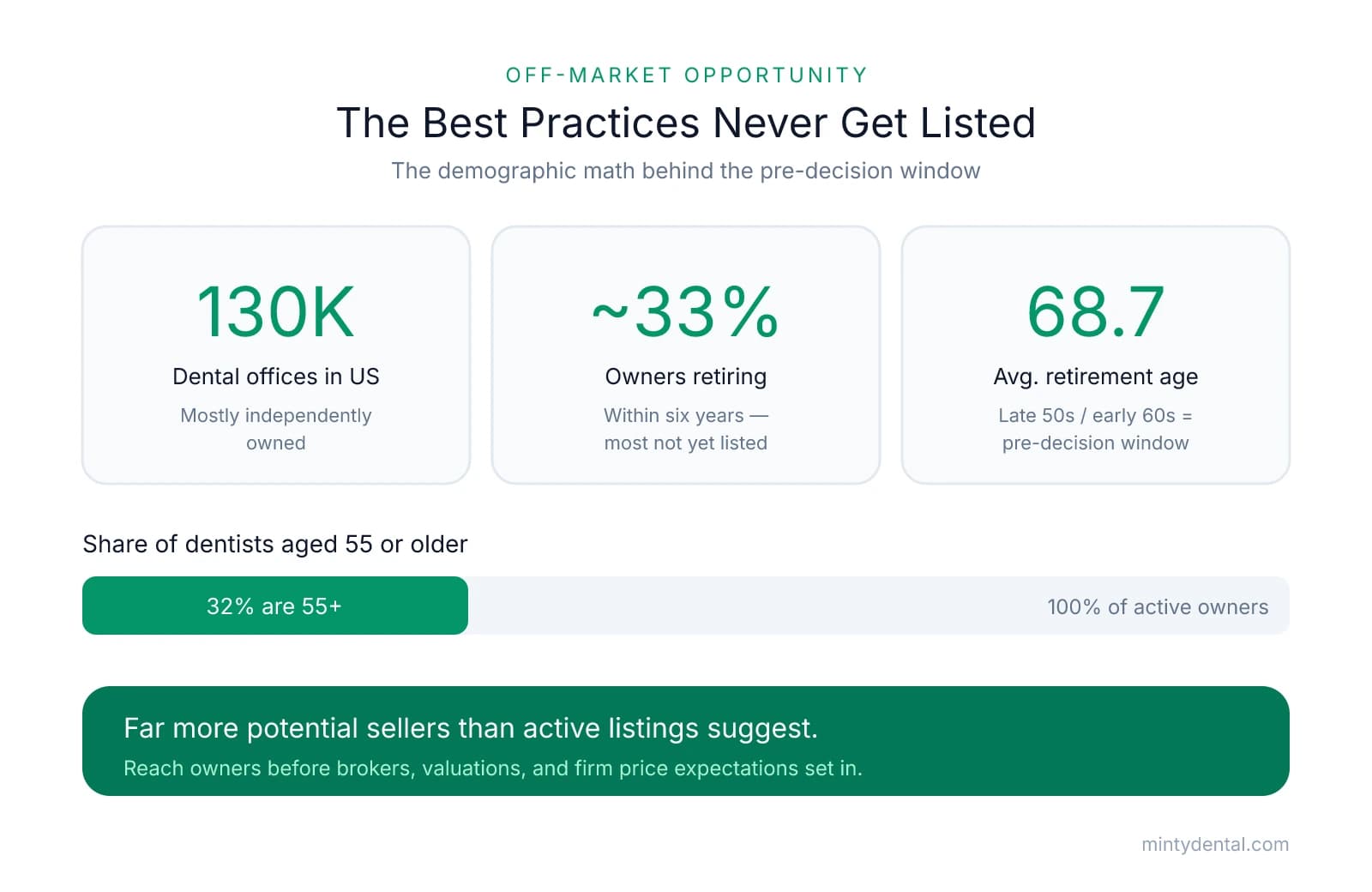
- There are roughly 130,000 dental office establishments in the US, the vast majority independently owned — far more potential sellers than active listings suggest
- Buyers who rely only on listing platforms compete in a smaller, more crowded pool where price expectations are already anchored by formal valuations
- The most effective approach to an unlisted practice starts with the seller's psychology — identity, legacy, and lifestyle — not the buyer's timeline
The Best Dental Practices Often Never Get Listed
Off-market dental practice transitions: A significant share of dental practice sales never appear on a listing platform. They close through referrals, study group connections, and direct conversations between owners and buyers who reached out before a broker was ever involved.
That's not an accident — it's a structural feature of the market. And for buyers willing to look beyond active listings, it represents one of the most underused advantages in practice acquisition.
The demographic math is hard to ignore. According to the ADA's 2025 Workforce Report, the average dentist now retires at 68.7 years old. Cross that with the fact that roughly 33% of dentist owners plan to retire within six years, and a clear picture emerges: thousands of owners in their late 50s and early 60s are approaching a transition but haven't yet pulled the trigger on a formal sale process. They're in a pre-decision window — open to the right conversation, not yet anchored to a listing price or locked into a broker relationship.
The scale of the opportunity is significant. The US Census Bureau's County Business Patterns data counts roughly 130,000 dental office establishments nationwide, the vast majority independently owned — a large pool of potential off-market sellers who will never appear in a marketplace search at any given moment.
DSO consolidation has added another layer. Many solo practitioners are aware of their exit options, but a meaningful share still prefer to sell to a private buyer over a corporate acquirer — for reasons that tend to be personal: staff continuity, patient relationships, the legacy of something they built. For buyers who can speak to those concerns directly, that preference is an opening.
Buyers who limit their search to listed practices are competing in a smaller, more contested pool where valuations are already set, brokers are involved on both sides, and the seller has had time to develop firm expectations. Off-market outreach reaches owners before any of that happens. It's also worth noting that associate dentists weighing a buy-in versus an outside acquisition often overlook this channel entirely, defaulting to listed practices when a direct approach to a nearby owner might yield a better fit at a better price.
The challenge isn't identifying who to contact. It's knowing how to start the conversation.
How to Find the Right Owners to Approach
The goal at this stage isn't outreach — it's list-building. Sending a well-crafted letter to the wrong owner is wasted effort; sending it to someone who's 42 with two associates and a recently renovated office signals you haven't done your homework. Before writing a single word of outreach, you need a targeted list of owners who are statistically likely to be in a pre-sale mindset.
State dental board license rosters are public records in every state and one of the most underused sourcing tools available. Each roster lists the licensee's name, practice address, and license issuance date. Owners who received their DDS or DMD between 1985 and 2000 are now in their early 60s to mid-70s — squarely in the window where retirement is a live question. According to ADA workforce data, 32% of dentists are currently 55 or older. Filtering a state roster by license issuance date is a fast way to surface that cohort in your target geography.
From there, layer in a second filter: solo practices with no associate on staff. An owner who hasn't brought in an associate has no built-in succession plan — no junior partner to buy them out, no natural internal transition waiting to happen. That structural gap makes them meaningfully more open to an outside buyer who approaches thoughtfully.
A few additional signals worth noting as you refine the list:
- Older Google reviews with no recent activity — a practice that hasn't generated new reviews in 18–24 months may reflect an owner who's coasting, not investing
- Aging equipment visible in practice photos — no recent technology upgrades can suggest an owner who's stopped reinvesting, often a pre-exit behavior
- No active website or social presence — common among owners in their 60s who built the practice before digital marketing mattered
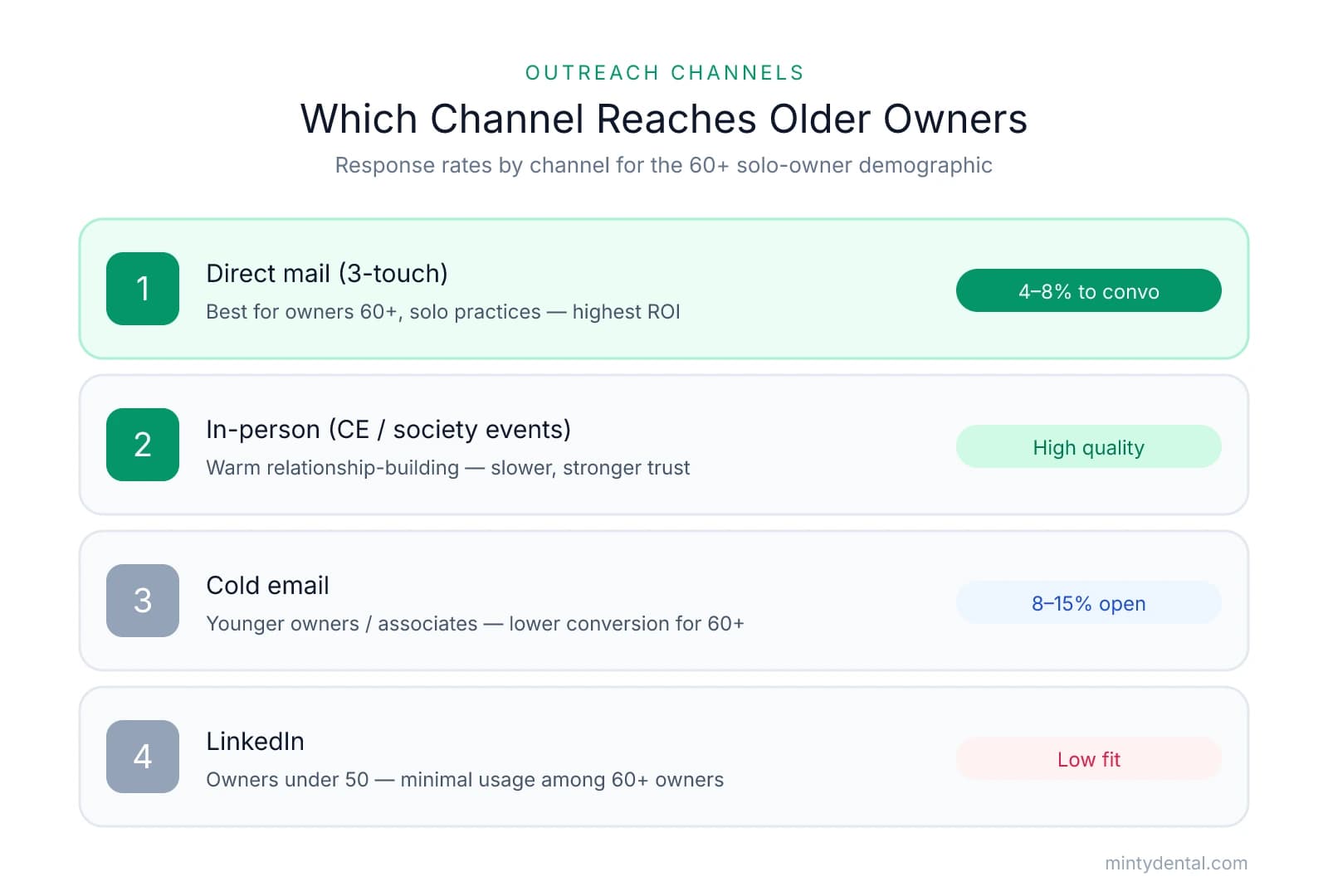
Once you have a refined list, direct mail to the practice address tends to perform best with this demographic. The USPS Household Diary Study found that 56% of small business owners physically read mail sent to their business address — compared to the 8–15% open rates typical of cold email. A three-touch direct mail sequence over 60–90 days converts roughly 4–8% of qualified addresses into a real seller conversation, per CT Acquisitions' data on dental-specific outreach.
For in-person channels, local dental society meetings, CE events, and study clubs consistently outperform LinkedIn and digital ads for owners in their 60s — reachable face-to-face in ways they simply aren't online.
| Channel | Best For | Realistic Response Rate | Notes |
|---|---|---|---|
| Direct mail (3-touch) | Owners 60+, solo practices | 4–8% to conversation | Highest ROI for this demographic |
| In-person (CE/society events) | Warm relationship-building | Hard to measure, high quality | Slower but produces stronger trust |
| Cold email | Younger owners, associates | 8–15% open rate | Lower conversion for 60+ cohort |
| Owners under 50 | Low for target demographic | Minimal usage among 60+ owners |
The practical discipline here is narrowing before you reach out. Target a specific geography, a practice revenue range that aligns with what your financing can support, and owners whose license age puts them in the 5–10 year pre-retirement window. A list of 40 well-qualified owners will outperform a list of 400 every time.
What to Say — and What Not to Say — in the First Conversation
With your list narrowed and your outreach channel chosen, the next question is the one that stops most buyers cold: what do I actually say?
This part feels awkward — and that's completely normal. You're reaching out to someone you may not know, about a topic they may not have discussed with anyone, regarding an asset that's deeply personal to them. The instinct is to be direct and efficient. In this context, that instinct tends to backfire.
Jumping straight to "are you interested in selling?" puts the owner on the defensive before any trust exists — and once that wall goes up, it rarely comes down. As Dental Buyer Advocates notes, the more effective opening isn't a purchase inquiry at all. It's a genuine request for mentorship.
The Mentor Ask
A senior dentist who's spent 30 years building a practice has real knowledge — about the local market, patient retention, what they'd do differently. Asking for that perspective is both honest and disarming, creating a natural entry point that doesn't require the owner to make any decision or reveal anything they're not ready to share.
A first outreach letter that works tends to follow this structure:
- Open with something specific. Reference the practice's tenure, a patient review, or a community reputation. Generic openers signal you're sending the same letter to 200 people. Specificity signals you chose them deliberately.
- Establish your own context briefly. Who you are, where you trained, what kind of practice you're hoping to build. Keep this short — the letter is about them, not you.
- Make the ask low-stakes. Something like: "I'd welcome the chance to buy you a coffee and hear how you've approached building your practice. I'm not here to pitch anything — I'd genuinely value your perspective."
No mention of buying. No valuation language. No timeline pressure.
Speaking to What Owners Actually Care About
Understanding why this approach works requires understanding what owners are actually afraid of. Commonwealth Transitions' research on seller psychology identifies three core concerns that surface in nearly every transition:
- Identity: For many owners, being a dentist-owner is who they are — not just what they do. The prospect of selling can feel like an identity loss before it feels like a financial event.
- Lifestyle: Owners value independence. What their day looks like after a sale — whether they stay on, step back, or exit entirely — is often more pressing than the purchase price.
- Legacy: Staff who've worked there for 15 years. Patients who've been coming since their kids were in braces. Owners want to know those relationships will be honored.
A buyer who acknowledges these concerns — even indirectly — stands out from every transactional inquiry the owner has ever received. Asking how they built their patient relationships, or what they're most proud of, surfaces the same territory without feeling scripted.
Transitioning to a Real Conversation
The shift from relationship-building to acquisition happens gradually and works best when it feels natural. One approach that tends to open the door: once you've had a genuine exchange, mention that you're actively looking to own a practice and ask if they know of anyone in the area who might be considering a transition. This keeps the pressure off them while making your intent clear.
When the conversation does move toward their own situation, emphasizing confidentiality — "I'm happy to keep this completely private, no obligation on either side" — reduces the perceived risk of engaging. Many owners worry that word will get out to staff or patients before they're ready. Removing that concern explicitly makes continued conversation feel safer. If things eventually progress to a formal transition, the structure of a seller employment agreement is one place where lifestyle and legacy concerns get translated into concrete terms — but that's a much later conversation.
The first one just needs to happen.
From First Conversation to a Real Deal: What Comes Next
The first conversation is the hardest part. What follows is mostly a matter of patience, preparation, and staying in the relationship without forcing it.
One reality worth setting expectations around: off-market deals move slowly. A well-planned dental practice sale can take anywhere from 12 to 36 months from the time an owner starts thinking seriously about it to the day keys change hands — and that clock often doesn't start until after you've already been in contact for a while. Starting outreach early isn't impatience. It's a strategic advantage that listed-practice buyers simply don't have.
When an owner says "not yet," that's not a no. It's an invitation to stay in the relationship. A brief, genuine check-in every three to six months — a note about something relevant to their practice, a question about how things are going — keeps you top of mind without pressure. When their circumstances shift, you want to be the person they already know.
What separates buyers who convert warm conversations into real deals from those who don't is almost always preparation:
- Financing pre-approval in hand. When an owner becomes ready, speed matters. A buyer who can say "I'm already pre-approved and can move quickly" is meaningfully more credible than one who needs to start the bank process.
- A clear acquisition criteria document. Being able to articulate your target revenue range, geography, practice type, and timeline signals seriousness — and helps the owner see whether you're actually a fit.
- An advisory team already engaged. Having an independent attorney and a dental-specific CPA ready before the conversation turns serious means you can respond to a willing seller without delays. As covered in more detail on hiring your own attorney, independent representation from the start protects your interests and signals professionalism.
When the financial conversation does begin, the most effective framing starts with the owner's goals — their retirement timeline, whether they want to stay on clinically, what happens to their staff and patients — rather than price. Price follows naturally once both sides understand what a good outcome looks like for the seller. Jumping to numbers before that foundation exists tends to collapse conversations that were otherwise progressing well.
One practical step that protects both parties early: a soft confidentiality agreement before any financials are shared. It signals that you're serious and organized, and gives the owner confidence that the conversation won't surface prematurely with staff or patients.
The buyers who close off-market deals aren't necessarily the ones who found the best practices. They're the ones who started early, stayed consistent, and were ready to move when the timing finally aligned.
Sources & References
The data and claims in this article are drawn from the following sources. We prioritize government data, peer-reviewed research, and established industry publications to ensure accuracy.
- Dentist Workforce— www.ada.orgIndustry
- 8 key dental retirement stats to know— beckersdental.comIndustry
- US Census Bureau's County Business Patterns data— census.gov
- USPS Household Diary Study— uspsoig.gov
- How to Find Off-Market Dental Practice Businesses for Sale— ctacquisitions.comIndustry
- Finding a Dental Practice for Sale: Outreach to Dentists— www.dentalbuyeradvocates.comIndustry
- The psychology of selling your dental practice— commonwealthtransitions.comIndustry
- Planning Your Dental Practice Sale Timeline— hemmenassoc.comIndustry
Ready to pursue your off-market practice?
Finding the right dental practice often means looking beyond public listings. Minty's acquisition experts guide you through identifying, approaching, and closing deals on practices not yet on the market—with no upfront fees.