Contractual Adjustment vs. Write-Off on the Dental Ledger

Co-Founder, Minty Dental
In Summary
- A contractual adjustment is the difference between your full fee and the PPO-allowed amount — required by your provider agreement and not billable to the patient.
- A write-off is money the practice had the right to collect but removed from the ledger anyway, such as a denied claim that was never appealed or an uncollected patient balance.
- Both post as negative entries on the ledger and look identical to anyone scanning an account — the distinction lives in the adjustment type code.
- Mixing the two codes corrupts your net collection rate and hides billing problems that could be resolved.
- Keeping them separate is what lets you tell recoverable revenue problems from expected contractual reductions.
Both Terms Reduce a Balance — But They Mean Different Things
A contractual adjustment is the gap between what your practice charges and what a PPO contract permits you to collect. When you join a PPO network, you agree to accept the plan's allowed amount as payment in full for covered services. The difference between your full fee and that allowed amount cannot be billed to the patient — it comes off the ledger as a required reduction. On an EOB or ERA, that reduction appears as CO-45, which stands for Contractual Obligation, reason 45: the billed charge exceeds the contracted allowed amount.
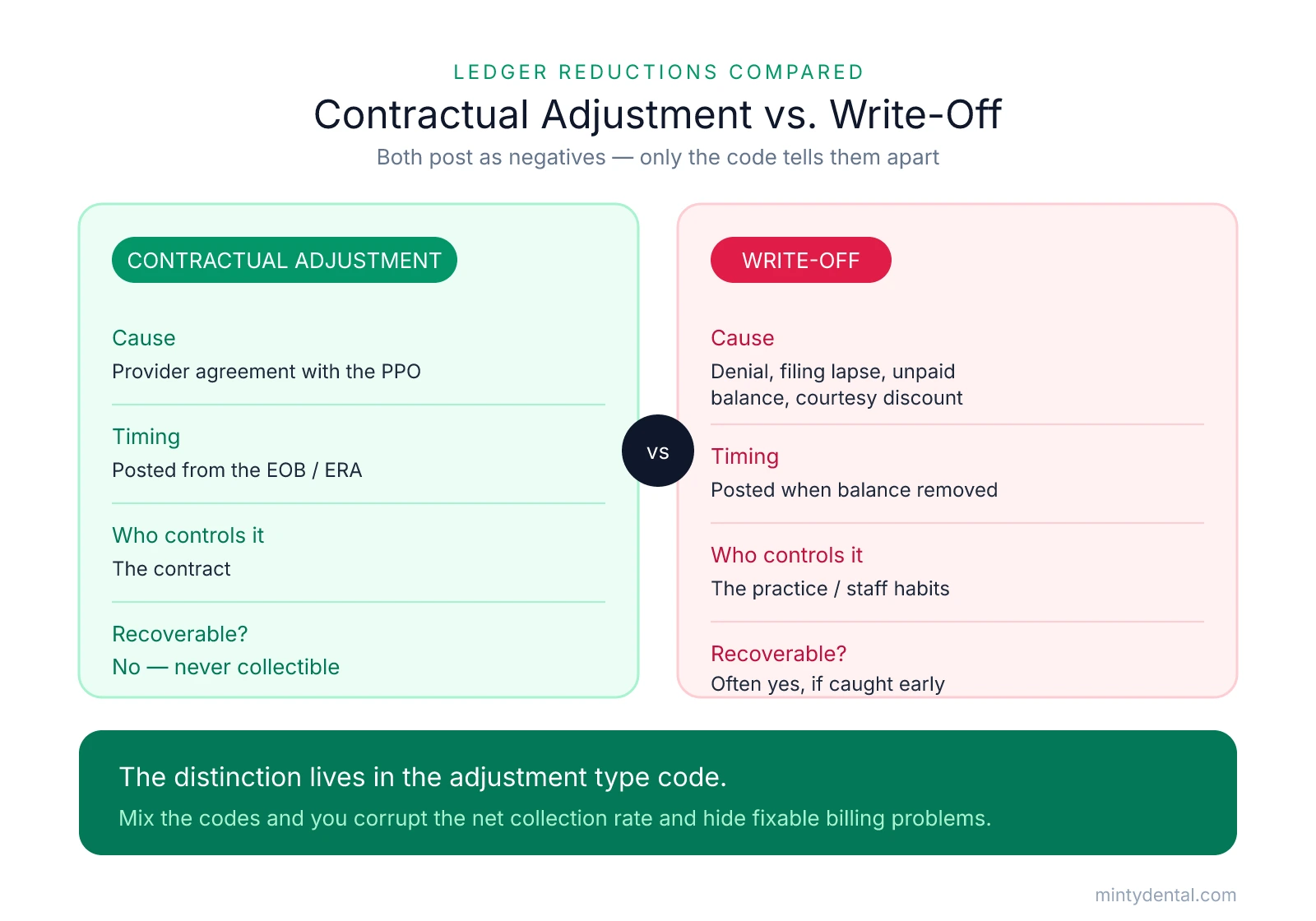
A write-off is different in kind. It's money the practice was entitled to collect but removed from the ledger anyway — a denied claim nobody appealed, a balance that lapsed past the timely filing window, an uncollected patient portion that aged into bad debt, or a courtesy discount given at the front desk. The practice had a legitimate claim to that revenue. The write-off reflects a decision, or an oversight, that ended it.
Both show up as negative entries on the ledger. That's the problem. Anyone scanning an account sees a balance go to zero either way, and the dollar sign doesn't tell them which type of reduction occurred.
To make it concrete, here's how a single procedure looks when everything goes correctly. All numbers below are hypothetical examples.
| Ledger line | Detail | Amount |
|---|---|---|
| Charge | D2392 two-surface composite, full fee | +$210.00 |
| Contractual adjustment | CO-45, PPO allowed amount is $140 | -$70.00 |
| Insurance payment | Plan pays 80% of allowed amount | -$112.00 |
| Patient copay | 20% of allowed amount | -$28.00 |
| Balance | $0.00 |
The $70 contractual adjustment was required by the provider agreement. It never represented collectible revenue, so removing it from the ledger has no effect on the net collection rate — the denominator shrinks by the same amount.
Now imagine the claim for that same procedure is denied, the filing window closes, and the $140 allowed amount is written off rather than appealed. The ledger still reaches zero. But this time, $140 that the practice had a right to collect simply disappears from the account. That's a write-off in the true sense, and it does damage the net collection rate.
The distinction doesn't live in the dollar amount or even the direction of the entry. It lives in the adjustment type code attached to the posting — CO-45 for a contractual reduction, versus whatever general write-off or denial code your PMS uses for the other. Without consistent, separate codes, every report built on that data is compromised: production figures, collections totals, and the net collection rate all depend on the adjustment types being accurate.
| Contractual adjustment | Write-off | |
|---|---|---|
| Cause | Provider agreement with the PPO | Denied claim, filing lapse, unpaid balance, courtesy discount |
| Timing | Posted from the EOB/ERA | Posted when the balance is removed |
| Who controls it | The contract | The practice (or staff posting habits) |
| Recoverable? | No — never collectible | Often yes, if caught early enough |
The write-off percentage on your ledger is worth watching for exactly this reason — if your write-off percentage looks high, it's worth separating contractual adjustments from true write-offs before drawing any conclusions about where the revenue went.
The EOB Is Where the Distinction Gets Made — or Lost
The EOB — or its electronic equivalent, the ERA — is the document that tells your team exactly which type of reduction belongs on the ledger. Reading it correctly is a billing skill. Skipping it is where the two types of reductions start getting conflated.
Every EOB line item carries a Claim Adjustment Reason Code (CARC) and a group code that categorizes why the payer adjusted the amount. The group code is the first thing to read. The EOB is distinct from a bill — it breaks down the treatments covered under your dental plan, the costs applied, and why certain amounts were adjusted, which is exactly why it's the authoritative source for posting decisions.
CO (Contractual Obligation) means the payer is applying the contracted fee schedule. The most common version, CO-45, signals that your billed fee exceeded the allowed amount under the provider agreement. That difference is the contractual adjustment — post it as such, do not bill the patient, and do not code it the same way you'd code a denied claim or a courtesy discount. The contract required this reduction.
PR (Patient Responsibility) means the patient owes the amount — a deductible, copay, or coinsurance. This line does not get written off. It belongs on the patient's ledger as a balance due. Writing off a PR amount because it's easier than collecting it is exactly the kind of revenue loss that hides in the wrong adjustment code.
OA (Other Adjustment) and PI (Payer Initiated Reduction) are worth pausing on before posting anything. These codes often reflect a unilateral decision the payer made — a reduction the contract may not actually require. They're not automatic write-offs. If your team posts them as routine contractual adjustments, you lose the signal that something may be worth questioning or appealing.
The correct posting sequence, once the EOB arrives, runs in a fixed order:
- Post the full UCR fee at procedure completion. Enter your standard fee, not the allowed amount. This preserves your true production figure and lets you measure the actual size of your contractual discount by payer over time. Practices that skip this step and enter the allowed amount directly can't track either.
- Post the insurance payment exactly as shown on the EOB.
- Post the contractual adjustment using a CO-specific adjustment code, matching the CO-45 line exactly — no rounding, no estimating.
- Post the patient responsibility balance so it appears as a balance due on the account.
Some practices post an estimated contractual adjustment at procedure completion, then correct it when the EOB arrives. That workflow is fine as long as the final posted figure matches the EOB precisely. The method matters less than the accuracy of the final entry and the consistency of the adjustment code used.
The problem isn't that staff are being careless — it's that most practice management systems make it easy to reach for the same general "adjustment" code regardless of reason. When every reduction posts under the same code, your reports can't separate expected contractual reductions from true write-offs, and neither can you.
Why Mixing Adjustment Types Corrupts Your Financial Reports
The net collection rate formula is payments divided by gross production minus contractual adjustments. The reason contractual adjustments come out of the denominator is that they were never collectible revenue in the first place. The PPO contract set the allowed amount before the patient ever sat in the chair. Excluding those reductions from the denominator gives you a realistic picture of how well the practice is collecting what it actually had the right to collect.
That logic breaks down the moment a non-contractual write-off gets posted under the contractual adjustment code.
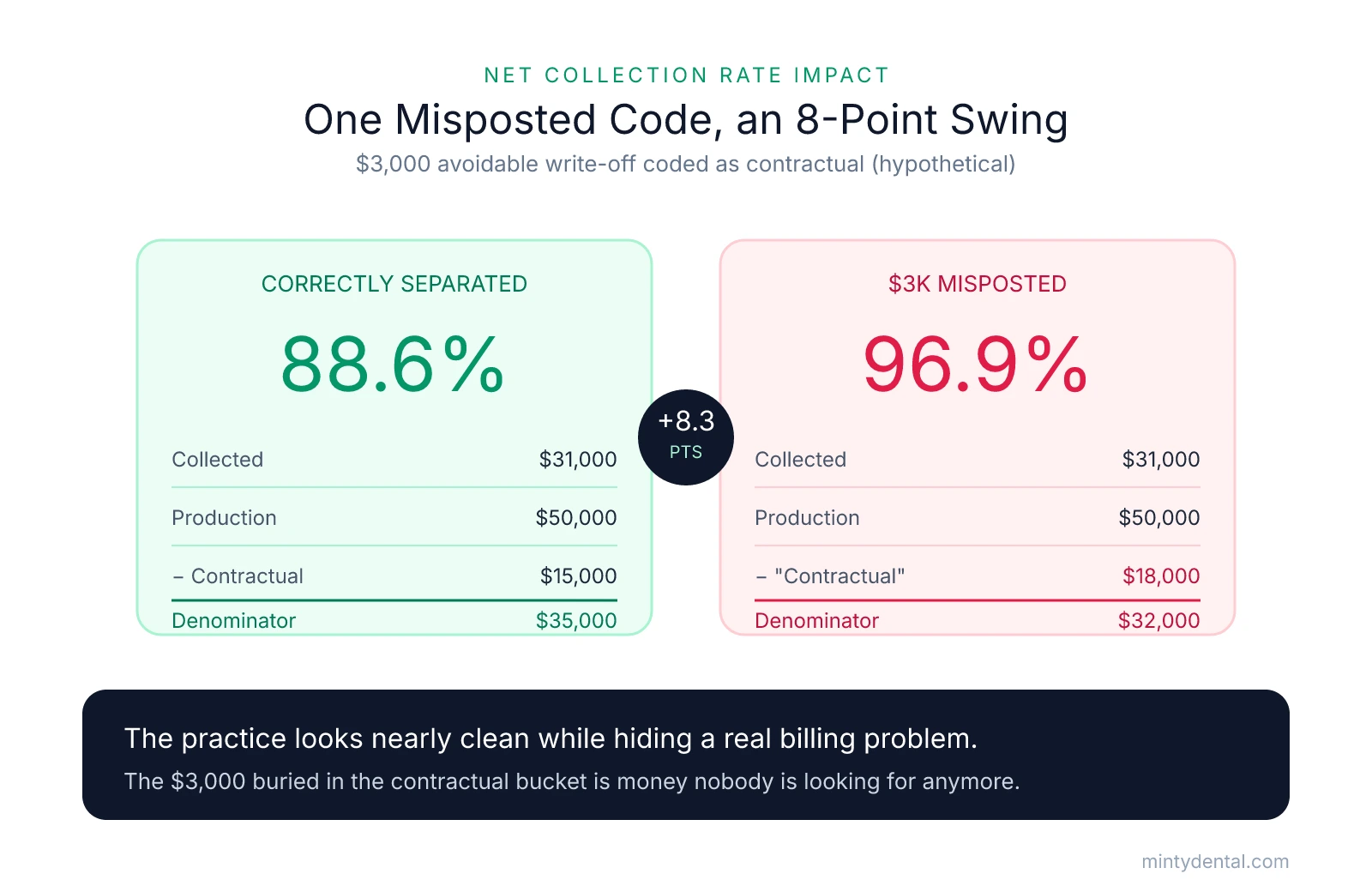
Consider a hypothetical month: $50,000 in gross production, $15,000 in true contractual adjustments, $3,000 in avoidable write-offs (a denied claim that was never appealed, a timely-filing lapse, a courtesy discount posted at checkout), and $31,000 collected.
Correctly separated ($35,000 denominator): Net collection rate = $31,000 / ($50,000 - $15,000) = 88.6%
With the $3,000 misposted as contractual ($32,000 denominator): Net collection rate = $31,000 / ($50,000 - $18,000) = 96.9%
All figures are hypothetical examples.
An 8-point swing, and the practice looks nearly clean when it has a real billing problem. The $3,000 that disappeared into the wrong code represents money the practice had a legitimate claim to — a denied claim with appeal grounds, a filing deadline that could have been caught. Because it's now sitting in the contractual bucket, it's invisible as a problem. Nobody's looking for it.
The reverse error is less common but worth noting. If a staff member posts a true contractual adjustment under a general write-off code, it stays in the denominator. The same $31,000 collected against a $35,000 denominator now gets worse if that $15,000 is treated as collectible revenue that the practice simply failed to bring in. That can trigger unnecessary alarm, prompt the wrong corrective action, or create confusion about why the net collection rate looks depressed when production feels strong. Understanding how gross and net collection rates interact matters here — you can't interpret either number accurately if the adjustment categories feeding them are mixed up.
There's a second reporting problem that doesn't show up in the collection rate at all. If every adjustment in the PMS shares one code, there's no way to break out contractual discounts by plan. You can't see that one PPO is responsible for a disproportionate share of your write-down, or that another plan's allowed amounts have drifted relative to what you're accepting from similar carriers. That plan-level view is exactly what you need before renegotiating a fee schedule or evaluating whether a particular PPO is worth staying in — and analyzing write-offs by individual carrier requires that the data was coded correctly from the start.
The structural fix has to be built into the PMS before the posting happens by setting up distinct adjustment type codes for each category. Each category represents a different cause, a different level of controllability, and a different question for management. Mixing them into one code answers none of those questions and quietly distorts the one number you trust most.
Auditing Your Ledger: What to Check and What to Do Next
Start with the adjustment type report in your PMS. Dentrix, Eaglesoft, and Open Dental all generate this report, and it shows every adjustment posted in a given period sorted by type and dollar amount. Pull it for the last 90 days and look for two things: adjustment types that are too broad to mean anything ("General Adjustment," "Write-Off," "Misc"), and any single adjustment type that accounts for a disproportionate share of total reductions. Either pattern tells you that distinct categories are being lumped together and your financial reports are working with unreliable inputs.
Once you have the totals, cross-reference your contractual adjustment figure against PPO gross production for the same period. General dental practices write off approximately 28 to 32% of PPO gross production to contractual adjustments at the national median. If your blended adjustment rate is running materially above that range, the most likely explanation is that non-contractual write-offs are hiding inside the contractual bucket. The contracts don't get more expensive on their own. The rate drifts up when other categories bleed in.
Three specific misposting patterns account for most of what you'll find.
The first is denied claims zeroed out as contractual adjustments. When a claim comes back denied and nobody appeals it, the balance has to go somewhere. If the team reaches for the standard CO-45 adjustment code, that revenue disappears into the contractual total. It shouldn't be there. A denied claim that wasn't appealed is a billing execution problem, not a contract requirement, and tracking your claim denial rate only helps if the write-offs that follow denials are coded separately so you can see the downstream cost.
The second pattern is patient balances written off without a documented collection attempt or a distinct bad-debt code. When an aging balance gets cleared to avoid AR clutter, the write-off should post under a bad-debt or uncollectible code, not a PPO contractual code. Posting it as contractual makes the adjustment look required by the plan. It wasn't. That revenue was owed by the patient.
The third is courtesy discounts posted under the same code as PPO contractual adjustments. A discount given at checkout is a practice decision, not a contract obligation. It needs its own code so management can see how often it's happening and whether it's consistent with practice policy.
To fix this in your PMS, create one code per PPO plan for contractual adjustments, a separate code for bad debt, one for courtesy discounts, and one specifically for timely-filing write-offs. Then restrict posting permissions so that only authorized staff can apply each type. When anyone can reach any code, consistency is impossible regardless of training.
After that, run the adjustment type report monthly alongside the net collection rate. A rising share of non-contractual adjustments is the earliest sign of a billing execution problem, usually appearing in the adjustment data weeks before it shows up as a meaningful drop in collections. If you want to go further, tracking which procedure codes are driving the most write-offs becomes possible once the adjustment categories are clean enough to query by code.
The report itself takes a few minutes to pull. What it tells you depends entirely on whether the data going in has been coded with any consistency. That's the problem worth fixing first.
Sources & References
The data and claims in this article are drawn from the following sources. We prioritize government data, peer-reviewed research, and established industry publications to ensure accuracy.
- CO 45 Denial Code Explained— www.aspectbillingsolutions.comIndustry
- All About Dental Explanation of Benefits | EOB— www.deltadental.com
- Insurance Write-Offs vs. Bad Debt in Dental Books— reciprocityaccounting.comIndustry
- PPO Write-Off Rate Dental Benchmarks | DSI— www.dentalstrategyinstitute.comIndustry
See What Your PPO Fees Actually Look Like
Your contractual adjustments are only as accurate as the fee schedule behind them. A Rate Check shows where your posted fees sit relative to your area and what a group fee schedule could change.