How to Reduce AR Days in a Dental Practice

Co-Founder, Minty Dental

In Summary
- AR days measures how long it takes to convert completed treatment into collected cash; the formula is Total AR divided by Average Net Daily Production.
- A practice producing $1.5M per year with 90-day AR has roughly $369K sitting in unpaid receivables; at 30-day AR on the same production, that figure drops to about $123K (hypothetical illustration).
- The target range is 30 to 45 days; most practices run between 60 and 90 days, which is a collections gap, not a production one.
- A healthy AR aging report keeps 75 to 80% of balances in the 0 to 30 day bucket and under 15% past 90 days.
- Insurance AR and patient AR age for entirely different reasons and need separate workflows to fix.
AR Days Above 45 Is a Collections Problem, Not a Production One
AR days, also called days in AR, is the average number of days between completing treatment and collecting payment. To calculate it, divide your total accounts receivable by your average net daily production (annual net production divided by 365). The result tells you, on average, how long completed work sits unpaid before the cash actually lands.
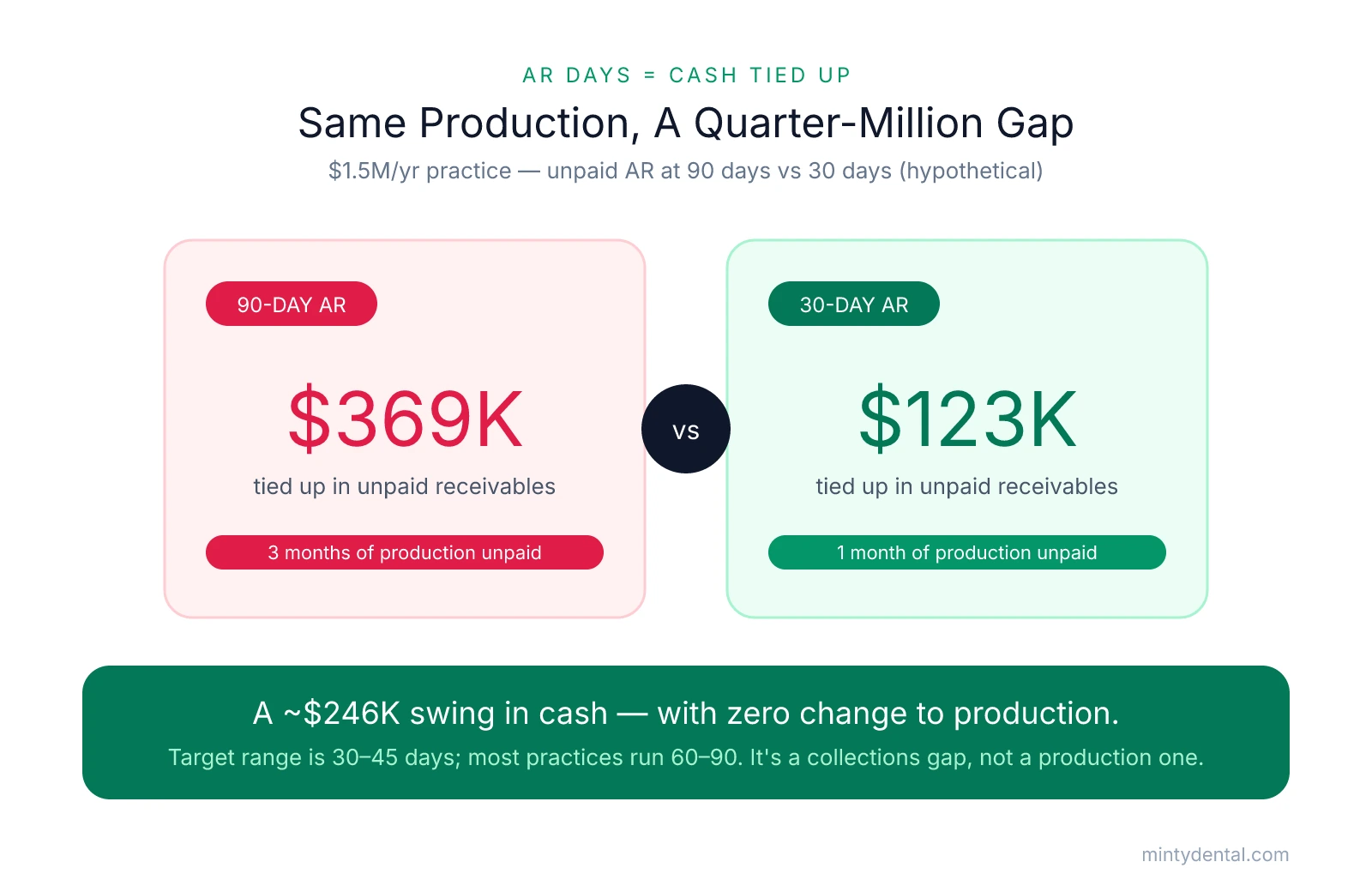
The reason this number matters more than the raw AR balance is what it reveals about your system. Two practices can carry the same dollar amount in AR and have completely different problems. A practice collecting $1.5M per year with 90-day AR has roughly $369K tied up in unpaid receivables at any given time. The same practice at 30-day AR carries about $123K. Same production, same fees, same patients walking in the door — but a cash position that differs by nearly a quarter million dollars (these figures are hypothetical illustrations, not benchmarks). That gap is sitting in your AR aging report, not on your schedule.
The target for a well-run practice is 30 to 45 days. Most practices average somewhere between 60 and 90 days, which is why production can look healthy on paper while the checking account feels tight. If you've ever found yourself wondering why your P&L shows a profitable month but the bank balance doesn't reflect it, AR days is usually where the explanation lives.
A useful companion metric is the AR ratio: Total AR divided by one month's production. A ratio above 1.0 means you're carrying more than a full month of production in unpaid balances, which is a red flag worth investigating before you look at anything else.
The tool for that investigation is the AR aging report, broken into four standard buckets: 0 to 30 days, 31 to 60 days, 61 to 90 days, and 90-plus days. A healthy distribution keeps 75 to 80% of your AR in that first bucket and under 15% past 90 days. When balances start migrating into the 60-plus and 90-plus columns, the probability of collecting them drops steadily. Past 90 days, you're often chasing claims that have already been denied, resubmitted without follow-up, or patient balances that were never clearly communicated at the time of service.
The most important thing your aging report needs to show you is where those balances are coming from, because insurance AR and patient AR age for entirely different reasons. An insurance balance that's 45 days old usually points to a claim submission or follow-up problem. A patient balance that's 45 days old usually means the amount wasn't collected at checkout, the patient didn't understand what they owed, or there's no system for following up after the statement goes out. Mixing the two into a single number hides which problem you actually have. Tracking AR days as part of your monthly KPI review with both buckets visible separately is what makes the metric actionable rather than just a number to report.
Reducing Insurance AR: Clean Claims, Fast Follow-Up, and Timely Filing Deadlines
On the insurance side, a clean electronic claim submitted on the day of service should be paid within 14 to 30 days. Paper claims take longer due to manual handling on the payer's end and should be avoided entirely. When your insurance AR is running past that window, the delay is almost always a practice-side workflow problem, not carrier slowness.
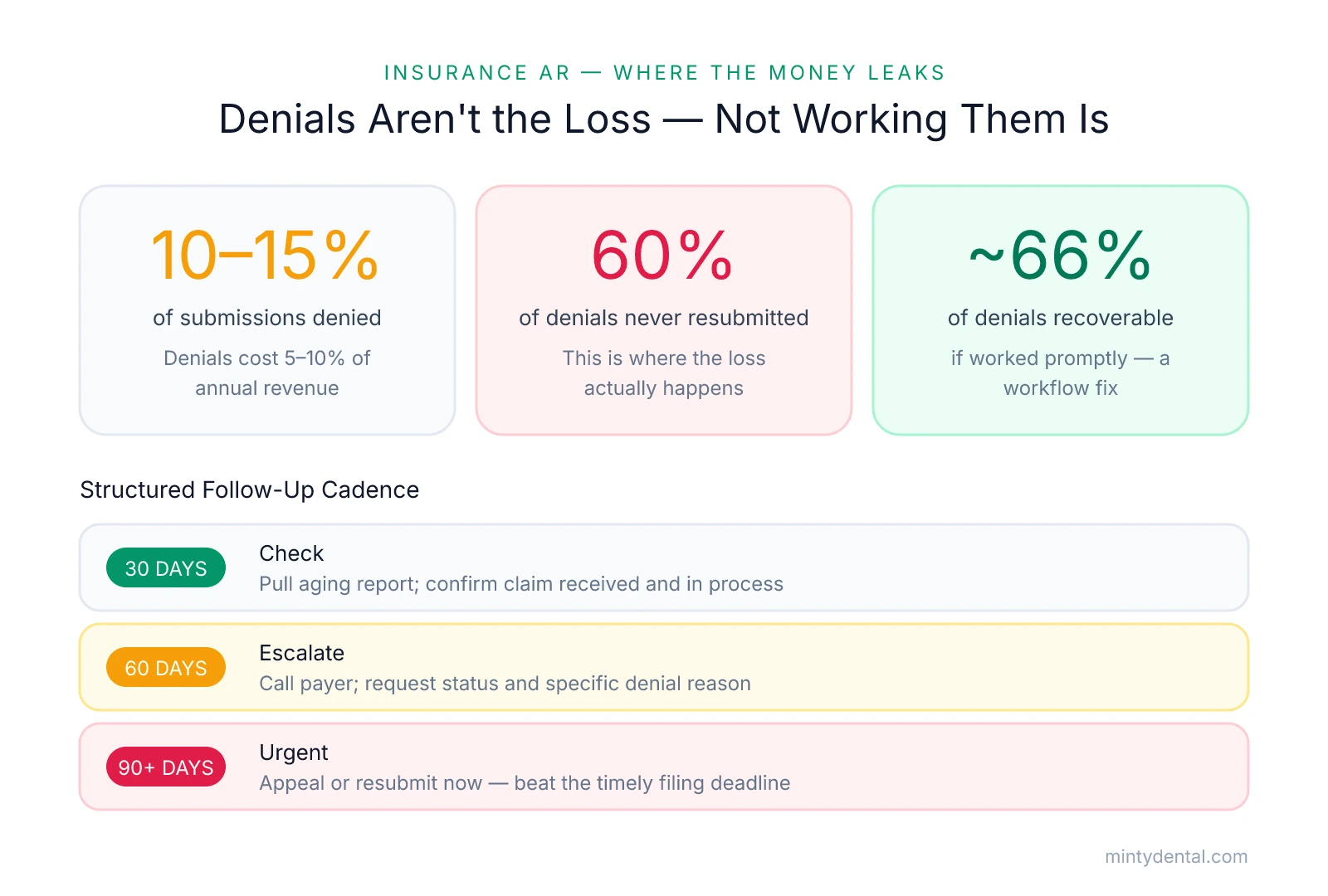
The cost of getting this wrong is real. Dental claim denials can cost a practice 5 to 10% of annual revenue, and denials affect roughly 10 to 15% of submissions. The more damaging statistic is what happens after a denial: as many as 60% of returned claims are never resubmitted. That's where most insurance AR loss actually occurs, not in the initial rejection but in the failure to work it. The upside is that roughly two-thirds of denied claims are recoverable if someone works them promptly, which means this is largely a workflow problem with a workflow solution.
Pre-visit eligibility verification is the highest-leverage step in the entire insurance AR cycle because it prevents denials before a claim is ever submitted. Inactive coverage, incorrect plan details, and missing pre-authorizations are among the most common denial causes, and all of them are detectable the day before the appointment. Verifying eligibility in real time before every visit eliminates the category of denials that are most frustrating: the ones where treatment was completed and the coverage simply wasn't there.
Once treatment is finished, the focus shifts to same-day electronic submission with complete documentation. Every day between treatment completion and claim submission adds a day to your AR. The claim needs to go out the same day as the visit, with accurate CDT codes, the correct procedure documentation, and any supporting narrative that a complex procedure requires. Nearly four in five dental bills contain errors, so for higher-fee or documentation-heavy claims, a dual-review step before submission is worth the extra few minutes. A clean claim is the only kind that reliably hits the 14-to-30-day payment window, and your claim denial rate will tell you quickly whether your submissions are landing clean on first pass.
From there, unpaid claims need a structured follow-up cadence with a defined schedule, not occasional attention.
| Stage | Trigger | Action | Goal |
|---|---|---|---|
| Check | 30 days unpaid | Pull aging report; confirm claim was received and is in process | Catch missing or stalled claims early |
| Escalate | 60 days unpaid | Call payer directly; request claim status and specific denial reason | Resolve denials before they age further |
| Urgent | 90+ days unpaid | Treat as critical; appeal or resubmit immediately | Beat timely filing deadline |
The 90-plus column is where timely filing deadlines become a hard constraint. Depending on the carrier, these windows range from 90 days to 12 months from the date of service, and missing them results in a permanent write-off. Unlike a coding error or a missing attachment, a timely filing denial can't be corrected and resubmitted, and it can't be billed back to the patient if you're in-network. That makes the 90-plus bucket in your aging report an urgent action item, not a low-priority cleanup task.
Reducing Patient AR: Collect the Right Amount Before the Patient Leaves
Patient AR is structurally different from insurance AR, and the workflows that speed up insurance reimbursement don't translate. Insurance claims age because of submission errors, missing documentation, or follow-up gaps. Patient balances age because the patient didn't know what they owed, wasn't asked to pay at checkout, or received a statement weeks after the visit when the visit itself felt like a distant memory. The fix is earlier in the process.
The structural pressure here has also increased. As high-deductible dental plans shift more cost-sharing to patients, surprise balances at checkout have become the primary driver of non-payment. A patient who expected insurance to cover most of the visit and is handed a number they weren't prepared for is far less likely to pay it willingly, and far more likely to ignore the statement that arrives later.
To avoid that dynamic, collect the estimated patient portion at the time of service, not after the EOB arrives. Waiting creates a second billing event that patients experience as unexpected. Even if the amount is exactly what they should have expected, they didn't plan for it, and the practice now has to chase it. The only reliable way to avoid that dynamic is to make the financial conversation part of the care conversation before the patient sits in the chair.
That starts with pre-treatment cost estimates built on verified benefits. When a patient understands their estimated portion before treatment, the checkout conversation shifts from delivering news to confirming a number they already know. Patients who understand their financial responsibility in advance accept it as part of the care relationship rather than a billing surprise.
For residual balances when the EOB differs from the estimate, send a statement immediately after the payment posts, not on the next billing cycle. Delay compounds the difficulty. A structured follow-up sequence handles what's left:
| Timeframe | Action |
|---|---|
| Within 48 hours of payment posting | Bill the residual balance with a due date |
| 30 days | Statement with a clear due date |
| 60 days | Phone call from a financial coordinator, not a form letter |
| 90 days | Escalation (collections referral or formal payment arrangement) |
The 60-day call matters more than most practices recognize. A form letter at 60 days is easy to ignore; a direct conversation with a coordinator who can answer questions and offer options actually moves balances. The 90-day point is where you decide whether to refer the account, and that decision is easier if the previous two steps were taken consistently.
Payment options reduce patient AR without straining the relationship. Third-party financing lets patients spread larger treatment costs without the practice carrying the balance, and presenting it straightforwardly as part of the financial conversation tends to land better than most teams expect. A stored card on file with written, PCI-compliant patient consent lets you collect residual balances automatically when the EOB settles, which eliminates the follow-up cycle entirely for patients who opt in. If you find the financing conversation uncomfortable to initiate, the framing matters more than you might think, and it's worth thinking through how your team presents those options.
The foundation for all of this is a written financial policy distributed to patients before treatment begins. Without one, your team has no consistent script and no enforcement mechanism. With one, the checkout conversation has backing: the patient signed it, they were informed, and the team is simply following a process the patient already agreed to. Practices that let collection rate leakage compound usually trace it back to an inconsistent or nonexistent financial policy at the front desk, not to any single payment problem downstream.
Reading Your AR Aging Report Every Month to Catch Problems Early
The AR aging report is the right tool for monitoring both insurance and patient AR, provided you read it the same way every month and start with clean data. Before you trust any number on the page, confirm that payment posting is current. Unposted payments make AR look older and larger than it actually is. If your billing team is a few days behind on posting EOBs, claims that have already been paid will still appear in the 31 to 60 or 61 to 90 bucket. Get posting current before you draw any conclusions.
Once you're looking at accurate numbers—with insurance and patient AR split into separate views—pay attention to where the weight sits across the aging buckets. A sudden bulge in the 31 to 60 bucket usually points to something that broke recently: a billing person left, a claims batch didn't go out, or eligibility verification slipped. A fat tail past 90 days is something different. That's a chronic process failure, and it typically means old claims have been aging without anyone actively working them. Both patterns are fixable, but they require different responses. The good news on the 90-plus column is that most aged claims are still recoverable if worked before timely filing and appeal deadlines close. Billing review data found that 61% of claims aged 90 to 180 days were recovered when someone actively worked them. The money wasn't lost; it just wasn't anyone's job.
Finally, track the AR ratio (Total AR divided by monthly production) as a trend rather than a snapshot. A single month's number can be misleading: a holiday week, a staff change, or a slow payer can all shift it temporarily. What matters is direction. If the ratio is rising over three consecutive months, your collections workflow has a problem that hasn't shown up in cash flow yet but will. Reading this monthly rather than quarterly lets you catch the drift before it becomes a shortfall.
The interpretation logic here applies whether you're reviewing your own practice or evaluating AR in an acquisition context: bucket distribution, aging by payer type, and the share sitting past 90 days tell you the same things about process health regardless of whose name is on the door.
Sources & References
The data and claims in this article are drawn from the following sources. We prioritize government data, peer-reviewed research, and established industry publications to ensure accuracy.
- Dental Accounts Receivable Management: How to Stop Leaking ...— sunrisedentalsolutions.comIndustry
- Dental A/R Aging Benchmarks 2026: Warning Signs - FinanceOps— financeops.aiIndustry
- 13 Tips to Reduce Dental Insurance Denials & Improve Collections— hellopearl.comIndustry
- Claims Denials: A Step-by-Step Approach to Resolution— journal.ahima.orgIndustry
- Patient Collections in Dental Practices Without Hurting Patient Experience— siriussolutionsglobal.com
- Overdue Accounts | American Dental Association— ada.orgIndustry
- What % of AR Over 90 Days Is Normal? Benchmarks - Luxen— luxentalent.comIndustry
Tighten Collections Before Your AR Drains Cash Flow
If your AR aging report still has room to improve, Minty handles the billing and collections workflows that turn production into deposits faster. Let us take the business side off your plate so you can focus on the chair.