Buying a Dental Practice Where the Owner Barely Works

Co-Founder, Minty Dental

In Summary
- An absentee-owner dental practice — where the seller works 1–3 days per week — can offer genuine upside, but the same dynamic that creates the production gap also creates risks that don't appear in the collections report
- Owner dentists work roughly 5 more hours per week than associates on average; a seller working far below that norm is an outlier worth scrutinizing carefully
- Goodwill represents 60–80% of a typical dental practice purchase price — in an absentee-owner scenario, whether that goodwill transfers to a new owner is the central question
- Normalized EBITDA requires replacing the owner's clinical production at market associate rates, which can significantly widen the gap between reported earnings and buyer-adjusted earnings
- The most important early distinction: did the owner step back intentionally and build durable systems, or did the practice quietly drift while the owner disengaged?
The Production Gap Is Real — But So Is the Risk Behind It
Absentee-owner dental practice: a practice where the selling dentist works 1–3 clinical days per week, with production sustained primarily by associates, a strong hygiene department, or both — while collections remain relatively stable despite the owner's limited chair time.
It's reasonable to find this type of listing exciting. The math looks compelling on first read: a practice collecting $900K with an owner working two days a week appears to leave significant chair time unfilled. A buyer steps in, adds clinical days, and collections grow without meaningfully increasing overhead. That story is sometimes true.
But the same dynamic that creates the production gap also creates risks that won't show up in a collections report — and understanding the difference between genuine upside and structural fragility is what separates a well-priced acquisition from an expensive lesson.
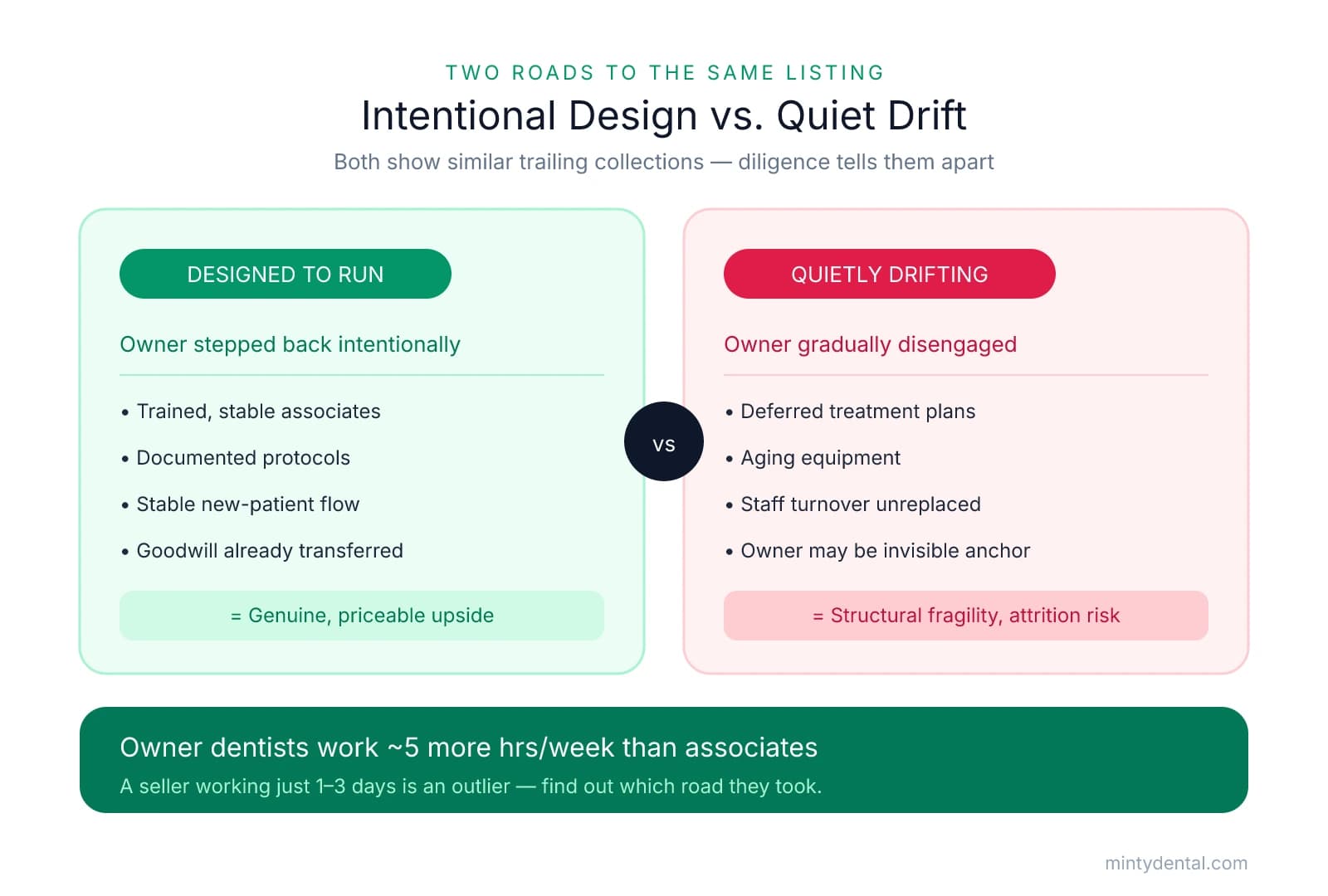
The baseline to anchor to: the ADA Health Policy Institute reports that owner dentists work roughly five more hours per week than associates on average. A seller working one or two days a week isn't just below that norm — they're a significant outlier worth understanding before you get excited about filling the gap.
The financial picture gets more nuanced once you apply normalized EBITDA thinking. A practice reporting strong net income with an owner working minimal days may look profitable — until you account for what it actually costs to replace that production. If the owner is generating $300K in clinical revenue across two days per week, replacing that output at market associate rates (typically 30–35% of collections) changes the earnings picture materially — enough to shift the valuation by hundreds of thousands of dollars.
Goodwill compounds this. With 60–80% of a typical dental practice purchase price representing goodwill, the central question in any absentee-owner acquisition isn't whether the practice is profitable. It's whether that goodwill is attached to the practice or to the seller. A seller who barely shows up may have already transferred patient loyalty to their associates — or they may be the invisible anchor patients trust without realizing it, and their departure could trigger attrition that doesn't appear in any trailing report.
Two distinct scenarios tend to produce the absentee-owner listing, and distinguishing between them early shapes everything that follows. In the first, an owner intentionally stepped back after building systems — trained associates, documented protocols, stable new patient flow — and the practice runs well precisely because it was designed to. In the second, the owner gradually disengaged and the practice has been quietly drifting: deferred treatment plans, aging equipment, staff turnover absorbed without replacement. Both can show similar trailing collections. Due diligence is where you find out which one you're actually looking at.
What to Verify Before You Believe the Upside Story
The upside story is easy to tell and hard to verify — which is exactly why this type of acquisition needs to go deeper than a standard practice review. The questions below aren't demands; they're the specific data requests that reveal whether the production gap represents real opportunity or a practice running on fumes.
1. Request Production-by-Provider Reports for the Trailing 24 Months
This is the single most revealing document in an absentee-owner acquisition. Ask for production reports broken out by provider — owner, each associate, and hygiene — for every month over the past two years. What you're looking for is the ownership structure of the revenue.
A practice where the owner produces 15% of collections is a fundamentally different risk profile than one where the owner produces 60–70%. As TUSK Practice Sales notes, when an owner drives 60–70%+ of revenue, buyers correctly price in key-provider risk. But the inverse is also true: low owner production can mean the practice is already associate-dependent, which is a structural feature if the associate is stable and willing to stay. Understanding what you're acquiring — a practice or a person — starts here.
2. Verify Actual Days Worked — Not What the Broker Says
Request appointment books and day sheets directly, not a summary. The Carroll & Company due diligence checklist specifically flags days worked by the owner as a core question — and for good reason. A broker may describe an owner as "semi-retired" when the appointment book tells a more complicated story.
Once you have the day sheets, calculate production per clinical day for each provider separately. If the owner's per-day production is strong — say, in the $4,600–$6,900 range that MGE benchmarks for general dentists — but their day count is simply low, the upside is real and quantifiable. If per-day production is also declining, the practice may be in clinical retreat, not just a scheduling gap.
3. Identify Who Patients Are Actually Loyal To
Production reports tell you where the revenue comes from. They don't tell you where the trust lives. Ask the seller directly: when patients call to schedule, do they ask for the owner, the associate, or their hygienist? Review online reviews for name mentions. If the practice has been associate-run for several years, patient loyalty may have already migrated — a positive sign for retention. If the owner is the invisible anchor, attrition risk after closing is real and won't appear in any trailing report.
Hygienist loyalty deserves its own scrutiny. In practices where hygiene drives a significant share of recall revenue, the hygienist's relationship with patients can be the most durable asset — or the most fragile dependency — in the entire acquisition.
4. Check New Patient Flow Trends
Pull new patient counts month-by-month for the same 24-month window. Flat or declining new patient flow in a low-owner-production practice suggests the practice has been coasting on an existing patient base rather than generating genuine growth. Stable or growing new patient flow signals that the systems generating demand are working independently of the owner's chair time.
5. Have a Dental CPA Normalize the EBITDA
A general accountant will read the P&L. A dental CPA who specializes in acquisitions will remodel it — replacing the owner's clinical production at market associate rates, adjusting for below-market owner compensation, and stress-testing what earnings actually look like once you're in the chair. In an absentee-owner scenario, this step is essential, not optional.
The Three Risks That Don't Show Up in the Financials
Clean financials are necessary but not sufficient. Due diligence can confirm that collections are real, production is distributed across providers, and new patient flow is stable. What it won't automatically surface are the structural risks specific to this type of practice.
1. Associate Departure Risk
If the practice runs primarily on an associate who isn't the buyer, that associate has no legal obligation to stay after closing. Their departure — to a competitor, a DSO, or their own practice — could remove the primary revenue driver overnight.
Before signing an LOI, review the associate's current employment contract carefully: notice period, non-compete geography and duration, and any language about practice sale triggers. It's also worth asking directly whether the associate has ever been approached about buying the practice themselves.
Negotiating an associate employment agreement as part of the transaction — with defined terms and a non-solicitation clause covering the patient base — protects both sides and keeps expectations aligned from day one. The deeper treatment of this dynamic in our guide to buying a dental practice with an associate dentist is worth reviewing before you finalize your offer structure.
2. Goodwill Transferability
In a practice where the owner barely shows up, patient loyalty has almost certainly migrated to the associate, the hygienist, or both — which is actually good news for retention. But it does mean the seller's personal goodwill is limited, and sellers sometimes inflate the goodwill story to justify the asking price. The IBBA has documented that 75–90% of businesses that go to market don't sell — often because value expectations don't match what actually transfers.
The practical mitigation is the patient-level production data you've already pulled. If 70% of production traces to the associate and hygienist, the goodwill is already where you need it. Price the seller's personal goodwill accordingly — it may be worth considerably less than the valuation assumes.
3. Operational Disruption When You Step In
A practice that has run on autopilot develops informal systems calibrated to an absent owner. The front desk handles scheduling independently. Hygienists manage recall without clinical oversight. The associate makes treatment planning calls that would normally involve a supervising dentist. When a new, engaged owner arrives and starts changing the operating model, staff friction can follow — not because the team is being difficult, but because they're adjusting to a fundamentally different dynamic.
Understanding how to evaluate the staff's adaptability before closing can surface these dynamics early. Planning a longer transition period with the seller — not just for patient introductions, but to map the informal systems the team has built — is often the most practical mitigation. A well-structured seller employment agreement can formalize 60–90 days of structured overlap before you start changing things.
None of these risks are reasons to walk away. They're reasons to structure the deal — and the transition — with more precision than a standard acquisition would require.
How to Price the Deal When the Owner Barely Works
Everything covered above — the due diligence, the associate risk, the goodwill transferability question — ultimately feeds into one practical decision: what should you actually pay?
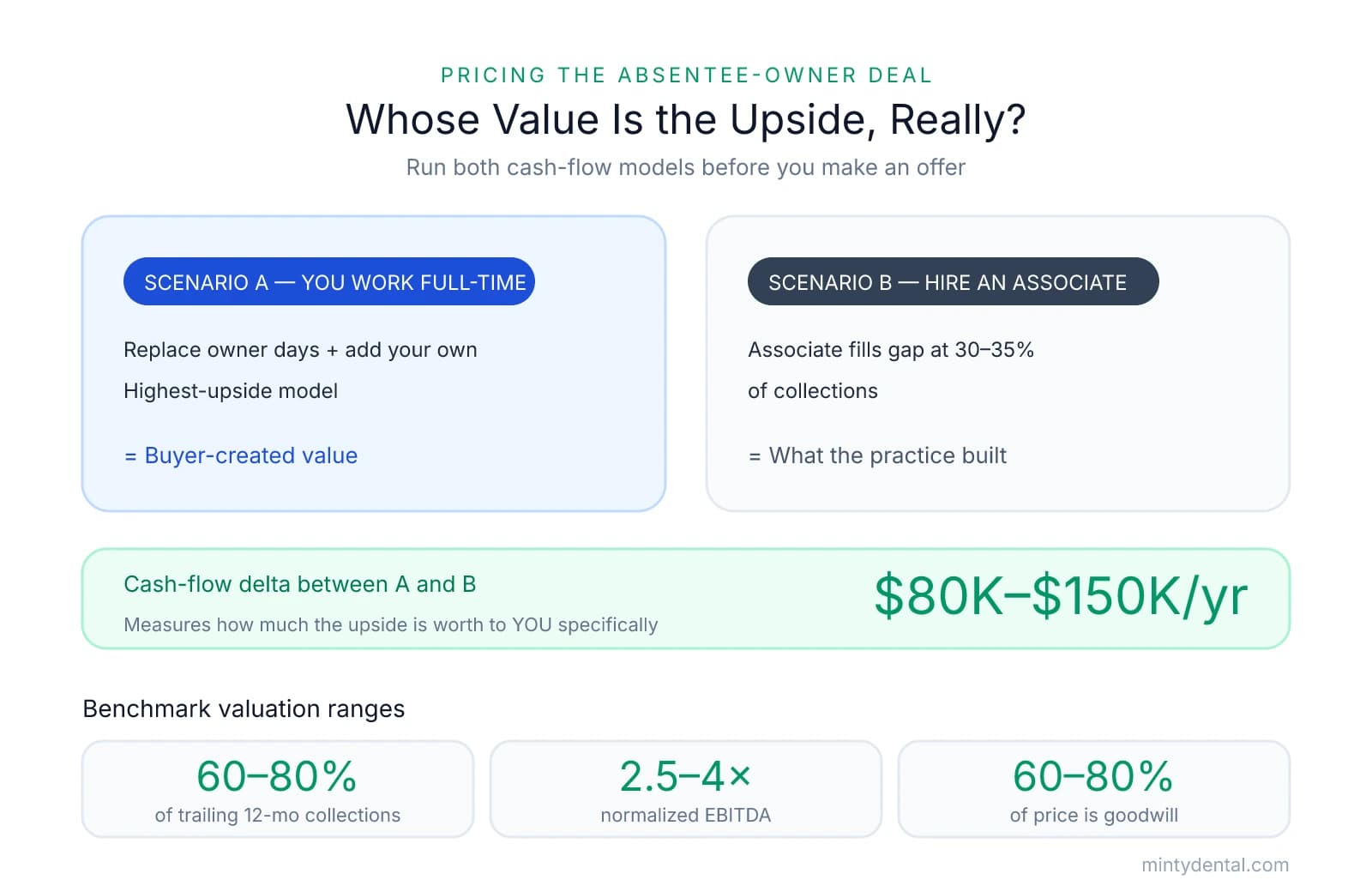
The answer starts with running two distinct cash flow models.
Scenario A: You step into the chair full-time. Model what the practice generates when you replace the owner's clinical days and add your own. This is the highest-upside scenario — and the one sellers tend to anchor their asking price to.
Scenario B: You hire an associate to fill the gap instead. Model the same practice with an associate covering the production shortfall at market compensation (typically 30–35% of collections). The cash flow difference between these two scenarios is often $80,000–$150,000 annually — and that delta is the clearest measure of how much the production upside is worth to you specifically, not to the practice in the abstract.
That distinction matters for pricing. If the upside in Scenario A depends entirely on your labor, that's buyer-created value — not something the seller has built. A seller arguing for a premium because "there's so much room to grow" is asking you to pay for work you haven't done yet. That's a reasonable place to push back.
Applying the Benchmarks
Per Dental Practice Loan Guide, general practices typically sell at 60–80% of trailing 12-month collections, or 2.5–4× normalized EBITDA. In an absentee-owner scenario, the EBITDA base must reflect associate-adjusted replacement costs — not the seller's minimal compensation. A practice reporting $350,000 in net income with an owner drawing below-market pay looks very different once you normalize for what it actually costs to replace that clinical output.
Practices with high owner dependence tend to receive a lower multiple, while practices that are genuinely associate-run with stable financials can support a cleaner valuation. The key word is stable. If collections are declining, price that trajectory in, not the peak.
When an Earnout Makes Sense
If a seller insists on a higher price based on projected growth, an earnout tied to post-closing collections can bridge the gap without requiring you to overpay upfront — letting the seller participate in the upside they're claiming exists while protecting you if the growth story doesn't materialize. Pairing this with a well-structured seller employment agreement that defines transition responsibilities gives you both coverage and continuity.
The Decision Framework
Worth pursuing when: the associate is stable and under contract, hygiene recall is strong, new patient flow is flat-to-growing, the owner stepped back intentionally with documented systems, and the financials hold up under normalized EBITDA analysis.
Worth walking away from when: new patient counts are declining, the associate has no contract or has been exploring their own options, the owner disengaged due to burnout or unresolved practice problems, or collections are meaningfully tied to the owner's personal patient relationships.
Buyers who do this modeling before making an offer are in a genuinely strong negotiating position. The seller has a story; you have a spreadsheet. In this type of acquisition, preparation is what creates leverage.
Sources & References
The data and claims in this article are drawn from the following sources. We prioritize government data, peer-reviewed research, and established industry publications to ensure accuracy.
- Overdue Accounts— ada.orgIndustry
- Dental Practice Valuation Guide (2026)— dentalpracticeloanguide.comIndustry
- What Owner Dependence Really Costs at Exit— tuskpracticesales.comIndustry
- Due Diligence - Carroll & Company— carrollandcompany.comIndustry
- How Much Should a General Dentist Produce Per Day?— www.mgeonline.com
- IBBA has documented— ibba.org
Ready to acquire your ideal dental practice?
Finding a practice with untapped potential is just the first step. Minty guides you through the entire acquisition process—from identifying the right opportunity to closing the deal—with expert support and zero upfront fees.